Just over a dozen miles from the front lines in the Russia-Ukraine war, kids are running in circles and screaming in Kharkiv, Ukraine. For a brief period, the nearly four-and-a-half-year war isn’t at the top of their minds. They’re in school—in an underground nuclear bunker refurbished by the United Nations High Commissioner for Refugees (UNHCR), one of nearly 200 schools that will be completed in Ukraine by the end of this year. Above ground, in Ukraine’s second-largest city, boarded-up windows and doors are ubiquitous. Air raid alarms go off multiple times a day. But these children are dreaming of the future, earnestly explaining that they’d like to be chefs, artists, police officers, and psychologists when they grow up.
I recently visited Ukraine, including stops in Kyiv, Lviv, Dnipro, Kharkiv, and Zaporizhzhia, as part of a delegation organized by the UNHCR. Few U.S. visitors have the opportunity to spend time in eastern Ukraine, in particular. I was struck by how exhaustion and determination characterized engagements throughout the visit.
“We have cards up our sleeve”
“We have cards up our sleeve,” quipped a Ukrainian policymaker, a sly twist on the infamous 2025 Oval Office meeting in which U.S. President Donald Trump told Ukrainian President Volodymyr Zelenskyy that Ukrainians “don’t have the cards.” To a large extent, this policymaker’s assessment is accurate. In a war increasingly characterized by attrition, every few weeks the battle space shifts in its geography, targeting, or technology.
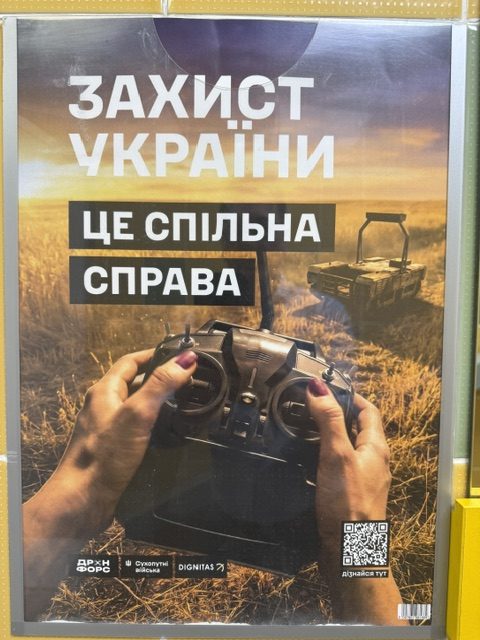
In recent months, Ukraine has increasingly taken the fight to Russia, using mid-range strikes to hit logistics and command and control, and long-range strikes in Moscow for demonstration effects, in particular. More than three-fourths of Russia’s Shahed unmanned aerial vehicles and cruise missiles are intercepted, using drones, fourth-generation fighter aircraft, and other platforms. When Russia adjusted the maneuverability of its ballistic missiles this winter, Ukraine’s military similarly adjusted. Its homegrown drone industry is infamously innovative. In the time it takes to brush one’s teeth, one drone factory I visited will have already produced 15 drones. Just after driving under fisherman’s nets while going through checkpoints in eastern Ukraine (in an effort to evade drone detection), I looked up and saw a dark cloud where a drone had been shot down moments before.
Senior Ministry of Defense officials explained that at the rate Russia’s military is moving, it’ll have the rest of Donetsk by 2036. While that figure is uplifting to those in Kyiv, the governor of Donetsk remarked that the mere 20% or so of his constituents who remain in Ukrainian territory are spending their days underground in bomb shelters. Moreover, the increasing number of places in the north and the east that the Ukrainian government has declared as requiring the evacuation of children and their caregivers is a reminder that the ground war remains dynamic.
Ukraine’s military appears to be prevailing for now in its tight technological race; however, recruiting personnel remains a difficulty. A few months ago, the defense minister delivered the astonishing announcement that 2 million people were avoiding military service and 200,000 had gone AWOL. I heard a number of stories about men being pulled off the street, particularly in eastern Ukraine. The personnel challenge “is not as bad as it seems,” argued one senior policymaker from the office of the president, who believes that the war’s character has changed such that capacity matters less than capability.
Moreover, Kyiv’s recently unveiled military personnel reform package—which includes a substantial increase in pay, fixed-term contracts, and a redoubled focus on enabling foreigners to serve in Ukraine’s military—may alleviate some of these strains. Russia’s massive and growing casualties—estimated by the Economist to be 3% of its fighting-age male population—and Russia’s increasing recruitment challenges seem to be somewhat quieting Kyiv’s concerns about its own capacity issues. Nevertheless, one senior official expressed concern that if a temporary ceasefire does ultimately occur, it will be very difficult to quickly mobilize personnel.
Living under escalating attack
Polling from March shows high levels of support for the war. More than 80% of Ukrainians believe they will ultimately win, a view echoed by Ukrainians I spoke with in the east. “Russia needs to be punched,” explained one tough old woman in Dnipro whose apartment building was struck by a missile, blowing out her windows and doors, and ruining her books. In Zaporizhzhia, a woman of nearly 80 underscored, “we will win,” after recounting how she sleeps in a bunker every single night because her apartment has been hit in three separate Russian attacks and her grandson cannot visit because of the danger. Neither is yet among the approximately 5.8 million refugees and 3.4 million internally displaced people caused by this war.
The cumulative toll on Ukraine’s population is palpable. To be sure, restaurants, bars, and shops are full across the country. But no matter where one is located, every morning at 9 a.m., the air raid alert app chirps, “Attention! Moment of silence. Stop and honor the memory of those who died as a result of Russia’s attack on Ukraine.”
2025 was the deadliest year for Ukrainian civilians since the war started, and 2026 is shaping up to be even worse. Civilian casualties are growing due to the increasing use of first-person view (FPV) drones on the front lines and the difficulty of countering ballistic missiles. One woman described the surreal experience of seeing an FPV drone flying around her garden; her elderly husband was later hit by a drone and can no longer walk. A policymaker based in the east explained that just before our meeting, he witnessed a drone buzzing overhead while walking his dog.
Throughout my entire visit, Kyiv was on edge, waiting for a massive Russian attack. It ultimately occurred on June 15 and was among the most sophisticated and diverse to date. Russia used a combination of sea-, air-, and ground-launched platforms, including drones and ballistic, hypersonic, and cruise missiles to target sites ranging from critical infrastructure to religious sites to residences. Ukraine’s air defenses continue to face difficulties countering ballistic missiles—not least due to the rapidly depleting stock of American-provided Patriot interceptors. Ballistic missiles remain the greatest threat, since Ukraine’s military is only able to intercept one-third or so of them, according to the Ministry of Defense.
Russia is also increasingly targeting the services of modern life. Over the coldest winter since the war began, the Russian military tried diligently to incapacitate Ukraine’s electrical grid and deprive Ukrainians of heat. As summer begins, humanitarian workers are growing concerned about attacks on water and sanitation. Protecting energy and health care facilities was described as a form of “resistance” to Russia by political leaders in Zaporizhzhia.
Aid organizations appear to be under growing threat as well. A warehouse filled with $1 million in UNHCR humanitarian aid was recently hit during a Russian ballistic missile attack in Dnipro. In the remains of the crumpled building, one could see pieces of charred wood ordinarily destined to replace windows blown out in Russian strikes.

It’s nearly impossible to get credible details of life in the areas the Russians do control. These areas are “painted in black,” explained one person trying to describe how difficult it is to get information out from them. Rumors of forced efforts to “Russianize” the people living there abounded—such as requiring Russian passports to access services, including, according to one story I heard, to retrieve the deceased body of a parent at the hospital.
An uncertain future
Russia is surely tracking Ukraine’s gains on the ground and considering how and in what ways to escalate. In addition to hitting critical infrastructure, Moscow could conceivably turn to attacks in cyberspace, threats to use nuclear weapons, sabotage operations, and continued attempts to employ terrorist tactics like car bombs.
Trump recently announced that he will focus on this conflict following birthday calls with Russian President Putin and President Zelenskyy. That will be welcomed by many Ukrainians, albeit with some hesitation. While I heard gratitude for U.S. support to date, something palpable has undoubtedly changed in the relationship over the last year. The Zelenskyy-Trump Oval Office meeting and the temporary pause in U.S. military assistance marked a turning point. Although that assistance later resumed, Europeans—not Americans—are now paying for it, and deliveries have slowed due to U.S. requirements in the Middle East because of the war with Iran. Materiel diversions like air defense systems are not the only casualty Ukraine has suffered due to that war; political attention has been diverted as well, since the same individuals are the main negotiators for both conflicts. Notably, they have yet to visit Ukraine—although they have managed to stop in Russia more than a half dozen times for discussions.
Above all, President Trump and his negotiators have been reluctant to pressure Moscow to make meaningful concessions to end the conflict. Absent a willingness to meaningfully engage both sides and levy expectations on them, the ceiling to U.S. efforts will be low. The recent enhanced involvement of three key European powers—the U.K., Germany, and France (E3)—can be helpful in redirecting the U.S. approach to date.
U.S. policy recommendations
- Prioritize negotiations in close coordination with the E3, given their expanding leadership role economically, politically, and militarily.
- Immediately arrange for negotiators to visit Ukraine, including Kyiv and the east, to get a deeper understanding of the war’s day-to-day reality and Ukraine’s perspective.
- Convene Ukrainian and European defense planners to game out potential Russian escalation scenarios.
- Study lessons learned for the United States on Ukraine’s experience with critical infrastructure protection, given the potential for similar targeting in a potential attack on the United States.
- Expand humanitarian aid in light of the worsening situation for Ukrainian civilians.
Author

The Brookings Institution is committed to quality, independence, and impact.
We are supported by a diverse array of funders. In line with our values and policies, each Brookings publication represents the sole views of its author(s).


Commentary
Dispatch from Ukraine
Mara Karlin details her recent visit to Ukraine as part of a delegation convened by the United Nations High Commission for Refugees.
June 23, 2026