When the question of negotiating a settlement of the Russia-Ukraine war arose, the Biden administration held to “nothing about Ukraine without Ukraine.” U.S. officials would not negotiate with Russian officials over the heads of the Ukrainians. The Trump administration does not appear to share that principle. Its chief Russia-Ukraine negotiator, Steve Witkoff, has traveled to Moscow eight times since March 2025 but has yet to visit Kyiv. Moreover, questions linger about what the U.S. and Russian leaders agreed to at their August 2025 meeting in Alaska.
Trump’s bid to mediate a settlement appears biased toward the Russian side, leading to falling Ukrainian confidence in the U.S. effort to end the war.
The meeting in Anchorage
In recent months, Russian officials have increasingly referred to what they call the “Anchorage understanding,” suggesting that Presidents Donald Trump and Vladimir Putin reached a possible agreement to end the war on August 15 last year. It may provide the basis for Russia’s current demands. How much the Trump administration bought into that “understanding” is unclear.
Witkoff and Secretary of State Marco Rubio joined Trump for the three-hour session with Putin, who was accompanied by Foreign Minister Sergey Lavrov and long-time foreign policy advisor Yuri Ushakov. In brief remarks afterward, Putin referred to settling the conflict with Ukraine and said, “Hopefully, the understanding we have reached will bring us closer to this goal and open the road to peace in Ukraine.” (Putin should have said peace between Russia and Ukraine; the war is not an internal fight among Ukrainians.)
When his turn came, Trump reacted positively, though he indicated the understanding was not quite a done deal. Neither leader provided specifics regarding the understanding, and neither took questions. However, following the meeting with Putin, Trump told Sean Hannity, “It’s really up to [Ukrainian] President Zelenskyy to get it done.” In a call with European leaders shortly after his meeting with Putin, Trump reportedly said that he supported Kyiv ceding all of Donetsk province to Moscow, which he believed would lead to negotiations and a quick end to the war.
Concern about the Alaska discussions prompted Zelenskyy to fly to Washington for an August 18 meeting with Trump. Zelenskyy was joined by the leaders of Britain, Germany, France, Italy, Finland, NATO, and the European Union. Their discussions focused on issues such as security guarantees for Ukraine.
The August 18 meeting seemed to shift the peace effort, leaving behind whatever understanding might have been reached in Alaska. Or did it?
The fate of Donetsk
The fate of the Donetsk province in eastern Ukraine remains a key—but hardly the only major—issue in the negotiations. Moscow currently occupies about 75% of the province and adamantly demands the rest—about 2,000 square miles (5,000 square kilometers) that the Russian military has failed to capture, despite four years of determined effort. The Ukrainians just as adamantly refuse. Some 200,000 Ukrainians call that land home. Moreover, the Ukrainian-held territory includes a belt of defensive lines and fortress cities that have long and successfully stymied Russia’s advance.
Last November, Witkoff and his Russian counterpart unveiled a 28-point peace plan. Point No. 21 said, “Crimea, Luhansk and Donetsk will be recognized as de facto Russian, including by the United States.” The plan had a confused paternity. A Republican senator claimed Rubio had suggested to him that it was a Russian plan. However, Rubio said that the American side “authored” it.
In subsequent discussions with the Ukrainians, some of which Rubio led, a 20-point plan emerged as an alternative to the 28-point scheme. That new plan did not require that Kyiv cede territory to Russia that the Russian military had failed to conquer.
Washington pressure on Kyiv?
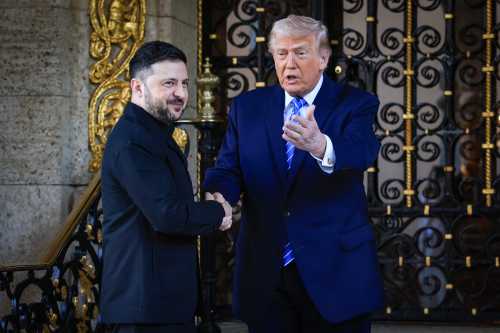
On March 25, Zelenskyy told the press that American officials had linked a bilateral U.S. security guarantee for Ukraine to Kyiv’s agreement to cede all of Donetsk to Russian control. Rubio angrily denied that, leading Zelenskyy to explain his understanding that a U.S. guarantee would come only after a settlement, but Russia would not agree to a settlement without all of Donetsk.
One would like to believe Rubio; it would be disgraceful for Washington to side with Moscow and pressure Kyiv on this point. However, Trump’s reported remarks to European leaders after the Anchorage meeting, along with the 28-point peace plan’s insistence on recognizing Donetsk as de facto Russian, undermine the secretary of state’s denial. Moreover, in recent months, senior Russian officials have referred to the understanding reached in Alaska and Russian control of all of Donbas. On March 29, for example, Ushakov discussed Washington pressing and influencing Kyiv, saying “this is what is needed now.”
On April 8, Vice President JD Vance criticized the Ukrainians and Russians for “haggling” over “a few square kilometers,” ignoring the fate of the people on the land and its defensive importance for Kyiv. Many read Vance’s comment primarily as a swipe at the Ukrainian side. On April 14, Vance said he was particularly proud that the Trump administration had ended U.S. financial support for Ukraine.
The impact in Ukraine
Questions about U.S. pressure and Witkoff’s one-sided engagement have eroded Ukrainian confidence in Washington. Polls show that 70% of Ukrainians do not expect the U.S.-brokered talks to succeed. Another poll indicated that only 28% consider the United States a reliable partner. (This drop in confidence in the United States is not unique to Ukraine. A poll in Poland said that only 30% considered America a reliable ally; another survey reported that 51% of Europeans viewed the United States as an unfriendly country, while only 25% regarded it as friendly.)
Zelenskyy’s frustration with Washington is growing. During my recent visit to Kyiv, a Ukrainian journalist commented that Ukraine now hopes for little more from the United States than intelligence support, Patriot missiles (purchased for Ukraine by NATO members), and that Washington will not pressure Kyiv to agree to an unacceptable deal. A retired senior Ukrainian diplomat observed that Ukraine “is losing” the United States as a strategic partner.
Ukrainian irritation with the United States and Washington’s mediation is understandable. One can be forgiven for thinking that Trump may have agreed in Alaska that Russia should have those “few square kilometers” of Donetsk. While it may turn out that Kyiv cannot recover the territory that Russia now holds, Ukrainians will not agree simply to hand over land that the Russian military has not occupied. Further, the United States should not associate itself with that kind of reward to a blatant aggressor that has caused the largest, bloodiest war in Europe since 1945.
If Trump indeed wants to successfully mediate a settlement to the Russia-Ukraine war, he needs to change course. First, he has to pressure Moscow to negotiate seriously. Second, he must give Kyiv confidence that he and his negotiators are pursuing a competent and balanced mediation. In both regards, he and his administration have considerable work to do.

Related Content

The Brookings Institution is committed to quality, independence, and impact.
We are supported by a diverse array of funders. In line with our values and policies, each Brookings publication represents the sole views of its author(s).

Commentary
Ukraine’s falling confidence in US mediation
April 29, 2026