On September 6, the 2.1 million citizens of the small eastern German state of Saxony-Anhalt could set off a political earthquake with reverberations all the way to Berlin if, as current polls predict, the far-right Alternative for Germany (AfD) wins the statewide election. An assessment by Germany’s domestic intelligence service that the national AfD is “confirmed right-wing extremist” is currently under judicial review, but a Saxony-Anhalt intelligence report says the classification of the party’s state chapter as confirmed extremist is final. “Its leaders,” asserts the document, have made numerous “Islamophobic, racist, and antisemitic statements,” and it adds that the state party “wants to abolish representative democracy in its current state.” For the tens of millions of Germans for whom citizenship is indivisible from accepting responsibility for the mass atrocities perpetrated by their country under National Socialist rule, this is an appalling prospect. It is no less concerning for many of their European neighbors.
Could the AfD actually win?
The AfD is currently polling at around 41% in Saxony-Anhalt. An absolute majority of votes, and thus the position of minister-president for its top candidate, Ulrich Siegmund, is within reach. The runners-up, the center-right Christian Democrats (CDU) and the Left Party (the far-left successor to the former East German communist party), are far behind at 23% and 11.5%. But whether the AfD can govern alone will hinge on the performance of smaller parties, whose parliamentary seats will be redistributed if they fail to surmount the 5% threshold: the center-left Social Democrats (SPD), at 8.5%; the Greens, at 6%; the far-left Sahra Wagenknecht Alliance (BSW), at 4%; and the liberal Free Democrats (FDP), at 3%. Indeed, some national initiatives are encouraging Saxony-Anhalt’s voters to cast their ballots tactically for these parties to keep the AfD out of government. (The academic vote simulator Projekt Zweitstimme has the probability of an AfD-only government at 33%.)
Should the AfD fail to achieve an outright majority, the task of organizing a CDU-led governing majority faces almost insurmountable difficulties. All the other parties—except BSW, whose leader has offered to play kingmaker for an AfD-led government—maintain a “firewall,” or “Brandmauer,” against any form of cooperation with the AfD. (The ban is functionally moot in many municipalities and districts.) The CDU has tied its hands even more by also excluding any coalition with the Left Party.
The clock will be ticking, as state law dictates that a new legislature must be constituted within 30 days of the election. Even if the CDU, which has headed several coalition governments in Saxony-Anhalt over the past 24 years, manages to pull together a coalition or rally the votes for a minority government led by incumbent Minister-President Sven Schulze—whether by relying on votes from the Left Party or poaching AfD state parliamentarians—stable, productive government will likely remain elusive. Profound disagreements on policy issues would guarantee severe tensions in such a cooperation.
The AfD’s radical leadership
The state AfD leadership projects optimism that it will govern Saxony-Anhalt. The 35-year-old Siegmund, a glib salesman with a degree in business psychology who once cofounded a company for room fragrances, has run a remarkably successful campaign. He has built it on discipline, personal charm, and friendly evasiveness when prodded on policy questions. His chief ideologue and deputy Hans-Thomas Tillschneider is rather less polished. After he tried to quash a video clip that showed a Russian army mug in his office, more clips and posts surfaced: other Russian memorabilia, Tillschneider waving a Russian flag, Tillschneider yelling “our enemies don’t sit in Moscow, they sit in Magdeburg and Berlin!”
Both Siegmund and Tillschneider have refused to disavow the AfD’s links to extremist movements like the Identitarian Movement (Identitäre Bewegung) or the Saxon Separatists (Sächsische Separatisten). Some of their own staffers once belonged to a neo-Nazi group. “Sieg! Mund!” is a frequent refrain at AfD rallies across Saxony-Anhalt (Siegmund, for his part, claims to hear no resemblance to a certain historical slogan). When an AfD member of the European Parliament chased down and beat a 14-year-old boy who had sabotaged a campaign poster in August with a baseball bat, neither Siegmund nor the state AfD condemned the act.
How would the AfD govern?
Siegmund’s pitch to voters is that the AfD will restore the country to “Germany, but normal.” Yet his party’s ideas about governance are anything but. The AfD’s Saxony-Anhalt chapter published a stunningly radical 258-page “government program” in March, which The New York Times called “partly unworkable, far exceeding the power of a state government.” Many of its proposals would be familiar to MAGA voters: segregation or deportation of refugees, abolition of funding for public broadcasters, total overhaul of schools and law enforcement, no more wind farms, rollback of LGBTQ+ rights, rejection of historical guilt, overtures to Russia. It condemns the Bauhaus school of design—whose roots in Saxony-Anhalt trace back to the 1920s—in coded language reminiscent of Nazi-era attacks on “rootless cosmopolitans.”
The Halle Institute for Economic Research says that implementing the AfD party platform would cost 2.2 billion euros (about $2.5 billion) in excess of what the state budget provides annually. Legal experts writing on the Verfassungsblog platform have argued that some of the program’s key components, such as its chapter on migration, would be unconstitutional. Insiders have raised doubts that an AfD government could fill the 150 to 200 state leadership positions necessary to govern, despite the creation of a training school for AfD cadres in 2025.
The AfD’s blueprint for power
Why the AfD—one of Europe’s most blatantly far-right parties, which is openly bent on changing the country’s constitutional order and has zero experience in democratic governance—has such appeal is a subject of intense debate in Germany. It is the largest opposition party in the national legislature and leads the polls nationwide at 29%. Its support is strongest in the former East Germany, but its origins are in the western states, where its appeal is growing. And while it was long considered a protest party, ideological conviction increasingly drives its voters. Analysts point to a range of factors: former Chancellor Angela Merkel’s “triangulation” and liberalization of the CDU, which left the right uncovered; economic inequality, weak civic infrastructure, and declining party identification; and resentment of what some critics call West Germany’s “colonization” of the former East after reunification in 1990.
Ulrich Siegmund himself—in a calculated appeal to Ostalgie (nostalgia for preunification East Germany)—is promising voters that an AfD government will bring back “our good old, safe Germany.” Numerous interviewers have asked him how this vision comports with Soviet occupation, the cruelty of the Communist Stasi police, or the rise of neo-Nazi skinheads who terrorized rural villages after the fall of the Berlin Wall, often armed with baseball bats (Baseballschlägerjahre), to no avail.
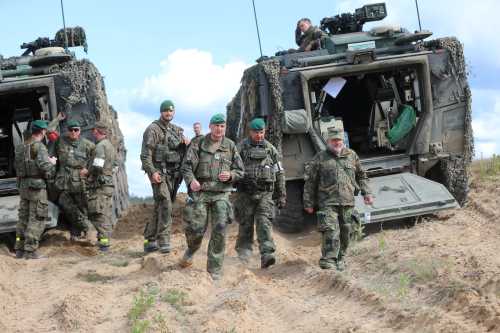
Another area of fierce contention is what could be done to defend the state’s democratic institutions against unconstitutional attack. Central to Germany’s constitution (the Basic Law) is the principle of militant democracy: the constitutional order must not remain neutral when faced with forces trying to abolish it. A much-discussed possible safeguard provided for by the Basic Law would be an outright party ban, but the political and legal hurdles are extremely high. There are also only two cases of a successful ban in postwar German history, both in the 1950s. Lawyers and practitioners across the country have been wargaming other ways to safeguard institutions and democratic processes in the case of the AfD gaining a foot in the door of power—or an AfD-run state attempting to block the passage of NATO troops moving to Europe’s eastern flank in case of a security contingency.
Will German democracy hold?
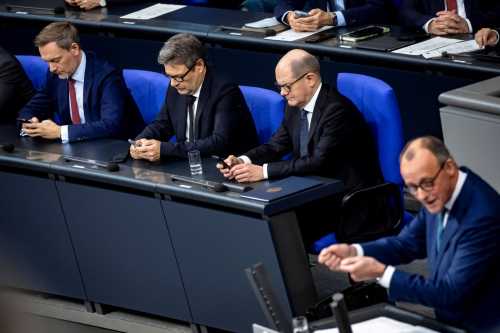
There are two further state elections in Mecklenburg-Western Pomerania and Berlin on September 20, where the AfD polls at 37% and 18%, respectively; it has little to no chance of gaining power in either. But if support for the CDU and SPD—who form the governing coalition in Berlin led by Chancellor Friedrich Merz—erodes in all three states, that could have national consequences. Calls abound within the SPD for cochairs Lars Klingbeil and Bärbel Bas, both of whom hold cabinet positions, to relinquish the party leadership in this case. There have also been speculations within the CDU that Merz’s chancellorship might come into jeopardy. The chancellor—who once promised to cut AfD support in half but instead has seen it double—is consistently unpopular; so much so that his eastern German peers, including Schulze in Saxony-Anhalt, are keeping him at arm’s length.
Meanwhile, the national AfD leadership is reveling in its prospects. Cochair Alice Weidel said in a prime-time television interview that her party seeks to rule the entire country, and that Saxony-Anhalt is “only the beginning.” Indeed, the AfD is looking at a win-win—whether it cuts its teeth on state-level governance now and uses Saxony-Anhalt as a laboratory for radical change in the rest of the country, or whether it further twists the knife on establishment parties forced into unwieldy, ideologically disparate coalitions to keep it from power. Either outcome is likely to make Germany more introverted and less capable of decisive political action, at a time when its neighbors in Europe need it to be exactly the opposite.
Authors

Related Content

The Brookings Institution is committed to quality, independence, and impact.
We are supported by a diverse array of funders. In line with our values and policies, each Brookings publication represents the sole views of its author(s).

Commentary
Could the right-wing extremist AfD govern a German state for the first time?
September 4, 2026