German state elections are normally placid affairs, with low turnout, limited media interest, and international press nowhere to be seen. But three recent votes, held on September 6 and 20 in the city-state of Berlin (population 3.9 million) and the two eastern states of Saxony-Anhalt and Mecklenburg-Western Pomerania (population 2.1 million and 1.6 million, respectively), have attracted attention around the world. And for good reason. Voters in three very different places turned out in historically high numbers to act on their deep frustration with national politics, with radical and potentially unworkable outcomes. Taken together, they may have lowered the curtain on postwar Germany’s stability-focused and centrist political culture, ushering in a new era of polarization, volatility, and fragmentation. Whether they will also end Chancellor Friedrich Merz’s political career is a question that still hangs in the balance.


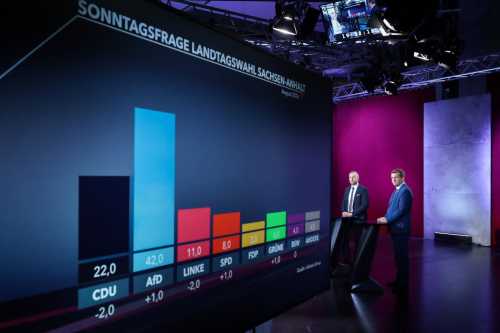
In rural Saxony-Anhalt, the Alternative for Germany (AfD) and its leader, Ulrich Siegmund, won a state election for the first time since the party’s foundation in 2013. The victory came despite the fact that the party’s state chapter has been classified as “certified right-wing extremist” by the state’s domestic intelligence service, and its 258-page party program contains what can only be described as startlingly malevolent proposals. The AfD secured a stunning 43.8% vote share, but it is three seats short of a majority, and no other democratic party has agreed to govern with it. So, its only path to government is a coalition with the tiny far-left Sahra Wagenknecht Alliance (BSW), a cultist offshoot formed by former members of Die Linke. (Die Linke itself is the successor to the former ruling party of communist East Germany, the Socialist Unity Party.) BSW struggled across the parliamentary threshold, winning 5.3% of the vote; it says it is willing to cooperate with the AfD but not to form a coalition with it. In a surprise move, the center-left Social Democratic Party (SPD) is now calling for a four-party counter-coalition. That arrangement, however, would require the BSW’s participation—and BSW, in turn, insists that it will only negotiate if the AfD is included. Gridlock appears guaranteed and might even force a new election.
In Mecklenburg-Western Pomerania on the Baltic coast, the AfD also came in first with 38.2% of the vote, but the popular incumbent Minister-President Manuela Schwesig, a Social Democrat, largely defended her ground by defining herself as the anti-AfD candidate. She is likely to form a government with the Greens and Die Linke.
In Berlin, voters handed the win to Elif Eralp of Die Linke, which received 25.7% of the vote to 18.8% for the Christian Democratic Union (CDU). Berlin is currently governed by a CDU mayor in coalition with the SPD and is home to many old and new immigrant communities. Eralp, too, cast herself as the anti-AfD candidate, and her campaign focused on affordability and the promise of widespread rental property expropriations, which appealed strongly to her party’s very young, urban, and diverse voter base. Eralp’s obvious coalition partners would be the SPD and the Greens. But in addition to some real policy disagreements, Die Linke may become toxic for the other parties because of the persistent allegations of antisemitism within its ranks—and Eralp’s repeated evasiveness when questioned about this problem. The appearance of Berlin’s most notorious mafia clan head at one of Die Linke’s election parties—and his reported remark that he felt supported by Die Linke—does not help. The outlook for a stable coalition is unclear.
The other side of the meteoric rise of the right- and left-wing fringes of German politics is the crumbling of the centrist mainstream once represented by the country’s former “popular parties” (Volksparteien), the CDU and SPD. For decades, the two parties routinely commanded joint majorities of more than 80% of the electorate. None of the three states voting in September has ever been governed by a mayor or minister-president from a party other than the CDU or SPD. For the Social Democrats, who have grown glumly accustomed to vote shares below 15%, the 35.5% brought in by Schwesig in Mecklenburg-Western Pomerania offered a reminder of former glories.
But the historic “disaster” of this election period, as Merz himself called it, belongs to the CDU. The party lost a third of its support in Berlin, saw its vote share roughly halved in Saxony-Anhalt, and failed to clear the 5% parliamentary threshold in Mecklenburg-Western Pomerania—the first time it has failed to win seats in any election since 1949. A triumphant Alice Weidel, the AfD’s national cochair, declared after the second and third elections that the AfD was now the CDU’s political heir. (Not entirely unrelatedly, she also repeated her contention that Adolf Hitler was a “left-wing extremist.”)
Nonetheless, the months of speculation—from the AfD, other parties, the media, and within the CDU itself—that Merz might have to step down as party leader or even as chancellor appear to have paused. Under Germany’s parliamentary system, it is possible for the head of government to lose a no-confidence vote and be replaced by the legislature without requiring new national elections. Merz has historically low approval ratings and has alienated even some of his own party’s traditionally loyal base to the point of open revolt. But a letter of support from eight conservative minister-presidents and a forceful television appearance on election day, in which he acknowledged his government’s failings but doubled down on his reform program and his pledge to support Ukraine, has for now stemmed the tide. Another no less potent reason may be the fact that none of his potential successors feel quite ready to mount an open challenge.
Merz and his CDU-SPD coalition must now deliver on their repeatedly stated contention that successful reforms and good government can sideline the extremists at both ends of the political spectrum. In particular, the chancellor has staked his authority on the implementation of a pension reform package that would raise the retirement age and add a capital-markets component to the traditional pay-as-you-go system. In his defiant election-day speech, he called these and other reforms an “antidote to the authoritarian poison.” News of an unexpected improvement in German economic data provides the government a welcome boost.
However, the surge of the extremist political fringes has exacerbated tensions within the centrist camp that Merz and his government will find difficult to contain. Some in the CDU want to abolish the firewall (Brandmauer) against cooperation with the AfD, but that could very likely split the party. The SPD’s left wing wants to reopen the pensions reform package, while Schwesig and the state of Saxony’s conservative minister-president, Michael Kretschmer, are questioning German support for Ukraine. The next hard test of Merz’s leadership will come with the legislature’s vote on the 2027 federal budget in October.
The AfD, meanwhile, polls at approximately 28% nationwide. And if Siegmund, its candidate in Saxony-Anhalt, fails to form a governing coalition, the AfD will be spared from having to demonstrate that it is actually capable of governing—and it will continue betting on the centrist parties’ capability to self-destruct without outside help.
Authors

Related Content
The Brookings Institution is committed to quality, independence, and impact.
We are supported by a diverse array of funders. In line with our values and policies, each Brookings publication represents the sole views of its author(s).

Commentary
Three state elections throw German politics into disarray
September 25, 2026