As the artificial intelligence (AI) boom brings large data center proposals to small and rural communities across the United States and beyond, the most resounding story to emerge is one of mismatched agency. In journalist Jasmine Sun’s words, “big companies descend on a small town and run roughshod over small-d democracy.”
Many people do not want data centers in their communities. And for good reasons: the costs are material, if still not fully understood, spanning noise and visual pollution, land-use change, and rising electricity demand with knock-on effects for water withdrawals and utility affordability. As with most large-scale developments, data centers also offer economic upsides—a surge of construction jobs, considerable tax revenue, and improvements in infrastructure. These can be significant but are not always guaranteed.
Given the scale and impact of data centers, people should have a voice. However, decisionmaking about data center siting is often fragmented, noninclusive, and based on criteria other than their impact on communities. In many parts of the country, states set tax exemptions and approve utility contracts, while local officials, often working part-time, negotiate one siting approval at a time, up against experienced corporate counsel imposing time pressure and confidentiality agreements. Local citizens are rarely directly involved in these processes and, where confidentiality provisions apply, may learn the terms of a proposed deal only after negotiations are well advanced. The result is that residents feel sidelined, fueling skepticism as to whether data center proponents are sharing all relevant information and whether public officials are acting in the community’s best interests. Because data center developments are closely associated with the rapid diffusion of generative AI in the U.S. and elsewhere, uncertainty about the projects themselves can also become entangled with broader concerns about AI’s economic and social impacts, as well as its existential risks.
Known remedies for these challenges exist—namely, community-led processes that surface varied priorities, align on a common vision, and help turn it into action. Historically, such processes have proven costly and complex, requiring time to build the trusting relationships on which collaboration depends—time that can be particularly scarce when communities are responding to fast-moving development proposals. Deliberative processes become more difficult to run when issues are emotionally and politically charged, as is increasingly the case with data center developments in the U.S.
Given this context, we undertook to explore whether the same technological advances driving the need for large data centers—generative AI—could be leveraged as a community resource for problem-solving. We began with a simple question: What if communities could use AI to help reach better collective decisions about data center developments and other similarly complex local challenges?
Those worried about AI’s impacts, or doubtful of its usefulness to society, may be skeptical. Our proposal may sound like a contradiction: If AI is seemingly—in contexts like the U.S. at least—being designed and deployed to replace people in work, how can it enhance people’s shared agency?
We argue that it can. When designed to support, not replace, human-to-human collaboration, and deployed in ways that communities own, govern, and control, generative AI shows considerable potential for enhancing shared problem-solving and collective intelligence. AI can collapse the time and costs that have traditionally kept broad, sustained participation in such problem-solving out of reach. An AI facilitator, unlike a human, has no problem with everyone talking at the same time. The key question is how to design AI systems that support more inclusive decisionmaking and that communities will adopt and trust.
Data centers are a test of community problem-solving
For communities to answer an AI buildout with AI applications of their own may sound odd given the warranted skepticism of AI’s usefulness and the fact that the technology has not been designed or deployed on community terms. But the broader proposition of AI’s value to communities extends beyond data centers and the U.S. institutional context in which this work is situated. Communities across different national and development contexts regularly face complex decisions that cut across policy domains, institutions, and stakeholder interests while lacking the capacity to integrate what people know and value into a shared course of action. Managing the data center boom is a clear and relevant example of this type of community decisionmaking.
Our motivating assumption was that communities can reach better decisions and better address shared challenges by transforming a complex issue (like whether to build a data center) from a discrete decision to an iterative process of community problem-solving that includes the perspectives, interests, and expertise of all stakeholders, not just elites and elected officials. Informed by existing literature, community problem-solving can be understood as including four phases that we summarize here as surface, align, implement, and learn, or “SAIL” (see Figure 1).
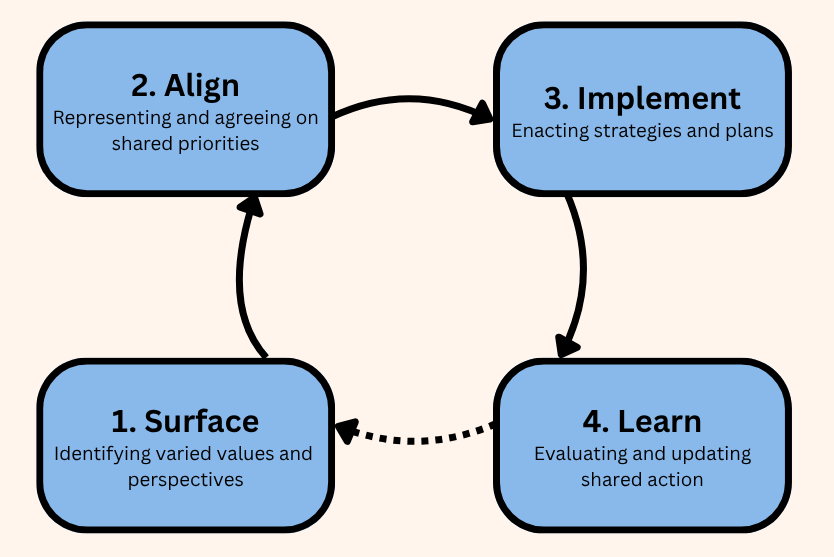
The cycle synthesizes standard loops in adjacent literatures, including the policy cycle’s stages of agenda-setting, formulation, implementation, and evaluation; the plan-do-study-act loop from improvement science; the observe-orient-decide-act loop from strategy science; and the plan-act-monitor-adjust loop from adaptive ecological management. Where these cycles typically begin from observation or agenda-setting by a single actor or organization, these phases emphasize the need for surfacing values and perspectives across many stakeholders and issues and aligning them before decision and action across multiple domains.
SAIL is aligned with decades of behavioral science research on group dynamics and collective intelligence. This research finds that groups that succeed in coordinating do so through establishing shared mental models and transposing them into technologies for shared action like maps and stories. In these settings, high–performing groups navigate a consensus-diversity tradeoff. Groups need consensus around shared goals to coordinate action. Yet groups solve problems better when they draw on more diverse perspectives.
Generating a shared vision and developing affordances for shared action is commonplace in small teams and organizations. However, doing so within larger and more diffuse communities can be prohibitively expensive, time-consuming, and often contentious. A long line of scholarship, from Ronald Coase on transaction costs to Elinor Ostrom on how communities govern shared resources, holds that gains that can arise from community-wide coordination go unrealized because the costs of establishing and sustaining coordination are prohibitive. Gathering what people know and want, mapping how issues interact, and keeping agreements on track take time, staff, and skills most public institutions cannot support. Even institutions with capacity for cross-issue convening, such as community foundations, find it difficult to systematically connect across issues. As a result, community problem-solving often narrows and focuses on single-issue initiatives or yes-or-no ballot measures.
Effective community problem-solving processes of surfacing, aligning, implementing, and learning are therefore defined by the challenge of managing two demands at once: maximally including participant perspectives while advancing a minimally complex set of shared actions. A township weighing a data center proposal, for example, must balance concerns about economic development, environmental sustainability, and social equity all at once. It must then carry what residents value through to implementation. And, hardest of all, it must neutrally evaluate whether its actions are working as planned and how they can be improved.
AI’s potential to augment problem-solving
Generative AI has the capacity to increase the effectiveness and lower the costs of each core phase of community problem-solving. AI can transcribe and summarize large volumes of input in seconds rather than weeks. It can help synthesize thousands of perspectives—and incorporate more of the nuance of each perspective—into a single navigable picture. AI can map how proposals interact across issues, making integration across stakeholders more tractable. It can also quickly judge ideas for feasibility and affordability as well as check facts.
No one questions whether a plane can transport someone across the country faster than a horse can. The plane is much faster. A similar comparison holds for AI versus humans in aggregating information. AI is faster.
Early applications of AI to community problem-solving demonstrate this potential. A preliminary landscape analysis of existing tools includes examples such as Taiwan’s vTaiwan process (which turned citizen input into consensus statements that shaped legislation), U.N. consultations in conflict settings, citizens’ assemblies, and large-scale listening. Several of these tools rely on established machine learning methods such as clustering and dimension reduction; generative AI extends them by working end-to-end in natural language and by letting nontechnical users produce new software artifacts to support collaboration and decisionmaking.
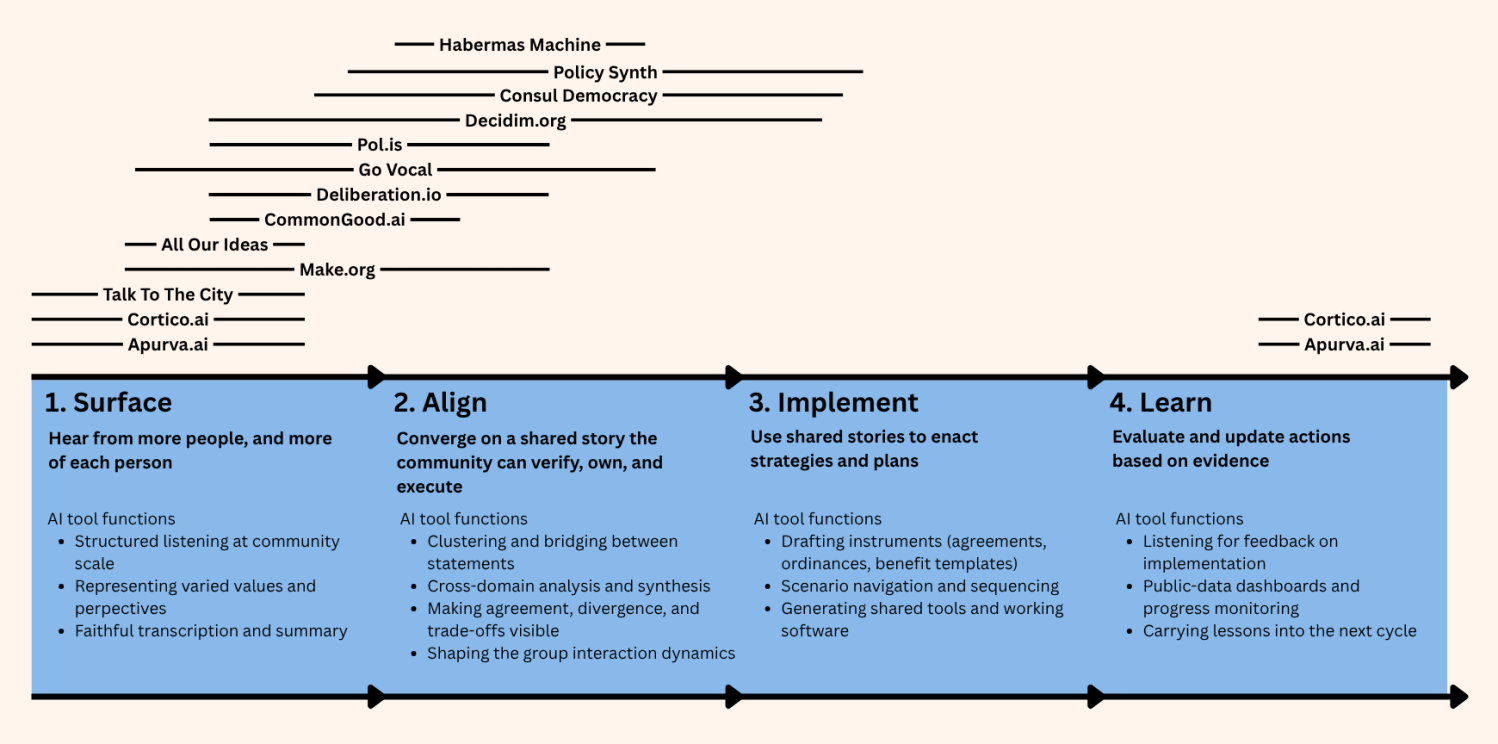
The scan is provisional and limited to tools built explicitly for public-interest use. Coverage thins sharply after the Align phase, and none yet supports the full cycle.
This scan shows that AI applications can help surface and align community perspectives. It also reveals the need for further innovation. First, most tools cluster in the early phases of community problem-solving. Few support action implementation or learning, and none covers the full cycle. Second, most are designed to address a single question, policy, site, or budget line, rather than multi-stakeholder cooperation across multiple issues.
Third, most AI systems entering civic use follow the logic of large consumer technology platforms: communities are users of tools designed, hosted, and governed elsewhere, with choices about what gets collected and how it is aggregated made outside the community by default. The Toronto waterfront project—abandoned in 2020 after sustained public disputes over data governance—showed how important digital infrastructure control is to community agency for problem-solving.
Taken together, these gaps sketch what a community-led protocol for AI-augmented problem-solving would need: tools that span all four phases of the problem-solving cycle, an ability to support multiple issues rather than one at a time, and infrastructure for keeping data and governance decisions local. Newer agentic development tools, including open-source alternatives, show promise in supporting these requirements by allowing nontechnical users to more easily build and host software configured to their own needs, while keeping data and decisions local.
A test in a fictional Michigan county
To explore ways to address these opportunities, a working group of over a dozen leading voices spanning AI research, policymaking, behavioral science, and community organizing gathered under the Brookings 17 Rooms initiative, a platform for multi-stakeholder, multi-issue problem-solving. The group designed and ran a structured simulation of a fictional Michigan county (Calder County) confronting data center developments. The scenario was informed by conditions in Michigan, where state-level tax exemptions and utility contracts have been granted for a major hyperscale data center campus, but where many townships that hold zoning authority feel unable to “get a straight story” about the expected impacts of developments on the sustainability and affordability of shared resources like water and energy.
In the scenario, Calder County’s community foundation and planning council convened three subgroups of county residents who had each been separately developing good-faith policy frameworks that townships could use to manage large-scale data center developments from different priority starting points: a group focused on securing the economic opportunities of data-center growth; a second group focused on environmental sustainability (watershed protection); and a third group focused on ensuring social equity (universal affordability of utilities). Each member of the working group was asked to assume the role of a county resident and assigned to one of these groups, forming a cast of county residents with diverse viewpoints and expertise. Participants received a brief on the scenario beforehand, including a one-page summary of each of the three policy frameworks (economic, environmental, and social). Participants were asked to consider how the proposal to which they were assigned could fit into an integrated strategy to maximize community benefits across economic, environmental, and social dimensions of data center developments.
The exercise ran as two 75-minute virtual meetings in one week, with 30-minute onboarding interviews with each participant beforehand. AI was positioned to augment and amplify participant perspectives across the four phases of problem-solving identified above:
- Surface: We conducted onboarding interviews to elicit each participant’s values, priorities, and expertise beyond their assigned policy team’s policy position; AI transcribed and summarized the interviews, and participants corrected and approved their summaries before the first meeting.
- Align: We used AI to map the values and priorities captured in the three policy proposals and participant onboarding interviews onto the Sustainable Development Goals (SDGs), a globally recognized framework of 17 goals and 169 subtargets spanning economic, environmental, and social dimensions of problem-solving. The common framework served to make divergent and overlapping perspectives across participants and groups visible in one picture.
- Implement: Between meetings, we used an AI coding agent to convert the group’s accumulated context of transcripts and documents into a working policy navigator software tool through which a township could enter its starting conditions and explore candidate strategies.
- Learn: Immediately after the meetings, AI was used to draft an early version of this memo and a technical working paper from the same record, as a basis for collaborative revision by participants.
Results
Among the various insights and outcomes of the demonstration, four key findings relate to AI’s role in problem-solving. Substantively, the exercise moved the group from three largely separate policy frames on paper—for economic development, watershed protection, and utility affordability—toward an integrated strategy of shared actions designed to advance all three dimensions at once. Specifically, participants identified four areas for joint action: mandatory disclosure of water and energy use, enforceable community-benefit agreements with proceeds directed beyond the facility, community equity stakes, and coupling water policy decisions to energy policy decisions. The policy navigator tool provided a shared environment in which participants could explore design and sequencing of these actions based on different township scenarios.
Overall, participants observed that AI helped the group:
- Surface participant depth and nuance. AI captured and preserved far more detail about each participant than human-only methods and in much less time.. If a validated record of each person’s concerns takes minutes rather than hours of staff time, scaling from 17 participants in this demonstration to hundreds or thousands of community residents is feasible. Scale was identified as a central design feature for future pilots.
- Align on a shared storyline for collaboration. The AI-generated maps allowed the group to visualize a higher-dimensional map for shared action. When the three policy proposals were mapped to the SDGs, they shared only one overlapping subtarget—using water more efficiently (SDG target 6.4). Mapping the onboarding interviews of each participant to the same framework revealed that participants’ underlying priorities overlapped across more than a dozen SDG subtargets. Regardless of the policy proposal to which they were assigned, participants emphasized priorities like transparency, trust, and inclusive decisionmaking (which mapped to various SDG 16 subtargets relating to inclusive and effective institutions). These priorities echoed real siting conflicts, where the loss of local control, and of venues where residents’ values carry weight, often outweighs concerns over any single environmental or economic concern.
Where the initial policy proposals treated water as a standalone issue, the shared map revealed a tight coupling of water issues with energy issues—a theme that ran through interviews with participants who work closely on these issues in Michigan. While participants described water as central to regional identity, and therefore the natural ground for collective action across townships, county, and state, energy was identified as the key constraint, since energy choices ultimately drive water outcomes communities care about. Building on these insights identified in the first meeting, working group participants were able to align quickly on the four strategies mentioned above to advance economic, environmental, and social priorities.
- Implement a working decisionmaking tool in two days. The policy navigator—prototyped quickly between virtual meetings using a coding agent with access to the group’s accumulated context—converted the group’s shared story and strategies into a tool for weighing options and sequencing actions. The tool was revised based on feedback provided in the second meeting.
- Learn from the process and communicate results. AI helped draft earlier versions of this memo and a longer technical working paper for collaborative editing by the group. The group identified placeholders for where the navigator tool could incorporate dashboards for monitoring progress toward shared goals.
Implications and emerging design principles
This simulated scenario was designed around fictional stakes and ran over two short meetings. Its participants were domain experts in AI, behavioral science, and policymaking—collaborative by disposition and largely comfortable with the potential benefits of AI adoption. Real deployments will involve deliberation with real stakes for action implementation and learning, and in which a wider diversity of participants will be invested in their personal position and potentially adversarial to opposing views.
Nonetheless, the demonstration suggested eight design principles as a guide to developing AI systems for community problem-solving:
- AI can support—but not substitute for—human relationships. Trust must be built between people, through processes they actively engage in and author. AI’s role is to improve the effectiveness and lower the cost of that human work, not to substitute for it. For people to trust the AI-enabled protocol, they must first trust each other.
- Position AI to surface values, perspectives, and knowledge. Deploy AI first in one-on-one or small-group conversations, before group debate, so that what each person knows, cares about, and advocates for is validated as a baseline for larger-scale collaboration and negotiation on policy positions.
- Use AI to build shared maps and stories. Groups act together when they see and validate the same picture or storyline. AI can synthesize thousands of perspectives into one current, navigable artifact built for exploration; shared visual representations can facilitate the formation of a shared mental model and amplify cooperation, especially for participants less practiced in verbal debate. AI can also surface relevant facts. In our fictional scenario, the need for infrastructure improvements with or without the data center was not widely known but became a key piece of information that supported the development of an integrated strategy.
- Balance scale with detail. The capabilities that enable AI to summarize and converge quickly can also flatten disagreement. AI must be designed to keep outliers visible, make synthesis inspectable and auditable, and let anyone trace a claim to who said it and how much agreement stands behind it.
- Communities own the configuration. Who convenes, who counts as a member, where data sits, and what stays private are choices with real consequences; coding agents make it easier to make and implement these decisions locally.
- Get close to the technology, but budget for usability. Conveners gain the most agency and control by using AI to build and host their own software applications for problem-solving; that ambition must be matched by investment in interface design, or the tools will not be used.
- Ground deployment in local norms and behavioral science. How AI is used to surface, align, implement, and learn should be informed by local preferences and leading evidence from the behavioral science of collective intelligence and related fields.
- Design for the next cycle. Because AI outputs persist in structured form, one cycle’s code, knowledge products, and measurable commitments can seed the next if developed using open-source principles.
Next steps
As an immediate next step, working group leads will publish the approach as a technical working paper and public code repository, including interview guides, SDG mapping scripts, tool components, and configuration documentation. Distribution could follow Consul Democracy’s model of open-source code, simple installation, and local or cloud hosting, so communities that want to use this work as a basis for further experimentation can control their own data, infrastructure, and tools.
In parallel, working group participants are considering suitable settings to pilot the approach with communities facing live decisions on complex challenges. Michigan townships weighing data center proposals are natural candidates, including places where capacity is thin and trust in institutions, and in AI, is low.
Additionally, the group identified the need for a public-interest research organization dedicated to the science and practice of AI for shared problem solving. The organization could be modeled on a focused research organization, but with an emphasis on embedding within communities as a basis for empirically evaluating the local effectiveness of proliferating tools against behavioral science, while helping connect local communities and processes to what works elsewhere.
The approach tested here proposes locally developed and governed AI to help communities surface knowledge and values and arrive at a shared vision across interconnected policy domains that can drive commitment to shared action. Whether it can do so under real-world conditions remains to be tested. If it can make multi-issue problem-solving faster, cheaper, and more inclusive, AI could become one tool through which communities reassert agency amid a present environment of technological and societal disruptions.
Authors









-
Acknowledgements and disclosures
This commentary was produced by a working group under the 17 Rooms initiative. 17 Rooms is a platform for advancing the economic, social, and environmental priorities embedded in the world’s 17 Sustainable Development Goals. The initiative is co-hosted by the Center for Sustainable Development at the Brookings Institution and The Rockefeller Foundation. Each Room was asked to focus on advancing “innovations in the how,” new approaches to implementation and collaboration that can address challenges facing people and planet.
This material is based upon work supported by Alfred P. Sloan Foundation under Grant No. G-2026-79344 .
The Brookings Institution is committed to quality, independence, and impact.
We are supported by a diverse array of funders. In line with our values and policies, each Brookings publication represents the sole views of its author(s).


Commentary
Could AI help communities navigate complex challenges like the US data center boom?
September 30, 2026