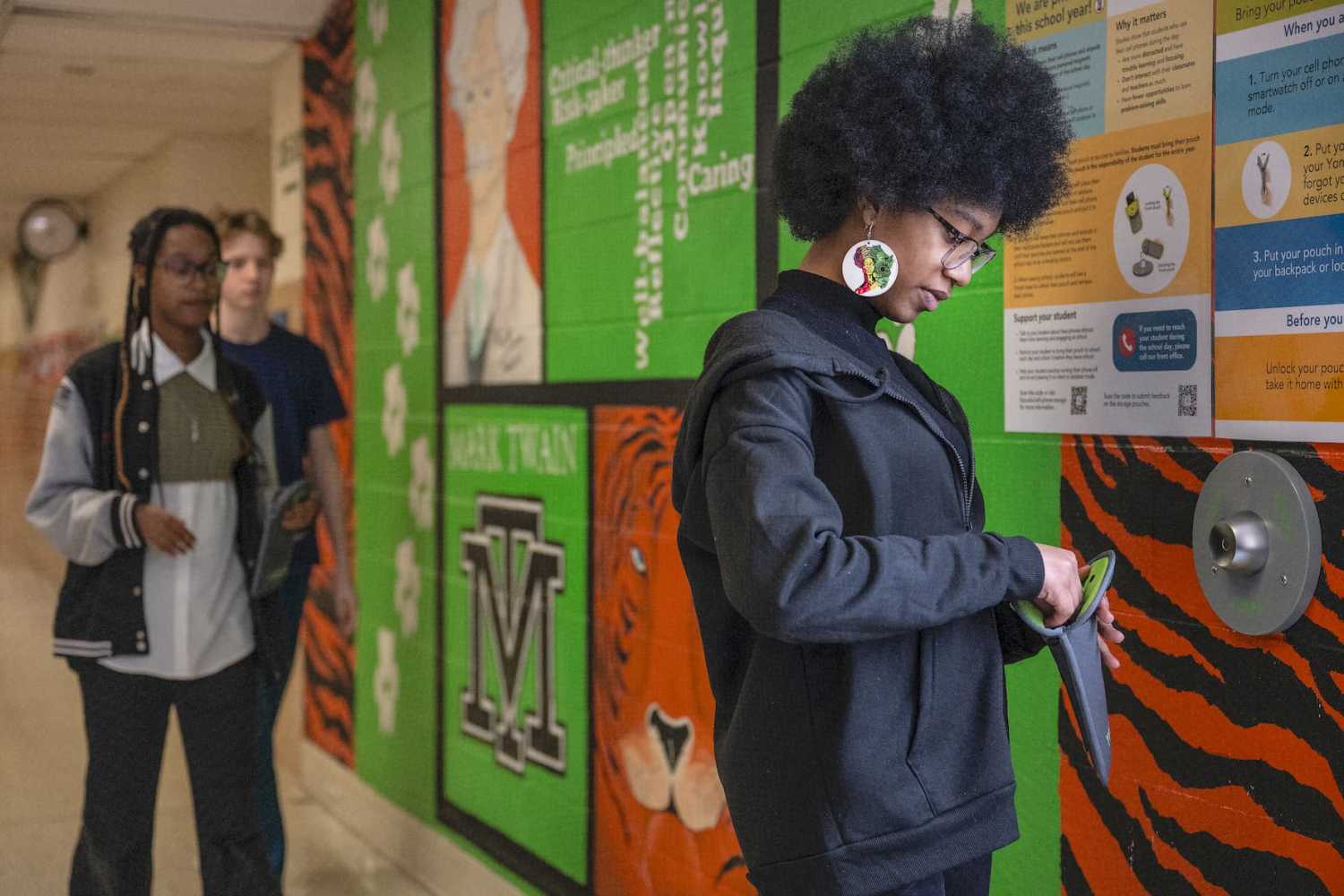
Cellphone restrictions are something of a unicorn in the world of education policy: They have been championed, implemented, and celebrated in recent years by those on the political left and right, in urban and rural settings, and across school types. The widespread embrace of this policy is a response to mounting research evidence that cellphones, and the social media and AI-powered apps they carry, can harm children’s learning, mental health, and emotional development.
Our best evidence so far suggests that these restrictions are having generally positive effects. These studies show that cellphone bans reduce students’ phone use (albeit not to zero), increase academic achievement (although effects vary by age and subject), and after an initial adjustment period, do not increase students’ disciplinary problems.
With virtually all students in the country now attending a school with some sort of cellphone restriction, we wondered what challenges schools face in implementing and enforcing these rules, and how students themselves are experiencing cellphone bans. At the beginning and end of the most recent school year, in October 2025 and May 2026, we asked a nationally representative sample of teens, including those attending public, private, and charter schools, drawn from households in the probability-based Understanding America Study (UAS) panel, about their schools’ cellphone policies and their own experiences with phone rules during the school year.
By foregrounding teens’ own reports, we offer insight into teens’ perceptions of and experiences with their schools’ cellphone restrictions, focusing on how the 2025-2026 school year unfolded with these restrictions in place. We also administered a parallel set of surveys to adult UAS panel members who live with a teen (in about 90% of cases, either the teen’s parent or grandparent), allowing us to compare teen and adult reports.
Reported phone use in schools increased over the year, despite restrictions
After our October survey administration, we reported that stricter cellphone restrictions were associated with reduced phone use in schools. While still true, our more recent data show that the enforcement and effectiveness of these policies waned between October and May.
For example, 28% of teens reported ever using their phone during core classes at the beginning of the year, compared to 42% by the end of the year. Perhaps explaining some of these increases, nearly half of teens (44%) reported that their teachers became less strict about enforcing cellphone policies over the year. Notably, adults did not detect this degradation of phone policy enforcement, with just 13% reporting that enforcement became less strict and 60% perceiving no change over the year.
While we can’t know exactly why reported enforcement decreased and usage increased during the year, common-sense hypotheses seem likely: Students may have learned to work around obstacles (e.g., Yondr pouches, locker requirements) or may have taken more risks breaking rules, particularly if they observed light or unevenly enforced consequences. Likewise, teachers may have become less vigilant over the course of the year, as an early-year focus on classroom routines and procedures gave way to a focus on covering content in depth.
Stricter policies may better serve schools and students
Cellphone policies vary meaningfully by school. In our data, 56% of teens reported attending a school with a bell-to-bell ban (e.g., no cellphone use at any time during school) while the remaining 44% attended schools with less-strict policies, typically restrictions on use during instructional time but not during lunch, passing periods, and other noninstructional times.
Our evidence suggests that policies like bell-to-bell bans persist across the year more than less-strict policies. For example, under bell-to-bell policies, there was a 10 percentage-point increase in the proportion of teens reporting using their phones during core classes (25% to 35% from October to May; Figure 1). In schools with less-strict policies, there was an 18 percentage-point increase (from 32% to over 50%). Although cellphone usage increased across the board by the end of the year, the increase at schools with less-strict policies was nearly double the increase (in terms of percentage points) at schools with stricter policies.
Teens have mixed perceptions of school phone rules, with some promising signs
We asked teens about how their schools’ phone rules affected them this past year, including impacts on their happiness, stress levels, academic performance, relationships with teachers, and more. As previously reported, at the beginning of the year, teens reported mostly negative or no impacts of phone restrictions on their overall school experiences and well-being, with nearly half reporting a negative impact on their happiness (Figure 2). Few reported positive impacts in October, with exceptions for the ability to pay attention in class, for which almost one-third of students perceived a positive impact of phone restrictions.
By May, opinions had shifted away from a negative impact and toward no impact. The greatest change was observed on the “happiness” question, where the proportion of teens who felt their school’s phone rules were making them unhappy dropped by nearly half, from 48% in October to 27% in May. Across all areas we asked about, the proportion of teens who reported their school’s phone policy had no impact on them increased from an average of 56% to 63%, and the proportion who reported a negative impact decreased from 24% to 17%, on average.
This is a big win for school cellphone ban advocates, with teens’ own protests, fears, and perceived need for devices often among the loudest critiques of cellphone restrictions. Although there was little change in the proportion of teens perceiving a positive impact of their school’s phone policy, with most shifts moving away from negative perceptions toward neutral perceptions, our results are still consistent with teens learning that navigating a day without their phones is not as devastating as they might have imagined.
Of course, some teens’ view that school cellphone policies did not impact their well-being and school experience could reflect the policies’ own weakening over the course of the year. For the most part, our data do not support this hypothesis, as students reporting less teacher enforcement over the year did not show systematic or meaningfully different shifting attitudes compared to students attending schools where enforcement was consistent throughout the year. In at least some cases, our data suggest that teens came to appreciate the benefits of these policies between October and May. In open-ended survey responses, we heard sentiments like, “I was able to pay more attention this school year since our phones were locked in pouches. There were less distractions” and “Having [a phone] there leads to the desire to use it, which causes distraction.” These teens acknowledged that cellphone restrictions improved facets of their academic lives.
One reasonable curiosity is whether school phone restrictions simply displace teen phone use to other parts of the day. Six in ten of our teen respondents (58%) said their school cellphone policy did not affect their phone use outside school. Another 12% said their school’s policy actually pushed them to use their phone less outside school than they would otherwise, with the remaining 30% reporting using their phone more outside school than they would otherwise. Teens’ parents largely observed the same pattern: 78% reported no change, 5% reported less phone use outside school than otherwise, and 17% reported more. Though it is encouraging that most students’ reported out-of-school phone use was unaffected, those who did report higher out-of-school use sometimes wrote comments about their phone’s addictive properties: “I’m not on it as much [at school] and you crave it [because] its like a drug” and “my body makes me want to get on my phone because of not using it all day… it’s not great.”
Schools should adopt and enforce bell-to-bell cellphone restrictions
On balance, our survey findings support continued implementation and enforcement of phone restrictions, including strong bell-to-bell bans. Students used their phones less and reported greater policy enforcement at schools with such policies, and although teens weren’t exactly thrilled about phone restrictions at any point, they were less negative about them by the end of the year than at the beginning.
These findings also have implications for systems adopting (or considering adopting) even broader restrictions on screen time in classrooms. Our survey data suggest high levels of support for efforts to reduce students’ exposure to screens in elementary classrooms (57% of teens, 62% of adults in favor of “eliminating all screens in classrooms”). While support wanes for broad restrictions in older grades (e.g., 16% of teens, 41% of adults in favor for high school classrooms), we believe it is reasonable for education leaders making decisions about appropriate classroom technology use to remain undeterred by initial resistance. After all, cellphone restrictions were quite unpopular at the start of the 2025-2026 school year, and by year’s end, they may have been less disruptive, inconvenient, and downright excruciating than students and families initially feared.
Related Content

Authors



The Brookings Institution is committed to quality, independence, and impact.
We are supported by a diverse array of funders. In line with our values and policies, each Brookings publication represents the sole views of its author(s).