The challenge
Over 20 million adults in the U.S. need long-term care or support in daily activities due to disabilities or other functional limitations associated with aging. Direct care workers—including home health aides, personal care aides, and nursing assistants—can provide these services in institutional settings or at home. In recent years, and exacerbated by the pandemic, growth in these professions has been constrained by low recruitment and retention, largely reflecting poor job quality and low wages. The result has been understaffing in institutional settings and unmet need in the home health market.
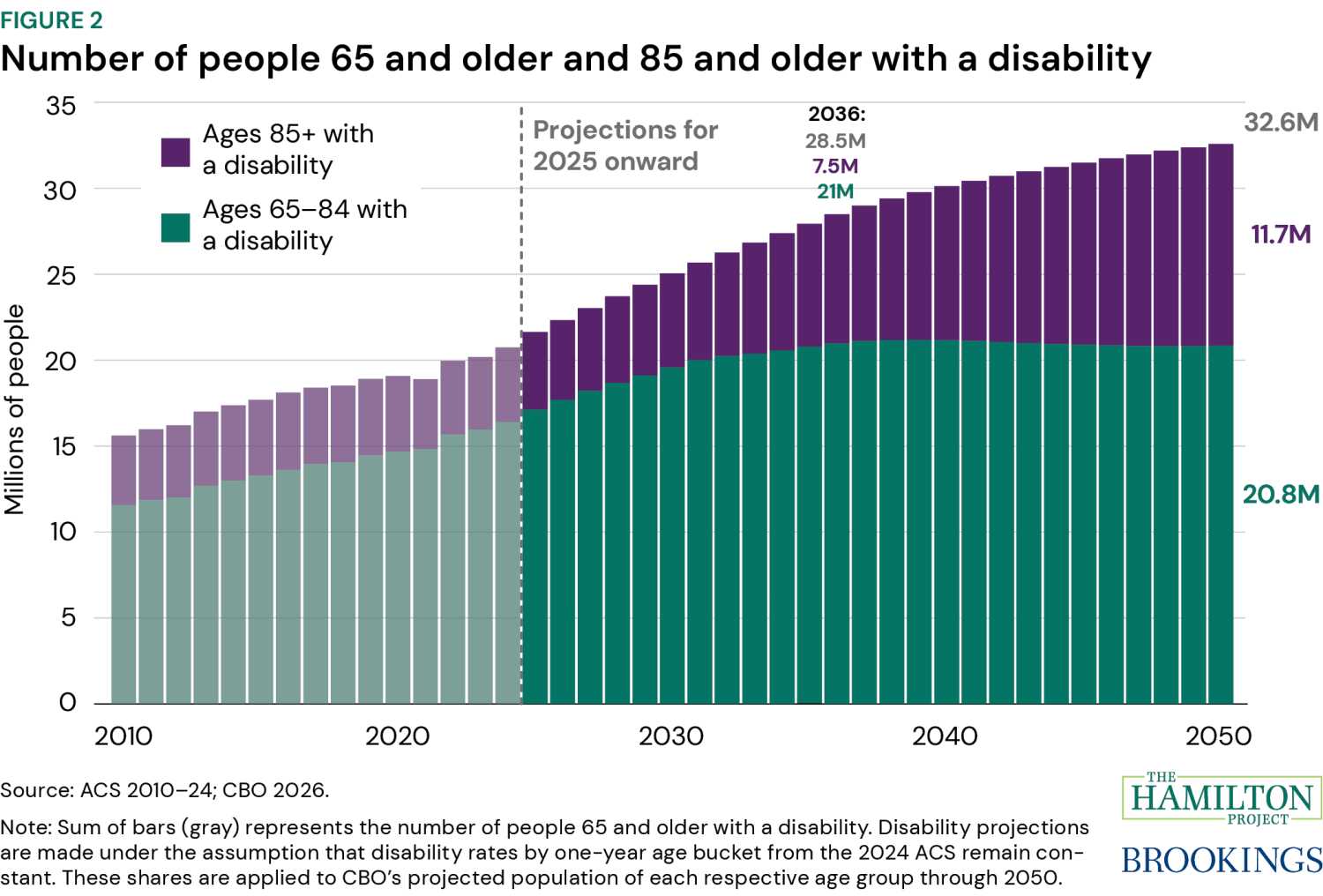
In the next decade, the gap between what the aging population in the U.S. needs and the capacity of the direct care workforce to deliver on those needs will grow. The population 65 and older will grow from 65.6 million to 77.5 million, and the number of people 85 and older will grow from 6.8 million to 11.1 million. As the population ages, the disabled population 65 and older is projected to grow by more than 6 million. Reflecting that demand, about 1.28 million additional workers will be needed in the sector by 2036, an increase of about 35 percent versus today.
While improving working conditions, including compensation, can attract more people to the direct care workforce, this alone will not be sufficient to meet growing need. The solution to the emerging direct care workforce crisis should also include the targeted recruitment of immigrants to work in the U.S. in this industry. Immigrants are disproportionately represented in the direct care workforce, and the presence of immigrants has been shown to improve quality of care and reduce elderly mortality.
The proposal
Tara Watson (Brookings Institution) proposes a temporary direct care worker visa, the H-1D, that offers a tailored and flexible way to address the looming workforce challenge and improve the quality of care available to older people needing support.
The H-1D visa would be a temporary employment-based visa for immigrants who have at least two years of experience in direct care to work in the United States in the direct care field. The visa would be additive to existing legal pathways and would be available to immigrants already living in the United States as well as to new immigrants. Like the H-1B visa, the H-1D would be structured as a three-year initial visa with an option for renewal. It would be dual intent with the possibility of applying for legal permanent residence after six years and would include dependents. The program includes safeguards to reduce the risk of exploitation and includes support for training and professional development for direct care workers. Following an initial pilot, 65,000 visas would be made available each year, a level projected to meet about 35 percent of the needed growth in the direct care workforce over a decade. The program includes a commission to periodically review the numerical caps, allowing flexibility if the demographic or economic outlook changes.
The H-1D would generate a meaningful new labor pathway with strong worker protections and an above-market wage floor. It allows for the recruitment of additional direct care workers from abroad as well as the stabilization and regularization of workers already contributing to the U.S. direct care sector. At the same time, the numeric cap is well below what would be necessary to fully address the direct care worker challenge through immigration alone, leaving room to grow the domestic workforce.
By expanding the direct care workforce, the H-1D would improve health and well-being for older adults. An adequate supply of direct care workers allows more older and disabled individuals to receive better care in both noninstitutional and institutional settings and to remain in a preferred setting for care. Research finds that increased availability of direct care workers resulting from higher immigration reduces negative health outcomes, including nursing home falls and overall mortality rates among older adults. Increased availability of professional care may also reduce burdens on family caregivers, allowing some to increase their own labor supply. Meanwhile, visa recipients and their families would benefit from the opportunity to live and work in the United States.
Watson’s proposal focuses on direct care for older and disabled adults, given the predictable demographic transition that will generate sharp increases in demand for direct care over the next decade. A similar model could be considered for other high-need occupations, and the success of this targeted program might help set the stage for broader immigration reforms.
Author

Related Content
2026


-
Acknowledgements and disclosures
The author is grateful for the superb research assistance of Eileen Powell of The Hamilton Project. She also appreciates the thoughtful contributions and feedback from participants in a March 2026 authors’ conference as well as the Hamilton Project team.
The Brookings Institution is committed to quality, independence, and impact.
We are supported by a diverse array of funders. In line with our values and policies, each Brookings publication represents the sole views of its author(s).


Commentary
A direct care worker visa policy to support the aging US population
September 29, 2026
Key takeaways: