
The challenge
Home health care is an important component of Medicare. In 2023, about 2.7 million beneficiaries in Traditional (i.e., fee-for-service) Medicare received home health care from over 12,000 home health providers at a total cost of $15.7 billion. Medicare home health services consist of skilled nursing, physical therapy, occupational therapy, speech therapy, aide services, and medical social work delivered in patients’ homes.
Compared to institutional alternatives, home health is often viewed as clinically appropriate, patient preferred, and less costly. At the same time, elevated profit margins and persistent concerns about overuse and fraud have fueled debates about whether and how to reform the Medicare home health system. Yet there is little consensus on how the program is performing or how it should evolve.
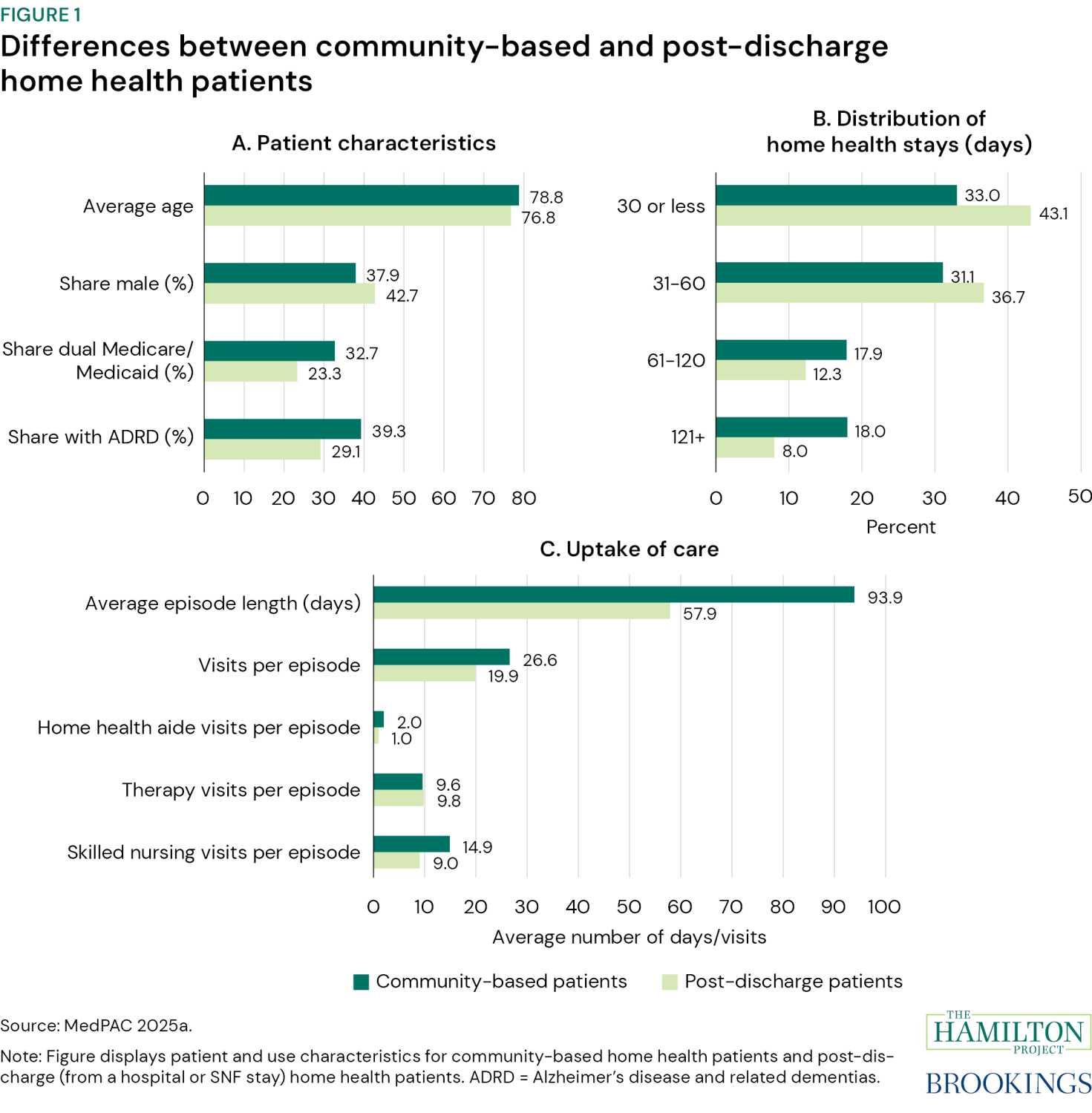
Liran Einav (Stanford University), Amy Finkelstein (MIT), Yunan Ji (Georgetown University), and Neale Mahoney (Stanford University) argue that these debates stem in part from a more fundamental issue: Medicare home health lacks a clear, agreed-upon objective. The program appears to try to serve multiple purposes: (1) mitigating costs by substituting for institutional post-acute care, (2) covering the costs of treatment and recovery from acute health events for home-bound patients, and (3) providing in-kind, long-term services and supports for frail older adults. This last objective overlaps with the domain of Medicaid long-term services and supports. In particular, “community-based” home health episodes, those initiated without a preceding hospital stay, are more consistent with a population receiving ongoing supportive care than a population recovering from an acute medical event.
Policy implications
The authors assess how well current program design aligns with each of these objectives, and discuss reforms that might help the program better meet them. For example, if Medicare home health is viewed as coverage for standard medical services—just delivered at home—the authors conclude that beneficiaries should probably face copays or other cost sharing, as they do for other Medicare services. (Currently, home health does not require cost sharing.) Likewise, if the primary goal of home health is to reduce use of costly institutional care, then it might make sense for home health eligibility rules to align more closely with eligibility requirements for Medicare coverage in institutional settings. And if Medicare home health is meant to serve as long-term care insurance, the authors recommend considering “cash-for-care” approaches, used in a number of European countries, that would give beneficiaries discretion over how to allocate a fixed budget for long-term care services.
The authors stress that the attractiveness of any of these reforms depends critically on the perceived goal (or goals) of the Medicare home health benefits. There is no single “right” answer for the optimal use of each possible tool; the decision depends on how different goals are weighed in the design.
Authors




Related Content
2026


-
Acknowledgements and disclosures
The authors thank the Laura and John Arnold Foundation for financial support, and participants in the Hamilton Project authors’ conference for helpful comments and conversations. Tia Cole and Ken Lin provided excellent research assistance.
The Brookings Institution is committed to quality, independence, and impact.
We are supported by a diverse array of funders. In line with our values and policies, each Brookings publication represents the sole views of its author(s).