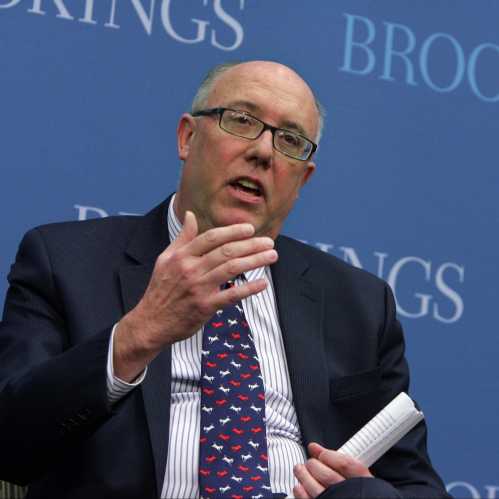
Bruce Riedel
Senior Fellow - Foreign Policy, Center for 21st Century Security and Intelligence, Center for Middle East Policy
Director - The Intelligence Project
Bruce Riedel is a senior fellow and director of the Brookings Intelligence Project, part of the Brookings Center for 21st Century Security and Intelligence. In addition, Riedel serves as a senior fellow in the Center for Middle East Policy. He retired in 2006 after 30 years of service at the Central Intelligence Agency, including postings overseas. He was a senior advisor on South Asia and the Middle East to the last four presidents of the United States in the staff of the National Security Council at the White House. He was also deputy assistant secretary of defense for the Near East and South Asia at the Pentagon and a senior advisor at the North Atlantic Treaty Organization in Brussels.
Riedel was a member of President Bill Clinton’s peace process team and negotiated at Camp David and other Arab-Israeli summits and he organized Clinton’s trip to India in 2000. In January 2009, President Barack Obama asked him to chair a review of American policy towards Afghanistan and Pakistan, the results of which the president announced in a speech on March 27, 2009.
In 2011, Riedel served as an expert advisor to the prosecution of al Qaeda terrorist Omar Farooq Abdulmutallab in Detroit. In December 2011, Prime Minister David Cameron asked him to brief the United Kingdom’s National Security Council in London on Pakistan.
Riedel is the author of "The Search for al Qaeda: Its Leadership, Ideology and Future" (Brookings Institution Press, 2008), "Deadly Embrace: Pakistan, America and the Future of the Global Jihad" (Brookings Institution Press, 2011; translated into Persian), "Avoiding Armageddon: America, India and Pakistan to the Brink and Back" (Brookings Institution Press, 2013), and "JFK's Forgotten Crisis: Tibet, the CIA and the Sino-Indian War" (Brookings Institution Press, 2015). He is a contributor to "Which Path to Persia? Options for a New American Strategy Toward Iran" (Brookings Institution Press, 2009), "The Arab Awakening: America and the Transformation of the Middle East" (Brookings Institution Press, 2011) and "Becoming Enemies: U.S.-Iran Relations and the Iran-Iraq War, 1979-1988" (Brookings Institution Press, 2012). His book "What We Won: America’s Secret War in Afghanistan, 1979-1989" (Brookings Institution Press, 2014) won the gold medal for best new book on war and military affairs at the INDIEFAB awards. His new book is "Kings and Presidents: Saudi Arabia and the United States since FDR" (Brookings Institution Press, 2017).
Riedel is a graduate of Brown (B.A.), Harvard (M.A.), and the Royal College of Defense Studies in London. He has taught at Georgetown University’s School of Foreign Service and Johns Hopkins University’s School for Advanced International Studies, and he has been a guest lecturer at Dartmouth, Harvard, Brown, and other universities. Riedel is a recipient of the Intelligence Medal of Merit and the Distinguished Intelligence Career Medal.
Bruce Riedel is a senior fellow and director of the Brookings Intelligence Project, part of the Brookings Center for 21st Century Security and Intelligence. In addition, Riedel serves as a senior fellow in the Center for Middle East Policy. He retired in 2006 after 30 years of service at the Central Intelligence Agency, including postings overseas. He was a senior advisor on South Asia and the Middle East to the last four presidents of the United States in the staff of the National Security Council at the White House. He was also deputy assistant secretary of defense for the Near East and South Asia at the Pentagon and a senior advisor at the North Atlantic Treaty Organization in Brussels.
Riedel was a member of President Bill Clinton’s peace process team and negotiated at Camp David and other Arab-Israeli summits and he organized Clinton’s trip to India in 2000. In January 2009, President Barack Obama asked him to chair a review of American policy towards Afghanistan and Pakistan, the results of which the president announced in a speech on March 27, 2009.
In 2011, Riedel served as an expert advisor to the prosecution of al Qaeda terrorist Omar Farooq Abdulmutallab in Detroit. In December 2011, Prime Minister David Cameron asked him to brief the United Kingdom’s National Security Council in London on Pakistan.
Riedel is the author of “The Search for al Qaeda: Its Leadership, Ideology and Future” (Brookings Institution Press, 2008), “Deadly Embrace: Pakistan, America and the Future of the Global Jihad” (Brookings Institution Press, 2011; translated into Persian), “Avoiding Armageddon: America, India and Pakistan to the Brink and Back” (Brookings Institution Press, 2013), and “JFK’s Forgotten Crisis: Tibet, the CIA and the Sino-Indian War” (Brookings Institution Press, 2015). He is a contributor to “Which Path to Persia? Options for a New American Strategy Toward Iran” (Brookings Institution Press, 2009), “The Arab Awakening: America and the Transformation of the Middle East” (Brookings Institution Press, 2011) and “Becoming Enemies: U.S.-Iran Relations and the Iran-Iraq War, 1979-1988” (Brookings Institution Press, 2012). His book “What We Won: America’s Secret War in Afghanistan, 1979-1989” (Brookings Institution Press, 2014) won the gold medal for best new book on war and military affairs at the INDIEFAB awards. His new book is “Kings and Presidents: Saudi Arabia and the United States since FDR” (Brookings Institution Press, 2017).
Riedel is a graduate of Brown (B.A.), Harvard (M.A.), and the Royal College of Defense Studies in London. He has taught at Georgetown University’s School of Foreign Service and Johns Hopkins University’s School for Advanced International Studies, and he has been a guest lecturer at Dartmouth, Harvard, Brown, and other universities. Riedel is a recipient of the Intelligence Medal of Merit and the Distinguished Intelligence Career Medal.
The U.S.-Saudi relationship had its finest hour under Bush. It’s no surprise that the Saudis want to remember the good old days. Given the acute crisis in U.S.-Saudi relations, Riyadh urgently needs a capable ambassador in Washington, but not one so tainted with the Khashoggi murder and coverup.
Somebody wanted this information [CIA evidence that MBS communicated with the top aide overseeing the Khashoggi hit team 11 times before and after the assassination] to come out, obviously. I think there is, inside the American national security bureaucracy, a fair number of people who have been warning for some time that Mohammed bin Salman is a dangerous, reckless, impulsive person and they weren’t getting any attention. And now they have proof positive of how dangerous and reckless he is. In Washington, the way you say, ‘I told you so,’ is to leak something... You don’t really need to know the content of these [CIA] reports, it is self-evident. Fifteen people don’t get on an airplane and fly to Istanbul for a day trip and fly back having murdered someone and then made phone calls from the scene of the crime back to the crown prince’s office. You are not talking about the weather.
This [evidence that Crown Prince Mohammed bin Salman communicated repeatedly with a key aide around the time that Jamal Khashoggi was assassinated] is the smoking gun, or at least the smoking phone call. There is only one thing they could possibly be talking about. This shows that the crown prince was witting of premeditated murder... Will the White House give up the cover-up of the cover-up? I don’t see any sign they are willing to change their tune. But this will certainly increase the pressure to get Gina Haspel to testify on the Hill.
There’s no White House green light to take any sanctions against the [Saudi] crown prince himself. So Pompeo is stuck. They’re all stuck. We’re now engaged in a coverup of a coverup.