Social Safety Net
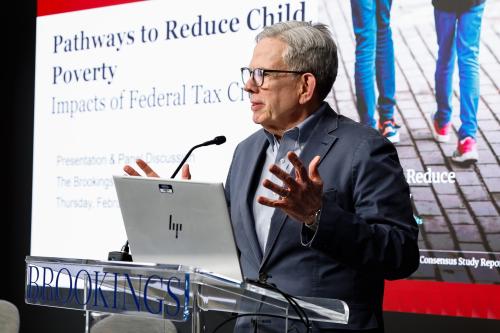
Pathways to reduce child poverty: Impacts of federal tax credits
10:00 am EDT - 11:00 am EDT
Past Event
10:00 am - 11:00 am EDT
1775 Massachusetts Ave NW
Washington, D.C.
20036
The Earned Income Tax Credit (EITC), created by Congress in 1975 and expanded several times since, has grown into one of the nation’s largest anti-poverty programs, providing cash to millions of working, low-income families.
On June 3, the Hutchins Center on Fiscal and Monetary Policy and the Center for Economic Security and Opportunity at Brookings discussed the economic and social impact of the EITC, as well as the Child Tax Credit, which was created in 1997 and expanded temporarily during the COVID-19 pandemic.
Participating included Jacob Bastian of Rutgers University, Jim Sullivan of the University of Notre Dame, Henrik Kleven of Princeton University, and Hilary Hoynes of UC-Berkeley.
Viewers asked questions in advance by emailing [email protected] and on X @BrookingsEcon using #EITC.





Moderator