
Introduction
The debate over AI and work is often framed as a choice between mass unemployment and widespread human augmentation. The economic evidence supports neither conclusion. Instead, the literature suggests that AI will likely produce sharply divergent labor-market outcomes on dramatically different timelines, rapidly displacing some forms of work while gradually augmenting others. These effects will also likely vary substantially across occupations, industries, and even employers.
The economic literature’s central contribution is not merely to show that AI adoption will be divergent and uneven. It is also that AI exposure is the wrong organizing principle for workforce policy. What matters is not just whether a certain occupation is exposed, but also how AI changes the value of human work, and whether it enhances human expertise and/or lowers barriers to economic opportunities.
Recent economic research offers four key findings that inform these questions and can help shape how policymakers respond to them. First, AI exposure does not necessarily translate into commercially viable automation or augmentation. Second, the central question should not be simply whether AI creates or destroys jobs, but also how it changes the value of human expertise. Third, successful AI adoption requires not only knowing how to use AI but knowing when to trust it. Fourth, as models become more reliable and capable of completing longer, complex tasks, AI adoption may become more autonomous, and commercially viable across a broader range of workflows.
These findings argue against both complacency and an immediate economy-wide sweeping intervention. Workforce policy should instead preempt the worst potential downsides of AI and develop a targeted policy framework that can adapt to evolving labor-market changes. It should prioritize the areas where policy can have the greatest economic impact: supporting workers who are actually displaced and expanding access to newly created high-return opportunities. Programs should involve employers directly in their design and promote domain-specific hands-on training, apprenticeships, and wage insurance.
The central challenge is not to forecast every job AI will affect, but to develop a new framework capable of identifying unforeseen disruptions while determining when, where, and how workforce policy should respond.
In the remainder of the paper, we highlight why a public policy response is imperative, examine the tension between policy uncertainty and the costs of doing nothing, discuss four insights from the economic literature and their implications for workforce policy, and propose five policy directions grounded in those findings. Specifically, we recommend prioritizing displaced workers and emerging high-productivity opportunities, designing domain-specific training, tailoring programs to shifts in human expertise, expanding apprenticeships, and establishing a federal wage-insurance program.
The economic stakes
The economic stakes AI presents for American workers are profound and far-reaching. AI is emerging at a moment when U.S. economic mobility has sharply declined and financial insecurity has risen, trends that may reverse decades of shared economic progress and create vulnerabilities that a technological disruption could deepen even if it ultimately delivers substantial gains.
The scale of these challenges is not insignificant. American households have far greater debt to income ratio today than they did four decades ago, homeownership has become less accessible for younger Americans, wages are increasingly polarized based on education, and incomes are failing to catch up with economic productivity gains (see Figure 1a). Moreover, and perhaps as a result of these challenges, economic mobility in America is in decline: whereas in the 1940s, roughly 90% of children grew up to earn more than their parents by the 1980s, that number is down to 50% and is still declining (see Figure 1b).
AI could help address these challenges by helping workers develop and leverage expertise, replacing the need for formal education and creating better jobs. But AI may also intensify these challenges by involuntarily displacing workers and causing persistent earnings losses, exacerbating wage disparities, disrupting career ladders, and undermining earnings growth on which economic mobility and homeownership depend (see e.g., Ben-Ishai et al., and Petrova et al.).
Policy design under uncertainty
There is little doubt that AI will transform the labor market, but the timing, scale, and distribution of that transformation remain uncertain. Because AI’s trajectory, commercial applications, and adoption patterns remain unknown, it is impossible to know today with any real certainty which occupations will decline, which new roles will emerge, how occupations will evolve, or which forms of expertise will become more valuable. We simply cannot reliably infer future occupational change from current AI capabilities or emerging applications alone.
Yet uncertainty about AI’s impacts is not an argument for inaction. Policymaking is about making consequential decisions in an effort to prevent uncertain harms. AI is no different. Policymakers must make consequential up-front decisions today about where, when, and how to prepare for an AI workforce transition whose precise nature will become clear only over time.
Similarly, uncertainty in some areas of policy should not prevent action in others. In particular, sweeping proposals have been advanced to address the workforce and distributional challenges posed by AI, for example universal basic income, higher taxes on capital, or reforms to social safety-net. These proposals may have merit, but implementing such ambitious reforms could be fiscally costly, politically difficult, and unlikely to command broad consensus in the near term. Our focus here is not to opine on such large structural changes, but to focus on practical policy changes that could be implemented in the near-term and where there is a direct connection to the economic literature.
While economic research cannot resolve all the uncertainties related to AI workforce policies, it can make policy choices more disciplined and informed. It can identify the mechanisms through which an AI workforce transition may unfold and provide guiding principles for designing effective programs. The analysis below draws from these findings and proposes core guiding principles for a workforce transition policy.
Our approach begins from the premise that policymakers should establish a new preemptive framework that balances the need for action with the risks of acting under uncertainty, adapts to evolving market shifts in demand, and is continuously informed by real-time empirical evidence.
What insights do we gain from the literature?
1. Technical capability does not imply impact
Much of the debate over AI and jobs relies on measures of AI exposure, the share of tasks within an occupation that AI may be capable of performing, to identify the occupations most likely to be impacted by AI. Gimbel et al., for instance, find that several exposure studies identify computer programmers or telemarketers as occupations that are likely to be impacted by AI because they contain higher shares of exposed tasks. At the same time, they also find that the studies often produce inconsistent projections as they differ substantially in which occupations they project as highly exposed
Technical capability, however, is not the same as economically viable automation. Identifying which tasks are exposed is an important starting point, but it is insufficient. Whether a task is actually automated in commercial environments depends not only on AI’s technical capabilities, but also on a broader set of practical and economic factors including task completion time, model reliability, error management and mitigation, and workflow or organizational integration costs.
Mertens et al. find that although Large Language Models (LLMs) are increasingly capable across a broad range of tasks, their performance remains inconsistent and vulnerable to errors, raising questions about whether they can be reliably integrated into workplace applications. As of the end of 2025, AI models were capable of completing tasks that took humans three to four hours to complete with only a 65% success rate. For many of these tasks, model failures make AI insufficiently reliable for meeting the average error rates that firms would tolerate in real-world commercial settings.
For comparison, human-reliability frameworks are far more strict in commercial settings relative to AI model performance. For instance, the Human Error Assessment and Reduction Technique (HEART), a human-reliability assessment framework that was developed to evaluate human performance and measure its likelihood of errors, indicates that human-error probabilities historically range from 2% for routine tasks that require limited skills to 9% for simple tasks performed with limited attention, and 16% for complex tasks requiring substantial comprehension and skill (see Williams and Bell). While human errors are highly dependent on context, there is no universal human-error standard, and these measures are not directly comparable, they seem considerably below the error rates observed on average for current AI models.
Mertens et al. also find that task duration itself matters. In fact, longer tasks are less likely to be completed successfully, as a tenfold increase in average task duration reduces model performance by 11%. For instance, as shown in Figure 1, healthcare support tasks, which have the shortest completion time (just over an hour), generate the highest model performance scores. By contrast, legal or architecture and engineering tasks, which take more than 20 hours to complete, generate the lowest performance scores. This finding is important as it suggests that occupations with longer task completion times may be slower to adopt AI.
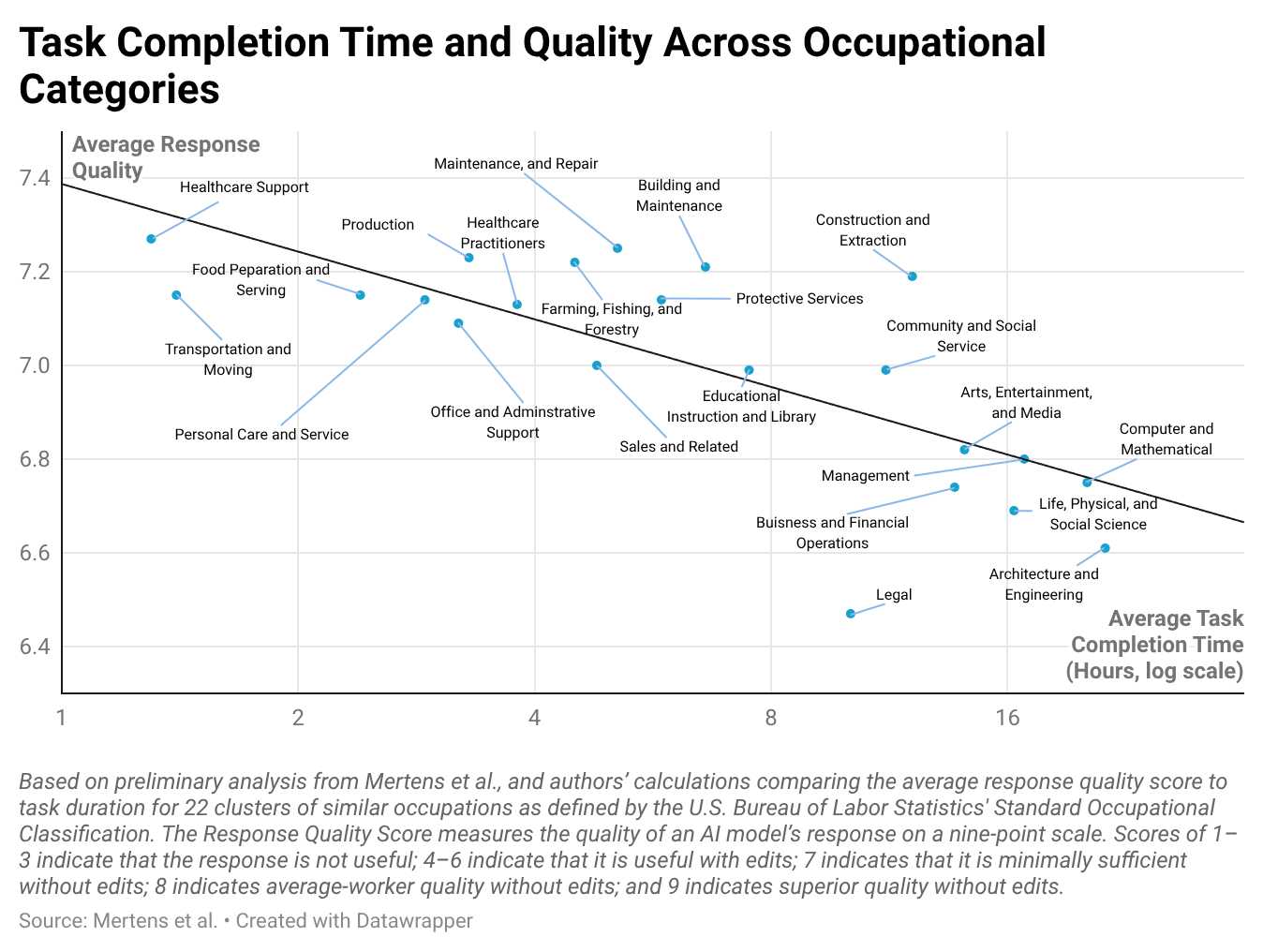
There is a clear historical precedent for the finding that task duration matters. Automation has often advanced by focusing first on the shortest, most decomposable units of work. In industrial robotics, early commercial viability was achieved in short, repetitive tasks such as spot welding or painting. By contrast, longer-duration tasks, such as installing wires or assembling final products, resisted automation for decades. This is because these tasks required continuous real-time computer vision and tactile feedback. In effect, the engineering and error-correction costs of automating these longer tasks exceeded their benefit relative to human labor (see International Federation of Robotics, Nguyen et al.).
A similar pattern emerged in digital labor markets. Earlier gig economy platforms, such as Mechanical Turk and Taskrabbit, succeeded by decomposing work into small, atomic microtasks, such as five-second image labeling or content verification. However, attempts to crowdsource long-form work, such as document writing, often failed due to coordination challenges, inconsistencies or integration costs. Ultimately, the managerial cost of auditing, correcting, and synthesizing these longer tasks often outweighed the efficiency gains of the technology (see Kittur et al.).
2. Automation does not imply negative worker outcomes
The economic literature has long recognized that task automation does not necessarily lead to a negative outcome for workers. Technological progress is often motivated by the desire to replace mundane human work (e.g., sorting through numerous documents or working on a factory line), which could make work more pleasant, more interesting or less dangerous. But it can also replace the more meaningful parts of work, making it less pleasant or less interesting (e.g., automating clerks’ specialized recordkeeping while leaving them with counting stock, and weighing goods responsibilities).
Autor and Thompson’s expertise framework provides a way to understand these changes. It suggests that the impact of AI depends less on the number of exposed tasks or affected occupations, and more on how AI may change the value of expertise—the unique capabilities or know-hows that enable a worker to differentiate herself and generate greater value.
Expertise creates an economic tradeoff. It enables workers who possess it to command higher pay, but it also serves as a barrier to entry by excluding workers who lack the capabilities required to perform expert tasks.
In accounting, for instance, if AI can automate bookkeeping and data entry but performs inconsistently in more advanced tasks such as tax advice or analysis, it would increase the need for human expertise. In this case, AI would increase accountants’ wages but reduce the occupation’s employment. On the other hand, if AI could reliably diagnose and treat the common conditions seen by family physicians, it would reduce the value of their expertise, potentially opening it up to being done by nurse practitioners.1 In this case AI would be reducing entry barriers to the occupation, thereby increasing employment but also lowering pay.
The expertise framework therefore indicates that some exposed occupations may generate more jobs at lower wages, while others may lead to higher wages but offer fewer job opportunities. The distributional question is hence not simply whether jobs disappear but rather how technology changes the value of human work and expertise.
3. AI integration requires experimentation, learning, and judgment
Because AI systems remain vulnerable to errors, limited interpretability, and non-deterministic outputs, integrating them into workplace tasks is not simply a matter of general AI literacy. Effective adoption requires task-specific training, experimentation, and feedback in real workplace settings.
As Fleming et al. note, deploying AI to automate human work requires substantial last mile customization. This may include adapting general-purpose models to particular business applications, training or customizing them using proprietary data, and achieving the level of accuracy required for performing workflows successfully. Similarly, Dell’Acqua et al. illustrate this challenge: generative AI substantially improved performance on tasks within its capabilities, but actually reduced performance when workers applied AI to tasks that were outside such capabilities.
This suggests that the central training challenge is not simply teaching workers how to use AI tools, but helping them understand when, where, and how those tools can reliably improve performance—and where they are likely to fail. For this reason, AI integration in the workforce is not merely an educational challenge, but an organizational and strategic one.
4. AI progress is likely to expand the range of commercially viable autonomous work
Recent advances in AI capabilities suggest that its impact on work often begins by complementing human workers but gradually evolves toward more autonomous execution.
The analysis by Mertens et al. support this idea, showing that while current LLM errors require significant worker adjustment and oversight, model failure rates are halving roughly every 2.5 years. If these trajectories hold, models could achieve an 93% baseline success rate across most professional text-based tasks by 2029, systematically shifting workflows from human-in-the-loop collaboration to more standalone automation. Appel et al. also find that the share of LLM directive conversations, where users gave Claude a task that was completed with minimal back-and-forth, rapidly increased over time as well. These findings suggest a pattern in which improvement in model performance is increasingly enabling delegation of tasks that do not require direct human oversight.
In practice, however, as we noted above, there is a gap between what AI can technically achieve and what is financially and organizationally viable. Even as technical progress moves very fast, AI integration barriers undermine its adoption in the broader economy. Svanberg et al., for instance, demonstrate that at today’s AI integration costs, U.S. businesses would choose to automate only 23% of the pool of computer vision tasks that can be performed by AI. These findings suggest that as model performance improves and model inference costs decline,2 business adoption is expected to increase across the economy. It remains unclear, however, where AI would become affordable, feasible and practical or how long it would take to get there.
Guiding principles for workforce transition programs
Drawing on the insights detailed above, we propose five guiding principles for AI workforce policies. These principles help clarify when public intervention may be warranted, where it should be targeted, and how programs should be designed to address the challenges of the AI transition.
1. Prioritize displacement support and high-productivity new opportunities
The uneven trajectory of AI automation makes a targeted workforce transition strategy both possible and necessary. Because disruption is unlikely to occur across the entire economy at once, public investment should focus on two leading priorities: workers facing actual displacement, and sectors where high-productivity new opportunities are being created.
Workers facing involuntary displacement should be a top priority because the economic costs of displacement are severe, significant, and persistent. Beyond the elevated risk of permanent labor-force exit, displacement also produces large earnings losses even among workers who do return to work. Davis and von Wachter, for instance, estimated that during periods of high unemployment, displacement has historically caused earnings losses that amount to a staggering 2.8 years of prior earnings.
Similarly, supporting transitions into high-productivity, high-impact sectors should be a central priority, not only because these investments may generate greater collective returns, but also because they address two fundamental challenges facing the U.S. economy. Employment remains concentrated in slower-productivity sectors, and population aging is increasing the economic burden on a shrinking working-age population (see e.g., Azenui et al.). Future growth may therefore depend increasingly on productivity gains. Because workers do not move frictionlessly across sectors, public programs that reduce mobility barriers may generate significant collective gains.
The policy response to these two priorities should differ. For displaced workers, we have a collective interest in supporting individuals who face significant displacement risks before they translate into persistent economic spillovers. Retraining alone is unlikely to be sufficient (see Altman and Schrag): support should be preemptive and include a broader set of tools, including job-search assistance and wage insurance—although we would also advocate for retraining where realistic employment pathways exist.
For emerging high-productivity sectors, by contrast, the challenge may be more focused on ensuring that interested workers can access the training needed to pursue new job opportunities in such sectors. The priority should be training programs designed to expand access and help more workers obtain high-quality opportunities in such sectors.
Although the economic evidence on workforce training programs suggests that such programs have not produced consistently strong results, particularly when they seek to help displaced workers transition into a new sector or occupation (see Card et al., Orrell et al. and Jacobs and Canedy), the implication is not that governments should avoid workforce investment altogether. Rather, it is that they should focus on programs that address the highest societal costs or generate the greatest benefits. Given the measurable and persistent costs of displacement (see Sullivan and von Wachter) and the benefits of securing broad access to the highest-impact new jobs, prioritizing these two areas is likely to deliver significant economic spillovers.
2. Design domain-specific, workplace-based training programs in partnership with employers
AI adoption involves more than learning how to use new tools: it requires workers to assess reliability, exercise judgment, and integrate AI into existing workflows (see Noy and Zhang and Dell’Acqua et al.). Generic AI literacy or proficiency programs alone are unlikely to be enough for promoting successful use of the technology, especially in occupations where AI applications are high-risk, and outputs are inconsistent or difficult to verify.
Given the heterogeneity of AI’s effects across tasks and work environments, effective training should be domain-specific and hands-on, enabling workers to test outputs, recognize system limits, exercise judgment, and learn how to integrate AI into the job-relevant workflows.
Additionally, workforce programs should not operate as mere education initiatives; they should be developed in partnership with employers who can help ensure that training is demand-driven and connected to actual hiring and placement opportunities (see Katz et al.).
With respect to AI in particular, because, as we detailed above, business adoption remains uncertain, and dependent on specific workplace conditions, employer participation is needed to ensure that training is aligned with actual deployment, responsive to evolving business needs, and connected to real hiring and placement opportunities. That role is, of course, important in preparing to integrate any new technology, let alone one advancing at the extraordinary pace expected of AI.
3. Align programs with shifts in human expertise
Workforce transition programs should distinguish between two different risks: labor displacement and wage erosion. In some occupations, AI may reduce employment, generating persistent adjustment costs and social spillovers that extend beyond the workers directly displaced (see Autor et al.). In others, it may place downward pressure on wages, eroding the value of prior skill investments and shifting much of the AI adjustment costs onto those workers (see Acemoglu and Restrepo). These outcomes require fundamentally different responses.
In occupations where AI increases the value of expertise but reduces employment, policy should support displaced workers’ efforts to find new employment in other occupations and new sectors through job-search assistance, wage insurance, and transition to new occupations. In occupations where AI reduces the value of expertise and hence expands employment but places downward pressure on wages, policy may focus on helping workers within the occupation to preserve or improve earnings through advancement pathways, apprenticeships, or support transitions into higher-paid occupations.
4. Promote AI apprenticeships
Apprenticeships provide an effective mechanism for worker placement. They reduce the opportunity cost of training for workers, provide employers with a source of screening and signaling, and align training with real business needs. They may be especially effective at times of structural changes and heightened workforce uncertainties (see Lerman). This is why apprenticeships may be particularly effective for an AI workforce transition.
If AI automates tasks that previously required formal education or years of experience, it could reduce the expertise needed to perform certain jobs. This could reduce barriers and broaden access to occupations that were once limited to workers with college degrees or extensive experience. While this potential is significant, it also creates a “signaling” problem: by lowering barriers to entry and substituting for formal education, AI may make it more difficult for employers to identify which workers have the judgment, adaptability, and learning potential needed to succeed in the role. Employers may therefore need first-hand observation of how prospective workers perform in real workplace settings, including whether they can use AI effectively and intervene when its outputs are unreliable.
Apprenticeships can help address this challenge by combining training with direct employer observation of a worker’s performance. Indeed, even before AI, occupations in which performance is variable and difficult to assess in advance often used work-based training arrangements, such as medical residencies, or legal internships, to determine how workers are likely to perform in practice (see Speckesser and Xu).
The challenge is that U.S. labor-market institutions often discourage employer investment in transferable skills. At-will employment, weaker collective bargaining, and relatively high worker turnover tend to reduce employers’ incentives to invest in employees’ transferable skills (see Altman and Schrag). For this reason, apprenticeships are more common in countries such as Germany and Denmark, where labor-market institutions support greater investment in worker skill acquisition (see OECD).
As AI shifts economic activity across sectors and occupations, policy should promote greater investment in apprenticeship programs, which may be particularly effective in supporting employee transitions both within and across different economic sectors.
Earlier federal efforts to promote apprenticeships have not achieved broad employer participation. But more recent initiatives take a more targeted approach: Department of Labor recent pay-for-performance models provide funding when employers hire apprentices or reach verified milestones, while the bipartisan LEAP Act would provide tax credits for apprentices hired above an employer’s historical baseline. By tying public funding to measurable outcomes and employer investments, these approaches may help scale apprenticeship programs that are both fiscally sound and economically effective.
5. Establish a federal wage insurance program
Wage insurance may be well suited for AI workforce transition because it targets a specific well-defined challenge: workers who lose a job but are reluctant to reenter the workforce at lower wages.
This challenge is significant because displaced workers are often reluctant to return to employment and accept lower wages or do so with substantial loss of earnings. Recent studies find that displacement produces lasting earnings losses. Among low-wage workers, earnings remain 13% lower even six years after displacement (see Rose and Shem-Tov), and a substantial share of such losses are caused by the destruction of valuable employer-specific non-transferable skills or the movement to lower-paying firms (see Lachowska et al.).
Prior U.S. experience with wage-insurance-type programs through the Trade Adjustment Assistance suggests that such programs were not only effective at reinstatement, but also could be maintained on a self-funding, budget-neutral basis (see Hyman et al.). For AI, wage insurance could be designed more flexibly: to target verified AI-related displacement and be deployed in sectors where automation is causing significant displacement.
Conclusion
Economic research suggests that the central workforce question is not simply whether AI will create or destroy jobs. That framing is incomplete and often misleading. The central question is whether AI increases the value of human work by strengthening expertise or instead replaces the distinctive capabilities that make human work unique and valuable. Equally important is how AI’s effects may be distributed: whether AI broadens access to economic opportunity or causes persistent economic losses for many workers while generating significant benefits for others. These are the central questions that should organize workforce policy in the age of AI.
The answers to these questions will differ considerably across the economy. AI is likely to produce divergent outcomes on dramatically different timelines, rapidly displacing some forms of work while gradually augmenting others. But that divergence should not be mistaken for an absence of urgency. AI is a generational transformation arriving at a moment when the U.S. economy is already facing a sharp decline in economic mobility and a concerning slowdown in productivity growth. An inadequate response would do more than expose workers to displacement and lasting earnings losses. It could also slow the reallocation of the U.S. economy toward higher-productivity occupations and sectors. Such a failure would impose substantial economic and geopolitical costs for decades.
We recommend five initial priorities: supporting workers facing displacement and expanding access to new economic opportunities, developing sector-specific training programs, aligning programs with changes in the value of expertise, expanding apprenticeships, and establishing a wage-insurance program. Where evidence remains limited, these policies should begin as targeted pilots, to be evaluated against market outcomes, labor-market shifts or advances in AI capabilities. The objective should not be to predict every occupational change in advance, but to envision a workforce framework capable of responding before a temporary disruption becomes lasting economic harm.
Related Content


Authors


-
Bibliography
Altman, Elizabeth J., and Eli Schrag. “Workforce Development Policy in the US: Context and Landscape.” Brookings Institution, April 2025.
Appel, Ruth, Peter McCrory, Alex Tamkin, Miles McCain, Tyler Neylon, and Michael Stern. “Anthropic Economic Index Report: Uneven Geographic and Enterprise AI Adoption.” arXiv November 19, 2025.
Acemoglu, Daron, and Pascual Restrepo. “Tasks, Automation, and the Rise in U.S. Wage Inequality.” NBER Working Paper No. 28920. Cambridge, MA: National Bureau of Economic Research, 2021.
Autor, David. 2022. “The Labor Market Impacts of Technological Change: From Unbridled Enthusiasm to Qualified Optimism to Vast Uncertainty.” NBER Working Paper no. 30074. Cambridge, MA.
Autor, David H. “Why Are There Still So Many Jobs? The History and Future of Workplace Automation.” Journal of Economic Perspectives 29, no. 3 (2015): 3–30.
Autor, David, and Neil Thompson. “Expertise.” NBER Working Paper No. 33941. Cambridge, MA: National Bureau of Economic Research, June 2025.
Autor, David, David Dorn, and Gordon Hanson. “The China Syndrome: Local Labor Market Effects of Import Competition in the United States.” American Economic Review 103 (6): 2121–68.
Azenui, Belinda, Sandile Hlatshwayo, and Michael Spence. “Economic Tectonics: A Closer Look at Structural Change and Productivity Trends in the U.S. Economy”, IMF Working Papers 2025
Ben-Ishai, Guy, Jeff Dean, James Manyika, Ruth Porat, Hal Varian, and Kent Walker. “AI and the Opportunity for Shared Prosperity: Lessons from the History of Technology and the Economy.”
Board of Governors of the Federal Reserve System. 2026. Financial Accounts of the United States: Z.1—Current Release. Updated June 11, 2026.
Card, David, Jochen Kluve, and Andrea Weber. “What Works? A Meta-Analysis of Recent Active Labor Market Program Evaluations.” NBER Working Paper No. 21431. Cambridge, MA: National Bureau of Economic Research, 2015; revised April 2017.
Chetty, Raj, David Grusky, Maximilian Hell, Nathaniel Hendren, Robert Manduca, and Jimmy Narang. 2017. “The Fading American Dream: Trends in Absolute Income Mobility since 1940.” Science 356 (6336): 398–406.
Cottier, Ben, Ben Snodin, David Owen, and Tom Adamczewski. “LLM Inference Prices Have Fallen Rapidly but Unequally Across Tasks.” Epoch AI, March 12, 2025
Davis, Steven J., and Till M. von Wachter. “Recessions and the Cost of Job Loss.” NBER Working Paper No. 17638. Cambridge, MA: National Bureau of Economic Research, 2011.
Dell’Acqua, Fabrizio, Edward McFowland III, Ethan R. Mollick, Hila Lifshitz-Assaf, Katherine Kellogg, Saran Rajendran, Lisa Krayer, François Candelon, and Karim R. Lakhani. “Navigating the Jagged Technological Frontier: Field Experimental Evidence of the Effects of AI on Knowledge Worker Productivity and Quality.” Harvard Business School Technology & Operations Management Unit Working Paper No. 24-013.
Jacobs, Julian, and Jordan Canedy. “Did US Worker Retraining Reduce Participant Automation Exposure?” arXiv preprint arXiv:2605.03767, May 5, 2026.
Kittur, Aniket, Boris Smus, Susheel Khamkar, and Robert E. Kraut. “CrowdForge: Crowdsourcing Complex Work.” In Proceedings of the 24th Annual ACM Symposium on User Interface Software and Technology, 43–52. New York: Association for Computing Machinery, 2011.
Fleming, Martin, Wensu Li, and Neil C. Thompson. “The Last Mile Problem in AI: Why Job Automation Will Be Slower Than Technological Progress Suggests.” Brookings Institution, August 29, 2024.
Gimbel, Martha, Joshua Kendall, and Ryan Kulsakdinun. “Labor market AI exposure: What do we know.” The Budget Lab at Yale.
Gundlach, Hans, Jayson Lynch, Matthias Mertens, and Neil Thompson. “The Price of Progress: Algorithmic Efficiency and the Falling Cost of AI Inference.” 2025.
International Federation of Robotics. “Robot History.” Accessed August 4, 2026.
Katz, Lawrence F., Jonathan Roth, Richard Hendra, and Kelsey Schaberg. “Why Do Sectoral Employment Programs Work? Lessons from WorkAdvance.” Journal of Labor Economics 40, no. S1 (April 2022): S249–S291. doi:10.1086/717932.
Lachowska, Marta, Alexandre Mas, and Stephen A. Woodbury. 2020. “Sources of Displaced Workers’ Long-Term Earnings Losses.” American Economic Review 110 (10): 3231–66.
Lerman, Rob, “Scaling apprenticeship to increase human capital” In Expanding Economic Opportunity for More Americans, 56–75. Washington, DC: Aspen Institute.
Mertens, Matthias, Adam Kuzee, Brittany S. Harris, Harry Lyu, Wensu Li, Jonathan Rosenfeld, Meiri Anto, Martin Fleming, and Neil Thompson. “Crashing Waves vs. Rising Tides: Preliminary Findings on AI Automation from Thousands of Worker Evaluations of Labor Market Tasks.”
Nguyen, Huong Giang, Marlene Kuhn, and Jörg Franke. “Manufacturing Automation for Automotive Wiring Harnesses.” Procedia CIRP 97 (2021): 379–384.
Noy, Shakked, and Whitney Zhang. “Experimental Evidence on the Productivity Effects of Generative Artificial Intelligence.” Science 381, no. 6654 (2023): 187–192.
OECD. Education at a Glance 2023: OECD Indicators. Paris: OECD Publishing, 2023.
Orrell, Brent, Greg Wright, Rachel Lipson, and David J. Deming. “What Works in Workforce Development—and How Can It Work Better?” Brookings Institution, March 8, 2023.
Petrova, Maria, Gregor Schubert, Bledi Taska, and Pinar Yildirim. “Robotization and Occupational Mobility.” Brookings Institution, February 12, 2026.
Rose, Evan K., and Yotam Shem-Tov. “How Replaceable Is a Low-Wage Job?” NBER Working Paper No. 31447, July 2023.
Speckesser, Stefan, and Lei Xu. “Return to Apprenticeships: A Comparison between Existing Apprentices and Newly Recruited Apprentices” Oxford Economic Papers 74, no. 1 (2022): 14–39.
Svanberg, Maja S., Wensu Li, Martin Fleming, Brian C. Goehring, and Neil C. Thompson. “Beyond AI Exposure: Which Tasks Are Cost-Effective to Automate with Computer Vision?” Working paper, 2024.
Sullivan, Daniel and Till von Wachter, “Job Displacement and Mortality: An Analysis using Administrative Data,” Quarterly Journal of Economics 124 (3) (2009): 1265-1306.
U.S. Department of Labor. “US Department of Labor Awards $162M to Expand Registered Apprenticeship Programs in Critical Industries.” News release, July 7, 2026.
U.S. Representative Mike Carey. “Reps. Carey and Budzinski Introduce Bipartisan LEAP Act.” Press release, March 10, 2023.
Williams, Jeremy, and Julie Bell. “Consolidation of the Generic Task Type Database and Concepts Used in the Human Error Assessment and Reduction Technique (HEART).” Safety and Reliability 36, no. 4 (2016).
-
Footnotes
- But note, the automation of this same task might make other physicians more expert, for example, emergency room doctors might focus more of their time on more expertise-demanding tasks. So, the expertise effects of automation are occupation-specific, not task-specific.
- Recent evidence suggests that the inference cost required to achieve a given level of model performance has fallen rapidly. Gundlach et al. estimate that the price of achieving a fixed level of benchmark performance declined by approximately five-to-tenfold annually across several benchmarks. Cottier et al. similarly finds rapid performance-adjusted inference-price declines across six benchmarks, although the magnitude varied substantially by task and performance threshold.
The Brookings Institution is committed to quality, independence, and impact.
We are supported by a diverse array of funders. In line with our values and policies, each Brookings publication represents the sole views of its author(s).