The paper summarized here is part of the fall 2026 edition of the Brookings Papers on Economic Activity, the leading conference series and journal in economics for timely, cutting-edge research about real-world policy issues. Research findings are presented in a clear and accessible style to maximize their impact on economic understanding and policymaking. The editors are Brookings Nonresident Senior Fellows Janice Eberly and Jón Steinsson.
See the fall 2026 BPEA event page to watch paper presentations and read summaries of all the papers from this edition. Submit a proposal to present at a future BPEA conference here.
Three papers presented on September 25 at the Brookings Papers on Economic Activity (BPEA) fall conference examine potential risks and rewards of the boom in artificial intelligence (AI): Why is AI so contentious, The vanishing advantage of specialization, and Financing the AI buildout.
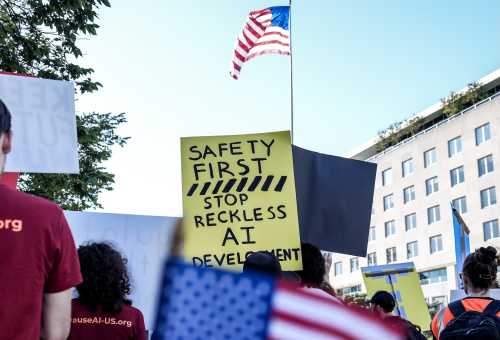
Why is AI so contentious examines why many people have a negative view of AI, despite its enormous economic potential. Many people, either through direct or pension-fund investments, have a financial stake in AI, the paper notes. Yet, according to survey results, around half of U.S. adults are more concerned than excited about increased use of AI in daily life.

The authors—Martin Beraja of the University of California, Berkeley, and Noam Yuchtman of the London School of Economics—ascribe the ambivalence not only to the fact that AI threatens many people’s professional security but also because it appropriated aspects of who they are for AI training data. They call this AI’s “original sin.”
“We have argued that AI is so contentious—and the conflict over it so visceral—because on top of the economic and existential concerns that every transformative technology raises, it raises a moral one: that it has built from people’s words, creations and expertise, taken without consent,” the authors write.
They write that they are not passing judgment on whether AI developers did something illegal and that that question will be decided by the courts. Their aim, they write, is to point out that policies most often discussed—universal basic income, retraining programs, and pauses in AI development—“will at best be incomplete” because they address people’s economic concerns but not AI’s “moral grievance.”
“Addressing the grievance itself requires private or public solutions that restore to human creators some measure of ownership and attribution of what has been, and is still being, built from them,” they write.
Authors


-
CITATION
Beraja, Martin, and Noam Yuchtman. 2026. “Why is AI so Contentious?” BPEA Conference Draft, Fall.
-
Acknowledgements and disclosures
David Skidmore authored the summary language for this paper.
The Brookings Institution is committed to quality, independence, and impact.
We are supported by a diverse array of funders. In line with our values and policies, each Brookings publication represents the sole views of its author(s).