Ask 10 educators what community engagement in education means, and you will likely get 15 answers. The term “community engagement” is commonly used but loosely defined.
At the Family, School, and Community Engagement initiative at Brookings’ Center for Universal Education (CUE), we have been studying community engagement in education around the world, defining what it means and why it is critical to young people’s learning and development. Through our collaborative research with institutions around the world, we have developed a typology to show how community engagement works.
Community engagement is vital to learning inside and outside the school walls
The “community” in family, school, and community engagement includes a wide range of programs, services, and resources that partner groups and institutions provide to children, families, and teachers in a school or education system. Community partnerships support what happens inside the school walls—ensuring students are fed, have quality aftercare opportunities, receive high-impact tutoring, and are developing cutting-edge skills. Community partnerships also support children beyond the school walls—promoting mental and physical health, developing civic leadership, fostering positive relationships, and cultivating creativity, exploration, and skills for work.
There is a growing body of research on how community engagement fosters learning, growth, and well-being. In this blog, we map who community partners are and how they work to help education decisionmakers and practitioners inside and outside of the school walls.
The “community” in community engagement
We created eight overarching groups to capture the people and places that serve as community partners in supporting young people’s educational journeys. Each group has a vested interest in their community’s education.
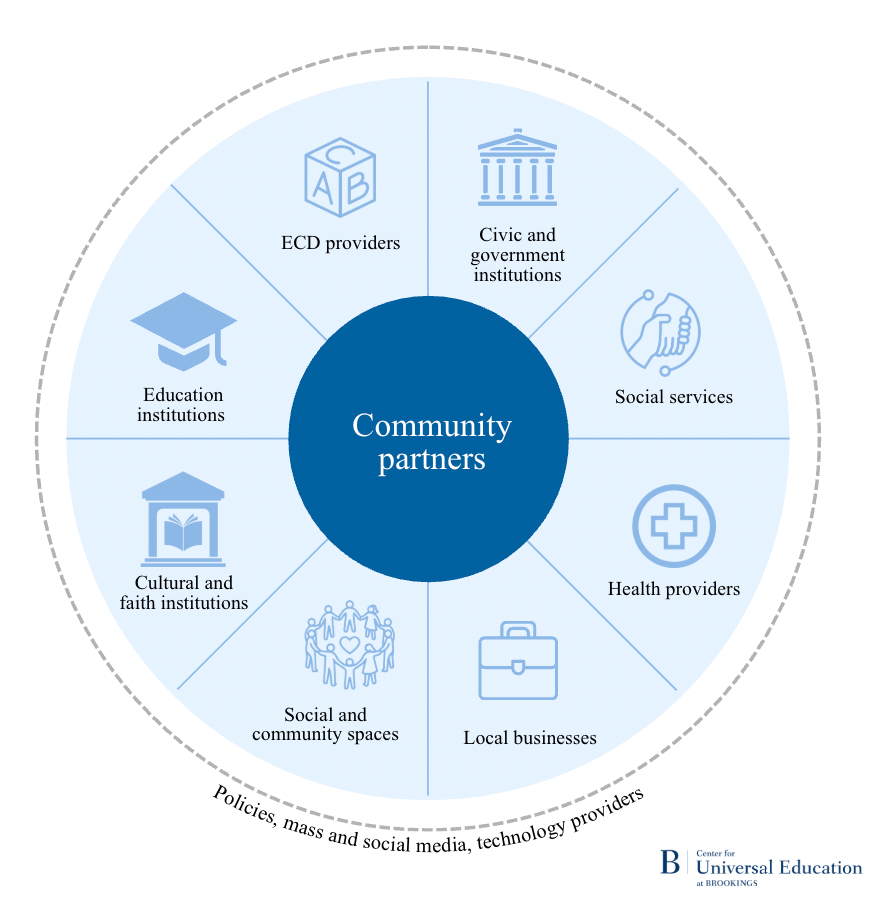
Community partners encompass a wide range of non-profit, for-profit, and governmental organizations that promote the learning, health, and safety of children in education ecosystems as well as the infrastructure. For example, local businesses provide grants, donations, technology, and workforce or service training for students. Cultural and faith institutions support students’ learning and well-being. Community also includes digital networks of mass and social media—everything from public broadcasting to generative AI companies—that broadly influence the nature and culture of how community partners engage with each other and schools.
How community engagement works
There are three common models of community engagement in the learning ecosystem, each with different intermediaries that serve as the community connectors. The collective goal across models is to bring critical institutions and organizations in a young person’s life together to create a network to support their learning, growth, and development.
In the first model, a single school is the hub for connecting and engaging the community. In the second, a zone of schools, such as a school district or a private or charter school network, serve as the connector. In the third, a local organization(s) or group of people—a community hub—serves as the intermediary and connector.
The first two models are based on early childhood zones and hubs developed by the Education Development Center’s the First 10 initiative. Hubs and zones serve as “critical units of change” and build the collective capacity of institutions to address the needs of children and families. The community hub model is based on the Remake Learning approach, a non-profit organization in Pittsburgh, Pennsylvania that facilitates a network of educators and innovators “to spark more engaging, relevant, and equitable opportunities to enrich Pittsburgh’s learning ecosystem.”
School hubs as connectors
In the school hub model, leaders in a school community champion the work of connecting community groups and partners with the school.
One well-known example is the community school approach, where school or ECD center leaders build collaboration between educators, families, students, and institutions in the wider community. For example, public community schools in Utah or Kentucky could partner with a health clinic that delivers medical, dental, vision, and psychological care, supplies schools with inhalers and glasses, or may provide evening adult literacy classes or summer programming for children. According to the community schools playbook, school leaders or staff typically manage these partnerships.
Another example is the MAIA Impact School in Guatemala. Rural, Indigenous girls receive a secondary school education rooted in their Mayan culture. The school—designed by and with leaders in the Indigenous community—has partnerships with community mentors, local employers, STEAM leaders, and health providers that provide medical and social support during school hours.
School zones as connectors
In the school zone model, leaders in a public school district or a private or charter school network champion connecting community groups and partners with the school. A community organization can also steward school districts and networks in building these connections.
The Butler Area School District (BASD) in Pennsylvania has been working with community partners to redefine their “portrait of a graduate,” or a depiction of the critical skills and competencies graduating students need to thrive in their personal lives, work, and post-secondary educational pathways. Through partnerships with local businesses and municipal government offices, district leaders have created pathways for students to earn credentials through real-world internships. BASD has also been working to transform the process for handling chronic absenteeism, working in partnership with government truancy officers and magistrates, students, and families to transform the system from one that is punitive to one that tackles the root causes of absenteeism.
Sometimes an intermediary organization can steward community engagement among networks of schools and districts in the zone. The Community Schools Learning Exchange works with school districts and schools in the U.S. to identify coordinators who can connect the dots between key community stakeholders, such as health and social service providers. There are also a number of U.S. non-profits such as SparkNC (North Carolina), Heart of Oregon Corps, and Southwest Colorado Education Collaborative that work with school districts to connect young people in rural and urban areas—often those who are historically marginalized—to local businesses to build their skills in high-demand jobs in their communities. In Rhode Island, a school district partnered with a non-profit organization and ECD centers to help families access health and social services for young children and support school readiness in the transition to kindergarten and beyond.
Community hub as connectors
In the community hub model, intermediary community organizations or groups connect and convene different partners around a shared educational goal or vision. Education institutions are often part of this community network, but the intermediary organization stewards community engagement.
Remake Learning has been refining the community hub model over the past two decades and expanding their networks across rural, urban, and suburban communities in Pennsylvania. Their flagship Remake Learning Days provides hands-on learning for children and families in a variety of community spaces, including tech and art centers, parks and playgrounds, and museums. In Uruguay, e.dúcate Uruguay facilitates similar Eureka! Learning Days, where community champions work with schools, businesses, cultural institutions, and social spaces—such as libraries, cultural sites, and parks—to create learning experiences for children.
Community engagement efforts can be highly localized, such as Associação Vaga Lume, a community organization that brings together elders and young people in the Brazilian Legal Amazon to create community libraries that honor history, celebrate culture, and promote storytelling and literacy.
It takes a village
‘Community’ comes from the Latin “communis—” meaning “shared” or “held in common.” Community includes a group of people with common characteristics, such as a teacher community. It can describe a place where people come together around a common mission—like a school community or a community school. It is also the network of individuals, households, or institutions surrounding a school and child—their “village” in the popular proverb “it takes a village to raise a child.”
Community engagement takes place in different forms across the learning ecosystem, both inside and beyond the walls of schools. Each different model helps build cohesion of a learning ecosystem, and it is this cohesion that prepares children and families to navigate the challenges of today and flourish in the future.
Authors


Related Content


The Brookings Institution is committed to quality, independence, and impact.
We are supported by a diverse array of funders. In line with our values and policies, each Brookings publication represents the sole views of its author(s).


Commentary
Why community engagement is vital to learning ecosystems
September 22, 2026