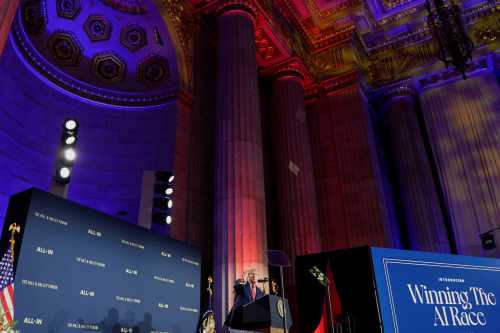
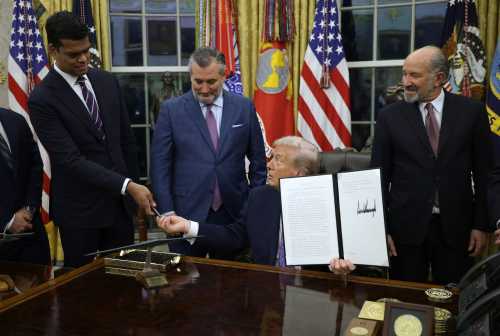
In July 2025, the Trump administration released its blueprint for artificial intelligence (AI)—America’s AI Action Plan—with a focus on deregulation and infrastructure investment to achieve “global AI dominance.” The plan represents a notable shift from previous, more cautious AI policies of the Biden era and emphasizes removing regulatory barriers and “ideological” bias in AI. It does so through three pillars: accelerating AI innovation, building American AI infrastructure, and leading in international AI diplomacy and security.
This approach and the administration’s prioritization of AI in government suggest major increases in federal AI spending from the prior years—something we hypothesized in two previous reports on the subject. In our 2022 report, we noted a chaotic spending profile under then-President Biden and suggested it reflected an immature market. We then predicted the market would dramatically grow in future years but expressed concern that maintaining a chaotic approach would have negative outcomes, including China increasing its AI lead over the U.S.
In our 2024 report, we documented dramatic growth in AI investment and a concentration of spending on the U.S. Department of Defense. Our analysis revealed a noticeable shift from experimental, shorter duration contracts to multiyear contracts, likely reflecting a shift from pilot testing to implementation. While the market was still chaotic, we observed that larger vendors began to enter the market, suggesting that this would lead to both larger and longer contracts.
In this report, we analyze the federal AI spending plan for 2026, presumably under the direction of the administration’s AI Action Plan, to better understand how federal AI spending is evolving. Further, given that it is projected that worldwide AI spending will grow from $1.75 trillion in 2025 to $2.52 trillion in 2026 (a 44% year-over-year growth), we would also expect to see a dramatic rise in the overall AI spend by the federal government.
Data and methodology
The data for this series was taken directly from federal contracts collected in three batches over a five-year period and consolidated by Leadership Connect, which has an extensive repository of federal contracts.
In this analysis, we reviewed all new federal contracts since our original report that had the term “artificial intelligence” (or “AI”) in the contract description. As such, our dataset has 472 contracts from 2022, 489 contracts from 2024, and 1,743 contracts from 2026. The 2022 analysis included contracts with effective dates from the first AI contract awarded in October 2016 through January 2022, while the 2024 article captured contracts from January 2022 to September 2023, and the current review covers contracts from September 2023 through March 2026.
Comparisons of spending across sectors use the North American Industry Classification System (NAICS), which federal agencies use to classify business establishments for data related to the U.S. business economy.
Findings reveal a maturing of the market, increase in AI contracts, and shift toward larger firms
Market growth
Between 2022 and 2024, we saw a maturing and focusing of the market. The value of funds obligated increased from $261 million to $675 million, a growth of over 150%, while the value of potential awards increased from $355 million to $4.6 billion, a growth of almost 1,200%. The 2026 budget was even more staggering; it showed the value of funds obligated increased to $7.2 billion (up 966% from 2024) and the value of potential awards increased to $91.8 billion (up 1,912%).
Despite these major increases in the amount of AI spending, the type of spending (as captured by the NAICS codes) has remained relatively constant. In 2022, 15 codes were used while just 13 codes were included in the 2024 and 2026 budgets.
For funding obligated by the government, NAICS 54 was the most common code used, followed by NAICS 51. NAICS 54 increased from $219 million for existing contracts to $366 million for new contracts, while NAICS 51 grew from $5 million in existing contracts to $17 million in new contracts. For potential value of awards, NAICS 54 increased from $311 million in existing to $1.9 billion in new contracts, while NAICS 51 grew from $5 million in existing to $2.2 billion in new contracts, eclipsing all other NAICS codes. Together, NAICS 54 and NAICS 51 represent 98% of the federal AI spending. As such, spending by all other NAICS codes were essentially mathematically insignificant, although there are a large number of contracts for which the NAICS code has yet to be assigned. The results by occupational code are listed in Table 1.
Agencies
Out of 441 U.S. federal agencies, the number with AI contracts continued to increase from 17 in 2022 to 23 in 2024, and 28 in 2026. New additions to the 2026 list include the Executive Office of the President, the National Transportation Safety Board, and the U.S. Agency for International Development. All three had a single contract for under $300,000. Falling off the list, not surprisingly, was the Smithsonian, which it appears had its only contract canceled. The Department of Defense continued to dominate in the number and value of contracts, growing from 254 contracts in 2022 and 657 contracts in 2024 to 1,319 contracts in 2026. As was the case in 2024, the Department of Health and Human Services (HHS) and NASA were a distant second and third with 134 and 71 contracts, respectively.
The Defense Department’s number of contracts compared to other agencies is not the only story. In 2022, the department’s share of potential value of contracts was $269 million, which represented 76% of federal AI spending. In 2024, its share of potential value of contracts rose to $4.3 billion, which represented 95% of federal AI spend and reflected a 1,568% increase from 2022. In 2026, the department’s total potential value of contracts rose an astounding 1,605% to $90.7 billion from 2024, which represents 98.9% of the federal AI spend. Potential value of contracts for HHS rose from $27 million in 2024 to $138 million in 2026 (representing a 448% increase), while AI spending for NASA declined from $47 million in 2024 to $45 million in 2026. In essence, the Defense Department grew its AI investment to such a degree that all other agencies effectively became a rounding error. Table 2 shows the breakdown by agency.
Major vendors
In 2022, contracting was dominated by small firms, many of whom were near military bases. We hypothesized that this was an indicator of a new, immature market and postulated that larger firms would soon move in and dominate as the market matured. In our 2024 research, we saw evidence of this with larger players, such as Booz Allen Hamilton, Palantir, and Accenture Federal Services, entering the market. In 2026, this evolution continued, and large established vendors now dominate the contracting space (see Tables 3a–3c).
While a small number of firms hold a significant amount of the contracting value, most firms have either one or two contracts (87%). This means that large firms may dominate the total contract value, but the market has a robust number of other smaller contributing vendors. We believe this is the sign of a healthy and still evolving market (see Table 4).
Contracting vehicles
From a contracting standpoint, there is evidence of a maturing market as an increasing number of contracts move to a firm-fixed price. This suggests that the federal government and vendors are sufficiently comfortable with understanding the work that needs to be done and can confidently cost out the work. However, the number of order-dependent contracts (in which pricing is determined separately for each order) still represents the lion’s share of potential value of awards, likely reflecting a desire for flexibility to experiment and further understand requirements and applications. Several types of cost-centered contracts (e.g., cost-plus-award-fee, cost-no-fee, cost-sharing, and cost-plus-fixed-fee) are also present and likely represent the immaturity of the market and an unwillingness to shift to a firm-fixed price arrangement (see Table 5).
In another sign of mixed market maturity, while Full and Open Competition and Full and Open Competition After Exclusion of Sources are, by far, the most frequent contracting approaches used, a significant number of contracts were not competed. The not-competed contracts are likely a sign that the federal government believes that specific AI capabilities are uniquely developed, so only a single firm can perform the work, which likely reflects a still-immature market (see Table 6).
Small and women-owned business participation
While the majority of contracts are awarded to corporations of all sizes, small-business set-asides represented about 34% of contracts awarded. However, despite Defense Department spending, only 12 out of the 1,743 contracts were set aside for service-disabled veteran-owned small businesses (0.68% of all contracts). The numbers are worse for women-owned firms. Women-owned small business set-asides were a single contract out of 1,743 contracts, and women-owned small businesses were also a single contract out of 1,743 contracts (0.05% for each).
At least one pillar of the Trump administration's AI Action Plan is well supported by the federal AI budget
In its AI plan, the Trump administration laid out three pillars focused on accelerating innovation, building AI infrastructure, and leading in international diplomacy. We examined the contracts looking for evidence to support these pillars.
Pillar 1: Accelerating innovation
This pillar is based on the administration’s push to eliminate AI regulations and contracting that it believes stymie AI development. Given the explosive growth in the number of contracts, contract value, and contract types in use, we find this pillar is strongly supported by the current federal AI budget. The creative use of different types of contracting vehicles implies that federal agencies are finding and adopting contracts that work best for them. We pointed out two discordant notes in the vendor firms: the low number of disabled-veteran firms and the very low number of women-owned firms. It is difficult to determine whether the limited representation of minority- and women-owned businesses is attributable to Trump’s executive order reversing diversity, equity, and inclusion initiatives, or to systemic barriers levied against them in competing for federal contracts. Nonetheless, ignoring this pool of vendors may be a mistake.
Pillar 2: Building AI infrastructure
This pillar focuses on building AI data centers and strengthening power grids. It takes a long time to contract and build such infrastructure, which also requires approval from various local government bodies. With that said, by one estimate, the U.S. has 4,011 data centers (as of March 2026)—nearly eight times more than any other country. Further, demand for data centers is expected to triple by 2030. All states have at least one data center, and Virginia leads the way with nearly 500 data centers, given its proximity to the federal government and strong fiber network. While it is not possible to deduce how much of the federal government’s spending is directed toward building data centers, their growth is explosive and will become a substantial budget line item as it relates to the federal AI plan.
Pillar 3: Leading in international diplomacy
While the federal government is spending a great deal on AI, the vast majority of it is going to the Defense Department, and it is unlikely that these advances will be shared with the international community. While the U.S. may lead the world in AI development, it is unclear whether it is providing any noticeable or impactful leadership in AI practices and policies.
The market has likely not reached full maturity, despite significant growth
Federal AI spending is on a sharp, upward trajectory and remains so intently focused on the Defense Department that spending by other agencies appears as almost an afterthought. As such, it is important to weigh the benefits of strong defense spending (greater national security) against its trade-offs in terms of individual freedom and the waging of war.
The public disagreement between Anthropic and the Pentagon highlights what could happen when AI meets warfare. Earlier in 2026, Anthropic refused to allow its tools to be used for autonomous weapons and mass domestic surveillance. As a result, the defense secretary labeled the company a supply chain risk, effectively ending the federal government’s work with Anthropic beyond just the Pentagon. Many more such situations will likely arise as AI matures. Until guardrails on AI are agreed upon and put in place, this will remain a legally and ethically contested space.
In our first article in this series, we postulated that the signs of a maturing market would be the entry of large firms and the emergence of large, fixed-price contracts. We can now see this happening, yet the market also reflects its early stage through the relatively large number of vendors with one or two contracts, signaling it has not reached full maturity. This suggests the federal government is still in the experimental phase of AI and that many exciting developments are likely to emerge if and when these smaller contracts yield valuable insights. Given that the pace of AI continues to quicken, we do not expect to see market saturation any time soon and, while we may not see 1,600% growth in our next report, we expect it to remain sharp.
Related Content

Authors



-
Acknowledgements and disclosures
Amazon is a general, unrestricted donor to the Brookings Institution. The findings, interpretations, and conclusions posted in this piece are solely those of the authors and are not influenced by any donation.
The Brookings Institution is committed to quality, independence, and impact.
We are supported by a diverse array of funders. In line with our values and policies, each Brookings publication represents the sole views of its author(s).