




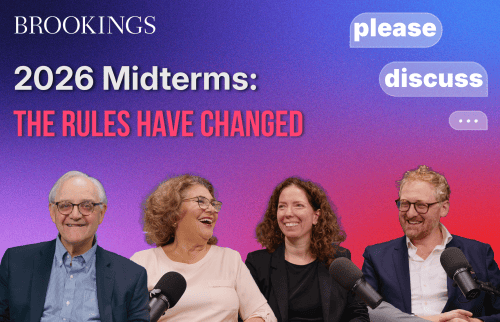
The first State of the Union address of President Trump’s second term is coming up, but Brookings scholars aren’t waiting for the speech to take the country’s pulse. In this episode, E.J. Dionne asks Molly Reynolds, Wendy Edelberg, and Melanie Sisson to offer their views on the governance, economic, and global security challenges that characterize America’s state of the Union today.
Transcript
DIONNE: What one word would you use to describe the state of the Union?
REYNOLDS: I would describe it as imbalanced.
DIONNE: Melanie?
SISSON: Well, my word is dissonant, and I think it applies broadly.
DIONNE: Wendy?
EDELBERG: I think about what we’re going to experience in the year ahead: chaos.
[music]
DIONNE: You’re listening to The Current, part of the Brookings Podcast Network. I’m E.J. Dionne. We are approaching the first State of the Union message of President Trump’s second term, but we aren’t waiting for the speech to take the country’s pulse. Today we have put our scholars on the clock to give you a concise, unfiltered look at the state of our Union.
You’re in for a treat today, because joining me are three of Brookings’s best. Molly Reynolds, a senior fellow in Governance Studies, who is also director and vice president, who tracks the power struggles between the White House and Congress. Wendy Edelberg, a senior fellow in Economic Studies, is going to talk to us about the president’s tariff policies and other aspects of the economy. And, Melanie Sisson, a senior fellow of Foreign Policy studies, who is tasked today with explaining to us what is going on in our relations abroad and where we stand.
Let me start with you, Molly. Talking about the power struggles and the balance of power and what’s happening to the separation of powers, and what have we learned in Trump’s first year and a month in office? And where do you see this going forward?
[1:49]
REYNOLDS: Sure. Well, the federal government is certainly leaner than it was a year ago, but not in a way that helps us ensure that agencies are effective and mission-driven and meeting people’s needs. Were federal agencies operating at a level that we would expect of them in a strong democratic state a year ago? No, there was plenty of room for improvement.
But very little that has happened since then suggests that we’re on a better path than we were a year ago. We’ve seen the Trump administration actively lay off individuals either by dismantling whole agencies or doing more targeted, but still very haphazard layoffs at agencies.
And perhaps more importantly, we’ve seen a real brain drain. We’ve seen many federal employees just decide this is not something that they still want to be a part of. In some cases at places like the Justice Department, it’s because of what they’re being asked to do by the administration.
And this is a real problem going forward, both in the short term and the long term. So a smaller, less experienced federal workforce is both a problem now because it means that agencies aren’t meeting people’s needs. We are, for example, in the middle of tax filing season. There are real questions about is the IRS up to the task at its current staffing levels.
But then over the longer term, how are we going to convince smart, talented experts to go into federal service to make sure that whatever comes next, the federal government is up to the task?
DIONNE: Thank you. Wendy, the official stats, certainly the administration says that inflation is defeated at 2.3%, yet the cost of living is still high. Voters do not seem satisfied with that. Beyond the CPI numbers, what is the actual state of America’s wallet?
[3:43]
EDELBERG: Yeah, voters definitely do not seem satisfied. There are lots of different ways of measuring inflation and a lot of those ways will get you something a lot higher than 2.3%. But whether inflation is 2.5%, 3%, or even 3.5%, I don’t think that that’s the driving force behind how households are feeling about the cost of living and whether or not things are affordable. Economists obsess about whether or not inflation is 2.5, or 3, or 3.5 because the Fed’s targeting 2. And it really matters if the Fed can achieve its target.
But for households, I think that they are thinking about their financial resources, and and frankly, I think overall, households’ financial resources are pretty good. Real incomes are up relative to 2019. We’ve seen particularly strong wage gains for people who work in lower wage sectors like leisure and hospitality. If you’re lucky enough to own a home or own stock, you’re also doing quite well.
But I think people are frustrated by these affordability concerns for basically three main reasons. One, there were a bunch of things that became a lot more expensive from 2020 to 2024, and I think people are a little scarred. Rents for new leases skyrocketed. Food prices skyrocketed. Owning a home became out of reach. Some of those factors were temporary and they’ve come down.
Number two, and here, I actually think this is most important, there are a bunch of structural factors that have been true for a long time, and even long before the pandemic. So for example, about 50% of renters pay more than 30% of their income on rent. That’s been true since 2010. Childcare, if you want really high quality childcare, is exceedingly expensive. That’s been true for a very long time in the U.S. The cost of health insurance has been rising year after year after year for a very long time. These are structural factors that really frustrate people, but I think have now been caught up in this affordability conversation.
And then third, and this is also a really important one, I think people are just super annoyed at the level of prices. You know, if anybody can think back to a conversation with a grandparent saying, you know, in my day, Coke was a nickel. Like, we are all going to be that guy, you know, as we get older, and I think people are just annoyed. If I walk into a grocery store, I would love lower prices. Now the problem is Trump promised to make very quick progress on all of these problems, and he’s failed to do so. So I think people are annoyed.
DIONNE: Bless you, because most economists say, don’t people look at the numbers? And I think you’ve explained exactly why people are still frustrated. That’s really helpful.
Melanie, I wanted to ask you, the president signed an executive order renaming the Defense Department. It’s not officially renamed, but they call it the Department of War. And they weren’t kidding. In 2025, there were military actions in seven different countries. In the new year, we had the events in Venezuela.
What is the actual state of our military and our security?
[7:07]
SISSON: Well, I think that the actual state of our military is that it is an organization that’s composed of a lot of people working really hard in the public interest every day under some newly challenging circumstances. And first, I should say that when we talk about our military, we’re talking about millions of people, service members and civilians, men and women from all kinds of different backgrounds, doing all different kinds of jobs. Those jobs are things like providing healthcare, they’re doing payroll, they’re purchasing the things that the services need, everything from socks to B-2 bombers. And of course there are people out in the field undertaking those active military operations.
They’ve been doing all of those things over this last year at the same time, as you note, that they’ve been directed to change an awful lot. They’ve been directed to change the language that they use. They’ve been directed to change who they employ; how they buy things; how they understand what they can and can’t do with artificial intelligence; how they understand where and how they’ll be used to defend the country.
And those changes are not just superficial; they have real outcomes. There are 60,000 fewer civilians working in the Department of War after this last year. Many were fired; many were urged into early retirement; and many left, as Molly described, for some other reasons.
Similarly, we’ve seen many senior officers — and these are people who’ve devoted very long and difficult careers to our military — we’ve seen many of them dismissed or pushed into early retirement. As a result, we now have far fewer people of color in the highest leadership ranks, and we have zero women in four star positions.
These changes, as you noted, come in addition to an awful lot of operational requirements that are being placed on the military. Things have not slowed down over the last year. To the contrary, estimates are that there have been about 600 kinetic military actions all around the world. That’s very busy. We’ve seen aircraft carriers having their deployments extended; that’s a difficulty for service members and for their families. And we’ve seen service members deployed to U.S. borders and to U.S. cities. And these are different environments with different kinds of demands.
It’s also the case that our military has been politicized by both Republicans and Democrats using the military to promote their particular points of view. So all of this, again, adds up to, I think, a military the actual status of which today is really hardworking, well-intentioned people doing their jobs in service of the country under newly challenging circumstances.
DIONNE: Yeah, and I’d like to follow up. One of those newly challenging circumstances is the state of our alliance with, particularly with NATO. The the battle over Greenland, and the president eventually backed off, but caused enormous of hard feeling among allies. Prime Minister Carney in Canada gave a very powerful speech suggesting that the old alliance may be ending and everybody has to get used to that and act accordingly. Where are we on the alliance at this point?
[10:32]
SISSON: Well, defense alliances are really serious business. They’re as close as countries can get to a guarantee to each other that they’ll join in and be there in time of war, with the idea that this signal is visible to anybody of malign intent who might have aggressive actions in mind and be persuaded that that it’s not worth the risk.
So, you know, the United States doesn’t enter into defense alliances lightly. We only do it when we think that we need to, in order to keep our economy working well and to keep our people safe. And as you said, right now there are a lot of big questions being asked about alliances. Are the alliances that we built after World War II still the alliances that we need today? If they are the alliances that we need, are they working well or do they need to evolve? If they’re not the alliances that we need, or they’re not working well, should we quit them? And if we do quit them, how confident can we be that we have what we need to keep our economy working again and to keep our people safe?
You know, the United States, these are big questions, there are no simple answers, and the United States has not picked a path one way or the other. And neither, by the way, have our allies, who also have a considerable say in the matter.
So what we have right now, the actual state of our alliance is, I think, is that there’s a lot of debate and uncertainty and discomfort. It may be that this discomfort will be productive, that it will generate some productive change in our alliances, the way that, you know, going to the gym doesn’t always feel good, but you end up stronger once you come back out.
It might also be that this is the beginning of a real breakup, and that we or our allies will choose to leave. And if we do that, then we’re going to have to face the reality that we’ll need new ways to protect the country, new ways to ensure that our economy can work well, and that we can protect our people. And that will be a period of transition.
And we should also recognize that if we end up in that period of transition, that there will be some actors who will be quite pleased and ready to take advantage of it opportunistically to make it more costly, more difficult, more prolonged than it might otherwise be. And they can choose to do that in ways that we can’t predict and that we can’t be confident about being able to prepare for either. So, it could be rough waters ahead.
DIONNE: Listening to you, I’m reminded of that great Joni Mitchell line, the folk singer, “you don’t know what you got till it’s gone.” And I think we’re having a big debate around that question.
Wendy, when I, I’ve thought for a long time that the affordability issue is also a wages issue and a take home pay issue. Greg Ip in the Wall Street Journal had a very good piece where he talked about the long term shift of money in the economy away from wages toward profits, that a lot of people are feeling that they are not getting what they need in their salaries or in their paychecks. Could you talk about the interaction between sort of how people feel about what they’re earning and the affordability crisis?
[13:43]
EDELBERG: I mean, these are, these are thorny, complicated issues.
DIONNE: That’s why I asked you.
EDELBERG: And I, you know, and if you look at how households are doing throughout the income distribution, the bottom 20%, the 20% of 40%, they are doing better now than they were, let’s say, in 2019. The trajectory of their improvement over that time period since before the pandemic is slower than it was in, let’s say, 2018 and 2019.
And 2018 and 2019, things looked actually quite good for households at the bottom of the income distribution. The labor market was quite strong. And we were finally starting to see what looked like durable and strong gains for wages and financial resources for households at the bottom of the income distribution.
And then COVID. COVID caused crazy gyrations in people’s wages, obviously as an inflation, in wealth. And when you work through all of those gyrations, we are now at a place where, you know, you look back through the sweep of what’s happened from 2019 to now, and generally speaking, households have done well. But that is not how people experience their own financial situations. I think for some people they’re looking back at the heady days of fiscal support in 2020 and 2021, and quite disappointed at their financial situations relative to how they felt in those years when checking accounts were flush, when, you know, the federal government was sending out very generous support to households. And at the same time, you know, people might have been getting the first break from working full-time and going into a job five days a week in their lives as adults.
So I think in some regards people are frustrated about their financial situations relative to that period. I think people are exhausted by the constant state of uncertainty that that we’re living with right now. And so much of the economy has changed. So I think people are trying hard to find their footing.
DIONNE: Just a real quick follow up, because I meant to ask you this too. Tariffs. We have not suffered as much inflation as people feared. What’s going to happen?
[16:13]
EDELBERG: Yeah. So the the statutory tariff rate suggests that we should be seeing an effective tariff rate that’s somewhere in the ballpark of 15%, and instead it looks like firms are paying something that’s closer to 11%. So we can get into the details of why it looks like the tariffs that are being paid are lower than the tariffs that are being posted. But my guess is that for the most part, we are going to make up that difference and the amount of tariffs that businesses are paying is going to rise.
But let’s stick with that 15% number for just a moment. What that would mean is that the level of prices should rise maybe about a percent-and-a-half. Once businesses raise their prices so that basically they can continue to make profits and continue to, like, earn a living as businesspeople, selling to consumers, and still those tariffs get paid to the U.S. government.
A percent-and-a-half on the price level? That’s not going to happen all at once. Even if it did happen all at once, that’s only an increase in inflation of, like, a percent-and-a-half over, let’s say, the course of a year, but it’s not going to happen all at once.
So I was never in the camp of thinking that tariffs were going to have massive, outsized effects on inflation. We just don’t import enough goods. And so I always thought we were going to see something like a half a percentage point of inflation in 2025, maybe another half a percentage point in 2026, and I think we’ll still see more in 2027. So frankly, you know, count me as not hugely surprised at the inflation effects we’ve seen.
DIONNE: Thank you. Molly, I really appreciated what you said about the state of our federal government and our federal workforce. There is a big issue right now about the separation of powers and the balance of power among the three branches. That seems to have radically changed in a very short time. I’d love you to talk about that and also how much of that has to do with the fact that, at least up to now with a few exceptions, the Republicans who control Congress have felt far more inclined to support President Trump than to challenge him. Can we look forward to any change in that or expect any change in that?
[18:39]
REYNOLDS: Yeah, so the power is just simply not well balanced among the branches. I mean, if we start with the executive branch versus Congress, despite occasional efforts by Congress to assert their preferences against the White House, including of recent spending legislation, as you note, the legislative branch has simply done relatively little to push back against many of the Trump administration’s activities and their expansive view of executive power.
Really importantly here, some of the power that the executive branch is using is power that Congress has given it willingly in decades past. But past Congresses did not foresee a president of the kind that we have right now using the power in the way that he has been. So that’s sort of, that’s one piece of this.
It turns out that much of what sustained a healthier separation of powers and balance of power between Congress and the executive branch in the past was really soft congressional power and norms. And we’ve seen that just simply not be successfully sustained in a politics of high polarization and high partisan team play, like you referenced.
The courts, meanwhile, are a really important part of the story too. So on one hand we have some federal courts, particularly at the district court level, who have been voluminously and vociferously pushing back against things that the Trump administration has done. Particularly in the last weeks, months in the immigration space, there are dozens and dozens of lower court opinions that really make clear that what the Trump administration is doing is out of step with what they understand the law to be.
At the same time, we have other courts generally higher up the judicial hierarchy, so appeals courts, and in some cases the Supreme Court, who are much friendlier to an expansive view of executive power and have been much more enabling of executive overreach.
And lastly, even in the situations where we might think that the courts are well positioned to help restore a better balance of power, we’ve also seen ways in which they’re just not equipped to do that. They move slowly. The most prominent of the cases in the federal spending space started a year ago and is still not resolved. And we also know that there are situations where administration actors have been willing to push up against the line in some cases, possibly go over the line in terms of compliance with court orders. So we really can’t sustain a healthy separation of powers system with one branch, the judicial branch being the backstop to a mis-calibrated balance of power between the other two.
DIONNE: Just a quick follow up, if I could. The couple of areas where you saw Congress push back, one was obviously on the Epstein files, and the other is since the killings in Minneapolis, there was some more pressure on the immigration policy, on the ICE and the like. What are we to make of that?
[21:46]
REYNOLDS: So I think, you know, those are two examples, there are other ones that we could give. I would describe all of it as necessary, but not sufficient for where we need to go in terms of a better, healthier balance of power between the branches.
DIONNE: Thank you so much. Yeah. I I think this is a question we’re going to ask in three years, how much of this was a peculiar result of this time with Donald Trump as president and how much of it will stay with us afterward. And we don’t know that yet.
I’d like to go to an entirely unfair question to everybody, and Brooking scholars are not used to answering questions with one word. But if we could go down the line just starting with Molly, what one word would you use to describe the state of the Union?
[22:39]
REYNOLDS: I would describe it as imbalanced. For our democracy to be strong, we need three healthy branches of government that can wield power against each other and two healthy political parties, and that is simply not what we are seeing right now.
DIONNE: That was a perfect Brookings answer — one word, but then the explanation. Why don’t you, well, let’s see what’s next.
[22:59]
EDELBERG: I, I’m going to, I’m going to use that same approach. When I think about what we’re going to experience in the year ahead: chaos. I think that there’s a chance that Congress will try to pass some reconciliation package to get more resources into people’s hands before the midterms. I think businesses are going to try to take advantage of the deregulatory environment before the midterms. I think that there’s a chance that the trade policy and tariff environment could become a lot more uncertain. We’ll see what the Supreme Court says.
And it was always the uncertainty aspect of trade policy and tariffs that risked derailing the economy. And so that’s a huge risk. We will see what happens with tariffs and how businesses respond in that environment. I think monetary policy is going to be a lot more accommodative than markets anticipate. That’s going to be a surprise.
And then finally, I think we’re in for a continuation of really low employment numbers given immigration policy. And I don’t know how the Trump administration and everyone else will respond, and I am betting that it will be with some suggestions of some really dumb policies.
DIONNE: Melanie?
[24:17]
SISSON: Well, my word is dissonant, and I think it applies broadly. In my particular focus on foreign policy, I conjure dissonant, because on the one hand we have a relatively recently released National Security Strategy that says the United States military is not going to be used for adventurism or interventionism abroad. And on the other hand, we have an administration that is very actively using the U.S. military for adventurism and interventionism around the world.
DIONNE: Thank you. I I think my word would be vexed, and I don’t have to explain it because I think our panelists have already explained it for me.
I want to thank Wendy and Melanie and Molly for braving the clock today. And thank you all for listening. Please visit us at Brookings dot edu.
[music]
I am E.J. Dionne, and we really appreciate your listening to The Current.
Participants




More information:
- Listen to The Current on Apple, Spotify, YouTube, or wherever you like to get podcasts.
- Learn about other Brookings podcasts from the Brookings Podcast Network.
- Sign up for the podcasts newsletter for occasional updates on featured episodes and new shows.
- Send feedback email to [email protected].
The Brookings Institution is committed to quality, independence, and impact.
We are supported by a diverse array of funders. In line with our values and policies, each Brookings publication represents the sole views of its author(s).

Commentary
PodcastWhat’s the state of our Union?
Listen on
The Brookings Current
February 12, 2026