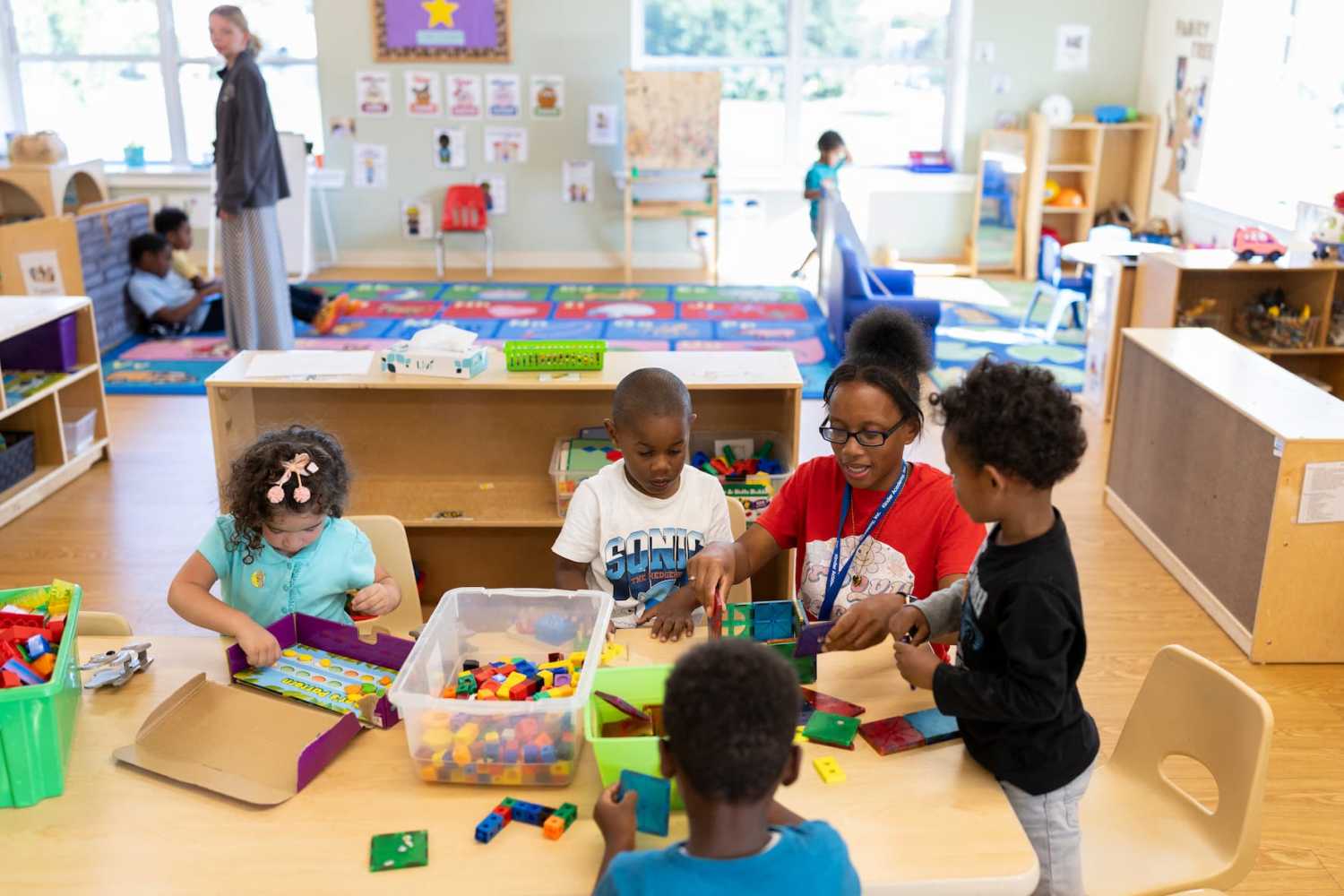
On Jan. 6, 2026, the federal government informed five states that their Child Care and Development Fund (CCDF) dollars—the primary mechanism states use to subsidize child care for low-income families—would be frozen while officials investigated alleged systemic fraud. The five states sued the administration over the roughly $10 billion in frozen social service funds, and, on Jan. 9, a judge ruled that the funds could not be blocked for at least 14 days while arguments are made in court. These events have drawn attention to the far-reaching consequences for children, families, and the economy when public investments in child care are abruptly cut off. Parents depend on these child care programs to work, and young children benefit from high-quality early care experiences.
In collaboration with the Virginia Department of Education, our team recently conducted research that sheds light on the likely consequences of suddenly halting subsidy funding in these five states. It also highlights the impacts of insufficient access to subsidized child care more broadly.
In the United States, only a small share of children eligible for subsidies through CCDF—about 15%—actually receive them. Demand for subsidized care far exceeds the supply, and as a result, many states maintain long waitlists for child care subsidies. In Virginia alone, nearly 19,000 families who applied for a child care subsidy were placed on a waitlist at some point between July 2024 and May 2025.
In August and September, we invited all these Virginia families to take a survey about how lacking access to subsidies affected their economic well-being and their children’s experiences. We received responses from 6,548 families, representing 35% of all families on the waitlist. To our knowledge, this is one of the largest surveys to date examining the experiences of families who are eligible for, but unable to access, child care subsidies.
Most families waiting for a subsidy reported serious disruptions to their ability to work or attend school. For instance, nearly half of respondents (47%) indicated that at least one adult in their household had left a job altogether due to child care constraints. Figure 1 shows their responses.
Many parents described the Catch-22 of needing child care to work but needing work to afford child care. One wrote, “We cannot afford child care. Therefore, I cannot work. We can’t afford to live on one income and it’s killing us.” Another shared, “I am unable to work due to a lack of child care. Me and my two daughters are currently homeless. We are living out of our car. Having child care would greatly improve our lives in many ways.”
Economic well-being of families with and without subsidy access
Even more striking were the large differences between families who remained on the waitlist and those who eventually received a subsidy. Everyone we surveyed had been on the waitlist at some point between July 2024 and May 2025. By the time of the survey, about two-thirds of families were still waiting, while about one-third had gotten off the waitlist and received a subsidy. These groups were similar in observable characteristics, so they provide useful comparisons.1
The families who received a subsidy were faring substantially better economically. Unemployment was half as common among families who received a subsidy. Among families still on the waitlist, 40% reported that at least one adult was unemployed and actively looking for work, compared to 20% among families with a subsidy. Nearly two-thirds of families who received subsidies reported increasing work or school hours, starting a new job, or accepting a promotion or new position as a result.
As shown in Figure 2, families who received subsidies reported considerably lower levels of economic hardship. This is evident in their experiences of food insecurity, concerns about running out of money, and struggles with past-due bills and credit card debt.
As one survey respondent explained, “Receiving child care assistance has allowed me as a single parent the opportunity to go back to work. I no longer have to worry about if I’m going to have to call out of work or if I will be fired due to not having someone to watch my son.”
Children’s well-being is poorer in families without subsidy access
Parents on the waitlist also described how the lack of a subsidy was impacting their young children. Half of these families reported they had no care for their child (not even from a relative or friend), and many expressed concerns about the negative effects on their child. One shared, “My son is turning 2 years old and is not yet talking or interacting with other children. Without access to affordable, quality care, he is missing vital opportunities for socialization and early learning that could support his development.”
Other families did manage to find nonparental care arrangements for their young children, but some reported concerns about the quality of these options. One explained, “My child is currently being cared for by someone I don’t fully trust, and quite honestly, I’m not sure it’s very safe. But it’s all that I can currently afford.” Another wrote, “I fear she isn’t getting the social interaction she needs, and I fear she’s getting too much screen time. Since her grandma works, she finds ways to keep her occupied like TV or tablet vs. learning.”
Families who accessed a child care subsidy were far less likely to note concerns about their young children’s learning, development, and safety. This is evident in Figure 3.
Limiting access to child care subsidies carries significant risk for family and children well-being
Denying eligible families subsidies is a policy choice. The federal government is attempting to fully freeze funding in five states. Around the country, most states already ration access to subsidies.
Although our study did not test the causal relationship between subsidy access and family outcomes, the survey responses illustrate the hardships families face when child care is out of reach. The responses also suggest that access to subsidies can substantially ease economic strain for parents and improve children’s experiences. These findings echo causal evidence showing that child care subsidies increase maternal employment and earnings.
At the same time, some states are moving in a different direction. In November 2025, New Mexico became the first state to offer free child care to nearly all families, regardless of income or immigration status. And on Jan. 8, New York announced a major expansion of free and low-cost child care. Virginia has substantially increased state allocations for child care over the last several years, and the governor’s proposed budget for 2026 includes enough funding to give subsidies to nearly all currently waitlisted families with young children.
Our findings underscore what is at stake when access to child care subsidies fall short. Families face higher unemployment, greater economic hardship, and less stable early care for young children. As policymakers weigh the future of child care investments, evidence from families themselves makes clear that maintaining the status quo—or moving backwards by revoking funds—carries substantial and immediate costs.
Related Content

Authors




-
Footnotes
- Starting July 1, 2024, the Child Care Subsidy Program instituted waitlists for all new applicants. When current users left the subsidy program, families from the same locality were offered subsidies (removed from the waitlist) on a first come, first served basis within priority groups. Priority was given to families who had at least one child age 0 to 5 who was not yet eligible for kindergarten, or who met any of the following criteria: having a child with special education needs, experiencing homelessness, having an active Child Protective Services case, or having a parent under age 18. One-third of responding families moved off the waitlist and received a subsidy. Respondents that received a subsidy looked similar to those who did not in terms of household income, focal child’s race, parent education, and whether the family primarily spoke a language other than English in their household. As expected based on the prioritization of families with younger children, families that received subsidies were more likely to have children that were preschool-age or younger (93%) compared to those that did not receive subsidies (80%).
The Brookings Institution is committed to quality, independence, and impact.
We are supported by a diverse array of funders. In line with our values and policies, each Brookings publication represents the sole views of its author(s).