Since taking office, U.S. President Donald Trump’s administration has taken a meat cleaver to several elements of the multilateral order (which sometimes goes by the ill-conceived phrase “rules-based order”). The imposition of sweeping, disorganized, ill-structured tariffs threw the World Trade Organization-based trading regime into question. The 2025 National Security Strategy makes sweeping arguments about American intent to enforce security and resource arrangements to its benefit within the Western Hemisphere, undermining the most essential point of the U.N., namely the prohibition against the acquisition of territory by force. And as the administration promised to withdraw from multiple international institutions, governments around the world waited in nervous anticipation of another shock to the system.
The first course: An executive nothingburger
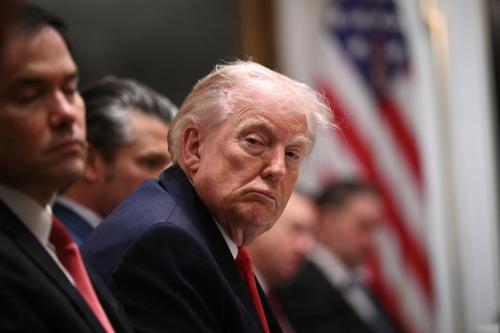
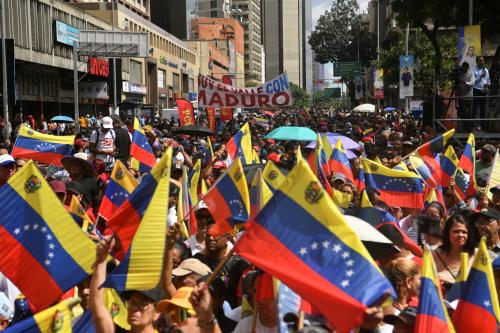
The Trump administration chose the evening of January 7, 2026, to release the executive order it had long heralded and repeatedly delayed: a list of international institutions and organizations from which it was either withdrawing altogether or withholding its support. It came three days after the drama of the U.S. raid on Caracas to capture Venezuelan President Nicolás Maduro and his wife, and amid renewed pressure on Denmark over Trump’s aspirations to own Greenland. The timing seemed intended to add texture to the message: U.S. power would be wielded without restraints, self-imposed or international.
Some of this is more in keeping with American foreign policy traditions than first meets the eye—there’s a long, largely sordid tradition of American intervention in Latin America, and every American president since World War II has made it clear that, in some circumstances, the United States will wield force without U.N. support. Four things distinguish the present administration: the flippancy with which it approaches the latter issue; the incoherence and inconsistency with which it has approached the issue of constraining autocrats; the sweeping way in which it has, in parallel, trampled on established trading rules and relations; and its willingness to exert pressure—even the threat of force—against its own allies. All of these behaviors are being interpreted, understandably, through the prism of the changing character of U.S. domestic governance, to wit, the flouting of democratic norms and the unapologetic erosion of the rule of law.
Set in that context, the administration’s list is a curious one—if not quite a nothingburger, then certainly far less important than the wider set of actions that contextualize it.
A comprehensive assessment would require a prior weighting of the relative importance of the various institutions named, a complex business. To be sure, though, the Forum of European National Highway Research Laboratories is less important than the U.N. Peacebuilding Commission (even though that body underperforms). One suspects, too, that bodies like the Pan American Institute of Geography and History and the Colombo Plan Council (a body with a rich history, now effectively just a meeting of ambassadors resident in Sri Lanka) will do just fine without U.S. participation. What’s more, many of the entities on the list are ones where the United States is not even a member or provides trivial levels of support. In this, the list feels—to borrow that dreadful term of condescension—performative. As analyst Eugene Chen puts it, there’s “more bark than bite” here.
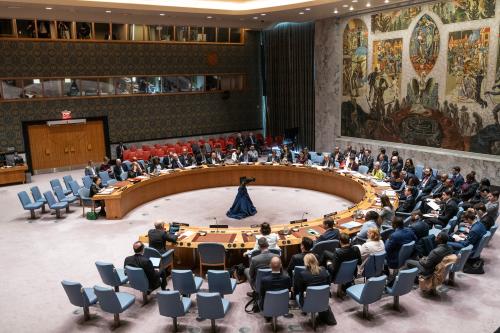
More striking are the institutions not listed in this executive order. That includes: the U.N. Security Council and the major U.N. departments responsible for peacekeeping, political negotiations and mediation, and humanitarian affairs; the major agencies responsible for refugee support, food assistance, humanitarian support to children, and development coordination; the international mechanisms for managing nuclear weapons, nuclear energy, chemical weapons, biological weapons, and conventional disarmament; the major international financial institutions, multilateral development banks, and central bank coordination tools; and the bodies that set global standards for labor, intellectual property, civil aviation, maritime affairs, and telecommunications. In short, the absolute core of the U.N. and the multilateral system. The list of institutions that the United States stays in seems to reflect the thinking of U.N. Ambassador Mike Waltz, as expressed in his entirely sensible confirmation hearing.
As for the rest, the list seems both to draw on a well-thought-out ranking by the American Enterprise Institute, but it also reflects the incoherent mix of perspectives, attitudes, allegiances, and ideologies present in the administration’s wider foreign policy. There is no simple through line here.
First, as has been noted, many of the entities listed in the executive order are obscure. That does not mean they don’t do helpful work—much that is useful in world affairs happens in the margins. Still, a U.S. withdrawal from the International Tropical Timber Organization, the International Lead and Zinc Study Group, the Inter-American Institute for Global Change Research, or the International Federation of Arts Councils and Culture Agencies does not a crisis of world order make.
Second, the withdrawals constitute a deeper push against climate change bodies and reflect a worrying anti-science push. Some of these are of modest significance, some are important—like the Intergovernmental Panel on Climate Change. As for withdrawing from the U.N. Framework Convention on Climate Change (UNFCCC) itself, it’s not the first time the United States has withdrawn its participation from the major international climate instrument, and it’s within reason to be skeptical about the UNFCCC’s effectiveness. But the more important issue is that this is part and parcel of a bleaker reality, namely the anti-science ideology that has gained a grip on parts of U.S. politics. I would support an administration that wanted to tear up the UNFCCC in favor of more focused moves to drive down the price of renewable energy; as for this administration’s flat-earth climate denialism, I despair, with or without its membership in the UNFCCC.
Third, there is a series of withdrawals from entities that are small, obscure, or where the United States plays a marginal role, but that reflect troubling intentions. What is gained, for example, by pulling back from the small, high-quality center that tackles hybrid threats, or the (inexpensive, useful) International Institute for Democracy and Electoral Assistance? The question answers itself. Vladimir Putin’s henchmen will be pleased.
Finally, there are withdrawals that reflect a skepticism about the U.N.’s role in economic affairs. I won’t lose any sleep over these. True, these moves will only save the United States pennies on the penny, at best, and will alienate some countries. But several of these entities would make the list for serious cuts from even the most internationally minded of reformers.
In the end, this executive order won’t change much. Governments that want to drive deep reform toward a more effective U.N. have much still to work with and will likely find a constructive partner in Waltz.
The second course: Crisis averted
In parallel to all this, and notwithstanding widespread concern about Trump’s chaotic approach to foreign policy, there was a lot of international support for his summer/fall effort to halt the fighting and devastation in Gaza (regardless of his earlier support for Israeli Prime Minister Benjamin Netanyahu’s strategy there). Among his initiatives, in that context, was the proposed establishment of a Gaza “Board of Peace” to oversee the ceasefire and rebuilding effort. As first presented, it bore a substantial resemblance to the long-established Peace Implementation Council for Bosnia, and like that body, it was eventually endorsed by the U.N. Security Council. Several world leaders showed up for a Trump-convened “peace summit” in Sharm El-Sheikh to lend their diplomatic support.
So imagine their surprise when, in January, they received their formal invitations to a wider Board of Peace, attaching terms of reference that appeared designed to replace the U.N. The text was stunning in its breadth and its absurdity: Trump himself would be the chair, both while president of the United States and afterward; Trump himself would have sole authority to accept members and decide on the body’s direction of action; members could buy a permanent seat for $1 billion, but Trump himself would control the funds. And he, and only he, could decide when the chair—himself—would step down, and who would replace him. Him, him, him. It was written in the word-salad-y language of formal institutions, purported to be the “mandate” of an international organization (minus pesky details like a treaty), and would come into force when—wait for it—three countries signed up.
Unsurprisingly, this all fell pretty flat. Hungary’s President Viktor Orbán proudly waved his invitation around, as did Belarus’s President Alexander Lukashenko and Argentina’s President Javier Milei. The Sunni Arab states collectively sidestepped the issue—they agreed to join the board but, in the language of their acquiescence statement, made clear that they were narrowly interpreting the board as germane only to the Gaza question as specified by the U.N. authorizing resolution. (“Yes, I’ll marry you; and by marry, I mean date; and by date, I mean maybe we’ll have coffee once a month.”) China did not comment and did not join. France’s President Emmanuel Macron made clear that the draft terms of reference, if implemented, would throw the U.N. Charter into doubt, and he had no intention of joining. Britain punted and said it was not joining yet. Canada’s Prime Minister Mark Carney did not officially join or reject, but his barn-burner speech in Davos made it clear where he stood—and then Trump, laughably, withdrew his invitation.
All of which culminated in a “signing ceremony” in Davos, minimally attended. Among the heavyweights in attendance were the presidents of Uzbekistan and Mongolia. Of G20 members, only one attended at the leader level: Indonesia’s President Prabowo Subianto, who, together with Turkey and Pakistan, had cosigned the Sunni Arab states’ “yes but not really” joining text.
In a rambling press conference given before he flew to Davos, Trump was asked about the U.N. and stressed—as he’s done before—that he supports the U.N. He argued that the Board of Peace would work in parallel with the U.N. and help it live up to its potential. He reiterated this line in the “signing ceremony.” People in Trump’s outer circle have suggested that it’s designed to compete with the U.N., not take it over—and to give him a job after he leaves the White House. There are grounds for skepticism.
All in all, a double nothingburger. But not by design.
There’s no crisis of world order in the international organizations list, to be sure, and it’s a crisis averted with the Board of Peace—by the self-evident absurdity of its structure and by major international leaders’ willingness to subtly, quietly, or explicitly reject its premise.
Still, we’re only a year into Trump 2.0, and none of this will end where it is now. As we head toward a Trump-chaired G20 summit in Miami late in 2026, doubtless all these topics will return and worsen.
Finally, none of it modulates the more essential point: that a decreasingly liberal United States now appears to eschew both the baseline argument for relative self-restraint in world affairs, and the case for basic decency in its relations with longtime and would-be allies. Neither the international organizations list nor the Trump Board of Peace constitutes a crisis in world order. But a crisis in world order is here.

Related Content
The Brookings Institution is committed to quality, independence, and impact.
We are supported by a diverse array of funders. In line with our values and policies, each Brookings publication represents the sole views of its author(s).

Commentary
Trump’s ‘Board of Peace’ and the multilateral order
February 3, 2026