Executive summary
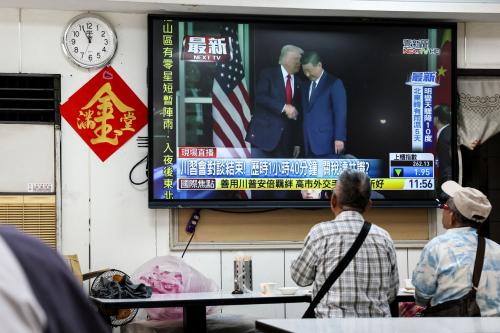
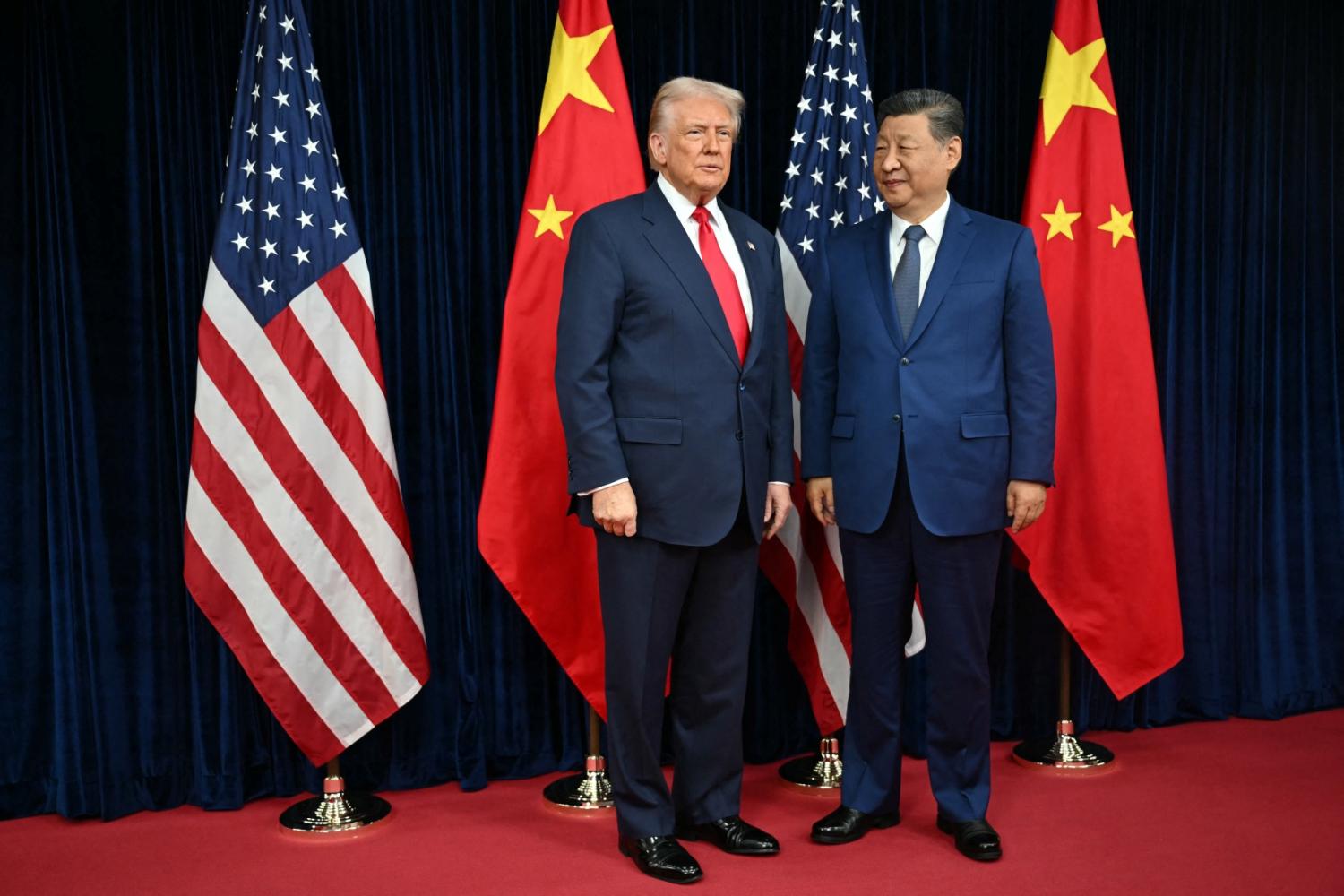
Without attracting significant fanfare, President Donald Trump has reoriented America’s approach to China. He has shifted the emphasis of the relationship away from an ideological battle or great power struggle toward competition focused on trade and technology. He has bestowed respect upon Chinese President Xi Jinping and, together, they have ushered in a period of relative strategic calm in the bilateral relationship. This was demonstrated by the one-year truce they adopted for their trade war during their October 30, 2025, meeting in Busan, South Korea. Trump’s supporters tout his progress in doing deals with China, while his detractors argue that Trump is giving more than he is gaining in return.
This discontinuity in Trump’s approach to the U.S.-China relationship begs the question of what effect it will have on the relationship’s trajectory in the coming years. This piece examines three possible pathways: first, a soft landing whereby both leaders invest in permanently improving the relationship; second, a hard split whereby Trump grows disillusioned and angry toward China over time, similar to the arc of events during the first Trump administration; and third, a situation whereby both leaders buy time to build insulation against each other, though without any pretense of expecting a permanent improvement in bilateral relations.
Of these three scenarios, I judge that the third, in effect extending the period of relative strategic calm, is the likeliest trajectory for the relationship in the coming years insofar as it serves both leaders’ larger objectives. I also explore factors that could limit or invalidate this period of relative strategic calm.
Trump’s shift on China
When President Donald Trump returned to office in January 2025, many analysts predicted he would pick up where he had left off in his hard-nosed approach toward China during his first term. Trump departed office in 2021 repeatedly blaming China for the COVID-19 pandemic, which he called the “China virus.” He blamed COVID-19 for costing him reelection. In the intervening years, Trump also lamented China’s underperformance in delivering on promises made as part of the U.S.-China Phase 1 trade deal.
Trump began his second term by reigniting the trade war that he began during his first term, at one point ratcheting tariffs on China up to 140%. When his escalation failed to deliver Chinese capitulation, and instead invited Chinese retaliation, Trump shifted course. In the second half of 2025, Trump showered praise on Xi Jinping, showed deference to China, declared the dawn of a “G2” era, and withdrew some of the sharpest points of Beijing’s irritation about America’s approach to the relationship. Trump and Xi capped this shift by agreeing to a one-year trade war truce at their October 30, 2025, meeting in Busan, South Korea.
Gone are the days of “great power competition” as the organizing principle of America’s China policy. This once nearly ubiquitous term in U.S.-China discourse did not appear once in Trump’s 2025 National Security Strategy (NSS). Instead, the NSS focused on technological and economic competition as central to the U.S.-China relationship.
Washington has ceased serving as the captain of efforts to organize allies to push back on China’s pursuit of its ambitions. American export controls on semiconductors and high-end technologies are no longer treated as nonnegotiable national security requirements. Now, they are employed by the Trump administration as potential deal sweeteners to attract Chinese concessions on Trump’s trade priorities. Over the past year, Trump has hardly, if at all, uttered any comments about human rights, Xinjiang, Tibet, or Hong Kong. Similarly, on Taiwan, Trump has calibrated America’s approach to cross-Strait relations to take account of Beijing’s sensitivities. Even as Trump approved a $11 billion arms sale to Taiwan, he also has signaled that he respects the importance China places on Taiwan. Trump consistently underscores his personal relationship with Xi in response to questions he fields about Taiwan.
Proponents of Trump’s new approach toward China argue that it is delivering results: progress on curbing the flow of fentanyl, promises of new purchases of American agricultural products, and a reduction in the risk of major power war. Critics contend that Trump is giving more than he is getting from Xi. They warn that Trump’s less assertive approach will embolden China to grow more aggressive, not just toward the United States but also toward America’s allies in the region.
In other words, there is a debate in the United States over the effectiveness of Trump’s more conciliatory approach toward China. There is less debate, however, over the judgment that Trump has broken with America’s approach toward China over the last decade. This shift has been sharp, but it has not attracted significant political or public debate outside of closely interested circles. This is due, in part, to the extraordinary pace and amplitude of domestic and external shocks that have crowded out debate over China policy. In ways only Trump could, he has set the United States on a less ideological and confrontational path. This discontinuity in America’s China policy raises a fundamental question: what are potential pathways for U.S.-China relations over the next 24-36 months?
This paper outlines three potential trajectories for U.S.-China relations for the remainder of Trump’s term: a soft landing, a hard split, and a trend toward buying time and building insulation. One could identify hundreds of potential variations among these three scenarios. The scenarios are not mutually exclusive or entirely self-contained. They are presented as a thought experiment to aid forecasting about the mid-term direction of U.S.-China relations. Of these three scenarios, I judge the most likely trajectory is a trend toward both countries buying time and building insulation against each other, in effect, extending their period of relative strategic calm.
Scenario #1: Soft landing
In this scenario, Trump continues to pursue a conciliatory approach toward China, and Xi reciprocates. Trump and Xi maintain regular communication and meet regularly. Through their active involvement, they build a shared agenda for advancing the relationship and exercise firm oversight over their respective governments to ensure their shared agenda is being implemented.
The framing of great power competition gives way to a new narrative around peaceful coexistence, or, barring that, managed competition and meaningful cooperation. Both leaders assert publicly that a constructive bilateral relationship will be conducive to peace and prosperity, whereas an adversarial relationship will make both countries less prosperous and less safe. Trump downplays ideological issues, instead asserting that both leaders are focused on improving the lives of their peoples. Both leaders embrace a narrative of the United States and China standing on the same side of transnational challenges, such as actively coordinating to resolve conflicts and preventing rogue actors from weaponizing artificial intelligence (AI) to develop and unleash deadly pathogens.
The two leaders lower barriers to trade and investment in both directions. China commits to increasing purchases of American exports such as airplanes, energy, agriculture, and semiconductors to reduce the bilateral trade imbalance. Beijing also removes restrictions on the flow of rare earth elements and other critical minerals. In return, America relaxes export controls on semiconductors and high-technology products and signals greater openness to Chinese inbound investment in non-sensitive sectors.
Trump prioritizes improving relations with China above America’s relationships with allies and partners such as Japan, South Korea, and Taiwan. He downplays the risk of conflict in the Taiwan Strait. As part of such efforts, he expresses support for greater cross-Strait communication, opposition to Taiwan independence, and openness to any peaceful resolution of cross-Strait disputes. Beijing responds by pulling back most of its military activities in the Taiwan Strait to its side of the unofficial median line.
Signposts that the relationship is moving down this pathway include consistent phone calls between both leaders, agreement on a plan for both leaders to meet regularly each calendar year on the margins of multilateral fora and further as needed, tangible bilateral agreements on issues of mutual interest, and the development of a shared vocabulary in both capitals for describing the relationship. Further indicators include the development of structured dialogues to tee up leader-level interactions and measurable progress in resolving bilateral disputes. If Venezuela and Iran continue to serve as the outlets of choice for Trump’s more hawkish advisors to channel their attention, and Trump remains personally and consistently engaged with Xi in directing the relationship, it would raise the odds of this scenario. Momentum in this direction also would require a deliberateness of planning and preparation that has not been evident to date in the more ad hoc nature of negotiations preceding leader-level interactions.
To demonstrate seriousness of purpose and investment in this pathway, leaders in both countries would need to send costly signals to each other that they are invested in stabilizing and improving relations. This would require each leader to take actions that give weight to their words of intent to improve relations. Both leaders would need to embrace a restraint-for-restraint model for managing relations. For example, Trump and Xi could instruct their militaries to make meaningful progress in risk reduction, including by regularizing military-military channels at the strategic, theater, and operational levels to mitigate risks of escalatory spirals. The two leaders could build a pattern of announcing new risk reduction measures at each summit, for example, by agreeing that agentic AI will never be delegated authority to launch strategic attacks on the other side’s critical infrastructure, space-based assets, or nuclear command and control systems. They could also jointly agree to commence arms control negotiations and commit to avoiding actions in space that generate orbital debris.
Scenario #2: Hard split
In this scenario, Trump’s efforts to stabilize and improve bilateral relations are unrequited. Xi refuses to yield meaningfully on the issues Trump prioritizes, including curbing the flow of fentanyl precursors, narrowing the trade imbalance, expanding market access, and working together to end conflicts in Ukraine and elsewhere. Trump grows frustrated by Beijing’s intransigence, concludes that China’s ambitions are incompatible with American interests, and responds by empowering his staff to degrade China’s economic and industrial strength. This scenario would broadly follow the arc of Trump’s first-term approach to China, where he initially prioritized securing a Phase 1 trade deal but eventually grew disillusioned and angry toward China, mostly owing to the global spread of COVID-19 and its impacts on his 2020 reelection campaign.
As this scenario unfolds, Trump grows more emphatic in warning that the global concentration of advanced manufacturing in China represents a national security threat. He prioritizes pushing supply chains out of China. Washington also intensifies pressure on other advanced economies to limit the flow of high-technology products into China. Trump pressures other leaders to embrace the objective of degrading China’s industrial dominance.
Trump begins mobilizing the American public to prepare for a long struggle. He asserts that China is deliberately seeking to poison America’s fighting-age population via its production of fentanyl precursors. He identifies China as an enemy that has already launched a war on the American people. He vows to cut China down to size and weaken Beijing’s capacity to inflict harm on the American people.
Trump begins hiring and empowering senior officials to launch a multidimensional campaign to knock China off balance. He significantly expands the scope of export controls and sanctions to squeeze China’s ability to climb industrial value chains. To limit China’s overseas influence and reach, the Trump administration launches a global campaign to compel countries to adopt America’s AI stack and to refuse China’s AI offerings. The Trump administration begins to condition security guarantees and market access upon countries’ decisions on AI adoption.
The Trump administration also attempts to drive a wedge between the Chinese leadership and the Chinese people. Through public messaging, cyber, disinformation, and other means, Washington seeks to build a narrative inside China that the country’s top leaders are corrupt and that the Chinese Communist Party is not serving the interests of the Chinese people.
Signposts that the relationship is moving down this pathway include a public break in Trump and Xi’s relationship, a breakdown in leader-level contact, and/or visible gaps in follow-through on agreements Trump touts as having been secured between himself and Xi, such as by continuing to withhold general licenses for U.S. firms to import rare earth elements and magnets from China. If Beijing takes an unexpectedly aggressive action, such as by launching an embargo around Taiwan or taking military action in the South China Sea or East China Sea against an American treaty ally, this also could push Trump toward this pathway. A return to government service of well-known advisors from Trump’s first term, such as Mike Pompeo, Matt Pottinger, and Miles Yu, could also be a leading indicator of a directional shift in policy.
Given Trump’s transparency in describing his feelings toward China and its leader, he would likely begin signaling that his sentiment toward Xi is shifting. He would become more direct and explicit in enumerating his disappointment and/or frustration with his Chinese counterpart. In other words, if the United States moves toward a pathway of letting it rip on China, it will not be sudden or surprising. There likely will be ample indicators preceding any such shift.
Scenario #3: Buy time and build insulation
In this scenario, both leaders signal that they value their ongoing trade war truce and intend to extend it beyond the one year that they agreed upon in Busan. Left unsaid but mutually understood by both leaders is a recognition that each is systemically vulnerable to the other. America depends on China’s rare earth minerals and magnets, in addition to batteries, active pharmaceutical ingredients (APIs), and the refining of raw materials like lithium and graphite. China similarly depends upon the United States for advanced U.S. technologies and software, aircraft components and engines, ethane for China’s chemical industry, and high-end machinery imports. More intangibly, China relies upon American universities to train its future leaders in advanced research fields. If either leader squeezes the other’s chokepoints, he will invite retaliation. As a result, both leaders operate with an awareness that weaponizing dependencies in the near term will not be zero-sum, but rather negative-sum.
Given these inescapable near-term conditions, both leaders seek to stabilize bilateral relations and use this time to race to escape their vulnerabilities to the other. Unlike the first scenario (soft landing), though, both leaders remain gimlet-eyed in their evaluation of the other side’s intentions. Neither leader assumes that there will be any lessening of long-term structural competitive dynamics in the relationship, but both operate tactically to avoid antagonizing the other to buy time for their respective efforts to harden against dependence on the other.
As part of efforts to buy time for advancing their respective self-strengthening agendas, they each avoid actions that would trigger strong retaliation from the other. Trump instructs his staff not to intensify economic pressure on China or take actions on Taiwan that break past precedents. Xi similarly instructs his staff not to initiate unilateral measures that could inflame bilateral relations. Both leaders work to manage the public narrative in their respective countries about the relationship. For Trump, this means shifting the narrative from great power competition to a focus on nonconflictual coexistence with China. For Xi, it means dialing down public discourse around “the rise of the East and decline of the West,” and highlighting the mutual benefits of positive relations instead.
At the same time, both countries accelerate efforts to reduce their dependencies on the other. The Trump administration builds upon its early efforts to invest in rare earth mines and refineries. It also intensifies coordination with allies and partners to develop a non-Chinese supply chain for rare earths and magnets. At the same time, Washington accelerates research to design out dependencies on Chinese-sourced rare earths and magnets in electronics such as cars, phones, computers, medical devices, and military equipment. Congress authorizes funding for the United States Government to hasten efforts to reduce dependence on China for APIs and other chokepoint vulnerabilities.
In Beijing, Xi mandates that China accelerate progress toward technological self-sufficiency and organizes China’s economy toward that goal. China’s 15th Five-Year Plan already prioritizes self-reliance in science and technology and sets a goal of achieving breakthroughs in “core technologies” such as semiconductors, AI, quantum computing, biotechnology, nuclear fusion, and 6G communications. China’s policy directives prioritize “technology self-reliance and national resilience” and set a strong demand signal to move away from integration with Western-produced technologies.
In many respects, parallel efforts already are underway by both sides to build self-reliance. The signposts to watch for in this scenario are not whether each side sets its compass toward this goal—both already have—but rather how well each side does in lessening its dependence on the other. Key signposts will include the following: Will U.S. government investments in mining and refining capacity for critical minerals outside of China show results? Is America able to deliver results from agreements with key partners such as Australia, Canada, Japan, Saudi Arabia, Indonesia, Malaysia, and Vietnam in expanding mining and refining capacity? Is the United States able to build up its critical minerals stockpiles to reduce vulnerability to fluctuations in supply? Do the U.S. government and its leading companies make innovative breakthroughs in technological designs that do not depend on Chinese-produced rare earths and magnets? On APIs, does the United States rebuild its capacity to produce at scale? Does the United States gain capacity to build batteries to meet basic domestic requirements? Do Trump and Secretary of the Treasury Scott Bessent continue to serve as the primary public-facing voices in the administration for explaining America’s approach to China? Do Department of Defense senior leaders continue to remain relatively mute on China? Do Republican members of Congress continue to refrain from publicly challenging Trump’s shift in approach to China?
Similarly, for China, the key questions are: Does China achieve breakthroughs in producing advanced semiconductor chips at scale? Do Chinese AI companies find ways to continue making breakthroughs amidst constraints on compute capability? Does Beijing develop reliable alternatives to the United States for securing aircraft engines and components? Ditto for high-end machinery?
Whichever country makes more progress in reducing its vulnerabilities will have a freer hand to pursue its national ambitions without risk of facing constraints from the other. In this scenario, the score in the bilateral relationship is measured by which side moves faster to reduce its dependencies upon the other. Everything else is secondary to efforts to reduce reliance.
Conclusion
The third scenario, buy time and build insulation, most closely reflects the bilateral relationship’s prevailing trend. This scenario does not assume any type of rapprochement and is unlikely to deliver major breakthroughs in the bilateral relationship. Unlike the first scenario, this scenario does not presume any permanent improvement in bilateral relations. As Trump described recently, it means, “We do everything we can to China, and they do everything they can to us.” The scenario is defined most concretely in bilateral terms by the pause in escalation it represents.
This pause works for both sides. Both countries are already working to use a period of relative strategic calm to build insulation from each other while they put in place policies and investments to strengthen themselves from within.
Efforts at self-strengthening have deep roots in both countries. In China, Chairman Mao Zedong extolled technological independence in the 1950s and 1960s as China’s relations with the Soviet Union deteriorated. Mao’s fixation on strengthening China’s industrial production, particularly in steel, contributed to his launch of the Great Leap Forward, a campaign that resulted in famine for tens of millions of Chinese citizens. Xi’s current efforts, by contrast, are far less draconian. Xi is not urging his compatriots to melt their farming equipment in communal smelters for the common good. Instead, he is channeling China’s abundant capital toward efforts to indigenize production capacity for science and technology outputs. China also enjoys different attributes now than it did during Mao’s time. Today, Beijing has access to abundant foreign exchange reserves, the world’s strongest manufacturing base, and many of the world’s leading scientists, engineers, and innovators. Nevertheless, Xi’s drive for greater self-reliance echoes previous periods in Chinese history.
Similarly, the U.S. government in recent decades has underwritten many technological breakthroughs. These include radar, aviation, semiconductors, GPS, and the early internet. The Trump administration believes it will be able to unlock next-generation breakthroughs through deregulation, tax cuts, abundant energy, and efforts to attract significant inbound investment.
Importantly, Trump also seems to have accepted the constraints of interdependence with China. After initially attempting to bully China into submission, Trump has more recently prioritized forging a nonconflictual coexistence with China. This is a departure from recent presidential administrations, including his first term, which prioritized great power competition. Instead, Trump seems comfortable viewing China as a political and economic peer, albeit one that will be constrained by debt, demographics, and loss of economic momentum over time.
Although the relationship’s prevailing trend points toward the third scenario (buy time and build insulation), such an outcome is far from preordained. It remains possible to envision the relationship developing in the direction of a soft landing or a hard split. For the soft-landing scenario to take hold, there would likely need to be a major deal or breakthrough that the two leaders could announce and jointly take credit for. One possibility for such a breakthrough deal would be a fourth joint communique to update the terms for how the United States and China relate to each other over Taiwan. According to this logic, it has been 44 years since the last joint communique relating to Taiwan; much has changed since then. A fourth joint communique, or some new type of understanding relating to Taiwan, could provide impetus for the two sides to unlock deals on other issues, such as trade and investment, that Trump covets.
While such a grand bargain regarding Taiwan cannot be ruled out, it also faces long odds. For one, Chinese leaders remain skeptical of Trump’s day-to-day control of his own administration. Beijing’s wariness was heightened last year when an understanding it believed both leaders had blessed not to aggravate economic tensions was undone by the Department of Commerce’s announcements of new export controls. Second, Chinese leaders observe that Trump changes his mind often on matters large and small. This reduces the value they place on deals they reach with him. And third, Beijing recognizes that Trump is a unique figure in American political culture and that his successor may not follow his same approach. In other words, even if Trump decides he would like to pursue a breakthrough deal and is prepared to make concessions to achieve it, it is not certain that Beijing would be willing to provide costly signals to secure such a deal, given Chinese leaders’ own uncertainty about the durability of any deals reached with Trump.
The second scenario (hard split) also remains a possibility, particularly as the U.S. midterm elections near. The Trump White House clearly remembers the effects of impeachment trials during its first term. The conventional wisdom inside the Trump White House is that if Democrats regain control of the House in 2026, they will launch impeachment efforts against Trump. This provides powerful motivation for Trump to avoid seeing the House of Representatives flip to Democratic control in 2026. Particularly if inflation remains high and employment conditions soften in the run-up to the midterm elections, Trump could grow motivated to scapegoat China as the source of America’s economic problems.
Trump has experience making this case. He has blamed China for America’s ills during stump speeches in previous election cycles. He could do so again in 2026. A few factors may mitigate against this outcome, though. First, there is no empirical data that taking a tough approach toward China will materially improve Trump’s ability to get other Republican candidates elected. Second, although polling suggests the American public remains wary of China, there is not presently a groundswell of animus toward China. The American public does not seem to be clamoring for a great power confrontation with China. If anything, the American public appears more focused on addressing its own challenges at home. Third, it is possible that Trump could feel more motivated ahead of the midterm elections to reach a deal with Xi that he could claim as a win for America’s workers than to burn down his relationship with Xi for the sake of political expediency. Lastly and relatedly, Trump has invested in building a narrative around his own productive relationship with Xi, which he uses as a proxy for his ability to do deals with China. Unless Xi takes an action to embarrass Trump or upset the American public, such as by attacking Taiwan or instigating an incident that causes the death of American servicemembers, it could be difficult for Trump to rip and replace his narrative of Xi as a friend with one of Xi as a foe. While such types of events cannot be ruled out as possibilities, they are not presently high probabilities.
Ultimately, the likeliest scenario for the remainder of Trump’s presidency is the third scenario (buy time and build insulation), if for no other reason than that it reflects prevailing trends and appears to align with both leaders’ broader goals around indigenization. As the preceding discussion has made clear, though, this forecasting is fragile to exogenous events. Nobody could have predicted in 2023, for example, that a wayward Chinese spy balloon would violate American airspace and derail momentum in the relationship. Particularly with U.S. and Chinese military platforms now frequently operating near each other in the South China Sea, East China Sea, and Taiwan Strait, there are real risks of incidents, intended or otherwise, that could trigger rapid escalation. Similarly, both countries could overdo their efforts to gain relative advantage in third countries, such as Panama, in ways that could dial up tensions. Or the two sides could simply fail to meet each other’s expectations, for example, around the pace and breadth of Chinese issuances of general licenses to U.S. firms to import rare earths and critical minerals, which could undermine efforts to stabilize relations.
As a result, there likely will not be a firm floor under the U.S.-China relationship for the coming years. Nor will there likely be a diminishment in the structural nature of long-term bilateral competition. Analysts, experts, and interested observers will need to follow developments closely and be prepared to update their expectations to account for unanticipated events. To the extent that there is any type of iron law for forecasting the direction of U.S.-China relations, it is that the relationship rarely travels along a straight line for long.
Author

Related Content
-
Acknowledgements and disclosures
The author would like to thank Allie Matthias and Joyce Yang for research support, Adam Lammon for editing, and Rachel Slattery for layout.
The Brookings Institution is committed to quality, independence, and impact.
We are supported by a diverse array of funders. In line with our values and policies, each Brookings publication represents the sole views of its author(s).