
This paper was prepared for the CEPR Paris Report 4: The New Global Imbalances, where it is published as chapter 8.
The U.S. current account deficit—which includes imports and exports of goods and services plus investment income, remittances by workers, and other transfers—nearly doubled between 2019 and 2024 (from 2.1% to 4% of U.S. GDP), and then shrank slightly in 2025 to 3.6%.
In “The Return of Global Imbalances: The US case,” I argue that the post-COVID widening of the U.S. current account deficit reflects a rapid recovery in U.S. aggregate demand from its 2020 trough, which boosted imports (such as chips associated with the AI boom) coupled with weaker demand recovery in trading partners, which restrained growth in U.S. exports. The strength of U.S. demand reflects the massive policy stimulus during COVID, persistently large fiscal deficits thereafter, and rapidly rising investment and asset prices fueled by the boom in artificial intelligence. In U.S. trading partners, stimulus spending was generally lower: The recovery in China and other Asian economies was delayed by lengthier COVID restrictions, and domestic spending in China was negatively affected by the country’s real estate crisis; and European economies faced the negative consequences of Russia’s invasion of Ukraine, which drove up the cost of their energy imports and other commodities.
Periods of large current account surpluses and deficits globally are nothing new—the period before the 2008-2009 global financial crisis was characterized by sizable global imbalances. The current episode reflects three major differences. One, in contrast to the earlier period, the U.S. current account deficit in 2023-25 was not accompanied by substantial deficits in other parts of the world. Two, current account imbalances are smaller as a share of GDP compared to the 2000s (for instance, the current account deficit peaked at 6.3% of GDP in the third quarter of 2006). And three, the external debtor position of the United States and its federal debt are both much larger than in the past.
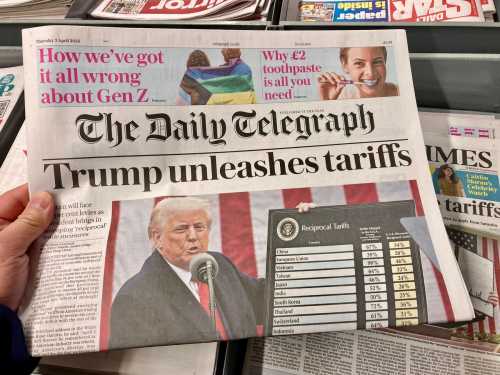
Is a large current account deficit a problem? Not necessarily. It may reflect high investment spending to install productivity-enhancing capacity, which will generate higher output and exports in the future. The boom in AI spending is arguably a case in point—even though both the spending and the soaring stock market valuations may turn out to be excessively optimistic. But strong U.S. spending is also sustained by fiscal policy—the U.S. federal deficit in 2025 was 5.9% of GDP even though unemployment is very low, and the federal debt is projected to rise further from already elevated levels. Although a gradual reduction in the U.S. budget deficit (which likely would be accompanied by some reduction in U.S. interest rates) would be desirable from a fiscal standpoint and help reduce external imbalances, such an outcome currently looks unlikely. While debt dynamics remain worrisome in many other advanced economies as well, U.S. Treasury securities (some 40% of which are held by foreign investors) play a pivotal role in the global financial system, and private investors, including hedge funds and other investors very sensitive to overall market conditions, are important holders of such securities. Over time the lion’s share of financing for the U.S. current account deficit has come from foreigners’ purchases of U.S. bonds. In an environment characterized by geopolitical uncertainty and adversarial policies and pronouncements of the U.S. administration vis-à-vis its main trading partners and geopolitical allies, the current trajectory of U.S. fiscal policy raises global financial stability concerns. The “Liberation Day” episode of April 2025, in which President Trump’s announced tariffs led to a sudden increase in U.S. long-term interest rates and dollar depreciation alongside global volatility, illustrates such risks.
Author
Related Content



-
Acknowledgements and disclosures
I am grateful to Maury Obstfeld, Helene Rey, and participants in the Paris December 2025 workshop for useful comments, and to Tristan Loa for helpful research assistance and fact checking.
The Brookings Institution is committed to quality, independence, and impact.
We are supported by a diverse array of funders. In line with our values and policies, each Brookings publication represents the sole views of its author(s).