High housing costs in the United States are no longer just a coastal crisis, especially for renters. The boom in lower-cost housing that powered growth in the Sun Belt has ground to a halt. At the same time, office vacancy rates are rising in a broad range of regional contexts because of the sticky shift to hybrid and remote work during the COVID-19 pandemic. Many of these underutilized offices are in desirable locations that are easy to access from anywhere within a region, and are co-located with appealing assets such as jobs, retail, and other amenities. The strength of these locations—combined with an overall need for housing—suggests an obvious solution: converting offices into housing.
This publication is part of a broader series examining the potential of office-to-residential conversions across six case study cities. The project is part of a cooperative agreement with the U.S. Department of Housing and Urban Development, and the research team is composed of contributors from Gensler, HR&A Advisors, Brookings, and Eckholm Studios.
In some market contexts, these conversions are already happening. However, in most places, office-to-residential conversions do not make economic sense, and there is a gap between the current value of office buildings plus their cost of conversion and the projected post-conversion value. Still, the prospect of losing economic and social value in the prime activity center locations where underperforming offices are located has motivated many local and state governments to make various interventions to facilitate conversions. At the federal level, the Revitalizing Downtowns and Main Streets Act proposes a tax credit subsidy to conversion projects in exchange for affordable housing.
Increasing the supply of housing in highly desirable locations that is means-tested for households with lower incomes would potentially increase the level of economic integration in these locations. And given the link between segregation by income and race in American residential patterns, it could potentially also have a desegregation effect. For students of American land use history, this has the ring of poetic justice, because it subverts the land use regulations—also known as “zoning”—that helped create modern segregation.
Zoning began as something explicitly motivated by race, but evolved into zoning of use, form, and intensity that was race-neutral in word but discriminatory in implementation. Comprehensive zoning ordinances shape where people live and work not by directly separating people of different racial groups into different residential neighborhoods, but by separating different land uses, such as multifamily rental housing and detached single-family housing. These same regulations also separated offices and housing.
This begs the question: By mixing housing into office districts through office-to-residential conversions, can American cities simultaneously alleviate high housing costs and reduce residential segregation?
This report explores that question by simulating the demographic outcomes of hypothetical office-to-residential (O2R) conversion scenarios in six cities. We review why desegregation is relevant to public considerations of O2R conversions, present the results of these simulations, and discuss the implications for cities. In certain market contexts, O2R conversion is a viable way to affirmatively further fair housing (a requirement of the 1968 Fair Housing Act, discussed in more detail below). This means it is critical that local decisionmakers who want to affirmatively further fair housing understand their context before investing in O2R conversion as a strategy.
What is ‘fair housing’?
Since 1968, the Fair Housing Act has prohibited housing discrimination on the basis of protected characteristics: race, color, religion, sex, disability, familial status, and national origin. For example, the law makes it illegal for a landlord to refuse to rent a house to a couple because they have children, or for a home-seller to turn away a buyer because they are Jewish. However, since the law’s passage, its impact has been contingent on proactive enforcement. One way of doing so is through the Justice Department’s Fair Housing Testing Program, in which individuals pose as potential tenants, customers, or buyers in order to collect data on their treatment by landlords, lenders, and sellers.
Housing discrimination is also institutionalized in local government through land use and transportation planning. For this reason, the Fair Housing Act requires federal agencies and recipients of federal housing funds to “affirmatively further fair housing” through their actions. While Department of Housing and Urban Development Secretary Scott Turner has moved to reduce these requirements for local and state governments, the Fair Housing Act remains the law of the land, and many local governments have adopted their own plans to affirmatively further fair housing.
What does it mean for a local government to “affirmatively further fair housing”? It requires taking meaningful actions—beyond simply combating discrimination—that overcome patterns of segregation and remove barriers that restrict access to opportunity based on protected characteristics. This requires both determining who lacks access to opportunity or what inequities exist among protected class groups and then creating and implementing policies or programs to promote integration, reduce spatial segregation, and transform racially or ethnically concentrated areas of poverty into areas of opportunity.
Simulating the impacts of office-to-residential conversion on neighborhood racial demographics
We examined the potential of converting vacant office space into residential units to affirmatively further fair housing in a broad range of U.S. places covering various regional office and housing market conditions where O2R conversions are already happening: Los Angeles; Winston-Salem, N.C.; Pittsburgh; Houston; St. Louis; and Stamford, Conn. Specifically, we examined a subset of census tracts in each city to estimate how many people, and of what race and ethnicity, might move into these newly created units.
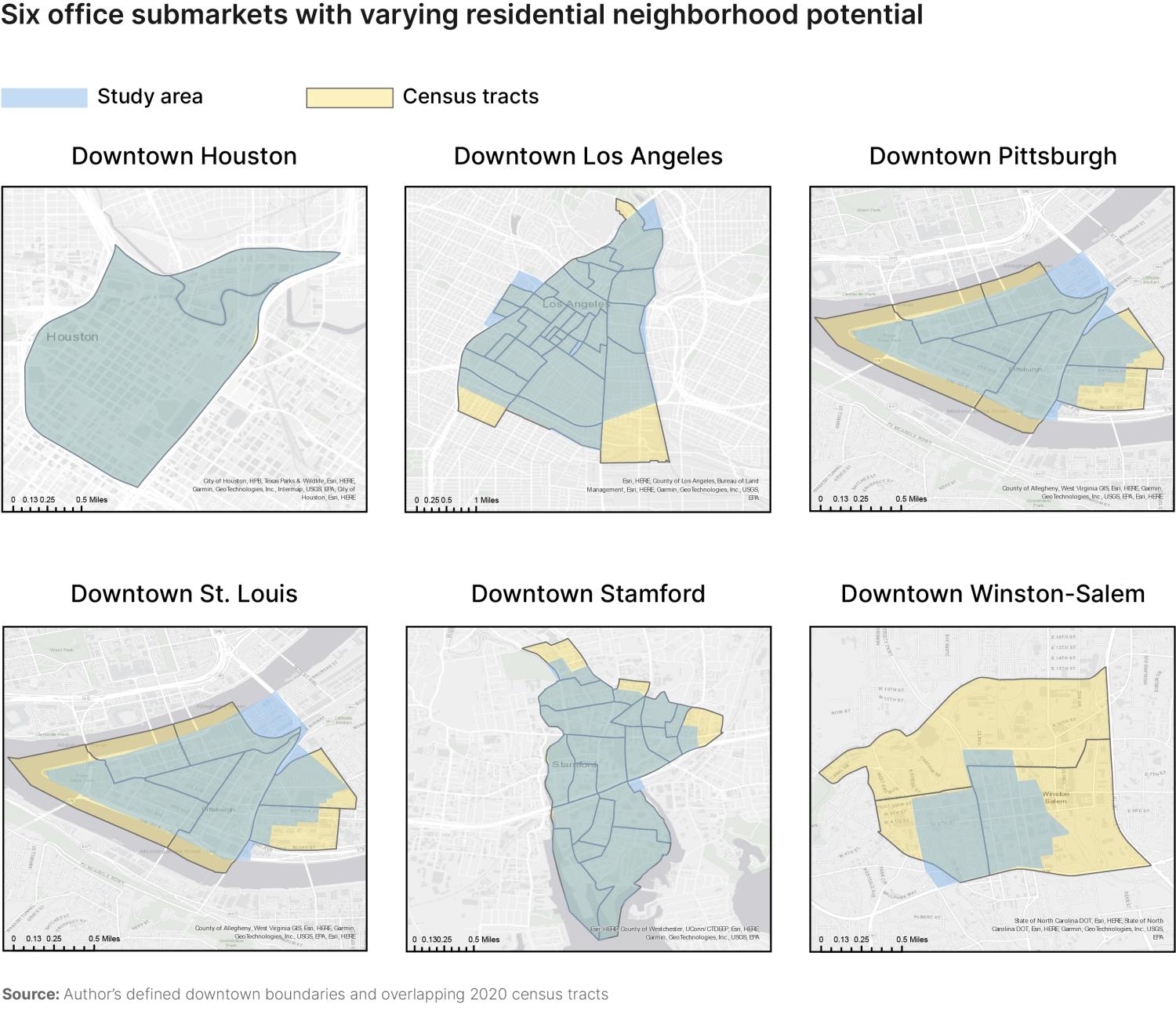
Figure 1 shows the office submarkets the larger project research team studied and each study area’s corresponding census tracts that were used in this analysis. While race is far from the only characteristic that defines protected class groups under the affirmatively furthering fair housing principle, we selected this characteristic to study because reducing racial inequality is a goal of many local governments, and because hyperlocal census data on racial demographics are available.
Our analysis assumes that 15% of vacant office space in each study area could be converted into studio, one-bedroom, or two-bedroom apartments. A single constant assumption about convertibility is simplistic and does not consider financial feasibility, but has the advantage of producing a set of scenarios that allows us to compare outcomes across markets. It is also not outside the realm of reasonableness, and is in some cases overly conservative. For example, in Winston-Salem, a single vacant office building accounts for 31% of all vacant office space in the downtown, and recent analysis by our larger research team suggests that converting this building to housing could produce 393 apartments. Even in Los Angeles, where O2R conversion projects have already yielded over 12,000 housing units to produce a downtown evenly mixed between office and residential, aggregate regional housing demand is strong and there are 135 office buildings that are more than 25% vacant—coincidentally representing 15.7% of the total office building inventory in the study area.
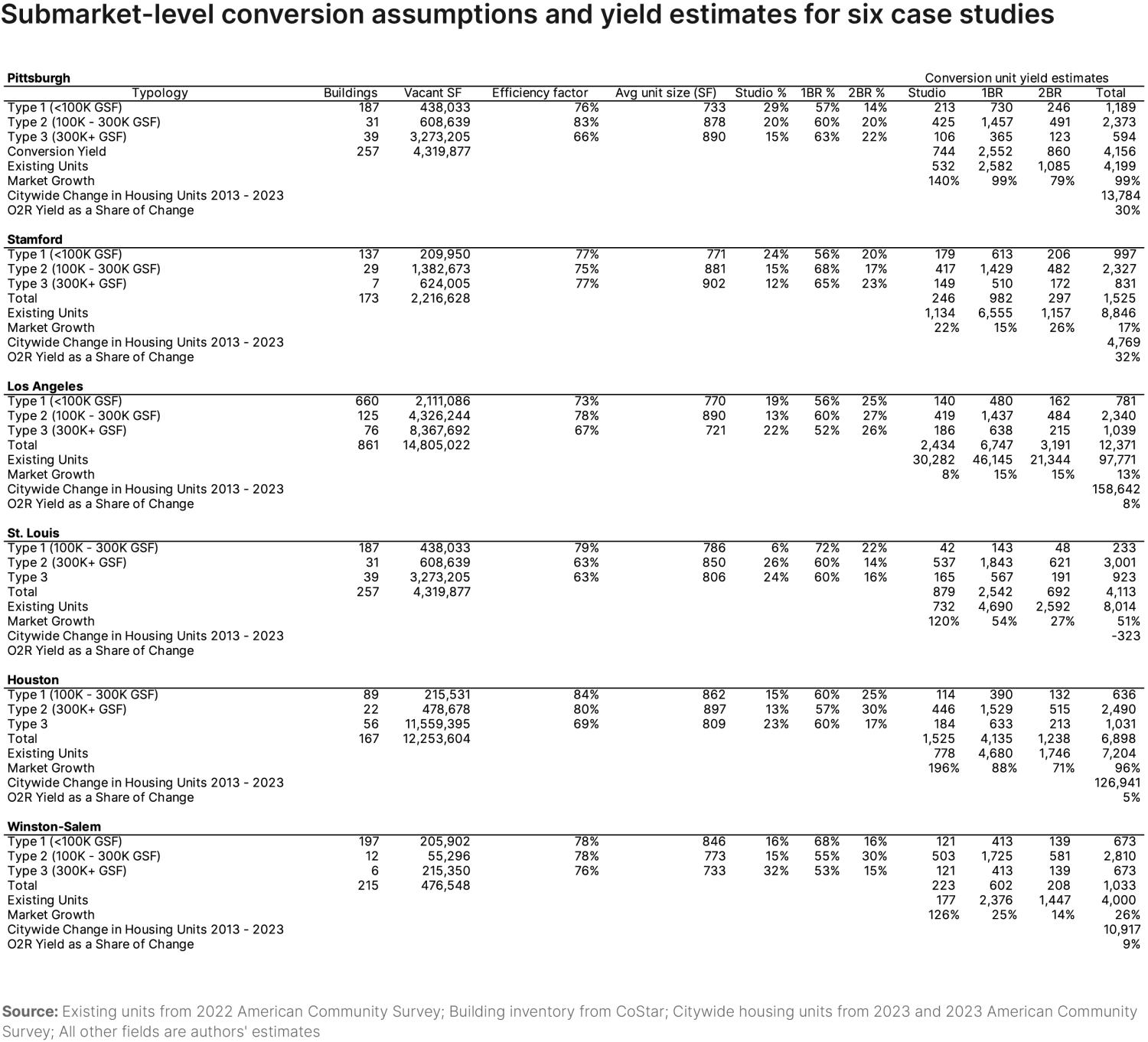
The larger project team’s previous analysis analyzed three “typologies” of buildings based on size and mass for each study area, and generated yield studies of how many housing units of each size (studio, one-bedroom, and two-bedroom) representative buildings from each typology could produce. For each typology, the research team estimated an “efficiency factor”—a ratio of how the total square footage of the office building would break into rentable area over the building’s gross area. We then generalized those estimates into yields per square foot and applied them to the study area’s full inventory mix to produce rough market-level yield estimates for new housing units produced through O2R conversion. These estimated yields are presented in Table 1.
In order to place these yields in context, Table 1 also includes the current size of the downtown housing inventory (“Existing Units”) as well as the citywide change in total housing units from 2013 to 2023. To translate these estimates from units to people, we made a conservative assumption that one person would live in a studio or a one-bedroom apartment, and two people would live in a two-bedroom apartment.
We then developed four scenarios using data from the 2022 American Community Survey (ACS) 5-year estimates:
- Scenario 1: All new movers into these units mirror the existing demographic makeup of current residents in each census tract. This is a linear projection of the status quo.
- Scenario 2: All new movers reflect the demographic makeup of residents who moved into these tracts within the last year.
- Scenario 3: Beginning with the same assumptions as Scenario 1, and adding an additional provision that a set percentage of new movers match the demographic profile of Low-Income Housing Tax Credit (LIHTC) household members at the state level.
- Scenario 4: Beginning with same assumptions as Scenario 2, and adding an additional provision that a set percentage of new movers match the demographic profile of LIHTC household members at the state level.
In order to create Scenarios 3 and 4, for each city we made a highly conservative assumption about the production of affordable housing by setting the share of new movers into affordable units at the level the city’s inclusionary zoning ordinance requires. For cities without such an ordinance (St. Louis, Houston, and Winston-Salem), we assume zero affordable housing units. However, since affordable housing is often built through other mechanisms, such as the LIHTC, this assumption is very conservative. Table 2 presents the results.1
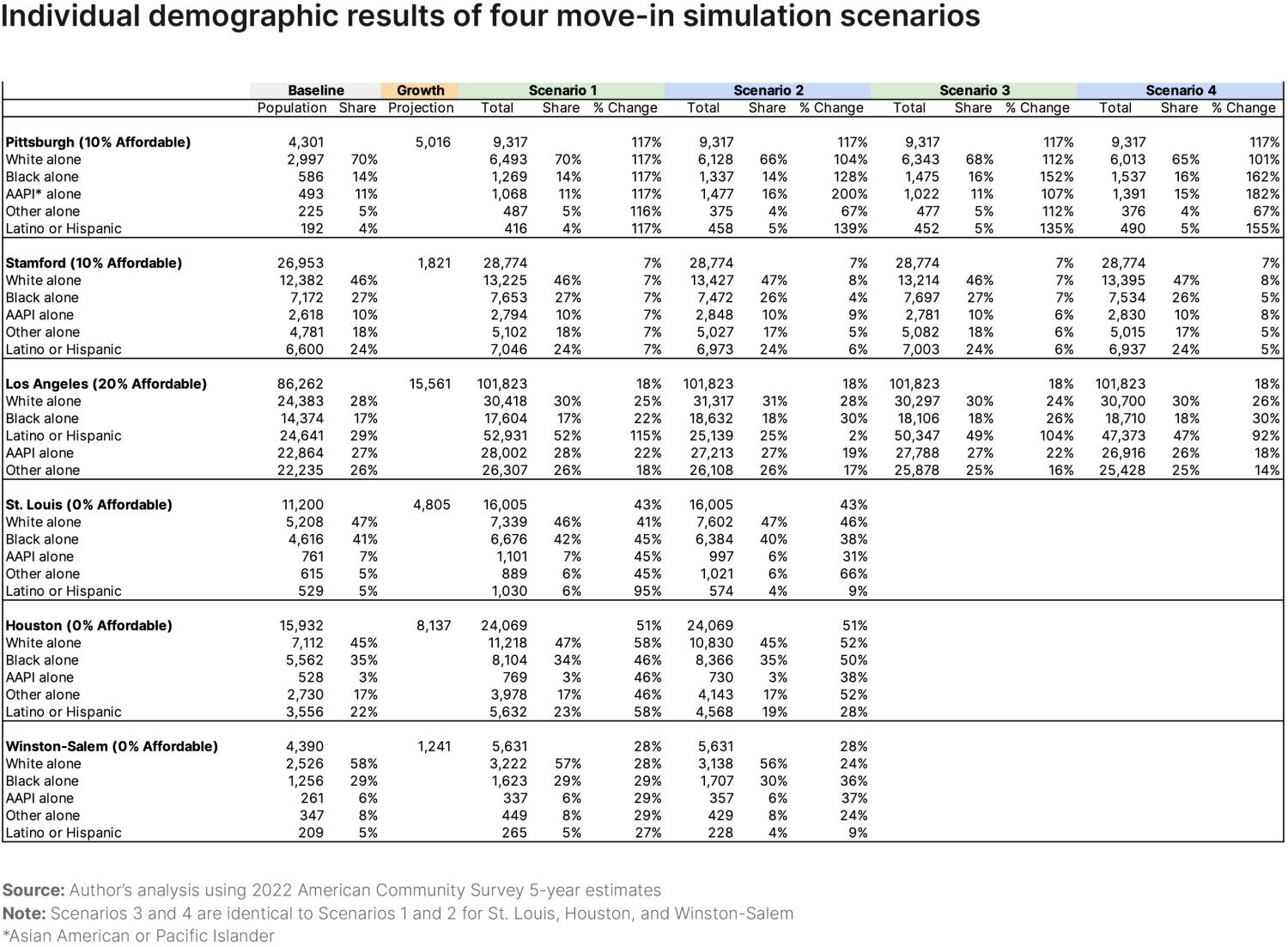
In our analysis, we used ACS data on individuals rather than households to estimate the racial and ethnic composition of new residents. This decision reflects a key data limitation: The ACS provides information on the race and ethnicity of individuals and heads of households, but not on the collective racial or ethnic composition of households as units. As a result, our scenarios assume that the proportion of individuals by race and ethnicity remains consistent within households, whether those individuals are part of the existing population, recent movers, or residents of affordable housing. While this introduces a simplifying assumption (that household racial composition aligns with individual-level demographics), it enables a comparable approach across cities using available data.
Key findings and implications for cities
Across our six case study cities, these rough estimates suggest a wide range of possible outcomes from O2R conversion in the study area submarkets. These outcomes fall into four categories.
- Producing meaningful amounts of housing: In most market contexts, O2R conversion in one submarket is a niche production strategy that does not match the scale of the housing crisis. This can be seen in Table 1, in which we compare the housing yield of downtown O2R conversion to citywide production over the last 10 years. However, in Stamford, where barriers to new housing are high, the estimated potential O2R conversion yield would be equivalent to 32% of all housing built there in the last 10 years (Table 1). In most other markets, understanding O2R conversion as a supply opportunity likely involves thinking regionally and looking at suburban office conversion.
- Affirmatively furthering fair housing: Most of our case study downtowns are already very racially diverse in ways that are representative of their citywide populations.2 However, this is not the case in Pittsburgh, where there is a difference in the racial mix of recent movers and established residents that produces a slightly more racially diverse downtown in Scenario 2 (see Table 2). The results of Scenarios 3 and 4 are even more diverse, likely because these scenarios include means-tested affordable housing, and the demographics of affordable housing residents in Pennsylvania are more diverse than the baseline demographics of downtown Pittsburgh. However, our results generally show that O2R conversion in one submarket does not do much for housing affordability unless deployed with tools such as the LIHTC or inclusionary zoning. Other research has explored the potential of office-to-co-living conversion to accomplish this.
- Changing downtown dynamics through placemaking: In Pittsburgh and Houston, O2R conversion could potentially double the number of housing units downtown (see Table 1), which would significantly change the areas’ dynamics, including the stakeholder groups who care about downtown, types and timing of retail demand, and foot traffic. However, by fully modeling each step of this exercise from unit production to demographic simulation, we estimate that because of major differences in the most likely feasible unit sizes in both cities (see Table 1), Pittsburgh potentially stands to gain twice the downtown population share as Houston (per Table 2, the population of downtown Pittsburgh could more than double, while the number of downtown Houston residents might increase by 51%).
- Revitalizing legacy cities: In St. Louis, where the housing stock contracted by 323 units over the last decade, O2R conversion is a population growth strategy that could add approximately 5,000 new residents (see Table 2) while increasing the size of the downtown housing market by over half (see Table 1). In Pittsburgh, O2R conversion could produce a supply of housing comparable to 30% of the housing built citywide over the last 10 years (see Table 1), which is notable not for the quantity of supply downtown, but because of how stagnant the rest of the Pittsburgh housing market is.
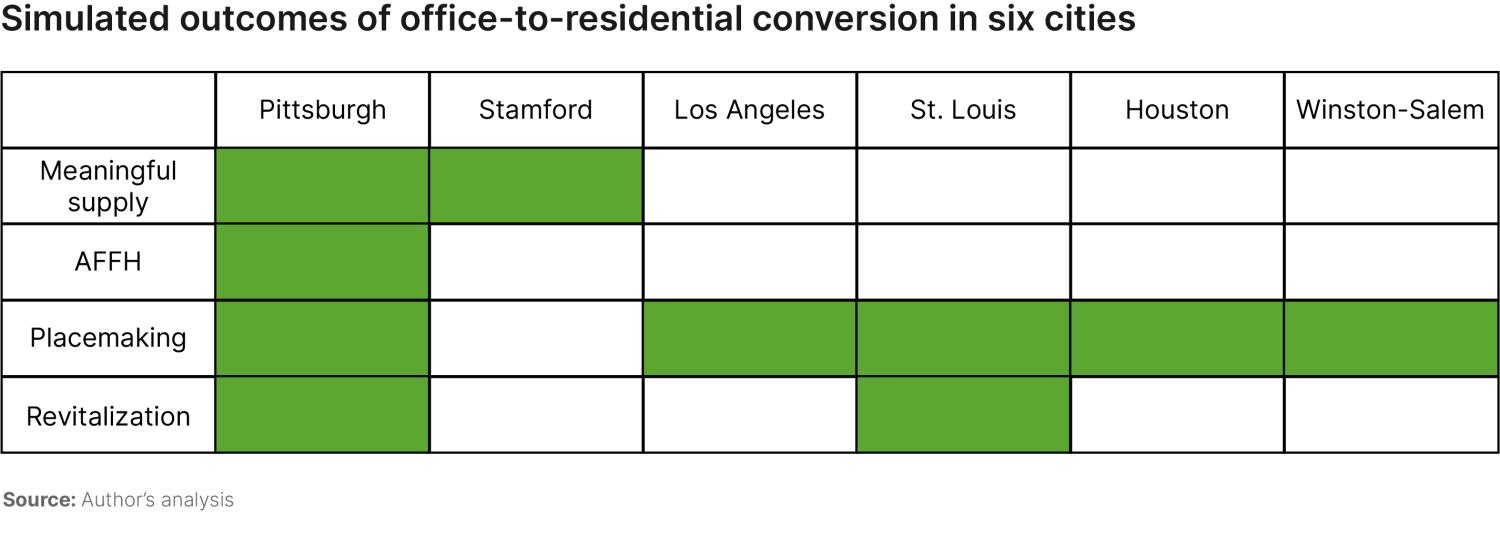
Our analysis predicts all four of these outcomes would only occur in Pittsburgh. In most other cases, the outcomes are highly distinct and non-overlapping because of the different baseline and market conditions of each case (see Table 3). Changing downtown dynamics through placemaking and revitalizing legacy cities are more common outcomes than producing meaningful amounts of housing or affirmatively furthering fair housing, though there are real situations in which those latter outcomes could happen. This likely reflects our case study selection, which was in part curated based on where O2R conversion has happened in the past rather than the actual mix of American communities with present-day office surpluses.
When local governments are considering planning objectives for small areas that have significant amounts of obsolete office inventory, staff should triangulate the planning area’s characteristics with those of these case studies to gain insight into which outcomes of O2R conversion activity are potentially more likely for that particular area based on existing conditions. This will help communities understand what the evidence base says O2R conversion likely can—and cannot—do for them. This research can help communities determine if certain goals they may have are realistic based on existing demographics and policies, and use this work as a tool to either curb expectations or be more aggressive in shifting policies to achieve goals.
Author
-
Acknowledgements and disclosures
The author thanks Dillon Mahmoudi for his substantial contributions to the methodology and analysis presented in this work. Thanks are also due to Jennifer Vey for reviewing a previous draft of this work, and Mary Elizabeth Campbell for research assistance.
The work that provided the basis for this publication was supported by funding under an award with the U.S. Department of Housing and Urban Development. The substance and findings of the work are dedicated to the public. The author and publisher are solely responsible for the accuracy of the statements and interpretations contained in this publication. Such interpretations do not necessarily reflect the views of the government.
-
Footnotes
- Note that Table 2 presents estimates for Latino or Hispanic households, but in the census, this characteristic is an “ethnicity,” and respondents who choose this ethnicity also choose a race such as white, Black, etc. Therefore, the population shares reported for this ethnicity overlap with the shares reported for the four race groups in Table 2.
- The racial demographics of each study area and city are separately reported in each individual case study publication.
The Brookings Institution is committed to quality, independence, and impact.
We are supported by a diverse array of funders. In line with our values and policies, each Brookings publication represents the sole views of its author(s).