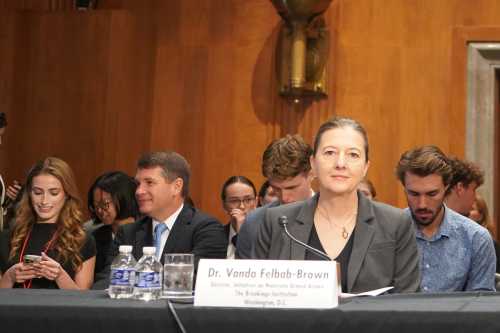
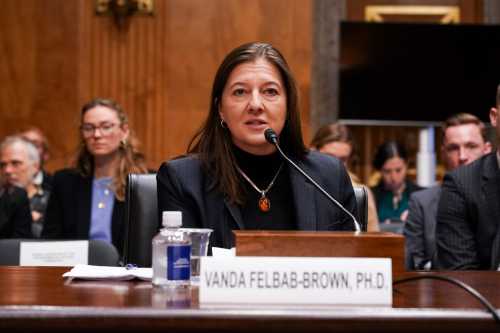
The following is an executive summary from Vanda Felbab-Brown’s testimony to the U.S.-China Economic and Security Review Commission’s hearing on “China’s Expanding Interests in Latin America: Development, Leverage, Coercion, and Crime” on March 19, 2026. It has been lightly edited and adapted from her prior testimony on December 9, 2025.
Executive summary
Over the past two decades, Chinese criminal networks have expanded in Latin America and the Caribbean, just like in other regions of the world, alongside China’s legal trade and investment expansion in the region. Their activities span the trafficking of drugs and their precursors; money laundering; illegal, unreported, and unregulated (IUU) fishing; wildlife trafficking; illegal logging and mining; and human smuggling.
All of these illicit economies and this highly violent criminality long predate the arrival of Chinese criminal groups. But the presence of Chinese criminal groups often leads to a dramatic increase and diversification in illicit extraction and smuggling, such as in natural resources contraband, because the demand for such products in China is very large. By connecting local illicit economies to global markets and increasing the value of commodities, Chinese criminal groups also motivate local criminal actors to expand and diversify their illicit activities.
Unlike Latin American criminal groups, Chinese criminal groups engage in little violence. Chinese criminal groups and legal businesses that engage in illicit activities rely primarily on corruption and patronage, developing networks of influence with local and national political and business elites and law enforcement actors. They also systematically exploit weak institutions, inadequate regulatory systems, and enforcement gaps.
Chinese networks remain the principal suppliers of precursor chemicals for the production of fentanyl and methamphetamine for Mexican cartels. They also supply chemicals for the processing of coca into cocaine across Latin America. With every new wave of scheduling of chemicals by China, these groups rapidly pivot to nonscheduled precursors and develop new recipes for the production of illicit drugs. They rely on the lack of conspiracy, racketeering, and material support clauses in China’s laws to escape China’s law enforcement actions.
Chinese underground banking networks have become the top money launderers for Mexican cartels, displacing other long-established money laundering systems in the region and elsewhere in the world. Since they are able to pass most of the costs on to Chinese citizens seeking to avoid China’s capital control systems, they are able to provide much lower rates to cartels than other money laundering networks. They utilize a wide range of methods, including mirror transactions that avoid international bank wires, trade-based money laundering, and cryptocurrency.
In extractive industries and fisheries, Chinese companies and intermediaries often exploit flawed licensing systems, weak inspections, fraudulent permits and falsified documentation, and poor supply-chain monitoring to move illegal ore, timber, and seafood under the cover of nominally legal operations. Other times in fishing, large Chinese flotillas engage in blatant illegality in the exclusive economic zones of Latin American countries, devastating biodiversity and economic resources. In wildlife trafficking, Chinese networks organize local hunting and export a wide variety of species to China and East Asia for high profits, as under-resourced environmental agencies and limited border inspections struggle to detect and prosecute the illegal trade. In economies with natural resources, Chinese investors, traders, and logistical operators frequently prefinance extraction, supply heavy equipment and chemical inputs, and guarantee the purchase of commodities such as gold, timber, and wildlife products.
Chinese actors’ portfolios of legal and illegal activities allow them to obscure their nefarious behaviors beyond money laundering. It also equips them with significant political capital with local authorities and businesses, and protects them from local law enforcement.
Chinese actors’ highly diversified and sophisticated operations span a wide range of illicit economies. Combined with their extensive presence in and exploitation of legal trade and regulatory loopholes, these practices have become business exemplars for Latin American criminal groups. They, too, have now learned to diversify their activities, such as into natural resource exploitation, beyond narcotics. By reducing money laundering costs through Chinese underground banking and expanding revenue streams, the Latin American criminal groups have become more resilient to law enforcement actions.
Chinese criminal and gray-zone networks in Latin America and the Caribbean should be understood as part of a broader ecosystem that erodes governance, regulatory authority, and elements of sovereignty, and that has existed for decades before the arrival of Chinese criminal groups. But by interacting with local criminal and corruption networks in Latin America as well as acting on their own, Chinese illicit networks amplify countries’ governance deficiencies and further weaken the already inadequate rule of law, policy autonomy, and fiscal stability.
Cumulatively, the illicit activities of all actors in Latin America contribute to the erosion of what can be described as functional sovereignty. The intermeshing of legal and illegal business, the entrenchment of corruption, and the weakening of regulatory and judicial institutions make it far harder for governments to transition toward transparent, rules-based governance, attract responsible investment, and achieve inclusive and equitable long-term development.
Latin American law enforcement agencies often struggle to act against Chinese criminal networks. Because these networks are not violent and are effective at developing high-level political protection systems in Latin America, authorities often consider them a low priority.
Moreover, some Chinese criminal networks provide services to the Chinese government and the Chinese Communist Party: developing broad influence networks and acting as the state’s eyes, ears, and enforcers within Chinese diaspora communities. These networks benefit from China’s reluctance to mount law enforcement efforts against them. Only when they attract extensive negative publicity abroad, which makes it too diplomatically costly for China to continue extending protection, might Chinese authorities become motivated to act against them.
In the past few years, China has been increasing its law enforcement engagement and cooperation with Latin America and the Caribbean through technological transfers, such as Safe Cities, and more systematic and structured law enforcement frameworks, such as the Global Security Initiative (GSI). By exporting an image of China as a country with very low violence and predatory crime levels, China now provides some form of bilateral or multilateral law enforcement training to the vast majority of countries in the region. At least 35 cities in Latin America and the Caribbean have bought the Safe System surveillance system and other Chinese law enforcement technologies, despite concerns about human rights, privacy, and other civil liberties, and the risks of Chinese espionage. Yet China’s law enforcement engagement with Latin America, like with the rest of the world, remains limited, selective, and self-serving. Its law enforcement assistance is instrumentalized and subordinated to its geostrategic objectives: China extends law enforcement cooperation to countries with which it enjoys positive relations and with those it seeks to bring into its orbit, and denies it to countries with which it has deteriorating relations.
In conclusion, I detail the following recommendations for U.S. policy:
- Help state authorities in Latin America and the Caribbean to develop law enforcement tools against Chinese criminal networks.
- Encourage the adoption of U.S. anti-crime and port monitoring and operations technology as alternatives to Chinese systems such as Safe Cities.
- Dismantle Chinese money laundering networks.
- Counter Chinese criminal groups’ operations beyond drugs.
- Build clean, transparent, and traceable supply chains.
- Reduce corruption and patronage systems and establish apolitical, independent legal systems.
- Scrupulously adhere to human rights and civil liberties protections, avoiding any kind of vilification of Chinese communities, and holding law enforcement accountable.
- Adopt comprehensive, sustainable socioeconomic anti-crime policies.
- Strengthen U.S. domestic resources, institutions, and laws for such support systems in Latin America and the Caribbean.
- Help Latin American and Caribbean governments and investigative systems, such as investigative journalists, to encourage China to take enforcement actions against criminal behavior by Chinese entities in the region.
In the subsequent parts of the testimony, I provide a very quick overview of the panoply of criminal groups in Latin America and the Caribbean and discuss their role in:
- The trafficking of illicit drugs and chemical precursors.
- Money laundering.
- Illegal mining.
- Illegal logging and timber trafficking.
- Wildlife trafficking.
- IUU fishing.
- Human smuggling.
In discussing these illicit economies, I lay out the threats and harms they pose. I further discuss U.S. efforts to engage China in advancing fentanyl and synthetic drug controls and anti-money-laundering cooperation. Next, I lay out the cumulative impact of Chinese criminal networks in Latin America. I also explore their patterns of exploitation of weak institutions and regulatory gaps. I further discuss the circumstances of illicit activities that lead to the erosion of government sovereignty. In the last two sections, I analyze the complex connections between some Chinese criminal groups and Chinese authorities, Chinese government responses to Chinese criminal groups and illicit activities, and China’s growing law enforcement cooperation with Latin America and its strategic implications. I conclude with detailed policy recommendations.
Author

Related Content

The Brookings Institution is committed to quality, independence, and impact.
We are supported by a diverse array of funders. In line with our values and policies, each Brookings publication represents the sole views of its author(s).



Commentary
TestimonyTackling Chinese criminal networks in Latin America
March 20, 2026