
Executive summary
As voters head to the polls in 2026 to elect 36 governors and thousands of state legislators, the economy remains their top concern. Households across the country are struggling to keep up with rising costs, and many communities remain disconnected from the high-growth industries generating good jobs that pay enough for households to afford the local cost of living. Meanwhile, technological, environmental, and demographic forces are rapidly reshaping the economy, with effects that vary across and within states and the geographic regions that comprise them. In this moment, the challenge is clear for governors and legislators: Modernize economic development systems to create the enabling conditions needed so that these forces grow good jobs and expand economic mobility, rather than deepen divides.
Accomplishing this mission requires more than a new program or policy—it will require a structural shift in how states manage their economies. To operationalize that shift, this playbook presents five structural “plays” to modernize state economic development. It includes priority steps for new leaders and detailed case studies for implementers, all informed by insights from hundreds of regional and state economic development leaders across over a dozen states. That fieldwork reveals that today’s economy is not shaped only by government, but by the combined activity of industry, higher education, and civil society—often organized and coordinated through regional networks. At its core, this playbook helps states better partner with the regional cross-sector networks that power their economies by:
- Better understanding the rapidly evolving economic moment as well as the unique strengths of the state and its regions that, together, can enable a proactive, adaptive approach to growing good jobs in the next economy.
- Building the state-level systems needed to align state and regional strategy, investments, and execution to deliver economic opportunity more effectively with limited resources.
- Investing intentionally in regional cross-sector coordination capacity, especially in less-resourced and economically distressed regions, to prepare regions to weather inevitable shocks and seize opportunities.
While the playbook is primarily intended for decisionmakers in state government, regional and state-level civic and business leaders also play a critical role. In fact, in leading states—where we’ve seen state-regional alignment catalyze significant private investment, strengthen local institutions, and grow good jobs in industries of the future—these leaders have provided durable advocacy and trust-based leadership across state administrations to design and help build state-level systems that work for their communities.
The context: An uneven, rapidly changing economy
In 2024, nearly half of U.S. households did not earn enough to make ends meet, and only 44% of Americans believe their standard of living will improve—down sharply from previous decades. Extensive research shows these economic challenges are not experienced evenly across place, and that variation greatly affects American workers’ economic prospects. Access to good jobs depends on where you live and that region’s ability to compete in the tradable industries that disproportionately create good jobs. Yet a growing share of regions are disconnected from those industries, contributing to lower employment rates and declining economic mobility.
At the same time, major structural forces—including artificial intelligence, the energy transition, and demographic change—are rapidly reshaping the economy. These shifts create new opportunities for innovation and growth, but also serious risks of job displacement, rising costs, and growing economic divergence.
The structural issue: The economy is regional, but governing systems are not
Most state economic development systems were designed for an earlier era, when growth could be secured by attracting a large employer with the right incentive package. Today’s economy, however, is increasingly driven by technology, talent, and energy—assets that exist in and are largely determined by regional ecosystems. While states have smartly expanded into workforce, innovation, and entrepreneurship over time, these additions have resulted in state systems that are:
- Fragmented across agencies, programs, and funding streams.
- Reactive rather than strategic and proactive.
- Misaligned across state, regional, and local actors.
- Over-reliant on incentives, underutilizing private and philanthropic co-investment.
- Focused on quick wins instead of longer-term economic outcomes.
To succeed in the next economy, states must rethink how they operate, starting with a fundamental reality: States hold governing power, but economies are regional. Labor markets, housing markets, infrastructure systems, and supply chains operate primarily in regional economies—spanning multiple counties but rarely reaching the scale of an entire state—and are organized around networks of firms, workers, universities, and civic institutions. Moreover, regions offer the connective tissue needed to translate investments into economic growth: trusted relationships across public, private, and civic sectors; deep knowledge of local assets and constraints; underutilized pools of capital; and the on-the-ground capacity to adapt quickly as conditions change. Yet these regional networks are undercoordinated and undercapitalized. Instead, it is states that ultimately have the authority, resources, and platform to align regional actors to achieve economic impact at greater scale. This creates a condition of mutual interdependence:
- States set direction (informed by rigorous data and stakeholder engagement); align and deploy resources across agencies (e.g., funding, staff capacity, policy, procurement); exercise their regulatory authority; and operate at scale in service of their statewide mandate.
- Regions, which are closest to economic challenges and opportunities, design strategies and coordinate execution, grounded in the reality of their advantages and institutions.
This sets the conditions for a new vision for state economic development: Connect more residents to good jobs by aligning and deploying the authority and resources of state government in more effective, adaptive ways through partnership with regional cross-sector leadership.
A new operating model: A state-regional playbook for economic transformation
Plays, not programs: This practical playbook is anchored by the five key “plays” outlined below, plus priority actions for the first 90 days to set the state up for success. The focus is not on creating new programs, but on reimagining how existing policies, institutions, and investments work together to improve alignment and effectiveness toward growing good jobs.
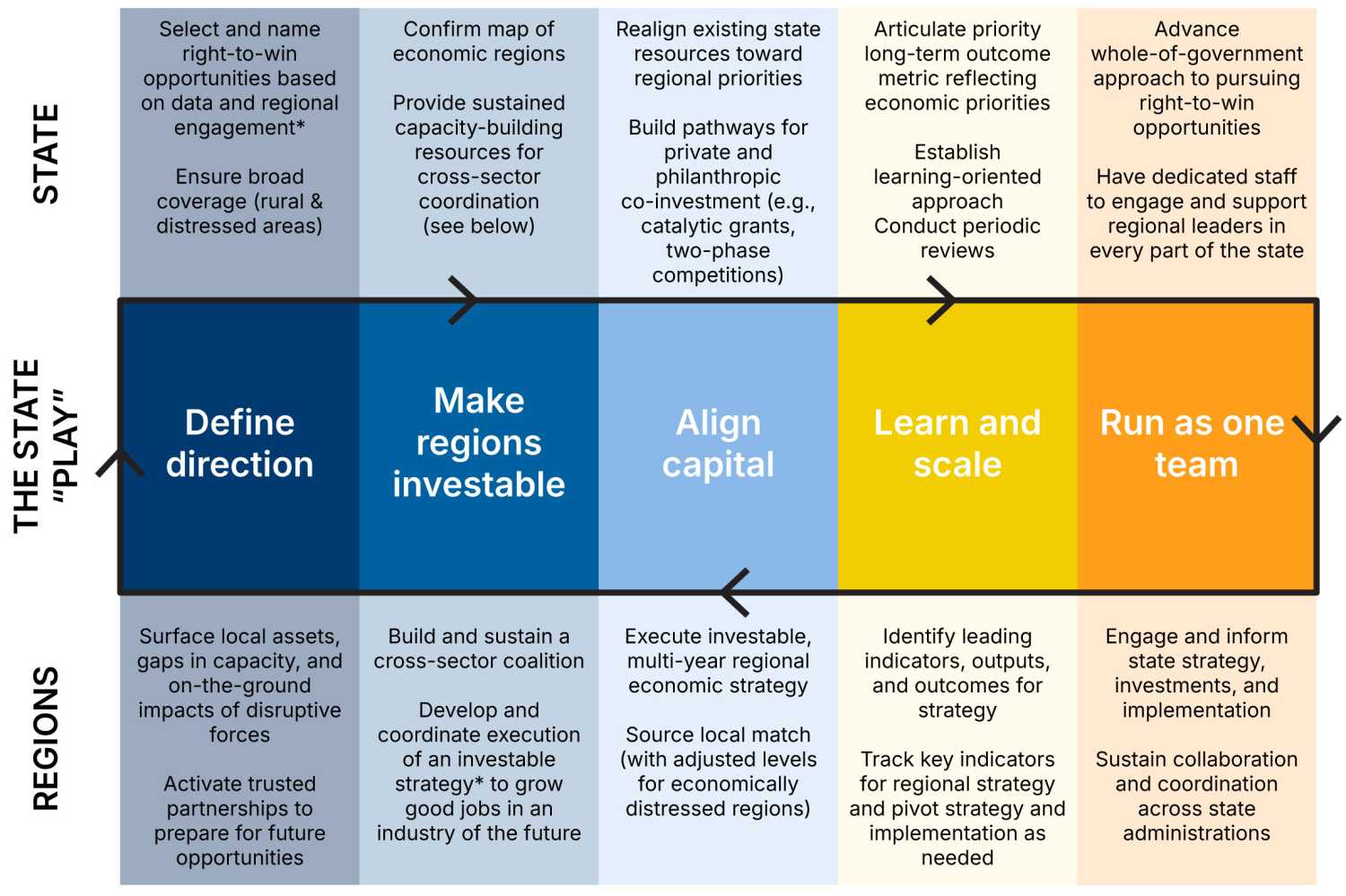
Play #1: Define direction. States—with broad input from stakeholders in industry and civil society—must identify a select number of “right-to-win” economic opportunities: specific industry clusters where regional assets and market dynamics suggest a realistic—sometimes known, sometimes emerging—competitive advantage (e.g., advanced pharmaceutical manufacturing in Virginia, quantum in Illinois). This requires combining rigorous market analysis with intentional regional engagement to move beyond broad sector priorities and toward precise, actionable cluster strategies whose value chains, altogether, engage assets in every part of the state. While regional stakeholders hold the deepest understanding of local assets, it is states that possess the fiscal base, authority, and public platform to reinforce and signal those priorities to the national and global economy.
Play #2: Make regions investable. Every region across the state should have a plan for its future prosperity—specifically a long-term, investment-ready economic strategy grounded in its assets and opportunities. This requires building dedicated regional capacity to coordinate with partners across sectors and ensure sustained alignment across strategy, investment, and execution (models exist in Indiana, New York, and Virginia, with early progress in California). High-quality regional strategies integrate catalytic projects across talent development, innovation, and infrastructure that address key gaps to seize a “right-to-win” economic opportunity. This step also provides a strong foundation for multi-region collaboration across a state.
Play #3: Align capital. States must realign fragmented funding streams to advance regional priorities, but this play will look different depending on authority, politics, and fiscal space. We offer four pathways, drawing insights from New York and Virginia, early work in other states, and recent federal place-based investments: realigning existing resources; deploying catalytic grants to support regional clusters; designing large-scale, multi-phase funding competitions; and convening collaboratives of private and philanthropic funders. The goal is to unlock co-investment from businesses, philanthropy, and local governments at a scale that can drive meaningful economic transformation.
Play #4: Learn and scale. Economic development systems must shift from compliance-driven reporting to performance-driven learning. States should adopt clear outcome metrics—such as employment rates, income growth, or shares of families making ends meet and disparities across groups—and build accessible data systems that enable continuous improvement. Resources should be reallocated toward strategies that demonstrate impact, while underperforming efforts are adapted or discontinued, as leading regional cross-sector coalitions from Oklahoma to West Virginia demonstrate.
Play #5: Run as one team. Finally, states must build the capacity to coordinate this new operating model across agencies and with regional partners. This includes creating dedicated teams to align economic development, workforce, housing, land use, infrastructure, and other relevant state resources around shared state and regional priorities. Offices of rural prosperity, which exist in a growing number of states, offer a potential model for ensuring prosperity in every part of the state—rural and urban. Strong relationships with regional leaders across the business, education, and civic sectors are essential to ensure that state strategies are grounded in real economic conditions and opportunities.
|
First 100 days agenda |
Priorities for the first six months |
|---|---|
|
|
The impact: Stronger regions, greater growth
In practice, this approach, while not yet widespread nationally, is already delivering strong early results. Evidence from across the country—including efforts in Virginia, New York, and Indiana—shows that when states align their authority, funding, and strategy with empowered regional cross-sector coalitions, they can unlock levels of coordination, co-investment, and growth that fragmented systems simply cannot achieve.
State-enabled regional strategies have catalyzed billions of dollars in public and private investment (as high as nearly 20:1 private match leveraged in Indiana, for example); accelerated the growth of globally competitive industry clusters, generating hundreds of thousands of jobs; and strengthened the capacity of local institutions to work together toward shared economic goals. They also prepare regions to weather inevitable shocks and seize opportunities, including existing and potential future large-scale private and federal investment. Just as important, these efforts are beginning to reconnect more workers and communities to pathways into good jobs—particularly in places experiencing long-term economic distress.
The 2026 election cycle presents a pivotal opportunity to expand these efforts. By modernizing how states work—aligning their funding and authority with regional strategy and execution—leaders can build more competitive, resilient, and inclusive economies. For newly elected governors and state legislators, alongside their regional partners, this playbook can be the foundation for a transformational strategy that creates more good jobs, stronger regional economies, and expanded pathways to economic mobility for more Americans.
How different leaders can use this playbook
This playbook is primarily designed for governors’ transition teams and senior state decisionmakers, as transitions create windows of opportunity to realign priorities, align agencies, and establish direction early. Yet in many successful state transformations, civic, business, philanthropic, legislative, and regional leaders built the foundation for action well before state leadership emerged. Thus, this playbook offers actionable insights for leaders across the public, private, and civic sectors interested in supporting regional economic transformation, whether they are early in ideation or looking to strengthen implementation already underway.
|
If you are: |
What you can do: |
|---|---|
|
A newly elected governor or on a transition team |
Build a more strategic, proactive, and modernized approach to economic development that aligns state agencies, regional priorities, and long-term economic opportunity. |
|
An incumbent governor or senior advisor |
Identify opportunities to strengthen coordination across agencies and improve alignment between state priorities and regional economic ecosystems. |
|
A state legislator |
Authorize, fund, and sustain more effective state-regional economic development systems that align workforce, infrastructure, innovation, and economic development priorities. |
|
A regional civic or cross-sector leader (e.g., at a regional economic development organization) |
Strengthen regional coordination, develop shared economic strategies, and demonstrate the value of state-regional alignment through implementation. |
|
A business leader and/or part of a state-level civic leadership organization |
Build a data-driven narrative to motivate action; assess appetite among leaders to align public, private, and philanthropic capital toward shared priorities. |
|
A philanthropic leader |
Invest in regional coordination capacity; assess appetite among leaders to align public, private, and philanthropic capital toward shared priorities. |
Read more
Authors


-
Acknowledgements and disclosures
Brookings Metro thanks the many regional and state leaders and national experts who helped inform and shape this work. We’d especially like to thank our colleagues Xavier de Souza Briggs, Ryan Donahue, David Johnson, Alex Jones, Robert Maxim, and Mark Muro as well as our collaborators David Adams, Andrew Bentley, Tyler Carroll, Jennifer Cash, Carrie Christensen, Sara Dunnigan, Kate Gordon, Bethany Hartley, Shawn Herhusky, Bob Isaacson, Matthew Isgro, Kate Mertz, Ken Poole, Lisa Riggs, Rohan Sandhu, Erin Sparks, Egon Terplan, and Adam Watkins for their thoughtful review of earlier concepts and drafts. This work would also not have been possible without the day-to-day work of the many regional, state, and civic leaders that have participated in our peer learning networks, including but not limited to our New Industrial Policy Implementers Network and our Regional Inclusive Growth Network; we thank them for inspiring and driving forward innovative regional, cross-sector approaches to grow good jobs. Support from the Robert Wood Johnson Foundation made this project possible. All remaining errors and omissions are the sole responsibility of the authors.
The Brookings Institution is committed to quality, independence, and impact.
We are supported by a diverse array of funders. In line with our values and policies, each Brookings publication represents the sole views of its author(s).