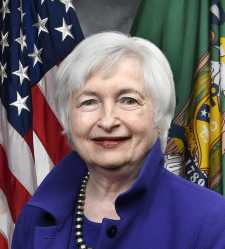
Janet L. Yellen, now a distinguished fellow in residence in the Hutchins Center on Fiscal & Monetary Policy at the Brookings Institution, participated in a panel, “The Future of the Fed,” at the annual meetings of the American Economic Association on January 4, 2026. A video of the panel is available to view here. The slides that accompanied this talk are also available for download.
I’m pleased to serve on a panel on the future of the Fed. My focus will be on threats to the Fed’s independence and the risk of fiscal dominance. Unfortunately, these topics are now receiving increased attention.
According to the consensus among economists, independence in setting monetary policy is essential to the Fed’s effective stewardship of the economy. That is why Congress mandated the Fed’s goals of maximum employment and price stability but delegated to the Fed the responsibility for choosing the settings of its monetary policy instruments to achieve them. Those decisions are intended to reflect data, analysis, and professional judgments, and to be free from political pressure. To ensure transparency and accountability, Congress requires Fed leaders to report regularly on their progress toward these goals. And to establish legitimacy and achieve public support, the Fed regularly explains its decisions to the American people.
This postwar policy framework is characterized by monetary policy dominance—that is, the Fed is not and must never become the fiscal authority’s financing arm. Fiscal policy’s job is to set taxes and spending, and to finance deficits through issuing debt to the market at prevailing interest rates. It is the responsibility of Congress and the president—not the Federal Reserve—to insure that the government’s intertemporal budget constraint is satisfied. It is their duty to ensure that the path of debt is sustainable.
Fiscal dominance refers to the opposite configuration—a situation where the government’s fiscal position—its deficits and debt—puts such pressure on its financing needs that monetary policy becomes subordinate to those needs. As a result, the central bank is pressured, implicitly or explicitly, to keep interest rates lower than warranted by macroeconomic conditions; or to purchase large quantities of government debt, not primarily to stabilize inflation and employment but to ease the government’s financing burden. In a fiscally dominant world, the government’s intertemporal budget constraint drives the price level. If markets don’t expect future primary surpluses to cover the debt, the adjustment eventually comes via inflation or default. This is the “fiscal theory of the price level.”
Fiscal dominance is dangerous because it typically results in higher and more volatile inflation or politically driven business cycles. When the central bank is constrained from raising rates or shrinking its balance sheet because that would increase debt service or trigger fiscal stress, inflation expectations may become unanchored. Households and firms may come to expect that inflation is the path of least resistance for managing high debts. Once such expectations take hold, stabilizing prices becomes significantly more costly. If inflation is firmly under control, the Fed has more flexibility to respond to labor market weakness. Fiscal dominance is also likely to raise term premia and borrowing costs as investors become concerned that the government will rely on inflation or financial repression to manage its debt. In addition, a central bank that is perceived as an arm of the Treasury may have less space to act forcefully in a crisis. For all of these reasons, avoiding fiscal dominance has been a central objective of modern central banking frameworks.
Should we be concerned about the potential for fiscal dominance? In my opinion, the answer is “yes.” In order to lower the costs of debt service, President Trump has vocally demanded that the Fed lower interest rates to levels well below most estimates of “neutral.” He’s threatened Fed independence by attempting to dismiss a Fed governor for alleged cause. And he has also asserted the right of the president to dismiss Senate-confirmed members of independent agency boards like the Fed for policy reasons.
But, by the standards of the fiscal-dominance literature, I would agree with Chair Powell that the United States is not in a fiscal-dominance regime today. The Fed raised rates sharply in response to the post-pandemic inflation, even when that worsened the fiscal arithmetic. Indeed, those interest rate increases caused the Fed’s own income to turn sharply negative in 2023. That followed many years of low rates and balance sheet expansion that generated large positive transfers from the Fed to the Treasury. A situation where the Fed is incurring losses has the potential to unleash political pressures that might compromise the Fed’s credibility and its budget autonomy. But the Fed’s decisions about asset purchases after the financial crisis and pandemic focused squarely on deploying them to achieve the Fed’s inflation and employment mandates and to address threats to financial stability. It ignored possible fiscal or political repercussions. Now, in the face of unprecedented presidential pressure to lower interest rates to reduce the costs of servicing the public debt, the Fed is standing its ground. Its decisions have been squarely governed by its responsibilities to lower inflation and keep the economy operating at full employment. And long-term inflation expectations remain anchored, in line with the Fed’s 2% inflation target. Nor is there much indication that market participants are concerned by the prospect of fiscal dominance, although term premiums in longer-term Treasury yields have risen considerably over the last year.
But the preconditions for fiscal dominance are clearly strengthening. Based on the Congressional Budget Office’s most recent long-term forecast, debt is on a steep upward trajectory. As David Romer emphasized, CBO projects a rise from roughly 100% of GDP this year to more than 150% over the next three decades. That forecast excludes the impact of the One Big Beautiful Bill, nicknamed OBBBA, and the revenue from tariffs. Together, they worsen the outlook. CBO also projects that net interest costs will rise from their current level. They now amount to 19% of revenue and 3.2% of GDP. They’ll rise to 28% of revenue and 5.4% of GDP over the next three decades.
The overall federal deficit is roughly 6% of GDP. That level has never before been realized except during wars and recessions. And the primary deficit, which must be roughly in balance to stabilize the debt/GDP ratio, is now about 3% of GDP. The needed belt tightening is significant—larger than in most programs supported by the International Monetary Fund. I’d add, parenthetically, that, luckily, that 3% of GDP is still well short of what the IMF required for countries experiencing severe capital-account crises. In light of such projections, and in the absence of any bipartisan effort to address the fiscal path, the three major rating agencies have already downgraded U.S. sovereign credit. They explicitly cite persistent deficits, a rising interest burden, and political gridlock. If market participants lose confidence in the likelihood of serious future deficit reduction, rising risk premia could trigger a debt spiral and pressure the dollar.1 If Congress is unable—or if it is unwilling—to adjust primary deficits, the problems will compound. The temptation to rely on inflation or financial repression to reduce the debt burden will surely grow.
It is possible that the fiscal outlook could improve significantly if AI results in a substantial and sustained productivity boost. In a recent paper, Elmendorf, Hubbard, and Liscow2 consider a scenario in which total factor productivity growth is 0.5 percentage points faster per year than in the CBO baseline for 10 years. They find that, at the end of a decade, debt held by the public will be lower by about 12% of GDP. We should not sneeze at such an improvement, but it is too small to be transformative. To prevent the ratio of debt-to-GDP from spiraling upward, the productivity boost would have to be sustained for 30 years. One reason the benefit is not larger is that higher productivity generally raises the return to capital and nudges up the equilibrium real rate of interest. But is a gain of about 0.5% for three decades realistic?
Of course, it is also possible that the budget could experience negative interest rate or growth shocks that would exacerbate the fiscal outlook. With a 100% debt/GDP ratio, a one percentage point increase in the average nominal interest rate on Treasury debt eventually raises net interest costs by roughly 1% of GDP. This could, for example, reflect a higher risk premium that investors demand for holding an ever-growing stock of U.S. debt. If higher debt crowds out private investment, and reduces GDP growth, the outcomes are worse. A decline in the pace of immigration would also worsen the fiscal outlook. Simulations show that the U.S. is currently on a trajectory where relatively modest adverse shocks (100–200 bp higher long-term interest rates and slightly weaker growth) would, over time, push the system into a zone where resisting fiscal dominance requires very strong institutional resilience and credible fiscal reform.
Fiscal dominance is not just about debt ratios and paths. It is also about institutions and laws that protect the Fed’s independence. A key protection insulating the Fed from day-to-day political pressures is its clear statutory mandate to focus on the goals of maximum employment and stable prices—with the choice of specific operating procedures and targets left to the Fed. However, Rand Paul’s “Audit the Fed” bill would direct the Government Accountability Office to review the Fed’s monetary policy deliberations and FOMC communications in real time. This is exactly the terrain Congress has historically kept off-limits. Such political second-guessing would, at a minimum, chill internal debate.
Congress can also change the Fed’s mandate. Historically Congress has not tied policy directly to debt-service costs, but President Trump has endorsed this objective. Recent proposed legislation would also limit the Fed’s ability to pay interest on reserves—currently the main tool for setting short-term rates. Another protection for Fed independence is the 14-year staggered terms for members of the Federal Reserve Board; according to the Federal Reserve Act, they are removable by the President only for cause. However, “cause” has never been clearly defined, and Trump is now testing the waters by attempting to remove Fed Governor Lisa Cook for alleged cause. It is still up to the courts to decide whether Governor Cook can remain in her job while litigation proceeds and the Courts opine on how high a barrier to dismissal “for cause” removal entails. If the bar is set very low, it could intimidate future Fed officials from speaking their minds. In addition, Trump, or a successor, could potentially remove Fed governors for policy differences. In recent cases, Trump has been testing the constitutionality of the Supreme Court ruling in 1935 called Humphrey’s Executor—which held that a president cannot remove a Senate-confirmed member of a multi-member independent agency board for policy reasons. The Supreme Court may be poised to overturn this protection, while suggesting that such a decision may not apply to the Fed. Fed governors, however, have responsibilities beyond monetary policy, including, for example, bank supervision. Would a decision to treat the Fed as “special” apply to governors in their exercise of these other, non-monetary roles? Another protection for Fed independence is that the Fed finances its operations from its own earnings, not through the appropriations process. That reduces the leverage that Congress or the president has via annual budget politics. But here, too, the rules could change, and the Fed’s income losses might provoke Congress to subject the Fed’s budget to greater congressional control.
What would keep the U.S. out of fiscal dominance? First and foremost, this requires credible medium-term fiscal adjustment—not abrupt austerity, but a believable path that stabilizes debt/GDP; for example, through gradual changes to taxes and entitlements or reforms that tilt growth and productivity higher. Unfortunately, however, the revealed preference of both parties has been toward deficit-increasing policy. Recently, the administration and Congress cut funding for the IRS which was targeted at reducing a huge tax gap—a shortfall of $7 trillion dollars over the next decade between taxes that are owed and those estimated to be paid. This was the “low hanging fruit” of deficit reduction. With Republicans opposing tax hikes, and both parties promising to protect Social Security and Medicare, it’s hard to see much room for serious deficit reduction. That said, bipartisan deals are sometimes feasible even amidst intense partisan conflict. It happened in 1997 when [President] Clinton and [Speaker of the House] Newt Gingrich agreed to balance the budget. There was also meaningful deficit reduction in 2023, when a potential debt ceiling standoff threatened default. A bipartisan agreement reduced deficits by about $1.5 trillion over the following decade. The projected depletion of the Social Security and Medicare HI [Hospital Insurance] trust funds in 2032 and market and ratings pressures could serve as similar pressure points. My hope is that such bipartisanship will emerge in the years ahead to place the United States on a sustainable fiscal course. I doubt that Americans will end up on the fiscal dominance course, but I definitely think the dangers are real.
Author
Related Content


-
Footnotes
- Incorporating tariffs and OBBBA in the projections produces only a slightly more concerning debt path because tariff revenue is a significant offset to the deficit increasing impact of OBBBA. If the tariffs are deemed illegal, however, the projections significantly deteriorate.
- Douglas W. Elmendorf, R. Glenn Hubbard, and Zachary Liscow, “Policies to Reduce Federal Budget Deficits by Increasing Economic Growth,” NBER Working Paper 33834 (2025), https://doi.org/10.3386/w33834.
The Brookings Institution is committed to quality, independence, and impact.
We are supported by a diverse array of funders. In line with our values and policies, each Brookings publication represents the sole views of its author(s).

Commentary
Remarks by Janet L. Yellen on the future of the Fed: Central bank independence and fiscal dominance
January 6, 2026