



We still want the rest of the world to know we’re a place of opportunity, a place to invest, and I’m inspired every day by the entrepreneurs that are bringing ideas or the solutions they’re using to solve their community issues. And that hasn’t changed for me.
Lakota Vogel, Eagle Butte, South Dakota
The season three finale of Reimagine Rural has Tony checking in with leaders in places he previously visited to see how the towns are faring. From stalled industrial developments in central Ohio and rural California to devastating floods in Globe, Arizona, this episode reveals how rural communities adapt and persevere amid unanticipated policy changes, leadership transitions, and natural disasters, keeping their vision alive even as their paths take unexpected turns.
Featuring (original episodes linked on place names):
Shamokin, Pennsylvania
- Justin Bainbridge: Downtown Manager, City of Shamokin
- Betsy Kramer, Program Manager for community Revitalization, SEDA CoG
- Michael McLaughlin, Mayor, City of Shamokin
Globe, Arizona
- Al Gameros, Mayor, City of Globe
- Linda Oddonetto, Deputy City Manager, City of Globe
Eagle Butte, South Dakota
- Lakota Vogel, Executive Director, Four Bands Community Fund
Licking County, Ohio
- Bryn Bird, Trustee, Granville Township
Humboldt County, California
- Linnea Jackson, General Manager, Hoopa Valley Utilities District
- Katerina Oskarsson, Executive in Residence, CORE Hub
Transcript
BACKES: We’ve turned the corner. There’s no doubt in my mind we’ve turned the corner. It’s just how fast we can go uphill now. And, you know, we want to keep our foot on the gas here and see what we can do.
PIPA: That was Jim Backes, chair of the Anthracite Outdoor Adventure Area outside Shamokin, Pennsylvania, when I interviewed him in 2022 for the very first episode of this podcast. It’s a sentiment I’ve often heard from local leaders and residents—that they’re making progress, but there’s still more to come and more to do.
So, for this last episode of season three of Reimagine Rural, I thought it would be a good idea to check back in with some of those places I’ve visited before to see how things are going, and what insights or lessons we might glean. After all, communities are dynamic places, and change is rarely a linear process.
[music]
I’m Tony Pipa, a senior fellow in the Center for Sustainable Development at the Brookings Institution, and your host for Reimagine Rural, the podcast where I capture the stories of rural places across America that are seeking to thrive amid social and economic change. Today you’ll hear from a collection of local people from places you’ve heard about before, and learn what’s happened in the continuing stories since we last saw them.
In our most recent episode, published in December 2025, I went back to the towns of Thomas and Davis in West Virginia and learned that the important decision on where to place a major highway was still unresolved. Three years ago, it’s what everyone was talking about. But it’s become totally overshadowed by a proposal to install a massive industrial development—a new power plant and data center—which took the community completely by surprise.
I’ll start today’s retrospective in Shamokin, in north central Pennsylvania, the town in the former anthracite coal country where I attended elementary school. Since I left elementary school, Shamokin’s lost about 40% of its population. And when I previously visited for the podcast, it had entered Pennsylvania’s Act 47 Municipalities Financial Recovery Program because of severe budget deficits.
That earlier episode documented how the town was in the early stages of a renewal connected to the development and growth of the Anthracite Outdoor Adventure Area, or the AOAA, an ATV activity park and conservation area on more than 8,000 acres of reclaimed former mine land.
Betsey Kramer was helping the city maximize economic benefits from the tourists coming to the area.
[2:42]
KRAMER: I’m program manager for Community Revitalization at SEDA Council of Governments, or SEDA CoG.
PIPA: SEDA stands for Susquehanna Economic Development Association, by the way.
KRAMER: So, I started in the City of Shamokin in 2019, July of 2019, through a legislative grant through Keystone, and I was supposed to work there for three years and then also have a downtown office, and have a strategic plan, which we had the Go Shamokin Plan, which was for economic development. And that was my roadmap.
I should have exited the City of Shamokin June 30th of 2022. But we asked, can we have an additional year? So we technically we had four years in the City of Shamokin and that took us till then June 30th, 2023.
Prior to that, I recognized the city really needs a lot of help. And so I worked with the Pennsylvania Downtown Center to get a framework of what would a downtown manager, what does that look like for the city of Shamokin?
BAINBRIDGE: I am currently the downtown manager for the City of Shamokin.
[3:51]
KRAMER: We hired Justin beginning of 2024. He now works out of my previous office and that also kept SEDA CoG engaged for three years, in a step down approach. So it was 75% of my time, then 50% of my time. And currently I’m at 25% of my time is devoted to the City of Shamokin.
[4:10]
BAINBRIDGE: I’ve lived here my entire life. My family has been a part of the city for as far as I could possibly remember. I worked in retail and management, business development, marketing for pretty much my whole life. And then me and my wife were talking, we were looking at the area and wondering what our future was for our kids. And then I seen this job posted online. And I wanted to be a part of trying to fix the area for my kids to want to live here and be proud of where they live.
PIPA: The transition from Betsy to Justin is not the only leadership change that’s happened since 2022. When I visited then, the mayor was Rick Ulrich. But there’s a new mayor now, Mike McLaughlin. Mike attended the same elementary school that I did, St. Edward’s, a school that’s since shut down.
[5:00]
MCLAUGHLIN: I also was born and raised in the city of Shamokin. Been here for my entire 63 years. Was a fellow St. Ed “Speed Boy” also. I own a bi small plumbing and heating business, the Plumbing Outlet. When we had a council person resign, I was asked if I would be interested in being appointed to that position, which I agreed to. I was appointed, and four months later, the mayor resigned and I got appointed to mayor. So that happened back in May. And then I decided I was going to run for mayor. I was elected in November of 2025.
PIPA: Mayor McLauglin is determined to continue the vision that Shamokin was pursuing when we visited last. The town had passed a resolution allowing ATVs to come off the trail to ride in certain parts of downtown, and the economic benefits were real. But there was still lots of clean up to be done, and there was—and still is—no place for those visitors to stay in town.
[6:11]
MCLAUGHLIN: Truly it’s, I think it’s the missing piece of the puzzle currently. We, we have so many people that stay outside of our area, even the ones that are visiting the AOAA, which is two miles from where I’m sitting. We have people that that are staying 20 miles away because it’s the closest lodging in hotels.
PIPA: Betsy and Justin have been working hard to identify funding for downtown improvements and to finance a hotel.
KRAMER: So, we’re up to about $17 million now in different grant funds and now we’re actually working on a lot of the projects, like the Streetscape project is now underway. And so Justin, specifically, he works a lot with the facade grants, and then he’s also been assisting developers with getting RACP funding.
PIPA: “RACP” stands for the Redevelopment Assistance Capital Program, financing available through the state for revitalization. In the 2022 episode we had heard from Andy Twiggar, who grew up in Shamokin and has plans to turn a blighted property into a downtown hotel. Due to the increased costs of building now, he is seeking additional RACP funding to make the project work. In addition to the hotel, addressing blight is one of Justin’s top priorities.
[7:32]
BAINBRIDGE: I was able to find information that the county has RACP line items that they don’t want to utilize. So I was able to have investors try to reallocate those and apply for them. We’re just waiting on an answer from the state if we were successful or not.
Blight is number one to me. I think the first step in revitalization is solving the blight problem to attract investors and then working with current investors and new investors and trying to attract people into buy some of our historic buildings and restore them instead of them falling apart with decay over time.
My focus is mainly downtown, but for blight it’s the entire city, because with the blighted buildings our housing stock is going down, and if the city can do anything to try to save these buildings and get them rented out again and get people to live here again, then our population goes up. And that’s more increased tax revenue for the city.
PIPA: Speaking of tax revenue, the town just voted down a proposal to establish home rule, which would have given the municipality more options to raise revenue through various means. So that was a disappointment to Mayor McLaughlin.
[8:41]
MCLAUGHLIN: Home rule failed by I believe it was like 60 votes, which would’ve been extremely beneficial to the city. Home rule would’ve replaced the third class city code, which is what the city operates on, and it’s truly handcuffed the city in what we can do. Things like increasing the EIT tax, the earned income tax. Currently the only avenue we have to recoup and increase any funds, revenue, is with property tax. Unfortunately that’s the only avenue the third class city code gives us without a home rule charter.
PIPA: At the same time, Justin described several properties that have been recently bought and are in different stages of revitalization. The downtown streetscape is underway. And while development still hasn’t begun in earnest on the hotel that city leaders discussed when I was here last, a plan is in place for the financing.
Even though leadership has changed, the city now has a downtown manager who can keep things moving along. And the vision is still the same. It’s to shift from being a lunch bucket town built on mining and other blue-collar work to one that’s based on tourism and welcoming visitors. That transition is still a work in progress.
[10:01]
MCLAUGHLIN: I’m not going to say we never will, but the days of having a factory in the middle of town that that employs a thousand people that walk to work are, you know, I’m going to say that’s almost a a fallacy in today’s world.
Shamokin in itself, we don’t have the land, nor do we have the area, you know, the area or the even existing buildings to house those kind of factories anymore. So the tourism business is for sure where where I think we need to go. People are coming here. We just gotta put that welcome carpet out and let them know that we want them here, and then get the supporting businesses.
PIPA: Betsy sees it happening, even if it’s taking time.
[10:48]
BETSY KRAMER: So I see Shamokin going through some huge growing pains right now, but there’s so much good that’s happening. All the work that’s happening right now, all the grants coming in that they now have a full-time downtown manager. These are huge, exciting opportunities for the city. As I said, I just think it’s a lot of growing pains because they’re transitioning from what they used to be to what their future is and truly their future is in outdoor recreation.
PIPA: For Justin, it’s about creating hope for the future, for his kids.
[11:20]
BAINBRIDGE: I want them to be able to be successful here in our area, attract businesses, and even if it’s not well, even industry. Even if it’s not in Shamokin, it could be in Coal Township, but living in Shamokin and being able to work and live here and stay and earn an honest living it, you shouldn’t have to give up opportunity to want to stay here.
[music]
The opportunity should be here for you to want to stay here.
PIPA: Now, as I did in season one, I went next from Shamokin to Globe, Arizona, to capture the story of change happening in that town about 90 minutes due east of the sprawling metropolis of Phoenix. I visited with Mayor Al Gameros and Linda Oddonetto, who, before our earlier episode, had become the town’s first economic development specialist. She’s now the deputy city manager.
Globe had made significant progress in revitalizing its downtown, opening a new aquatic center and other improvements, and was about to embark on a restoration of a former historic school into new affordable housing. Since I talked to them in 2022, it seemed as if the successes just kept coming.
[12:31]
GAMEROS: Since then, things have really accelerated and we’ve been very, very happy with the results. You know, seen marketing take off, seen tourism take off, seen developers come into our city. In the past year, we’ve opened up the senior affordable living facility. Hill Street School apartments has 64 units in it. That was a big plus for us. We’re trying to address a housing issue that’s in our community, and that’s just one part of it.
PIPA: As Linda explained, the Hill Street School project was a particular feather in Globe’s cap.
[13:05]
ODDONETTO: It’s a fantastic project. It’s a hundred-plus-year-old historic school that is a fantastic example of adaptive reuse. And the city actually won an award from the Arizona Association for Economic Development for Economic Development Deal of the Year in a small community. It’s the very first state tax credit project in in the state. It’s really about community development. It’s not just bringing housing into into a community. It’s it’s working with the community and what does the community need. And so it’s been a fantastic addition into the north entrance into our historic downtown.
PIPA: The project was emblematic of the energy and momentum that had built downtown.
ODDONETTO: We actually rebranded right after we spoke with you last Tony, and it was a really fun, inclusive process with a lot of our stakeholder groups, our bed tax organizations. And so we rebranded. We have fantastic city swag that’s that’s offered in a lot of our downtown shops.
PIPA: All of that momentum took a big hit in September 2025 when a major storm came through and floods tore through downtown. Here’s Mayor Gameros.
GAMEROS: On that night of September 26th when that storm hit and the waterways in our community started to run over, it it was truly disheartening. You know, I left my house as soon as I heard about it. The road was already blocked. They had roadblock because of the water levels. When you got to around the area of the Chamber of Commerce, oh, just the devastation. We saw cars everywhere. We saw debris everywhere. There was, tanks, propane tanks all over the roadways just to get to the entrance of the downtown area.
And then once you got down into the Broad Street downtown area, it was even more disheartening. And again, this only affected about one-eighth, one-quarter of our downtown, more in the north end of it. But to see the storefronts that were ripped off from the front and to see all of their contents laid, spread out all over Broad Street was was totally, you know, it it just hard to to see and and to take in.
So, you know, the water level came, which we’ve never seen that high. And it came from the back of these buildings and tore in from the back of the buildings and through them and came through the front and everything washed out through there.
PIPA: The night was chaotic … and dangerous.
[15:38]
GAMEROS: There was one restaurant that had about 40 people in there, and the water came through and people were standing on tables. And that water got as high as five feet. And it finally broke out the front windows and people were swept out into the roadway and and they were holding onto whatever they could—trees, bumpers of cars or whatever just to save themselves.
We were very fortunate, although we did lose two lives that night—people that were driving downtown—we were very fortunate that wasn’t there wasn’t more deaths that occurred that night.
PIPA: Most local leaders realize that they are likely to experience setbacks as they pursue progress. But experiencing something at this level of devastation? It’s just hard.
[16:20]
ODDONETTO: In just infrastructure lost, we’re well over $30 million, and that’s not even taking into account the state highway that runs right through our downtown and parallel to our historic downtown that Mayor just described what happened on that night.
Collectively, there was about a hundred businesses impacted. And if we had to put a dollar figure as of what we know right now on that, we’re looking at about a $10 million loss.
PIPA: Community members and the city’s staff got busy immediately.
ODDONETTO: What we have seen is local nonprofits have come together because we know these state and federal resources are are not going to come fast to the aid of really the private sector, if at all.
We’ve worked with Local First Arizona, United Fund of Globe, Miami, and the Salvation Army to create two different flood relief programs to assist residences and to help with business recovery. And seen a tremendous amount of support pour in from all over the country. It’s just been amazing to see. We’ve brought in, fundraised just a little over $2 million.
GAMEROS: We brought in a type three incident management team, a wildland team to manage search and rescue, because we still didn’t know how many of people or vehicles were missing within our community.
And we brought in an emergency manager, that came in and really organized what our staff was already doing. You know, making sure that we were following the the the command system, making sure we had all our assignments taken care of. And they helped us through the process, working with the state. Because we we filed a declaration of emergency the very next day by noon.
PIPA: The town had a $3 million emergency reserve fund that they were able to tap into. They also used their enterprise fund. And the response to the disaster shows just how much the social fabric in town had strengthened.
[18:14]
GAMEROS: From the very first day when we opened up on Sunday at noon, we had hundreds of people volunteers come down with with their shovels, with rakes, with wheelbarrows. We had contractors coming in to to help start the cleanup process. At one point during the week, we received about 3,000 volunteers to our community that came in to help with the process.
PIPA: There’s still a lot of work to be done. But many of the businesses are starting to reopen.
GAMEROS: I believe we’re not going to stray away from our original plan. I think we we we we still had a little bit of ways to go as far as getting to the end game of where we were working on economic development and everything. I think this is just going to delay us a little bit, but it’s not going to stop us from moving forward.
ODDONETTO: This is a a blip, a little, it’s a little bump in the road that we we didn’t anticipate, but it’s going to make us stronger because now we can revisit our emergency action plans, put those pieces in place because it’s, unfortunately, it’s not a matter of when if this’ll happen again, it’s just a matter of when.
[music]
So we can be better prepared and even bounce back harder and faster the next time that something like this happens.
PIPA: Globe put a lot of hard work into developing a vision for their shared future, with the input of many community residents and leaders. The storm and its floods were not anything residents could anticipate, especially at the ferocity that occurred. But they remain committed to the plan they’ve already set out. We send only best wishes as they work their way through recovery.
Next, I travel back to Eagle Butte, South Dakota, to the Cheyenne River Sioux Reservation. In 2023, I visited with Lakota Vogel, executive director of Four Bands, which is a Community Development Finance Institution, or CDFI, that had been successfully helping residents launch small businesses, and I spoke to her again to catch up.
[20:20]
VOGEL: A lot of shifts have happened in the way people approach or feel about doing business with the level of of uncertainty in the climate. So we’ve shifted a lot of our conversations when we support an entrepreneur in the business ideation stage, and we do a lot more scenario planning than we’ve ever done before.
So the small business and us sit down and do a lot more scenario analysis on what cash flow projections can look like. And that’s obviously dependent on the type of business and if they have any impacts in the current economic climate. But surprisingly, entrepreneurs are still feeling optimistic and hopeful, which is one of the key components of starting a business.
And so a lot of them still feel they have solutions they can apply to the market and see a market opportunity and we have the financing ready to help them capitalize on that market opportunity.
PIPA: Even with the uncertainty, Lakota is still seeing the innovation and creativity that often defines the local businesses that Four Bands finances.
[21:23]
VOGEL: So we’ve had a very interesting one called T’s Sweet Treats. So that one is really unique to a rural economy. She cooks at night and then while she was working, she would have interruptions during her workday because people would be coming to pick up their order of cake pops or chocolate covered strawberries or cakes, birthday cakes.
And so she worked with a company and created a vending machine. So it’s a refrigerated vending machine. You can go to this vending machine and get cake pops, or like I keep mentioning, the chocolate covered strawberries, obviously my favorite.
But the unique feature is it’s kind of like Amazon boxes. So if you’ve ordered a customized birthday cake from her, she puts it in this Amazon type of box feature, and you can go in and enter a code. You go pick up the birthday cake for your son’s birthday party.
So it’s allowed her to create this and she’s actually created employees. So she hasn’t been able to keep up with a demand in the community. So she actually has some bakers that are keeping her vending machine stocked and assist her when she’s doing her full-time employment.
PIPA: When I visited the last time, a coalition of Native CDFIs that Four Bands is a part of had been awarded $45 million through a new grant program administered by the Economic Development Administration of the Department of Commerce. Lakota talked about what that support has meant for Four Bands and the community since.
[22:42]
VOGEL: It’s been great. It’s been it’s been a lifesaver in this moment. It’s exploded our loan growth, you know, to where on average we were deploying somewhere in the $8 [million] to $10 million prior to this. And now this year alone, in the end of 2025, we’re we’re looking at about a $13 million deployment to new opportunities, which was unexpected. It wasn’t in my strategic plan. It was a growth that we just didn’t foresee in the market because it, we hadn’t seen the market potential because of the limitation we had placed on ourselves for the the loan amount.
We’re confident that we can stay on pace, but we’re doing it through different ways. Like, we’re participating out a lot of our big dollar deals. We’re finding a lot of partners in that space, and we’re even attempting to sell some of our micro loans to a secondary market to get the capital back to continue to meet the need.
So I think as we’ve hit barriers, we’ve also had a lot of innovative ways to continue to to serve our communities.
PIPA: Having said that, Lakota does acknowledge that the economic and political climate have created pressures that are acutely felt in Eagle Butte.
[23:52]
VOGEL: I would say what’s different now in 2025 than what was in 2023 was there’s a lot less laughter, a lot less perception of opportunity, a lot less just optimism. So I think we approach this sort of head on, taking everything day by day. But generally our narrative about doing the work hasn’t changed. I just don’t think we do it with a smile on our face anymore. And we’re a resilience mode of this is who we are, this is what we’ve been doing, this is a a moment in time, and we’re not going to let it divert the course of our business.
PIPA: Residents and businesses in the Eagle Butte community have come to support each other in new ways, to strengthen the fabric of their community.
[24:38]
VOGEL: Your cup doesn’t need to be overflowing, but if you have more, you share. We’ve been using that quote a lot when we’re talking about the interdependence theory, because I will say being a part of a community that is really impacted by it inflation, food inflation—a lot of the costs are higher, we’re in a k-shaped economy—it’s really impacting our consumers in a way of stress. It’s, it’s the most financial stress I’ve seen in our community in my 14 years of practice. I realize as rural communities, we’re we never show up in the data as the the non-top one percenters. We’re always in that sort of middle income bracket. We will never show up in the data that will influence the large decision-makers about what to do with inflation.
But all we can do is keep telling our story.
So I think we’re being pulled a lot into the collectivist mindset of you need to share everything you have at Four Bands. You should never sit on assets or have growth in your own company. And so that’s why we keep pulling back to this interdependence. We also need to be healthy in order to make sure we stay here and continue to exist to serve communities.
PIPA: Through it all, the vision for Eagle Butte and Four Bands remains the same: resilience and innovation equal opportunity.
[25:57]
VOGEL: We still want the rest of the world to know we’re a place of opportunity, a place to invest, and I’m inspired every day by the entrepreneurs that are bringing ideas or the solutions they’re using to solve their community issues. And that hasn’t changed for me.
So I I think we’re staying on course as far as all of that goes.
[music]
And we just want everybody to know that, you know, healing isn’t really like a solo journey. It’s something we do together and we’re all in this together.
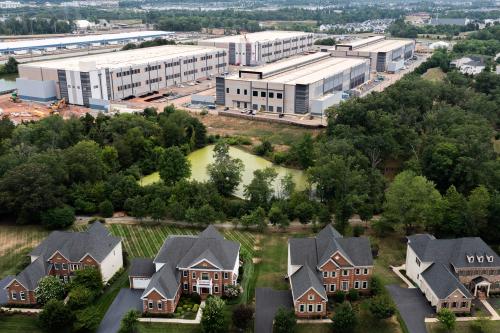
PIPA: From that example of mutual support in Eagle Butte, let’s move into the second season of Reimagine Rural to check in on Granville Township in central Ohio. Granville’s located on the edge of a $20 billion industrial development by Intel Corporation to build semiconductor chip fabrication plants on a former 800-acre hog farm. A massive project incentivized by subsidies in the CHIPs and Science Act of 2022.
The planned development had taken Granville and all the other surrounding jurisdictions by surprise, since they weren’t included in the dealmaking. When I visited in late 2023, construction was in full swing, with trucks lining a newly paved four-lane road. Progress, however, has hit a snag.
Here’s Bryn Bird, a Granville Township trustee.
[27:26]
BIRD: The CHIPS Act had promised about $20 billion investment to the Intel site here in Johnstown, Ohio. I think in the end they’ve only seen about $10 billion of that investment. But with the administration change, the current administration, the Trump administration, really pulled back on the CHIPS Act and the investments behind the CHIPS Act.
Also, Intel really slowed down their construction. You know, they they have had a lot of problems, you know, with their stock, with where they’re at. And so they announced in early January 2025 that they were slowing down. You know, originally this was all supposed to be done in 2026, which we all I think knew that was kind of a really hard deadline to have ever met.
But then they said, oh, 2028. Now they are saying, you know, fourth quarter 2031. And we continue to have announcements come down that they’re further slowing construction. The latest announcement was in July of 2025, where, you know, they said that it not even the first fab would be operational until the end of 2031.
PIPA: Not only has the project slowed considerably, the stability of Intel itself has come into question.
[28:45]
BIRD: In August of 2025, the current Trump administration did make an $8.9 billion investment into into Intel. In the Oval Office, Trump said that he was buying part of Intel. What they did was, you know, buy stocks and it was about $9 billion worth of stocks to kind of shore up some of that.
PIPA: All of this has created a great deal of uncertainty around the project, and raises questions about whether it will ever come to fruition.
[29:14]
BIRD: I asked Congressman Troy Balderson, you know, point blank. I said like, this has caused a lot of havoc of, like, are we preparing? Are we not? What’s happening? And he assured us, you know, that the biggest thing is there still is really no end user for the chips coming out of this Intel fab. And that they really have to solidify who will be the end user in order to, I think, really push the production forward.
I am not an expert on all the various chip manufacturing and the changes in the chips and what’s happening over in China, but I know that, like, they’re skipping generations. So as we’re, like, working to build a fab, they have already, like, skipped generations of what type of chips are coming out. And so, can we keep pace and will we build something that will be literally obsolete by the time our fab is built?
PIPA: Now, in the meantime, like Thomas and Davis, West Virginia, the two towns I revisited in our last episode, a new industrial development has replaced the concerns about the Intel mega site: data centers.
[30:20]
BIRD: Central Ohio has 110 data centers sited here. Just this week in Johnstown, Ohio, on the same road as Intel, another 136 acres were sold to a data center, which now brings that up to 800 acres go into a data center just on that same road.
PIPA: Proposals to site data centers have become ubiquitous across rural America. So while the focus in central Ohio has shifted from building semi-conductor fabs to housing warehouses full of computing power, what hasn’t changed? The concern about what this industrial development means for the area’s groundwater, which is so important for the area’s agricultural economy.
BIRD: And now what we’re seeing is the water, you know, speculation happening. Everyone’s saying Ohio really doesn’t have any groundwater laws and we’re allowing these companies to come and purchase farmland to take the water from underneath. And we don’t really know what is the ramifications of these decisions?
PIPA: Bryn pointed to the example of Utica, a small town that seemed beyond the development that kicked off with Intel’s investment.
[31:28]
BIRD: Out in Utica, Ohio, which is so far away, nobody ever thought it would be touched. It was like really far out. Oh, Intel won’t touch it. I think they all thought they were safe. They have a lot of great water and they’re now seeing farmland being purchased. You know, $20, $25 million I think for a hundred acres because there’s water underneath.
Farm Bureau just did a a a town hall meeting in Utica. I don’t even know if they have a full thousand people out there. It’s a very small village. Farm Bureau led the town hall, brought in all the people to talk about the water. And an hour before the meeting started, they were at capacity. They had people standing in the parking lots trying to hear, you know, what does this mean?
And some of the messaging was, oh, there’s nothing you can do about it, just try to get as much money as you can out of these deals. That was one message. And then some message was, you know, we need to push back. We need to ask for better regulations. We need to make sure our wells are being tested as this is happening.
PIPA: It’s become a real political issue.
BIRD: But there really still has not been a concerted effort about what regulations do we have for Ohio groundwater? Where are we going? I’ve met with both governor team’s candidates. We had an agricultural round table and all the agricultural groups. Really, that was the number one conversation, was what is the groundwater? What are you going to do about it?
PIPA: I asked Bryn whether the Framework process that we heard about in the 2024 episode, where the jurisdictions surrounding the Intel mega site worked together for a year to develop a shared vision for land-use and resource management, has helped.
[33:04]
BIRD: The communities that are committed have stayed in it and continue to work together and collaborate. There is an initiative between Granville, Alexandria, and Johnstown to have some of their own water and sewer joint governmental, you know, contracts, plans, work together, figure it out.
With the Framework, you know, we were only working with that core group of 16 and it was very focused around Intel. Well, now Intel may or may not be happening, and if it does happen, it’s not happening for at least, you know, six, seven years. And so I think that really took the wind out of the sails.
PIPA: It turns out that the process also did not extend far enough, given the development that’s happening now. In the end, Bryn still thinks Licking County needs to take a leadership role.
[33:53]
BIRD: Utica was not a part of that that group at all, because nobody ever thought it would leapfrog and get so far away so quickly. And so I think that Framework provided a really strong partnership at the time. And it really did help. But at the same time, I think it’s not as big as it needs to be, and the county still has not done a county comprehensive plan.
The county, they’re working on a land use plan at this point, but they, you know, the county has also continued to kind of not, I don’t think really have a seat at the table. They’re trying to say they want everybody to figure it out locally and come together.
PIPA: The aggressive development has continued to put pressure on property values, which was an issue when I visited previously.
[34:38]
BIRD: We all just went through our property value reevaluations, and farmers were seeing barns that went from a barn, you know, valued at $250,000 to a million because these property valuations were so extreme. Many townships saw a 70% increase in their properties. And our county auditor, you know, he fought the state saying, can’t I at least take out these, like, insane, speculative properties that were purchased by mega corporations that do not, it is not the same as grandma’s house four miles away. But they said, no, you know, you have to, you have to reevaluate all the properties.
And so we are all being, I mean, truly drowned in our property taxes, because of what is happening on some few properties where they’re selling, you know, land for millions, hundreds of millions of dollars, and how that affects all of our property values.
PIPA: That pressure on property values also puts pressure on the school systems that rely upon the revenue. All of this to say, it makes it hard for the local rural governments to manage.
Yet, there are some rays of light. In the 2024 episode, I experienced a contentious situation where an elected township trustee had sold farmland with abundant water to the company behind the Intel development. In the end, the Village of Granville was able to sign an agreement with the buyer so that they have a seat at the table when they are testing the land and getting ready to sell the water.
Bryn pointed out that there remain creative and collaborative ways that can enable these rural places to help steer all this activity in a way that protects the integrity of their communities.
[36:24]
BIRD: For me, with Granville, a lot of our character, and we’re so blessed, comes back to trustees. Years ago, there’s one trustee, Jim Havens, he was a trustee who started the open space program where we purchased farmland. And we purchased the development rights of farmland. So the farmers keep farming it. They own it, but they cannot break it apart and turn it into housing. And we financially compensate them through a tax that everybody pays into. So we’re the only township in Ohio who does it. We have over 2,200 acres protected.
And so our comprehensive plan is about to be adopted. And again, it’s where we we say that the values of our community are to, you know, put agriculture first, to remain small, you know, to remain focused on our local businesses.
We’re, again, the only community in Ohio where we write a joint comprehensive plan. So our village and our township, we stay, we’re working together. Most of the times, villages and townships work adversarially. You know, the township wants to protect all their land. The village wants to grow. And they can be very adversarial.
[music]
We work really hard. That we always joke, we’re like siblings.
PIPA: For my last check-in, I head west from the industrial development around the digital economy in central Ohio to the proposed industrial development around clean energy in rural northern California, where residents and Native Tribes in Humboldt County were engaged in trying to make sure that a huge, proposed development of offshore wind would benefit their communities.
That project was also a planned multi-billion dollar investment. Katerina Oskarrson describes the collaborative effort that formed to put Tribes at the table to help steer this project.
[38:12]
OSKARRSON: So, CORE Hub formed in 2021, initially to respond to our region’s climate and energy vulnerabilities. The original founders of CORE Hub were very concerned about energy developers attempting to build in Native American sacred places without Tribal Nations’ consent.
Then, in 2022, when Department of Interior licensed floating wind farms in the Pacific off of our coast, it was really a pivotal moment for for CORE Hub to focus on that issue. And so what we did was we convened a diversity of voices and especially of people who are generally underrepresented in big development projects, and most certainly the Native American stewards of these lands.
PIPA: Linnea Jackson, who’s general manager of the utility for the Hoopa Valley Tribe, is a member of CORE Hub.
[39:19]
JACKSON: So the Hoopa Valley Indian Reservation is located inland from where the actual industry would happen. We are located off the Hoopa 1101 Circuit, which has energy resiliencies issues. It is a, one of the worst poorest performing circuits in PG&E service territory. And that is due to the number of outages that are occur and the duration of those outages.
We were looking at grid development that would need to occur statewide in order to be able to transport the energy generated from this resource. Is there a way that those upgrades can provide resiliency and help strengthen the grid within our region?
CORE Hub was able to bring multiple disciplines to the table. So you had local and county elected leadership, you had Tribal Nations. And it really gave a holistic perspective on all of the facets that were needed for this upcoming industry,
PIPA: Katerina reminded me just how complicated it would be to create an offshore wind farm.
[40:22]
OSKARRSON: It’s not just offshore wind farms, right? It’s offshore wind farms; it’s a port development; it’s transmission development; supply chain; and and supporting infrastructure.
And so you have several sort of multi-billion dollar industries. Each has different developer, which is multinational company. And each component of the industry cluster is governed by different state, local, and federal policies.
PIPA: When I visited Humboldt County in February 2024, there was still an open question of whether the local community would even benefit from the power it would generate. Would it get to Hoopa Valley, for example?
OSKARRSON: When we last spoke, California state agencies were deciding whether there would be a local connection. And California independent system operator approved these transmission upgrades to support offshore wind development in in Humboldt. And it did include a connection to a local grid. If the transmission project moves forward, it would include, sort of, that increased capacity and reliability benefit to the area around Humboldt Bay, which is which is very good, but it wouldn’t address the issues that Linnea and other parts of Humboldt region are facing.
PIPA: So, some progress on that front, if not everything the group hoped for. They also made progress on steering the port redevelopment. But the change in presidential administration? It brought a major blow to the project.
[42:03]
OSKARRSON: In early 2024, the Humboldt Bay Harbor district, which is our port authority, was awarded $426 million dollars from the U.S. Department of Transportation. When the podcast aired in May 2024, the network was, I think, making really great progress in in shaping how that port side would be redeveloped, that included things such as advocating for development of state-of-the-art, zero emissions facility, basically to ensure it’s done in the greenest and cleanest possible way with zero emissions
We made a lot of progress on securing commitments around human safety. Especially focusing on issues of human trafficking and missing and murdered Indigenous people’s crisis that that we have in in a region.
And then, in August 2025, the the federal administration announced the cancellation of this funding.
PIPA: From Linnea’s perspective, this is a major setback, but it’s not the necessarily the end.
[43:17]
JACKSON: We’ve always been told that this is, you know, a 10- to 15-year project and maybe even further with full development of of all of the lease areas. So we knew this was a long-term project. But to have years and years of investment, of getting to understand the complexities, the nuances, and all parties involved to kind of have the rug pulled out from you so there was then lack of resources—a unknown capacity of whether this industry is still going to proceed is a major setback.
All of these become unfunded mandates, right? And so I no longer have, you know, funding to be able to participate this, even though we still want to … I, you know, with anything tides change, right? Large projects, you know, as you call them, have hiccups or setbacks. But we still want to be actively participating, as there are initiatives happening on on a state level. You know, California is is progressive. They have energy goals, which is quite different than some other states across the country. We are a pretty progressive state and we would like to keep in line with those climate and clean energy goals, and the Tribes are going to be a big part of that moving forward, including Hoopa.
PIPA: Indeed, the Tribe continues to move forward with its own projects to strengthen its resilience and have dependable energy.
[44:40]
JACKSON: We had a project called TERAS, which is Tribal Energy Resilience and Sovereignty, which was a multi-pronged application through the U.S. Department of Energy Grid Resilience and Innovation Partnerships, Redwood Coast Energy Authority—which is our local CCA—Schatz Energy Research Center, and four sovereign Tribes put an application in and was conditionally awarded for that.
And that was going to provide microgrids, you know, for this region. There would be, you know, a stronger, more resilient interconnection. But internally we are moving forward with our own initiatives to have Tribal microgrid build out.
And unfortunately within, in the beginning of this year, you know, the initiatives changed from a administrative level. And that has also been detrimental. Recently, within the last month or so, there was an initiative that ruled back $7.5 billion in clean energy funding. And the TERAS project was one of those projects that was unfortunately on that list, although we have not received an official project termination,
PIPA: CORE Hub and Hoopa Valley Tribe remain undeterred. They’ve experienced how long it often takes to enable such large-scale changes. When I visited previously, they had just begun the process of taking down the dams on the Klamath River, something that the Tribes had worked for decades to achieve.
[46:15]
JACKSON: So the removal of the Klamath dams obviously is is a huge win for the region, for the environment, for endangered species. You know, we’re looking at water quality, we’re looking at the return of salmon, we’re looking at increased spiritual and recreational resources.
I think it provides perspective that at some point where you think something is unachievable, you know, it’s just too large of an initiative to take on. Those types of things can be achieved with partnership with, and it wasn’t, you know, only the Tribes. It was working with so many different parties to come together. And I think that’s a a true model of of participation and cooperation between multifaceted entities to kind of achieve a large-scale decision.
PIPA: Linnea can envision what this means for the Tribe.
[47:12]
JACKSON: My hope for the future is for us to build infrastructure, to be a part of projects, but also have to simultaneously worry about and protect the environment, protect our homelands, protect cultural resources, providing projects that provide work resiliency and workforce initiatives, maybe some educational components. Tribes operating these facilities, including tribal microgrids.
[music]
And so I do believe that the future would be true partnership with Tribes having ownership and operation of our own infrastructure to build resiliency that we need, because some of these projects aren’t going to reach rural areas, which is what we’re talking about.
PIPA: Across all these places in rural America, I continue to hear several themes. A major one is the capacity of local residents and leaders to be involved, to collaborate, to influence and even direct what is happening in their communities. This means having the staff and the resources to be actively engaged, and to have planning and decision-making processes that put local leaders at the table.
All of these places have encountered unanticipated changes: a natural disaster, new development proposals, significant shifts in federal and state policy. These local leaders have needed to be adaptive and nimble to react while keeping larger goals and vision in mind.
And running through it all is commitment. Consistency. Persistence. Changes for the better take time; transformation takes longer still. These stories, they highlight just how important it is for there to be leaders, residents, and groups who are committed for the long haul. My ongoing conversations with rural Americans show just how widespread pride in their places is across the country. It’s that love for their place that makes them committed. And that love of place is what gives them hope.
Thanks for listening.
[music]
My sincere thanks to all the people who shared their time with me for this episode.
Many thanks to the team who makes this podcast possible, including Fred Dews, supervising producer; Molly Born, producer; Gastón Reboredo, audio engineer; Daniel Morales, video manager; Zoe Swarzenski, senior project manager at the Center for Sustainable Development at Brookings; Adam Aley and Elyse Painter, also in the Center for Sustainable Development, who provide research support and fact checking; and Junjie Ren, senior communications manager in the Global Economy and Development program at Brookings.
Also, my sincere thanks to our great promotions team in the Brookings Office of Communications and Global Economy and Development. Katie Merris designed the beautiful logo.
Finally, support for this podcast is provided by Ascendium Education Group. The conclusions and recommendations of any Brookings publication or podcast are solely those of its authors and speakers, and do not reflect the views or policies of the Institution, its management, its other scholars, or its funders. Brookings recognizes that the value it provides is in its absolute commitment to quality, independence, and impact. Activities supported by its donors reflect this commitment.
You can find episodes of Reimagine Rural wherever you like to get podcasts and learn more about the show on our website at Brookings dot edu slash Reimagine Rural. You’ll also find my work on rural policy on the Brookings website.
If you liked the show, please consider giving it a five-star rating on the platform where you listen.
I’m Tony Pipa, and this is Reimagine Rural.
Participant
HOST
More information:
- Listen to Reimagine Rural on Apple, Spotify, or wherever you like to get podcasts.
- Learn about other Brookings podcasts from the Brookings Podcast Network.
- Sign up for the podcasts newsletter for occasional updates on featured episodes and new shows.
- Send feedback email to [email protected].
- Find out more about the Brookings-AEI Commission on U.S. Rural Prosperity.
- Discover more research on Reimagining Rural Policy.
The Brookings Institution is committed to quality, independence, and impact.
We are supported by a diverse array of funders. In line with our values and policies, each Brookings publication represents the sole views of its author(s).

Commentary
PodcastProgress reports: Revisiting people and places from Reimagine Rural
Listen on
Reimagine Rural
January 6, 2026