On February 21, 2026, Andrew Yeo, senior fellow and SK-Korea Foundation Chair, joined two leading experts—Professor Victor Cha, president of the Geopolitics and Foreign Policy Department at the Center for Strategic and International Studies and distinguished professor at Georgetown University; and Professor Dukgeun Ahn, former dean and professor of international trade law and policy at Seoul National University and also former minister of trade, industry, and energy for the Republic of Korea—to discuss the state of U.S.-South Korea economic relations. The edited transcript below captures their assessment of the Supreme Court’s ruling on the International Emergency Economic Powers Act, the bilateral trade relationship, economic security, and navigating U.S.-China competition.
Andrew Yeo:
We are here on the sidelines of the Trans-Pacific Dialogue in Washington, DC, to discuss U.S.-South Korea economic relations. Yesterday, February 20, the U.S. Supreme Court ruled against U.S. President Donald Trump’s reciprocal tariffs imposed on countries, including South Korea, arguing that the president overstepped his authority by invoking the International Emergency Economic Powers Act (IEEPA). What is your initial assessment of the Supreme Court IEEPA ruling, and how might it affect trade relations with South Korea, including Trump’s standing threat to raise tariffs?
Victor Cha:
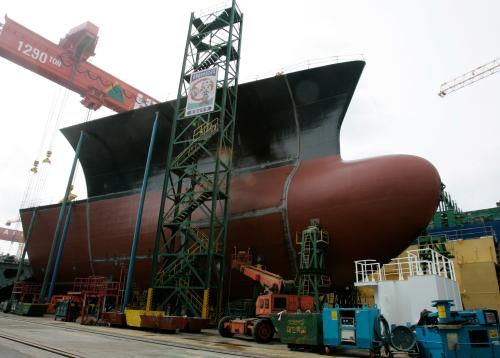
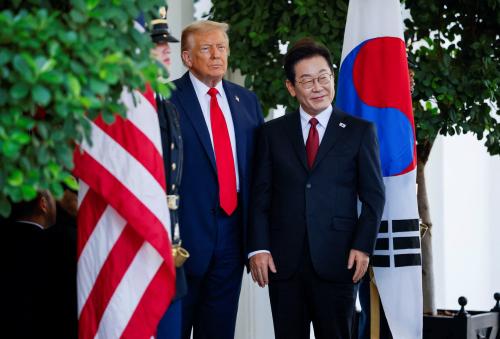
The premise of the bilateral trade and investment framework outlined in a November 2025 joint fact sheet was to reduce the 25% tariffs that Trump had put on South Korea. We’re now in a situation where the legal rationale for tariffs has been undermined by the Supreme Court. Yet it’s most likely that the Lee government will not want to change or reopen the agreement that it has made with the United States. So, even though there might be an opportunity for President Lee Jae Myung to say, “Hey, we’re not at 15% anymore. We’re at zero,” South Korea is in a position where the Lee government may prefer to just keep tariffs at 15%. But that’s largely because of all the other equities in the joint fact sheet that are valuable to both countries, such as shipbuilding and potentially nuclear submarines for the U.S. side. Seoul and Washington worked very hard to make a trade deal happen, and I don’t think any side wants to reopen those issues.
Lee, however, might face domestic criticism from people within his own party, who are actually saying, “No, we want to reopen trade negotiations.” Not because they want to lose the shipbuilding or nuclear submarine agreement, but because they want to lower the $350 billion in investments Lee pledged to initially reduce tariffs from 25% to 15%. But reopening trade negotiations could be a disaster for Seoul. If Trump is already upset that the investments are not moving quickly enough, and he hears that the Korean side wants to reduce that number because of the Supreme Court ruling, he’ll go ballistic.
Andrew Yeo:
Minister Ahn, before the IEEPA ruling happened, I was initially planning to open our discussion by asking your thoughts about President Trump’s threat to raise South Korea’s reciprocal tariff rate back to 25%. Was there any validity to Trump’s accusations that South Korea was moving too slowly on investments or had not fulfilled its commitments in areas related to non-tariff barriers and digital services? With the IEEPA ruling, has the United States now lost some of its leverage to push Seoul on these other issues?
Dukgeun Ahn:
As Victor explained, I don’t think the overall trade and investment framework between the two countries will be affected too much. The agreement was not based on any international rules or norms but was essentially a deal negotiated bilaterally. Now that IEEPA measures no longer work, Trump may use other domestic, legal measures. He’s turned to Section 122 of the Trade Act of 1974 to impose a 10% global tariff on countries. If that doesn’t work, they will change it to Section 301 that addresses trade agreement violations or unreasonable or discriminatory practices burdening U.S. commerce, or Section 232 of the Trade Act of 1962.
The Trump administration will try to determine the tariff level depending on the domestic situation, and the Korean side essentially has little choice but to simply accept that. Moreover, based on the language in the memorandum of understanding, the investment package is independent from these tariff arrangements. So, other arrangements will not be affected by the ruling on IEEPA. But as Victor mentioned, Trump’s tariffs for many other countries may provoke a huge domestic political controversy if opposition parties in those countries try to raise this issue.
Andrew Yeo:
Does the Supreme Court ruling inject more or less uncertainty for global trade moving forward? On the one hand, you could argue that reciprocal tariffs under IEEPA were struck down, so that tool is gone. But as you mentioned, Minister Ahn, there are other tools like Section 232 or Section 122 that Trump has invoked to levy new 10% tariffs. Given these other potentially available tools that Trump might deploy, do you see ongoing uncertainty when it comes to trade? And if I could follow up, will there be any spillover effect on the security relationship and U.S.-South Korea alliance modernization?
Victor Cha:
The IEEPA ruling creates more uncertainty in the markets and for businesses. There are 10% tariffs now, but no one knows what’s going to come after that. Countries and businesses will have to hold still and tread water for the next four to five months.
Whether economic uncertainty spills over to the security side, right now, it doesn’t look like it. The additional spending on buying U.S. military equipment, the additional spending on improving combined U.S. and South Korean discussions on wartime operational control—all these things appear to be moving forward. South Korea has committed to increasing defense spending by 3.5%, and in virtually every public forum, Elbridge Colby at the Pentagon refers to South Korea as a model ally.
So, overall, the alliance modernization effort seems to be progressing. The wildcard, of course, is if there’s something that upsets Trump again, such as the National Assembly not advancing the legislation needed to release the first tranche of the $20 billion investments to the United States. Trump might try to leverage something on the security side, but I don’t think you can draw a direct line between the Supreme Court IEEPA ruling and something negative happening in terms of the security equities of the relationship.
Dukgeun Ahn:
I believe the IEEPA ruling will cause much more uncertainty. Currently, Section 122 can last for only 150 days. After that, the Trump administration will have to find another mechanism. Now, it looks like the administration may try to take action using Section 301 (note: the U.S. Trade Representative employs 301 tariffs against countries it deems as having “discriminatory” or “unfair” trade practices). But 301 targets particular countries and basically blames a country for doing bad things.
For example, suppose that the Trump administration adopts 301 measures against South Korea, saying that it is engaged in unjustifiable trade practices that burden the U.S. economy. The Trump administration is basically blaming the Korean government for illegal trade practices. Such accusations would not just be economically but also politically difficult for the Korean side to accept. After the Supreme Court ruling, some countries, such as Brazil, India, China, or even the European Union, may not easily be able to adapt to new measures. So, the path forward looks more uncertain and dangerous.
Andrew Yeo:
I’m going to shift gears a little bit and talk about economic resilience, which has become an increasingly important issue in U.S.-South Korea relations. Victor, you just published a book, “China’s Weaponization of Trade,” which argues that the United States and its allies—including South Korea—should build coalitions to de-risk and strengthen collective resilience against Chinese economic coercion. Are initiatives such as the Mineral Security Partnership (which South Korea helped lead last year) or the Trump administration’s recent launch of the Forum on Resource Geostrategic Engagement the types of collective resilience you had in mind?
Victor Cha:
China has been weaponizing trade with countries and companies around the world for well over 30 years. In the book, we catalog over 600 known cases of China’s use of economic coercion against 18 governments and 470 companies on issues related to Tibet, Taiwan, Tiananmen Square, and human rights in Xinjiang. In the book, we discuss that all the countries coerced by China need to de-risk by building more resilient supply chains, but they also need to come up with a deterrent strategy for stopping China from using economic coercion willy-nilly.
There are two elements of collective resilience. One is a focus on building resilient supply chains, particularly when it comes to critical minerals. And then the other is to also have some sort of coalition of countries. If China uses economic coercion as a regular tool of diplomacy, we are going to impose costs on China for using that sort of strategy.
Andrew Yeo:
Professor Ahn, when you were serving as minister of the Ministry of Trade, Industry, and Energy, collective resilience and critical minerals came to the forefront with the shortage of germanium and gallium in 2023. How did critical minerals factor into South Korea’s economic security strategy?
Dukgeun Ahn:
Critical minerals are actually the flip side of the semiconductor export controls imposed by the United States. The United States is blocking semiconductors, but China is not blocking critical minerals since it also needs semiconductors, which depend on minerals. If they block critical minerals, then they cannot use semiconductors.
But China may gradually increase export controls on rare earth minerals as it becomes more autonomous in manufacturing semiconductors. If it can produce semiconductors domestically, then it has more space to block rare earth minerals. In the future, countries will need to manage the supply chain risk, but recently, more countries have seen the United States as another risk factor. As you see from the recent speech by Canadian Prime Minister Mark Carney or many reports from think tanks in the middle powers, such as the U.K., Canada, Australia, and Germany, it looks like there’s an awakening as countries try to find alternative arrangements.
Andrew Yeo:
President Trump is expected to travel to Beijing at the end of March, where he may seek a trade truce or adjustments to export controls in exchange for greater market access. What will Seoul be paying attention to in a meeting between Xi Jinping and Trump? Where might U.S. and South Korean interests converge or diverge on export controls, investment screening, and sensitive technologies in the context of U.S.-China strategic competition?
Dukgeun Ahn:
Like many other countries, South Korea is cautiously watching to see whether a U.S.-China agreement or “compromise” will help only U.S. industries and companies or if this arrangement can prevent China from taking coercive measures for overall supply chains. For example, if a compromise on export controls prevents China from withholding rare earth minerals this year and next year, then other countries in the global economy will benefit.
But if this arrangement only allows U.S. companies to have exclusive access to these materials, then other countries in the global economy will suffer a lot because of supply chain disruption by this arrangement. In that case, a U.S.-China bilateral compromise might create huge distortions. It would also make it possible for China to use its deal with the United States as a negotiating chip against other countries. The latter scenario will probably push more countries toward China, contrary to what the United States may have intended or designed with the deal.
Victor Cha:
Let me add a couple of points. On semiconductor chips, there is a degree of decoupling taking place at both ends of the supply chain. At the high end, it’s export controls by the West. At the lower end, it’s the input, the minerals coming from the Chinese side. But Minister Ahn makes an interesting point about how, in that sort of tradeoff, China is disadvantaged because it can’t decouple on critical minerals, because then it will lose all access to the finished product (i.e., chips).
At the same time, that also sheds light on Trump’s recent decision to supply the H200 Nvidia chip to China, because then that is basically losing leverage on critical minerals. The second point is on the upcoming summit. I entirely agree with Minister Ahn. The scenario that I worry about as it relates to Korea is that Trump will cut some sort of deal that again staves off any critical minerals pressure from China for another year or until the next summit, in return for some market access and some agricultural products.
But, if at the same time, it does nothing for South Korea, and then China moves on to an economic coercion campaign against Korea with regard to the nuclear submarine deal with the United States—we saw early evidence of this right after the U.S.-South Korea shipbuilding agreement, where China threatened five U.S. subsidiaries of Hanwha Ocean—a truce between Trump and Xi would not help Seoul. So, for me, it’s entirely possible that, at some point, China will enact some sort of economic coercion campaign. And it could be unannounced and very subtle, perhaps on some form of critical minerals, to put pressure on the Lee government to step away from the nuclear submarine deal. China would not put pressure on the United States, but it would instead pressure South Korea. That would be a very bad scenario.
Authors


Related Content
2025
The Brookings Institution is committed to quality, independence, and impact.
We are supported by a diverse array of funders. In line with our values and policies, each Brookings publication represents the sole views of its author(s).
Commentary
Navigating uncertainty in US-ROK economic ties
March 6, 2026