As the Islamic Republic continues its violent crackdown on political protesters, Brookings Foreign Policy scholars examine whether this crisis will prove to be the tipping point for Iran’s government.
Muslim governments’ silence and the politics of regime survival
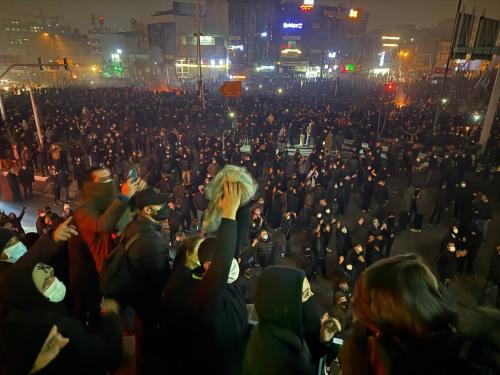
The scale of violence deployed by Iran’s security forces against protesters has been staggering, even by the standards of the Islamic Republic. Thousands have been killed since demonstrations began, with many more detained or tortured.
Yet across much of the Middle East, Muslim-majority governments have remained conspicuously quiet. Expressions of concern, if they exist at all, are carefully calibrated and devoid of moral condemnation. Instead, regional powers appear focused on preserving the status quo—passing messages to the Trump administration in hopes of deterring another costly U.S. intervention or regime-change operation. This impulse has brought together unlikely actors: Iran’s former adversaries, such as Saudi Arabia and the United Arab Emirates, alongside onetime champions of the Arab uprisings like Turkey and Qatar, all quietly backchanneling for an off-ramp.
Concerns about regional turmoil are understandable. The Middle East is exhausted after years of war in Syria, Yemen, and Gaza. A direct confrontation with Iran could draw in Israel and ignite a wider conflict. Gulf states fear disruptions to energy trade and retaliation from Tehran, while Turkey worries about refugees and the possibility that unrest could empower Iranian Kurds, creating a contiguous Kurdish zone stretching from Iran through Iraq to Syria.
But geopolitics alone does not explain the silence. Most regional powers are themselves autocratic—and deeply wary of mass protest. Iran’s uprising is leaderless and driven by broad social grievances, evoking uncomfortable memories of the Arab Spring. For governments that survived those uprisings through repression, co-optation, or external backing, the lesson was not reform but deterrence.
Publicly championing Iranian protesters would therefore set an awkward precedent. It would legitimize the idea that sustained street mobilization can bring down entrenched regimes—an idea most Arab governments, and increasingly Turkey, have worked hard to discredit at home. In this sense, Tehran’s repression is not an aberration but part of a shared regional playbook: criminalize dissent, securitize society, and frame protests as foreign conspiracies.
The result is a moral asymmetry—one to which Arab states and Israel appear equally prone. Muslim leaders and institutions such as the Organization of Islamic Cooperation, which have spoken daily about Gaza, have largely avoided condemning Tehran’s shoot-to-kill orders. Gaza rightly commands global outrage—but so does Iran. The silence on Iran suggests that, in today’s Middle East, solidarity stops where regime survival begins.
A weaker Iran is bad for Hezbollah but good for Lebanon
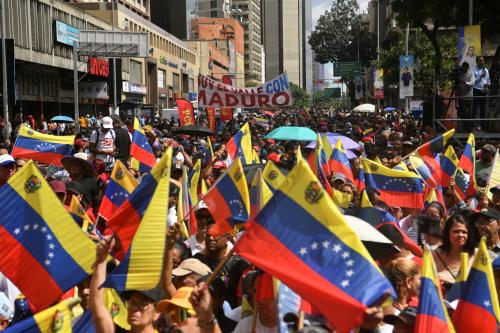
Hezbollah, the onetime crown jewel in Iran’s proxy network, is down but not out. Bashar al-Assad’s overthrow complicates Hezbollah’s arms smuggling, and Nicolás Maduro’s seizure seals a favored venue for money laundering and illicit gold transfers. Despite a November 2024 ceasefire, Israel, having already degraded Hezbollah’s arsenals and decapitated its leadership, continues to pound alleged Hezbollah targets in Lebanon, amidst unrelenting U.S. pressure for Hezbollah’s rapid disarmament.
Hezbollah’s biggest blow could be yet to come: losing Iranian support. Logistically, Iran already faces obstacles in supporting Hezbollah, not only because of Assad’s fall and Israeli intelligence penetration but also due to increased Lebanese vigilance (including searches of Iranian diplomatic baggage). The current Iranian protests could doom the Iranian-Hezbollah partnership altogether.
If the regime collapses, whatever comes next—a successor government or internal struggle—will not prioritize Hezbollah (and may denounce the group to highlight the Islamic Republic’s misrule). Even if, as seems more likely, regime brutality quiets the Iranian streets for now, Iran’s leaders have no solutions to the economic catastrophe that provoked the protests—and diverting scarce funds to the “axis of resistance” could reignite popular rage.
Iranian Foreign Minister Abbas Araghchi noted communications with the Trump administration, desperately hoping that nuclear diplomacy might this time (unlike in June) prevent U.S. military action. Given the wreckage of Iran’s nuclear program, Araghchi might find more interest in Washington with an offer to direct Hezbollah to disarm and demobilize.
Iran’s weakening and Hezbollah’s degraded capacities have already facilitated Lebanese initiatives that would have once been unthinkable. Last week, the Lebanese Armed Forces (LAF) announced the completion of the first of five disarmament phases (a move the Israelis called “encouraging” but insufficient). Breaking a decades-long taboo, the Lebanese government authorized direct civilian talks with Israel, with two rounds in December. In another unprecedented move, the LAF, responding to information from the U.S.-led mechanism set up under the November 2024 ceasefire, has raided private houses, searching for weapons. But Lebanon will not be truly sovereign until Hezbollah is forced to fully disarm and demobilize. This becomes easier as the Islamic Republic’s sponsorship weakens along with the regime.
Iran’s uprising is at a turning point
Structurally, the Islamic Republic is a tough regime for protests to topple. With oil wealth, ideologically loyal security forces, and some genuine popular support, it has been able to put down four mass uprisings in the last two decades. This time, however, intense pressure from sanctions, crippling inflation, a string of military defeats, a looming succession crisis, and the wild card of potential American intervention all make the regime’s survival more uncertain.
The regime, for its part, is not taking any chances, meeting the protests with an unprecedented level of repression. Even the official estimate of 2,000 people killed is significantly more than any of the previous four uprisings. The word “massacre” is undoubtedly appropriate.
In the history of revolution, massacres are often pivotal turning points, for good or for ill. They could crush the movement, like in Tiananmen Square. They could transform the struggle into an insurgency and civil war, like in Syria in 2011. Or they might embolden protesters to redouble their efforts, like in Sudan in 2019. Indeed, in Iran back in 1978, it was the massacre of Black Friday that galvanized the protests into revolution. If Iranians today take those lessons to heart, and double down on peaceful resistance, they may begin to demoralize the security forces and initiate a cascade of defections that collapses the regime. All revolutions seem impossible, until they become inevitable.
Will there be a day after in Iran?
The future of Iran’s embattled and weakened regime has never seemed more precarious. The most recent wave of mass protest, seemingly larger and more widespread than those that erupted in 2019 and 2022, may be a tipping point. Or not. Regime security forces killed an estimated 1,500 people in the “Bloody November” protests in 2019. The death toll in the current protests will likely be even higher. And thus far, the regime has shown few internal cracks. Nonetheless, there is far more uncertainty today than in earlier protest waves about whether the regime can kill enough Iranians to hold onto power. The depth of its economic and ecological crises, the weakening of its regional allies, and the aftermath of Israeli-U.S. strikes have created an unprecedented level of vulnerability for Iran’s leadership.
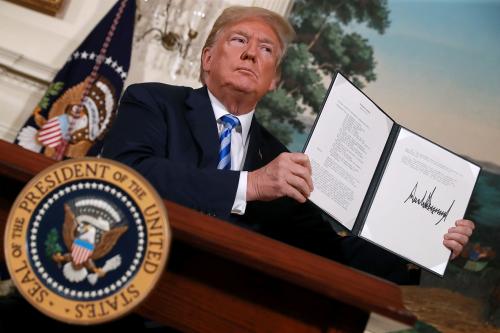
Whether President Donald Trump acts on his threats against the regime, and whether military action would have its intended effects—highly uncertain—it will be critical to assess what might follow the regime’s collapse, and how anything the United States does might affect the odds of a transition to something other than a more repressive replacement. The regime may be illegitimate in the eyes of many, if not most, Iranians, and the case for political transition is indeed compelling. Yet the administration’s bomb-first, plan-later approach—coupled with its lack of concern for what follows—will do little to help Iranians striving to build a better future.
Instead, it could be the prelude to something even worse.
An uprising like no other
Iran is undergoing the most dramatic upheaval since the 1979 Islamic Revolution. Its economy is collapsing. Political frustration has mounted. This discontent is occurring against the backdrop of profound Iranian weakness across the region, given that its closest partners have been devastated or deposed, including Hezbollah, Hamas, and the Assad regime in Syria. And the 12-day war this summer further demonstrated the regime’s vulnerability, given how deeply Israel penetrated the Iranian leadership and its system, and how easily the American military attacked its major nuclear sites.
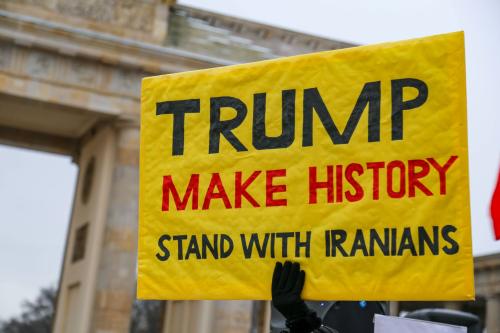
As massive protests engulf Iran, and the regime responds with violence and vitriol, there are four simultaneous dynamics that make this moment unique. First, the geography: protests are ubiquitous around the country. Second, the diversity of the protesters, who represent a wide range of Iranians. Third, there is some effort to rally around Reza Pahlavi, the shah’s son, who was overthrown by the Islamic Revolution in 1979. And fourth, the United States has threatened to use force in support of the protesters. Given that Trump previously authorized military strikes on Iran, these threats hold at least some credibility. How these four elements play out, and the extent to which the regime in Tehran continues responding with violence to protesters’ demands, will determine how this phase of the Iranian uprising develops. This may be the beginning of the end of the Iranian regime, but that journey could easily take a very long time.
Colin Powell’s warning
Writing back in 1992, Chairman of the Joint Chiefs of Staff General Colin Powell warned in a famous Foreign Affairs article about a tendency of civilian policymakers that he’d observed in the Vietnam War: “They like to try a little bit of force, and if that doesn’t work, try a little more.” It is worth bearing that comment in mind today.
To be sure, the United States has sometimes successfully pushed strongmen out of power with limited uses of force and gotten better outcomes as a result. Ferdinand Marcos in the Philippines in 1986 and Manuel Noriega in Panama in 1989-1990 come quickly to mind. (Earlier, there had also been several CIA-assisted coups—as in Iran, the Democratic Republic of the Congo, and Chile—though those usually wound up leading to worse governments in the end.) The verdict on Venezuela this year is still very much out.
But in the current context, with Trump asserting to use limited military force to protect civilians in Iran, a different set of cases comes to mind. Collectively, they caution against the expectation that a limited dose of force can make things better and stop the killing or improve the humanitarian situation. I would cite the following potential precedents as cautionary notes:
- Somalia 1992-1993, where what began as a humanitarian relief operation ultimately led to “Black Hawk Down.”
- Kosovo 1999, where a limited set of air strikes originally expected to protect the Kosovar Albanians from Slobodan Milosevic’s Serb militias led to a dramatic worsening of the situation until the air campaign was dramatically escalated (producing success after 2.5 months).
- Iraq 2003, where the initial American attempt at a “shock and awe” air campaign to drive Saddam Hussein from power failed; the United States wound up on the ground for more than eight years.
- Libya 2011, where an Obama administration decision to work with NATO allies to protect endangered Libyan civilians, which was predicted to be brief, lasted six months, ultimately contributing to the death of Moammar Gadhafi and anarchy (that continues to this day).
Where such operations have worked, as in Afghanistan in 2001 against the Taliban and in Iraq in 2014-2019 against the Islamic State, they required capable coalition partners on the ground, teamed with U.S. airpower and special forces. I am highly wary of getting involved in the current situation.
Why Arab Gulf states fear US military action against Iran
While Arab Gulf states have almost universally seen Iran as a major regional foe ever since the 1979 Islamic Revolution, they are not aligning with Trump’s threats to take military action against Tehran. Instead, they are counselling against a new war in their immediate neighborhood—even as they recognize that a regime they have long despised appears increasingly vulnerable.
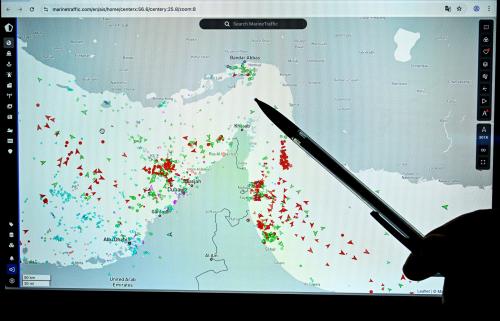
One reason is obvious. A war could expand into their own territories, a risk that has led the Gulf states to favor containment and pressure over open warfare with Iran. Yet there is something even bigger today: The regional strategic picture has dramatically changed. For several Arab states—with the likely exception of the United Arab Emirates (UAE)—Israel is now seen as a bigger strategic threat than Iran. Thus, some Arab states fear that the collapse of the regime in Tehran will not only impact their economies and security but also make Israel the biggest strategic winner at their expense.
These fears have sharpened amid the evolving confrontation between Saudi Arabia (supported by Egypt and other Arab states) and the UAE in Yemen, Somalia, and Sudan. Saudi policymakers increasingly interpret the UAE’s interventions around the region as part of a growing strategic alignment with Israel—one that risks encircling them at a time when they fear Israeli regional hegemony. The Saudis still hope for improved future relations with Israel, but they have real fears that, regardless of the costs of U.S.-Iran military confrontation, the net result will enhance the prospect of Israel’s regional domination.
Certainly, it strains credulity to argue that Trump is being motivated by sympathy for the Iranian people, particularly after allowing the far greater horrors in Gaza to unfold for two years. But Washington’s effort to frame potential military action against Iran in humanitarian terms only deepens regional unease, as autocratic Arab regimes fear that such justifications could one day be turned against them.
Authors





Related Content
The Brookings Institution is committed to quality, independence, and impact.
We are supported by a diverse array of funders. In line with our values and policies, each Brookings publication represents the sole views of its author(s).
Commentary
Is Iran on the brink of change?
Brookings experts weigh in
January 15, 2026