




In recent days, the Iranian regime has conducted an unprecedented and bloody crackdown on protests across Iran. In this episode, Brookings Fellow Aslı Aydıntaşbaş is joined by two Iran experts, vice president of Foreign Policy Suzanne Maloney and visiting fellow Mara Karlin, to discuss the unique nature of the protests and the regime’s violent response, options for U.S. military action, and President Trump’s possible endgame.
Transcript
MALONEY: After about two weeks of protest, the regime escalated to a point that we’ve never seen before with really brutal violence across the board, indiscriminate killing of protestors on the street. But the regime did manage to silence people, and I think at this point in time, Iranians are simply trying to pick up the pieces to try to ascertain where their family members, loved ones, who went to the streets might have been to try to recover from this incredibly brutal episode. But also, I think to look toward the future and possibly another round of protests.
[music]
AYDINTAŞBAŞ: Hello everyone. Welcome to The Current. My name is Aslı Aydıntaşbaş and I’m a fellow at the Foreign Policy Program at Brookings Institution. I have here today two amazing colleagues to talk about Iran, the very dark chapter in the history of Iran after massive protests and a crackdown.
On my left is Suzanne Maloney, the vice president of Brookings and the director of Foreign Policy and also a preeminent Iran expert. Welcome to the current Suzanne. And also with us is Mara Karlin, a visiting fellow of Foreign Policy and former assistant secretary of defense for strategy plans and capabilities.
Suzanne, I want to start with you. It seems like the recent wave of protests have somehow died down. Where are things at the moment after such a brutal crackdown?
[1:35]
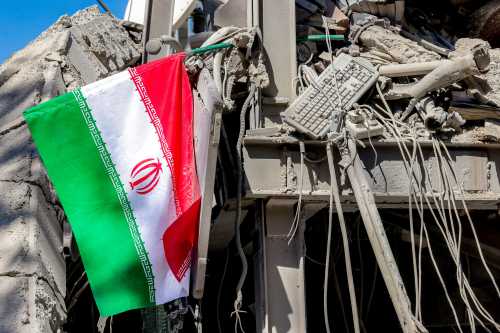
MALONEY: I think today Iran is in a state of shock and grief and discovery of just how horrific the crimes of this regime against its own people have become with a crackdown as unprecedented in Iranian history and really at a scale that is, has few comparisons in recent history of the region.
We know that the protests began as a result of economic conditions, but very quickly turned into anti regime protests. There were many who were shouting slogans in favor of a return of the Shah and the monarchy that preceded the current regime before its own overthrow in the 1979 revolution.
And for the first few weeks, those protests were relatively quiet in terms of the regime’s response. But then after about two weeks of protest, the regime escalated to a point that we’ve never seen before with really brutal violence across the board, indiscriminate killing of protestors on the street.
Iranians have been kept off the internet by a blackout, but it’s not entirely clear how how sustainable that will be. They are now focused on retrieving the bodies of friends and family of trying to de developed some kind of a reasonable estimate of how many thousands may have died and been injured in this really brutal crackdown that the regime unleashed.
[2:55]
AYDINTAŞBAŞ: And unprecedented even by the standards of this regime, right?
[2:59]
MALONEY: Absolutely unprecedented. This regime has used violence really since its inception. But this open gunfire on the street, mowing down large numbers of innocence who were protesting against both the economic conditions, but also demanding some kind of change in the nature of the regime and its engagement with the world is something that we’ve never seen before. The regime has used varying levels of violence in prior rounds of protests, but not the kind of indiscriminate killing of at least thousands. We don’t know the exact number yet.
AYDINTAŞBAŞ: I’ve seen as high as 18,000.
MALONEY: I think that’s a credible number. We know that there were protests taking place all around the country and that this kind of random violence was used in in a number of cities. But at this point, given the communication challenges and given the fact that so many people are still trying to identify and locate family members and friends, I don’t think we have a, yet, a a reasonable tally
[3:56]
AYDINTAŞBAŞ: We should add too, for our listeners, that you have personally witnessed protests in Iran when you were a researcher working on Iran in 1999.
[4:08]
MALONEY: This is true. I I landed in Iran on the night that the Iranian regime broke up protests that were taking place at Tehran University. That was much smaller and more isolated in some respects, but it was the first of what became a series of increasingly large uprisings against this regime.
And I think that, you know, what we’ve seen over the course of late 2025 and early 2026 is just the culmination of a of a wider and deeper sense of disillusionment with the regime, discontent with the Islamic Republic, and determination on the part of Iranians to try to change their political fate.
[4:43]
AYDINTAŞBAŞ: Well, Mara, I want to turn to you. Both you and Suzanne have written about the unique nature of these protests and the sociology behind it and so on, and why it may be different from the previous cycles of protests and repression that Suzanne has described.
But I want to bring you in as a U.S. government explainer at this moment. Please tell us what happens inside U.S. government when something like this happens, when an adversary, a longtime adversary, is is faced with massive protests. What are the dilemmas that policymakers are facing? What are the mechanisms in place to discuss something like this and what the options are?
[5:22]
KARLIN: Absolutely. You know, one thing that makes this moment a little bit unique as well is that President Trump has loudly proclaimed support for the protestors. Tweeting things like “help is on the way,” encouraging them to take over government institutions. So what we would see happen within the U.S. government is some sort of convening across the interagency, in particular across the Department of Defense, as folks started to brainstorm options, what’s possible, what could be achieved. And given President Trump’s enthusiasm for potentially using force in this case, and of course this is notable since just about six months or so ago, he actually used force against Iran and and hit its nuclear targets as you’ll recall. You know, I assume that that’s probably a pretty intense process.
And right now folks in the Pentagon could be looking at kind of a number of different things, probably thinking about two different approaches. The first approach is what are the things you can do to help get the protestors’ voice out so we can find out the details of so much of what Suzanne is is raising? And the other piece is what can you do to try to slow down or impede the regime’s efforts to murder the protestors?
[6:34]
AYDINTAŞBAŞ: Are we sort of to to think that maybe military option, use of U.S. military has limited impact on the ground in terms of regime change. Maybe I’ll turn to Suzanne, because you’ve written about this in the New York Times. What tools does U.S. have at this moment?
[6:53]
MALONEY: Well, I’m interested to see, hear what Mara has to say because she’s actually been in the position of having to make these kinds of determinations. But my sense is that given our track record in this part of the world in particular, our ability to shape positive change on the ground through military force, particularly if we’re unwilling to put boots on the ground, is going to be inherently limited. There are certainly ways that we could disrupt the regime’s course of capabilities through military strikes. There are also other alternatives to try to achieve that same end.
Ultimately though, people on the streets are not necessarily going to be able to rise up and overturn a regime as well entrenched as the Islamic Republic has been without the development of an alternative political leadership, a political movement that can in fact contest and even negotiate with the regime.
And so we really need to do much more work in terms of helping to support and build an opposition in Iran to encourage defections from the regime that might actually create a pathway to some sort of different alternative. President Trump has obviously used military force successfully in trying to decapitate other regimes, particularly the Maduro regime in Venezuela.
I don’t think that that’s a viable option for Iran, simply because this is a regime that has spent 47 years tried to buttress its hold on power. There’s a symbiotic relationship between the clerics who lead the state and the praetorian guard, the military, the Revolutionary Guard, and others who uphold that power. They’re very much all in it together, and they’re unlikely to turn on one another even in the face of American military force.
[8:25]
AYDINTAŞBAŞ: Mara, I will come back to you. First, is there anything else you would add to that list of options for United States?
[8:33]
KARLIN: Absolutely. So there’s non-kinetic, so not using force overtly, and then kinetic options that the U.S. military would have. So non-kinetic would be things like help get the protestors access to more Starlink modems, for instance, so they can get out the details of their experience. Kinetic options could be things like hitting persona targets, like potentially the Supreme Leader or people around him, or hitting certain places. You can imagine, like, you know, government buildings.
The U.S. military, the U.S. government can do a whole bunch of stuff. I think the question is to what end? What impact is it actually going to have on the ground? And right now, this is a particularly ripe issue because President Trump has sent a carrier strike group, the Abraham Lincoln, out to the Middle East. There have been U.S. fighter jets that have arrived in the region. And so you’re seeing a real effort to do what’s known as “set the theater,” to put kind of a a heavier, sort of fatter military posture, more military capabilities around the region in case there’s a desire to use force.
I guess what I wonder is if the U.S. and Iranian clocks are a little bit off right now.
AYDINTAŞBAŞ: Tell me.
[9:44]
KARLIN: So what I mean by this is, is last week was really I think where we saw the apex of these protests and all of the horrific violence. And that has slowed down a whole lot, and it’s slowed down not least because of the regime’s response.
And yet when you look at the U.S. piece, the U.S. is sending all of these military capabilities, but they’re not there yet. Right? And so when the president made the decision to send a number of them, that was probably last Wednesday or so, right? About a week or so from where we are, and they’re not even there yet, many of them.
[10:17]
AYDINTAŞBAŞ: For our listeners who may not all be experts on Iran, what happens if United States was to take down Iran’s spiritual leader, Ayatollah Khamenei? What would happen? What would the impact be?
[10:30]
KARLIN: So from a purely operational perspective, it depends on how the operation actually goes. And this is where I really agree with Suzanne, that using the Venezuela Maduro case study is not exactly right. That went extremely smoothly. We lost zero U.S. service members. I mean, it was, it was really successful in and out. It’s also why looking at the events of last summer when the U.S. hit the Iranian nuclear sites is also not a great case study, right? That is an issue in which the U.S. military had been thinking about for merely decades.
AYDINTAŞBAŞ: So they had war plans ready.
[11:02]
KARLIN: They had thought a lot about that, that it, right? It was a known threat and a known, known concern. This is really different, just operationally. What does it actually look like to go in, take out potentially key individuals, and support a groundswell of protests that don’t appear to have any kind of leader? And in particular this idea that Suzanne mentioned that we haven’t seen mass defections. That’s usually one of these indicators that one looks for to be able to figure out is a regime about to fall.
Now to be sure, and I’d be curious if Suzanne agrees with this, the regime seems like it is in a very precarious position. It’s lost a whole bunch of friends over the last year or so. Hezbollah is very weak. Hamas is very weak. The list doesn’t look great for them. And then of course, during the Israeli and American attacks this summer, I think the regime was shown shown to have such minimal control of its territory and its airspace. So it’s not in a very good position.
That said, use of force would be an external shock, and we don’t quite know how it will play out and who these replacements might be.
[12:12]
AYDINTAŞBAŞ: Suzanne, I want to ask you the same question. What would happen if Ayatollah Khamenei died after a U.S. bombing campaign or a strike or a special op?
[12:21]
MALONEY: Well, look, we’ve only seen one instance of leadership succession in Iran; that happened in 1989. And many did not presume that the Islamic Republic would survive the death of its very charismatic and powerful founder, Ayatollah Ruhollah Khomeini. In fact, the regime did survive. It became more powerful. The office of the Supreme Leader became more powerful under Ayatollah Khamenei.
And there has been an enormous amount of effort invested, particularly in the past six months since the events in June when he was forced into a bunker both to prepare for succession, to prepare for someone else to step into that role, but also to ensure that the regime itself can hold without him. Because there were, there were attempts, at least appearance of attempts, to decapitate the regime by the Israelis back in June. So they they understand that this is a real risk, and my sense is that the regime would hold.
But as Mara has said, this is a, a time of epic weakness for the Islamic Republic. It has been demonstrated to have very little ability to defend its own cadres from external attack. It has lost all of its proxy militias that were as deterrent forces around the region. And its nuclear program is effectively buried under the ground at the moment.
So this is a regime that, you know, was willing to use absolutely unprecedented and incredibly violent force in order to to put down protests by thousands of people around the country. They will do what they have to do to stay in power. And I think the fact that we didn’t see defections suggest that they’re all prepared to hang together even if it requires unprecedented violence.
[13:57]
AYDINTAŞBAŞ: I want to pivot to President Trump and ask both of you how you read his thinking on Iran to the extent that you can. He is right now as we speak in Davos, very much talking about Greenland and bashing Europeans. But Iran must be on his mind. He’s also been all over the map on this issue. First stepping in and saying U.S. is ready to help protestors. In fact, he’s called on Iranians to seize institutions and said help is on the way. And then he stepped back saying there was some type of a deal and that executions are stopped. But how do you read him? Let me start with you, Suzanne.
[14:35]
MALONEY: Well, I think that the president took a very unusual step of inserting himself personally into what was happening on the ground in Iran with his tweets. The first of which was issued only hours before the U.S. operation in Venezuela, in which he said the United States was locked and loaded and ready to come to the rescue of Iranian protestors.
He tweeted again multiple times, suggesting that the United States was going to help in very concrete ways. And I think that there has been, at least initially, a sense of intense disappointment and even a sense of betrayal by many Iranians who in some cases literally believed that the United States was going to assume a very direct role on the ground in trying to shape events, and have not seen that.
AYDINTAŞBAŞ: If I could interrupt you, do you think that got more people out on the streets?
[15:25]
MALONEY: We’re hearing anecdotal reports of people who said, yes, I’ve seen that the president has committed to be here with us, and I’m going to go because this is a historic moment. And so I am sure at a at an individual level, it did persuade some Iranians to join the protests.
I do think it also creates a a precedent, which is quite worrisome for us, because the president effectively put American credibility on the line with his social media tweets. We’ve become almost inured to the idea of an American president tweeting his innermost thoughts to the entire world without any kind of policy process, interagency discussion about options and preparations.
But I think this is a case where in some respects, the president committed to do things he wasn’t in a position to do. He may have left a trail of tears in Iran by those who who believed him. And he may now be forced to take action or may feel compelled to take action simply to make good even on his promises, even if it’s not going to achieve the outcome that that he either intends or that the Iranians themselves are hoping for.
[16:30]
KARLIN: Look, I don’t know what’s inside President Trump’s brain, but we do know that he’s had a bit of a history with Iran. I mean, it’s definitely a topic that is is sort of perturbing him. Look, there are clearly many issues on on his plate, to put it, to put it lightly. But this is one that he comes back to, nevertheless. And so it seems to me that even if, as I said, the clocks are a little bit off, this will come back again. It’s just a matter of time.
[16:56]
AYDINTAŞBAŞ: Just, we’re speculating here, but what do you think the end game is for President Trump?
KARLIN: If I had to guess, it’s that this regime is no longer in power and that he is able to say something like, just as though Maduro is no longer running Venezuela, so to you no longer have the Supreme Leader running Iran.
AYDINTAŞBAŞ: Suzanne, I would ask the same question. What do you think President Trump’s end game is?
[17:20]
MALONEY: I think he wants some kind of a historic outcome. But it’s clear from what we saw over the course of the days in which he was contemplating and perhaps preparing for military action, that at least some within his administration see a historic outcome being the potentially very generous deal on the Iran nuclear issue, where if Iran were prepared to make historic concessions and give up its enrichment program, which of course is now quite set back by Israeli and American military action in June of 2025, that they might in fact countenance such a deal. It would be abhorrent, given the violence of this regime to try to achieve some kind of a compact, which keeps it in power. But I could see at least some potential alternative to what Mara has anticipated, a, a, a different character of the regime but with a some kind of a nuclear accord.
[18:13]
KARLIN: And these may not be mutually exclusive either. I mean, when we’ve seen President Trump use force in his first term in this term, it’s been brief, discreet, he’s had very clear objectives. And effectively it’s been go in, do whatever the mission is and then be done. Right? There’s no long-term sort of sustained operations, ground operation, you, you name it. And so you could imagine something happening on the military side and also then something happening on the on the nuclear side. Time will tell.
AYDINTAŞBAŞ: Well, this has been a fascinating conversation. I suspect we’re going to keep talking about Iran over the next few months. It just doesn’t feel like the end of the story. And of course, we should also recognize that it’s been a very, very dark chapter in the lives of millions of Iranians. But I want to thank you all and thank our listeners.
[music]
There’s more on our website, Brookings dot edu. My name is Aslı Aydıntaşbaş, and this is The Current.
Participants


More information:
- Listen to The Current on Apple, Spotify, YouTube, or wherever you like to get podcasts.
- Learn about other Brookings podcasts from the Brookings Podcast Network.
- Sign up for the podcasts newsletter for occasional updates on featured episodes and new shows.
- Send feedback email to [email protected].
The Brookings Institution is committed to quality, independence, and impact.
We are supported by a diverse array of funders. In line with our values and policies, each Brookings publication represents the sole views of its author(s).
Commentary
PodcastIran’s uprising: What’s the endgame?
Listen on
The Brookings Current
January 22, 2026