



TechTank, a biweekly podcast from the Center for Technology Innovation at Brookings, explores today’s most consequential technology issues. Moderators Nicol Turner Lee and Darrell West speak with experts and policymakers to share data, ideas, and policy solutions that address the challenges of our digital world.
Manufacturing relies on various technologies, but advances in artificial intelligence, robotics, and automation are reshaping it. This innovation is critical to maintaining U.S. competitiveness and improving efficiency in the manufacturing sector.
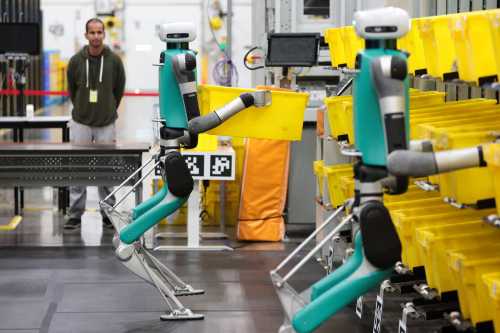
Robotics are particularly important to support the economy, advance military preparedness, and maintain necessary levels of production as workers age out of manufacturing, but governments and businesses will need to support this acquisition to accelerate the use of these technologies.
In this episode of the TechTank podcast, co-host Darrell West is joined by Suzy Teele, the chief strategy officer of the ARM Institute, to discuss her work to advance manufacturing innovation and the implications of these innovations during a time of “megachange.”
Listen to the episode and subscribe to the TechTank Podcast on Apple, Spotify, or Acast.
Transcript
[00:00:00] CO-HOST NICOL TURNER LEE: You’re listening to TechTank, a biweekly podcast from the Brookings Institution exploring the most consequential technology issues of our time. From racial bias in algorithms to the future of work, TechTank takes big ideas and makes them accessible.
[00:00:25] CO-HOST DARRELL WEST: Thanks for joining our Brookings TechTank podcast. I’m Darrell West, senior fellow of governance studies at the Brookings Institution Manufacturing is embracing many types of digital technologies. We are seeing advances in AI, robotics, and automation that are reshaping manufacturing processes. It is a way to improve U.S. competitiveness and bring greater efficiencies into the sector. Many firms are introducing robotics as a way to build the economy and advance military preparedness. Yet there are questions about robotics can do and what governments and businesses should be doing to accelerate these technologies. To discuss these important questions, we are pleased to be joined by a distinguished expert. Suzy Teele is the chief strategy officer of the ARM Institute. ARM stands for Advanced Robotics for Manufacturing and is part of the Manufacturing Innovation Institute. It brings a hub to advance manufacturing innovation and serves as an incubator of ideas for government and business. Suzy, welcome to our Brookings TechTank podcast.
[00:01:35] GUEST SUZY TEELE: Thank you very much, Darrell. I’m happy to be here.
[00:01:38] CO-HOST DARRELL WEST: So why don’t we start just by having you tell U.S. a little bit about the ARM Institute and what it and you are doing to advance robotics in manufacturing.
[00:01:48] GUEST SUZY TEELE: Certainly. Thank you for the opportunity to share the work that we’ve been doing now for almost 10 years. So the ARM Institute was started in January of two thousand seventeen, one of 18 Manufacturing USA institutes. And the mission of these institutes, which overall were started about 14 years ago, was to grow U.S. manufacturing, but to use advanced technologies like robotics or AI or additive manufacturing in place of, low-cost labor. And so these institutes are spread throughout the United States, and we’ve shared that mission to advance the use of automation technologies and advanced manufacturing technologies throughout U.S. manufacturing. The ARM Institute is focused on robotics and AI. That’s been our mission since we started. We’re headquartered in Pittsburgh, Pennsylvania, home of Carnegie Mellon University, which is one of the top universities in the world for robotics and AI, and we’re a strong partner with them as well as, our consortium. One of the things that’s very unique about the institutes, the Manufacturing USA institutes, is they are all structured as public-private partnerships. And so each of U.S. shares the mission to build a consortium of members who have solutions to help grow U.S. manufacturing, be it on the workforce side or the technology side or the implementation side. we are very lucky to share that we’ve got over 500 organizations that are members of our consortium, and we work with them very closely to advance the state of technology to make it easier for all manufacturers of all sizes to use robotics To ensure that they, that their workforce has the skills that they need in order to implement and manage robotics in their environment, and to help them understand how to even get started with robotics. So our mission is very broad. We’re, again, focused on servicing U.S. manufacturing, and our goal is to make it as easy as possible for manufacturers to adopt these technologies.
[00:04:00] CO-HOST DARRELL WEST: That is a great overview. I’m super impressed that you have 500 organizations that you’re working with, and certainly the public-private partnership, I think, is a key to advancing innovation in this area. So what is the current state of robotics in manufacturing? How is robotics being used, and what kind of deployment levels are we seeing?
[00:04:23] GUEST SUZY TEELE: I wish I had better numbers for you, but I would say with robotics, the large manufacturers that we traditionally think about, manufacturers in transportation, aerospace, auto manufacturing, have been using robots for decades. And we all have seen pictures of cars being assembled, by robots. Unfortunately, for small and medium sized manufacturers, it’s still been a bit of a challenge. Based on our best estimates, only about 8% of small manufacturers are using robots today. And we’ve learned that there’s three primary reasons why, if I can share that with you. The first is that they just don’t know where to start. They don’t know what they should consider for automation on their factory floor. The second is they don’t know who to turn to help them solve those problems. There are certainly people in the market that can help them do that, but often those people are, also trying to sell them a solution, sell them a piece of equipment. And so they feel somewhat uncomfortable and not getting a true answer for that. And the third is finding the workforce. there’s a huge demand for entry level robotic technicians, robotic operators in the United States. There are a number of organizations that are working, and schools that are working to produce them, but there aren’t enough of them out there in order for these smaller manufacturers to feel comfortable bringing the technology in. We’d love to see that number grow. There are a number ofthings happening in, in the United States today that I believe are really good trends to help that grow. But it’s, it, we have a lot of room for improvement in that area.
[00:06:07] CO-HOST DARRELL WEST: No, that’s interesting that such a small number of the small, firms are, just using, robotics. But I assume that figure is probably going to grow over time because it just, it does seem like a lot of companies are moving in that direction, and your institute as well as, other organizations are trying to provide the knowledge that would help those firms expand their operations. And I know that your institute does a lot of work with the military and defense firms. How are they utilizing robotics?
[00:06:39] GUEST SUZY TEELE: That is true. We’ve been doing a lot of work since we started, and a key focus area that we’ve been working on is modernization. And when we go back and look at the government’s own manufacturing organizations, they’re called or- the Organic Industrial Base, or OIB as they refer to them, some of those facilities haven’t been updated since World War II. And so they’re still trying to do things like maintain equipment, right? Main- repair equipment, build new capabilities, and they’re working with very outdated capabilities. And so this has put an extra strain on our U.S. government in terms of wanting to be able to produce things quickly, but also finding the people that want to work in these environments since they’re so antiquated. So we’ve spent a quite a bit of time working with these locations to help them better understand, again, very similar with commercial manufacturers, areas for where they could best, use robotics to help improve the responsibilities that they have to support our war fighter.
[00:07:47] CO-HOST DARRELL WEST: So are you focused on basically getting robots into the manufacturing process or to actually get robots out into the field of action?
[00:07:59] GUEST SUZY TEELE: For us, in particular, we’re 100% focused on manufacturing. So our ability to produce more, i- is really where our focus is, not necessarily out in the field.
[00:08:14] CO-HOST DARRELL WEST: So I’m just curious, just given the prominence both of the Iran war and the Ukraine war, are there any examples of how firms are introducing robotics into their manufacturing processes there?
[00:08:28] GUEST SUZY TEELE: A big area is energetics. It’s an unfortunate point of war, but we do produce things like, weapon systems and bombs and missiles and things of that nature. And so there’s a big focus on energetics and the safer and faster production of that as a result of these wars. And, that’s an area where we’ve been able to provide support in the manufacturing process itself.
[00:09:00] CO-HOST DARRELL WEST: So when you’re using the term, energetics, since that’s probably a new term for many of our, listeners, what does that refer to?
[00:09:08] GUEST SUZY TEELE: That refers to the, it refers to missiles, and it refers to, ammunition, just all those devices that, as the government like to say, blow things up.
[00:09:22] CO-HOST DARRELL WEST: So in terms of how defense firms might be using, robots either in, missile manufacturing or ammunition, manufacturing, and of course, we’ve heard a lot about the great use of, all that equipment, abroad and possible shortages, that may be emerging. How can robotics h- help aid national security in the United States and our defense capabilities?
[00:09:50] GUEST SUZY TEELE: By solving the, one of the biggest challenges, which is getting people to want to work at those locations. That producing energetics is a very difficult and potentially unsafe environment. And so robots take away the dull, dirty, and dangerous jobs, that’s their primary purpose, that people face in areas like producing something that is easily combustible, as an example.
[00:10:22] CO-HOST DARRELL WEST: So I assume that then one of the primary benefits of robotics is in the safety area, in just protecting the workers who might be assembling, these things. Are there other benefits of robotics in the defense area in particular?
[00:10:38] GUEST SUZY TEELE: A huge area is inspection. We see– We do a lot of work in inspection. If you think about the complex, items that we produce, right? Whether we’re producing ships, whether we’re producing submarines, whatever it is we’re producing, there’s a lot of very detailed and intricate inspection that needs to happen, and we’ve been able to work with, several of our member organizations to improve upon the inspection and quality process of that in some cases, we’ve got, some projects that we’ve done, with the military focused on using, AR and VR to do inspection and, and having robots do the inspection, pick up… robots actually pick up the, particular component and look at it and to see if it meets quality as opposed to a human being having to physically look at something like that. So I’d say a-another big area, outside of what I call just basic production is inspection and quality management.
[00:11:44] CO-HOST DARRELL WEST: So I’m just curious if there are lessons from the defense area for non-defense firms. Of course, there are lots of other firms that are active outside the military area. I’m not sure to what extent, you’re involved in, those areas as well, but are there particular lessons that we’re finding?
[00:12:02] GUEST SUZY TEELE: I think the key lessons go back to something that I mentioned earlier. If any manufacturer is doing something that is dull, meaning inspection can be very dull, right? If you’ve got to look at something with your eyes all day to determine if it’s at a quality level or not. If it’s dirty, right? meaning that, it’s physically, it’s very physically challenging for somebody to, to work in a, in an unclean environment, or if it’s dangerous. Those are the areas if any manufacturer has any process, and I would guarantee that almost all of them have at least one of those processes in their environment, that’s a place that you can apply robotics.
[00:12:44] CO-HOST DARRELL WEST: Now that’s interesting. So basically there are lessons both for the defense as well as the non-defense areas.
[00:12:52] GUEST SUZY TEELE: Yes.
[00:12:52] CO-HOST DARRELL WEST: What do you see as the barriers to additional progress in the robotics, area, and what should we be doing to improve innovation in that area?
[00:13:04] GUEST SUZY TEELE: I actually have seen– I’ve been at the ARM Institute for almost ten years, and I’ve probably seen more action on the part of our government towards recognizing the value of robotics both as a key, a, key ingredient in us, growing and securing manufacturing, as well as a key potential growth area of revenue than I’ve seen before. We’re seeing, for instance, just recently, Senator McCormick of Pennsylvania is recommending a national ro- commission on robotics. We’ve seen the revi- and that’s a bipartisan, bill that he’s working to get approved. We’ve seen the revival of the robotics caucus, which had been dormant for a few years. We’ve seen new organizations spring up, like the, or existing organizations like, A3, which is the Association for Advance- Advancing Automation, becoming intimately more involved with helping the U.S. government understand the importance of robotics for national security, for, manufacturing growth, and for economic growth. And so there’s a lot of ways that organizations today are really coalescing around these key focus areas. And so it’s very exciting to see that. when I started in this role nine years ago, the thing that I heard over and over again was, “Robots are taking jobs. That’s why we don’t want to have robots in, in, at, at all.” But, since that time, so much has changed. The labor market is very different now. There’s usually an average of about a half a million jobs open in manufacturing in the United States at any point in time. we all know that the, the, birth rate and growth of, of, children and growth of, giving birth has slowed down in the United States. And the other factor is that the average age of a manufacturing worker is fifty-five. So you combine those factors and you realize that robots are critical in order for U.S. to continue to build what we’re building today, as well as build what we need for the future. And I think that our government is really starting to realize this, and that they’re putting some muscle behind that. So I would say that’s a very welcome change. Obviously, we’ve been an advocate for that in the time that, that we’ve been here, but it’s great to see so many other partners also advocating for the use of robotics as a way to, again, help national security and help strengthen our economy.
[00:15:57] CO-HOST DARRELL WEST: Now you mentioned the role of government, and I’m sure that’s, critical in this whole area. [00:16:01] Are there specific things that government should be doing in this area?
[00:16:08] GUEST SUZY TEELE: Certainly there’s been a lot of discussion about tariffs and where tariffs should be. And, that w- we have a challenge in that because we build so few robots in the United States today, we only supply about 10% of the world’s robots. It’s very interesting, like so many things we’ve done in the United States, we’ve invented the robots, but other countries became much better at building them. And so the majority of robots that are in use in the United States are from countries like Japan, like South Korea, Germany, Switzerland, Denmark. And so we don’t build a lot of robots here, but we have a huge and very thriving, young robotics industry here. But they need those parts from those other countries or those robots from those other countries in order for them to do their development work. And so we’ve got an interesting th- that we’re watching from a tariff standpoint is how the government does that. But the government, I believe they’re asking for a lot of input. They’ve asked for our input. They’ve asked for others to be very thoughtful about what things we wanna put more restrictions on coming into the country and what things are okay coming into the country to allow our younger robotics industry to grow. So that’s one area that I think we’re all watching is the tariff situation. Secondly, it’s workforce. There’s an renewed focus on apprenticeships, which is great. I think there’s a lot more that we can do there. At the end of the day, our biggest challenge is that young people are not being told that manufacturing is a great career for them.
[00:17:58] Honestly, that’s the biggest problem we have to solve. I grew up in Pittsburgh, Pennsylvania. I lived through the ’70s and ’80s when all the manufacturing of steel left Pittsburgh, and we had 26% unemployment. As a kid growing up, my parents said, “You can do whatever you want, but don’t go into manufacturing.” So we have a whole, 70 or 80 years of you don’t do this because of what we lost in the ’70s and ’80s that we have to unravel as a country. And quite frankly, that’s been our biggest challenge. little– when you talk to a young kid, they’ll say they wanna be a doctor or a lawyer or a nurse or a teacher, but they don’t ever say, “I wanna be a manufacturer.” So I think one of the biggest things that our government can do is help, help everyone understand that this is a viable career path, that this is something that you can get a lot of personal satisfaction out of because you’re making things, and that it should be considered as viable career as any of the other things that you’re taught when you’re eight years old.
[00:19:06] CO-HOST DARRELL WEST: No, I think, those are all, great points, and at Brookings we’re, very strong supporters of apprenticeship programs. We know that’s worked very well in Germany, for example. there are places in the United States that have been using them, fruitfully as well. What other thoughts do you have just in terms of how we can train the workforce to deal with, robotics or to get people into manufacturing in general?
[00:19:32] GUEST SUZY TEELE: I have to give a plug for something that we’ve created. It was created with taxpayer dollars, so we don’t generate any revenue off of it. But we do have a website out there called Robotics Career. That’s, robotics with an S career.org. And on that site we have all kinds of information about why you should pursue a career in manufacturing using robotics, what those careers look like, how much they pay, what kind of education you might need to get into them, and what kind of jobs are available in them. We’ve got it– We have over 19,000 jobs– I-I’m sorry, 19,000 training programs cataloged on that site, everything from microcredentials to PhDs. so somebody could go on the site and say, “I live in Denver, Colorado. What training programs could be available to me to learn how to work with robots and have a career in manufacturing using robots?” We’ve defined a competency framework based upon input from our members who are manufacturers and educators of the skills that people need, and we defined a career pathway. So all that information is available on our site, and we also have jobs. So we go out and we pull jobs from common sources like Indeed and others and present them on our site. We typically have an average of 20,000 jobs on our site. So someone can come and create a free account. They can track, applying for jobs. They can look for the education that they need. They can understand what skills they have and what skills they may still need in order to move into a career in manufacturing. So we’re, really proud of that site. I, appreciate this opportunity to promote it. It’s there for U.S. to use and, we had over 120,000 people use it last year, and we just hope that usage continues to grow.
[00:21:31] CO-HOST DARRELL WEST: No, that’s a great, resource for people. So that’s, roboticscareer.org.
[00:21:38] GUEST SUZY TEELE: Correct.
[00:21:39] CO-HOST DARRELL WEST: What factors right now are constraining the introduction of robots into the manufacturing process?
[00:21:47] GUEST SUZY TEELE: There’s a few. One is just that general issue that we talked about earlier, where people are not sure exactly where a robot could provide the most benefits. but let’s assume that they get that expertise to be able to do that. Another constraint is that all of the robotic systems that we, that we use don’t talk to each other. And so if you find an organization that may pick one manufacturer’s robotics for a certain type of activity, and then they need to use another, robot from another activity, the ability for those to share information is not great because they all are using their own proprietary software languages. So that’s one of the areas where I think we can make a lot of advances is if we can, increase the ability for robots to interoperate with each other so that they can look across the full line. AI is definitely gonna help that, for sure, because they can collect the information from the different robots and then try to figure out the right, look at the broader process from that, but that’s certainly one of the challenges. They could always be easier to use and more flexible, and we continue to work on that. If you’re a small manufacturer, you’re likely a custom manufacturer, and so you’re running production lines where you’re making, what we call a high-mix, low-volume environment. You’re making low volumes of lots of different things. To have to stop and reprogram your robot every time that you have a new thing that you need to make is a challenge, right? that’s an extra time that, that needs to be invested. So trying to fix that high, mix, low volume problem is a really big one that we’re focusing on right now.
[00:23:53] CO-HOST DARRELL WEST: I think you mentioned that the U.S. only produces 10% of the world’s robots. So I’m just curious, are there efforts now to bring robot production back to the United States? is this such an important strategic issue that we need to make special efforts to, onshore, that type of capability?
[00:24:17] GUEST SUZY TEELE: Yes, the government considers it a strategic issue because if we’re purchasing robots from, countries that maybe we don’t have the best relationship with, there are opportunities for them to use those robots and the software on that ro- those robots to gather information about our environment, right? So there is a national security risk. Luckily, most of the robots that we buy come from allies, but there are robots that are purchased in the United States today that don’t come from allies
[00:24:54] CO-HOST DARRELL WEST: Yeah, I think you mentioned that among the countries that seem to be doing a good job of, robot production includes places like Japan, South Korea and Germany among, some other places. So at least those are, friendly, nations. But I’m curious, what are other countries doing to build their robot, capabilities, that perhaps the United States is not doing? And are there ideas from abroad that we should emulate?
[00:25:22] GUEST SUZY TEELE: It’s very interesting. I did some work with an organization called the Special Com– SCSP, Special Competitive Studies Project. I don’t know if you guys are familiar with them or not, but they’re working on a overview of United States versus China and what they do better than us, because they are the world’s biggest user of robots and now the world’s biggest, supplier of robots. And one of the things that’s very interesting about what they do that I learned is that they actually build the whole infrastructure for robots in one community. So it makes it much easier and faster when all the parts that you need to im- in order to build a robot are right there. You don’t have to worry– wait for them to be shipped from overseas. So I think what they have done that’s a lesson that we can learn from is building these ecosystems where the suppliers of the parts and even some of the users of the resulting technology are all in one location. That’s not necessarily easy for U.S. to do, but we can make that easier for U.S. to do. We can think about, creating hubs across the United States where we’re bringing in the early stage, companies as well as the suppliers. One of the biggest challenges our early stagecompanies have is they can’t get the manufacturers to make the parts that they need because the volume’s too low And so can we solve that problem? Can we find a way so that our early stage robotics companies don’t have to go overseas to get parts because we’re able to have an environment where manufacturers, where they’re incented to create that small number of parts, 5, 10, 15, 20, that are needed until that, company takes off and it needs a lot more? So those are a couple areasthat I think, a- as well as the workforce, which we touched on, that I think can really help grow our industry.
[00:27:30] CO-HOST DARRELL WEST: Yeah. It does seem like getting the parts production, aspect, in a stronger position would help a lot, and then, definitely, improving the, workforce, development. So I want to thank, Suzy Teele for sharing her thoughts with U.S. today. She works at the ARM Institute, which is, working, very hard to advance robotics in manufacturing in the United States. At Brookings, we write regularly about various kinds of digital technologies. You can find more information on our Brookings TechTank blog located at brookings.edu. Thank you very much for tuning in.
[00:28:09] CO-HOST NICOL TURNER LEE: Thank you for listening to TechTank, a series of roundtable discussions and interviews with technology experts and policymakers. For more conversations like this, subscribe to the podcast and sign up to receive the TechTank newsletter for more research and analysis from the Center for Technology Innovation at Brookings.
Related Content


Participants


The Brookings Institution is committed to quality, independence, and impact.
We are supported by a diverse array of funders. In line with our values and policies, each Brookings publication represents the sole views of its author(s).

Commentary
PodcastHow robotics is reshaping manufacturing | The TechTank Podcast
Listen on
July 6, 2026