



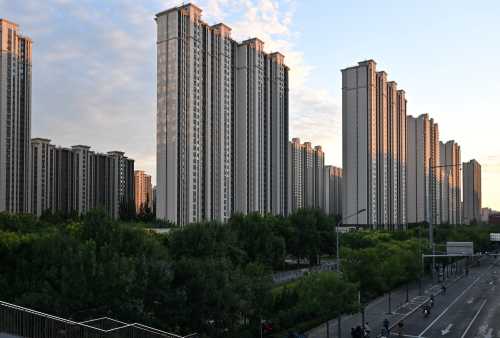
China’s real estate sector and infrastructure account for nearly one-third of economic demand in China. Plus, Chinese households allocate far more of their wealth to housing (nearly 70%) than households in other countries. So with the country’s real estate sector entering its sixth year of adjustment, the implications for China and the rest of the world are growing. In a new BPEA paper, Kenneth Rogoff and Yuanchen Yang look for clues on what will happen next in another recent real estate crisis, that of 1990s Japan. On today’s episode of the Brookings Podcast on Economic Activity, Rogoff and Yang are interviewed about their findings by Brookings Senior Fellow Gian Maria Milesi-Ferretti.
Related Content

- Listen to the Brookings Podcast on Economic Activity on Apple, Spotify, YouTube, or wherever you like to get podcasts.
- Learn about other Brookings podcasts from the Brookings Podcast Network.
- Sign up for the podcasts newsletter for occasional updates on featured episodes and new shows.
- Send feedback email to [email protected].
Transcript
[music]
EBERLY: I am Jan Eberly, the James R. and Helen D. Russell Professor of Finance at Northwestern University.
STEINSSON: And I’m Jón Steinsson, Marek Professor of Public Policy and Economics at the University of California Berkeley.
EBERLY: We are the co-editors of the Brookings Papers on Economic Activity, a semi-annual academic conference and journal that pairs rigorous research with real-time policy analysis to address the most urgent economic challenges of the day.
STEINSSON: And this is the Brookings Podcast on Economic Activity, where we share conversations with leading economists on the research they do and how it will affect economic policy.
Real estate has long been a cornerstone of China’s economic development, but it’s now in its fifth consecutive year of decline. The increased global trade tensions of the last decade have made this a particularly salient concern for China.
As its title suggests, the new BPEA paper, “A tale of two countries: The real estate crises in 1990s Japan and contemporary China,” compares China’s current real estate crisis with the historical precedent of Japan three decades ago.
On today’s episode, the authors, Kenneth Rogoff, Maurits C. Boas Professor at Harvard University, and Yuanchen Yang, an economist at the International Monetary Fund, will be interviewed by Gian Maria Milesi-Ferretti, Senior Fellow at Brookings.
EBERLY: I’ve always found interesting parallels between Japan’s economic development led by focused investments in particular industries, and China’s development strategy. These authors point out that their real estate markets also have interestingly similar trends. Japan’s real estate boom led to an eventual bust that lasted decades and was associated with a long economic malaise. The situation is different in China: it had a real estate boom and crash, but it doesn’t have the debt overhang in the banking sector that was so important in Japan.
But the authors argue that a Chinese real estate collapse could have similarly profound impacts on the Chinese economy through other channels, since it is such an important part of household wealth.
STEINNSON: Let’s now turn it over to Gian Maria to hear this conversation with the paper’s authors.
[2:35]
MILESI-FERRETTI: Welcome to this podcast. I am delighted to have with us, Professor Ken Rogoff and Yuanchen Yang, who is at the IMF. They are going to talk to us about a fascinating new paper. Welcome, Ken, and welcome, Yuchen.
ROGOFF: Thank you.
YANG: Thank you.
MILESI-FERRETTI: Let me start with a just broad question to set the stage for the work you have done. Can you please briefly walk us through, what the real estate boom and bust episode in China has looked like?
[3:17]
ROGOFF: Well, real estate has been the cornerstone of the Chinese growth model, and if you include infrastructure which is closely related, it accounts for roughly a third of demand in China over a very long period. It has been the engine along with exports of China’s growth.
And what interested us some time ago was a sense that not only was there extensive building in the main marquee cities – Beijing, Shanghai, Xinjiang, Guangzhou – but it extended way out into the countryside. And we start exploring this actually in a series of papers dating back to 2020, where still, people thought this would go on forever, and China’s data is difficult to access.
But we found that they publish extensive data on how much they built of everything brick by brick, block by block. Even though much of their data is very secretive, vacancy rates, prices, they’re very proud of how much they built, and we realized the overbuilding was simply vast in China. We saw that China had as much or more per capita housing as rich countries like France or the United Kingdom, and China is a very poor country by comparison. When we started this, our view was outside the box, to say the least, and we received a lot of resistance from scholars and well now for some time prices have been crashing in China, it’s many years later.
It’s pretty clear that they’ve reached a classic overbuilding boom bust. And the question is, how long it’s gonna last, how deep it’s gonna be. And in this paper, we try to think about, well, China’s probably still ongoing. It doesn’t seem anywhere near the end.
But we could look at Japan, which has a lot of similarities, where their real estate crisis started sometime in the 1990s and, took at least a decade, maybe two decades by some measures to unwind, and look at some comparisons, and lessons. And we find that China and Japan are more alike than you might think.
And then finally, what’s I think super interesting about the paper is that people had thought China would never have a real estate crisis, not a Western style, not something deep and long lasting because so much weight had been given to the idea that it’s mostly financial. It’s a banking crisis, dating back to Bernanke’s wonderful 1983 American Economic Review paper.
But in China, there isn’t lending nearly to the extent that there was in the United States. China has a high savings rate. houses are nearly as underwater even now as they reached in the United States. The Chinese government has huge administrative capacity to quickly resolve debts and get around the problems we usually worry about.
So how was it they were having this problem? And that’s what we try to explore in this paper.
MILESI-FERRETTI: So, let me ask you then, what features are common to previous, real estate bust episodes such as the one in Japan. Now, Ken, you already alluded to it, but can you guide us, our listeners a bit through the intricacies of how these episodes work out in practice?
[7:17]
ROGOFF: Well, I’ll say a little bit and turn it over to Yuanchen. I think something people tend to forget about is how important the fundamental overbuilding, over investment, is to these crises. That is ultimately the trigger. Yes, there are amplifying factors such as the one Bernanke stressed, and our paper stresses others.
But at the end of the day, it’s this wild overbuilding, and we’ve seen it in many places. You can go to Florida and look at the U.S. real estate crisis where there was massive overbuilding. You can certainly look at Japan where there’s overbuilding not only in housing, but also in infrastructure. The famous bridges to nowhere captures, what happened in Japan.
And Robert Solow ages ago emphasized decreasing returns, the tyranny of diminishing returns, and that is the core problem. It’s the Chinese crisis in some ways looks like why Russia petered out and, in some ways, many other Asian countries do. And this is not to deny the amplification mechanisms, but it’s very important to look at this core.
We’re not the first to say this for goodness’ sake. There are classic papers going back into the early nineties by Alwyn Young. There are theoretical papers by Andre Schleifer and others showing that this can happen, and so we then had to ask ourselves the question. Well, if it isn’t a pure banking crisis, what amplifies it?
We had looked certainly at local government debt, which is a big issue in China. Maybe Yuanchen can expand on that a little bit, but what we stress in this paper is a big part of it is the collapse in housing prices is a huge collapse in wealth because Chinese citizens hold over 70% of their wealth in housing.
They have all sorts of restrictions on what they can hold, problems with their markets. And I think some people get confused and think that, well, the price collapsed, the mortgages are being defaulted on. That’s not really the first order problem. There is certainly, construction firms that do that, there are local governments that have problems, but the first order problem is that people feel a lot poorer and cut back their consumption accordingly. We provide estimates of that and suggest that it’s very important and was also important in Japan.
Yuanchen, do you want to add to that?
[10:00]
YANG: Yeah, of course. for China, really estate over building is a major contribution to local government debt. and it is clear in Japan’s case as well where over building and higher collateral value contributes to the debt levels in the private sector. I would also add, like to emphasize here, that housing busts also tend to be geographically uneven, just like housing booms.
For example, cities or regions with more cumulative investment during the booms often experience deeper and more persistent price declines during a bust. And this cross-sectional pattern holds in both China and Japan. And for China, we focus on 300 prefecture level cities. And for Japan, we focus on 43 prefecture level cities as well.
And this cross-sectional pattern holds in both cases. So, this illustrates the highly uneven distribution of both the booms and busts. For China the most severe epicenter of the crisis occurs in so-called tier three cities. These cities experience large population outflows, are less prosperous, but in the meantime, there are more dependent on local government, lent revenues for local government revenues. For Japan, even excluding, Tokyo and Osaka, these major cities, the pattern that more cumulative investment leads to lower prices holds in the rest of the country, in those smaller cities as well.
[11:30]
ROGOFF: Just to add to that, the unevenness of housing booms and busts happened in the United States. The housing crisis was really concentrated in a few states, and tier three cities are smaller and less prosperous, but they’re, first of all, not small. In China, you can have few million people and be a tier three city, and they account for 60% of China’s GDP, so their footprint’s very big.
If the listener wants to think of a tier three city, I grew up in Rochester, New York. That’s a tier three city, U.S. style, Cincinnati, Liverpool; places like that are what we’re talking about.
MILESI-FERRETTI: So, you already anticipated some of the themes of my third question, but I think there are still things to be added to what you already said.
I was going to ask you, what are the special features of the Chinese real estate market? What should listeners know about it? As in comparison to the real estate markets, they’re familiar with. And, what role do these special features play in explaining the macroeconomic repercussions of the real estate crisis?
[12:46]
ROGOFF: Well, Yuanchen very, succinctly highlighted our analytical evidence where we don’t just look at the aggregate, but we have very disaggregated data on growth, on building, on real estate investment pipeline. It’s a very detailed dataset.
What’s interesting about China to me is that this is a country with tremendous state capacity, and they had the reasonable idea with 1.4 billion people to try to have them not all move to a few big cities, to try to spread things out. And to do this, they developed a system which incentivized building out in the far regions of China. China has a lot of state capacity, a lot of ways to have incentive. There are market incentives, but there’s a lot of non-market.
And I might say that if anyone knows anything about Japan, it’s not so dissimilar. a lot of state capacity. And frankly, when I was watching this, when we were together at the IMF, Gian Maria, in the early 2000s, I couldn’t have told you it was stupid. I mean, if you look at Mumbai and what happened to São Paulo, it seemed like a disaster.
So, they’re trying to make it really attractive. And the roads, the buildings, the houses in the tier three cities are built to a very high standard. There are national standards for these things. However, it turned out that these forces of agglomeration, which have been so important since the 1980s operate in China. They’re social. They have to do with economic and to make a long story short, the good jobs never came. Young people didn’t so much wanna live there, and so China has a housing bust at a physical level, which is dramatically more than we had in the United States. And I think it’s gonna take longer to absorb.
And of course, Japan has its own issues, where now if you go into the countryside, there are vast swaths of housing, which has simply been abandoned.
[15:06]
YANG: I think to illustrate how special China is, it’s important or it’s helpful to bring in some international perspective. We have a chart in the paper which shows the investment over GDP level across countries, and China’s level, stands at 40% for two decades. And this is epic, not just by historical standards, but also, it’s second only to the levels seen in Iceland prior to the global financial crisis.
And it’s hard to label Iceland as a comparable country for China. And a lot of this investment is on real estate. So overall, China has experienced a tremendous investment drive, in infrastructure as well as in real estate. That is an investment perspective.
When doing the research, I’m also amazed by the store of household wealth in housing. For average Chinese households, about 70% of their asset is in housing and housing valuation far exceeds other asset classes in China, whereas, for example, for Japan and for the U.S., housing asset and other financial assets are of broadly similar magnitude, but for China, housing asset is about five times GDP. So, the price declines we’ve seen has triggered a significant reversal of wealth effects.
And also, like we find significant negative sentiment, of people about house prices, about their income, about future economic prospect in general, which have also amplified the effects of, negative wealth effects, et cetera, of the housing market adjustment of the macro economy.
[16:46]
ROGOFF: And just to supplement that, what Yuanchen said. Again, everybody thought you could never have the kind of problems with real estate that we had in Western economies, that they wouldn’t have the kind of financial system, the state backs everything. The state can work everything out, but what we argue is that while those aren’t, you know, wrong, there are other factors and they probably operated in the United States and in the Western countries and have perhaps been understated in the literature.
MILESI-FERRETTI: I thought the part on sentiment was super interesting in the paper. I just wonder whether you could spend just a minute telling us how you got around to measure sentiment, to identify, its impact separately from the size of investment channel.
[17:41]
YANG: Yeah, sure. We built on the methodology developed by prior papers, IMF working paper. It uses the cutting-edge large language models, in analyzing the newspapers, journals, et cetera, to measure real time sentiment, negative or positive, to housing market news.
And this measure is then disaggregated at the city level by multiplying it with a city level, attention to housing market news. So, this is our measure for housing market sentiment and how we separate with the baseline wealth effect. First, we estimate consumption reaction to house price declines.
This constitutes our baseline, and we observe about 0.15 coefficient on the consumption response to house price decreases. And on top of that, we have an interaction chart of the house price instrument with our sentiment indicator. So, by estimating the coefficient on the interaction term, we separate the baseline wealth effect with a sentiment effect.
We find that the sentiment effect could amplify wealth effect by two times as large as a baseline.
MILESI-FERRETTI: Thank you. My following question is more speculative in a sense, at least in part. I wonder on the policy front, what has the government done? What measures has it chosen to try to deal with the crisis? And have these measures been effective? The speculative sort of forward-looking part is, do you have any suggestions from your paper on alternative policy strategies that could help contain the macroeconomic impact of the aftermath of the crisis?
[19:39]
ROGOFF: Big question. Very cryptically, the governments tried to take steps at least to backstop local government debt, the local governments, and deal with their financing issues because they provide a lot of basic services. But it’s a very big and decentralized country and it’s hard enough to do in the United States.
It’s very hard to do in China. I think everyone leading with the IMF has had the recommendation for decades that China try to build up consumption, which accounts for a far smaller share of GDP in China. And that’s proven difficult to do, for many reasons. One of which is they don’t have as good a social safety net.
So, people wanna save more, and it’s not trivial to change that overnight. One thing we point out towards the ends of the paper is that many people have said, well, China will just build up in electric vehicles and solar panels and nuclear power plants and just shift their building. And our view is that yes, that can work up to a point, but first of all, China cannot easily export its way out of its problems.
It’s just too big, it’s current account has fallen from 10% to 2% of its GDP since 2010. But as a share of rural GDP, it’s the same. And China’s just not Singapore. It can’t easily just shift gears. Also, these other sectors are just much smaller than the housing sector.
Again, going back to our earliest work, we emphasize that the size of real estate and infrastructure was a third of demand, and you can’t replace that easily.
MILESI-FERRETTI: And also, I presume the employment intensity is going to be different between construction and investment in say, the solar panel industry or electric vehicles, and that may have implications you’re absolutely right. The modern factories in China are very automated and employ far less people just like everywhere else.
Okay. So, I have mentioned a number of times that to understand the problem you need to take into account the size of China. How does its real estate crisis affect the rest of the world? Obviously, there is an impact if China’s growth rate is lower because of the macro repercussions of this decline in wealth, that has an impact on trading partners. But I wonder whether there are other impacts you can think of that could be triggered by what has happened.
[22:33]
ROGOFF: It affects the rest of the world massively. Gian Maria, you have worked and maybe are working on the so-called global imbalances problem, which crudely speaking is the U.S. runs very big current account deficits and China runs very big current account surpluses and real estate has been a source of domestic demand, which helps make the current account surplus smaller.
You employ people working for things that are consumed at home, and the collapse in Chinese, real estate is contributing to this problem. That’s less domestic consumption. It’s also so big, it’s affecting global investment. If you look at measures of global investment, a big part of why it’s fallen is the Chinese real estate sector.
And why does that matter to the rest of the world? Well, they consume all kinds of goods from the rest of the world to go into construction, from the vehicles to the iron ore, you know, et cetera, et cetera. China’s slow down in real estates having a massive impact on many, many countries, around the world.
MILESI-FERRETTI: Yuanchen, anything to add here?
[23:48]
YANG: Not much, but just an interesting figure because according to the IMF, the decline in global investment in the past few years was almost entirely driven by China and driven by China’s real estate sector. So, what we’re looking at, the issue we’re looking at here, has global implications as well.
ROGOFF: That is a stunning statistic, by the way, that Yuanchen just cited, I mean this Paper is about why world investment has dropped.
MILESI-FERRETTI: Yeah, you mentioned earlier, the 40% investment rate that’s almost basically double advanced economies investment rates. So, even if that implies that the investment share of China is twice as large as the GDP share, roughly speaking, so it’s a big chunk of world investment indeed.
Well, this was absolutely fascinating. Thank you very much, Ken. Thank you very much, Yuanchen. I warmly invite our listeners to read this paper. It is full of fascinating facts in addition to all the conceptual issues that we have been discussing during these past 25 minutes. Thank you very much.
ROGOFF: Thank you.
YANG: Thank you.
[music]
STEINSSON: Once again, I’m Jón Steinsson
EBERLY: And I’m Jan Eberly.
STEINSSON: And this has been the Brookings Podcast on Economic Activity. Thanks to our guests for this great conversation and be sure to subscribe to get notifications about new releases of this podcast.
EBERLY: The Brookings Podcast on Economic Activity is produced by the Brookings Podcast Network. Learn more about this and our other podcasts at Brookings dot edu slash podcasts. Send feedback to podcasts at Brookings dot edu and find out more about the Brookings Papers on Economic Activity online at Brookings dot edu slash B-P-E-A.
STEINSSON: Thanks to the team that makes this podcast possible. Fred Dews, supervising producer Chris Miller, co-producer, Gaston Reboredo, co-producer and audio engineer. Show Art was designed by Katie Meris. And promotional support comes from our colleagues in Brookings Communications.
Participants





The Brookings Institution is committed to quality, independence, and impact.
We are supported by a diverse array of funders. In line with our values and policies, each Brookings publication represents the sole views of its author(s).

Commentary
PodcastHow long will China’s real estate crisis last?
April 16, 2026
Listen on
Brookings Podcast on Economic Activity