Spending, Taxes, and Deficits: A Book of Charts contains 132 pages of conventional-wisdom-defying insight into federal spending, taxes, budget deficits, and debt in 2026. This is the fourth in a series highlighting key myth-busting charts.
A closer look at basic government data from the Congressional Budget Office, Office of Management and Budget, and the Treasury Department helps answer a basic question: Who—or what—really balanced the budgets from 1998 through 2001?
For many economists, budget experts, and Americans of a certain age, the late-1990s balanced budgets tell a rare government success story. But politicians can’t claim full credit.
Budget deals were all the rage among 1990s politicians
After the federal deficit reached a post-World War II peak of 6% of gross domestic product (GDP) in 1983, deficit reduction became a leading issue in American politics. Several deficit-reduction laws were passed in the late 1980s and early 1990s. Billionaire and 1992 presidential candidate Ross Perot earned a surprising 19% of the popular vote thanks to a quirky campaign that focused heavily on fiscal responsibility.
The winner of that 1992 race, Bill Clinton, subsequently made deficit reduction a centerpiece of his first budget submission and tax increase enactment. The following year, Rep. Newt Gingrich (R-GA) led Republicans to their first House majority in 40 years on a promise to balance the budget within seven years.
The resulting clash between the GOP’s aggressive timetable and President Clinton’s more gradual approach produced contentious government shutdowns in 1995 and 1996. And yet by 1998 the budget had achieved balance for the first time since 1969—and remained balanced through 2001. A dominant political narrative emerged: High-profile belt-tightening budget deals negotiated by Clinton and Gingrich reduced the deficit and balanced the budget just a few years later.
But budget deals contributed relatively little to balanced budgets
The surprising reality: The elimination of the deficit was largely a temporary historical accident, driven by forces mostly beyond the control of the politicians who claimed credit for it.
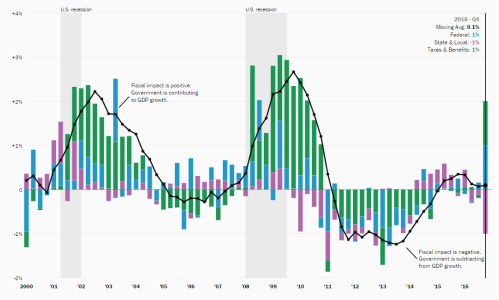
Chart 110 (Figure 1 below) maps the path from 1992’s deficit of 4.5% of GDP to the peak surplus of 2.3% of GDP in 2000—a swing of 6.8 percentage points. Nearly the entire improvement in the federal government’s fiscal position resulted from two events: the end of the Cold War and a temporary stock market and tax revenue bubble.
The end of the Cold War brought defense savings
The first major deficit reduction driver was defense savings resulting from the collapse of the Soviet Union. After President Reagan’s Cold War military buildup peaked with a defense budget of 6.0% of GDP in 1986, the collapse of communism in Europe prompted Congress to trim defense spending to 4.7% of GDP by 1992 (see Chart 33, Figure 2 below). Then, during the 1992-2000 period of broader deficit reduction, the defense budget further declined to 2.9% of GDP, the lowest share of the economy since the 1930s. These savings account directly for roughly one quarter of all deficit reduction between 1992 and 2000, and more when the resulting interest savings are incorporated.
Obviously, President Clinton and Congressional Republicans cannot be credited with ending communism in the Soviet Union and Eastern Europe. Such events were driven by decades of internal Soviet and Eastern European developments—perhaps with a nudge from President Reagan and others who had drawn the Soviets into a costly arms race just as their economy was becoming increasingly fragile.
A stock market and tax revenue boom brought even more savings
The second deficit reducer was an unanticipated (and ultimately unsustainable) surge in temporary tax revenues in the late 1990s. Early 1990s corporate restructuring and substantial investments in emerging internet technologies produced a late-1990s burst of stock market and economic activity. That boom produced an extra 2.2% of GDP in annual tax revenues—particularly from capital gains—while simultaneously driving down unemployment costs and other countercyclical spending as a share of the faster-growing economy. Altogether, economic factors account for roughly 60% of all deficit reduction from 1992 to 2000.
It is difficult to identify contemporary White House or congressional policies that produced the corporate restructuring or internet-era expansion. And while Democrats often credit President Clinton’s 1993 tax increases with a significant share of late-1990s deficit reduction, the resulting 0.7% of GDP in tax revenues represents roughly one-tenth of the total improvement over this period. So while Republicans can note that Clinton’s 1993 tax increases were not the primary driver of deficit reduction, Democrats can respond that those increases did not derail the subsequent economic boom as Republicans had aggressively warned.
The accidental nature of 1998–2001 surpluses is confirmed by their quick unraveling
Shortly after the 1990s ended, the same two factors that had accidentally balanced the budget—an absence of powerful global adversaries and an aggressive tax revenue bubble—reversed course and unbalanced it. In 2000, the stock market bubble burst because any of the technology companies commanding enormous valuations couldn’t generate profits to justify them. The Nasdaq began a freefall that ultimately reached 77%. In early 2001 the economy fell into recession, erasing the earlier tax revenue surge. Then the September 11, 2001, attacks prompted a reversal of earlier defense reductions.
The federal budget has run deficits ever since, and they have expanded substantially—the product of repeated tax cuts, spending increases, and the long-anticipated costs of 74 million retiring baby boomers receiving Social Security and Medicare.
Politicians can claim credit for one kind of success
The balanced budgets of the late 1990s—and the swift return to deficits that followed—are a useful reminder of how elected officials often have less control over short-term federal budget fluctuations than is commonly believed.
Politicians routinely receive too much credit when things go well, and too much blame when things go wrong. In this case, there is little basis for crediting 1990s politicians with the broader geopolitical, economic, and technological forces that eliminated budget deficits between 1998 and 2001.
Perhaps the politicians’ true fiscal achievement of the 1990s was more modest. They stayed out of the way on economic and foreign policy and then resisted the temptation to spend the resulting windfall on expensive new initiatives—at least temporarily.
For more insights into federal spending, taxes, deficits, and debt, check out Jessica Riedl’s 2026 federal budget chartbook.
Author

Related Content



The Brookings Institution is committed to quality, independence, and impact.
We are supported by a diverse array of funders. In line with our values and policies, each Brookings publication represents the sole views of its author(s).
Commentary
How did the budget get balanced in the late 1990s?
Cold War defense cuts and a temporary tax revenue boom—not politicians alone—drove the balanced budgets of the late 1990s
May 11, 2026