In the past week, the Trump administration has significantly intensified pressure on the Mexican government to allow the U.S. military to take direct actions against drug cartels inside Mexico. Going beyond U.S. air strikes against drug labs and cartel bosses, the U.S. demands appear to include U.S. soldiers on the ground, presumably in joint raids with the Mexican military.
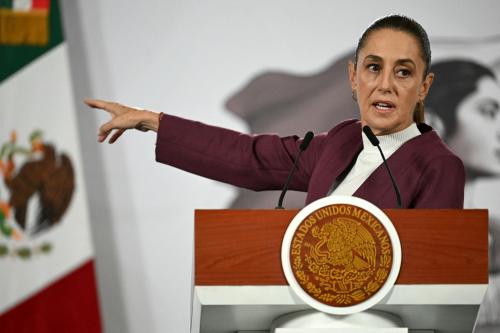
For decades, including at the height of U.S.-Mexico cooperation under the Merida Initiative during the Felipe Calderón administration, the Mexican government and public have considered the U.S. military’s presence in Mexico to be an inconceivable redline. Such a presence is seen as an intolerable encroachment on Mexico’s sovereignty, particularly for a country that still vividly recalls the U.S. annexation of more than half of Mexico’s territory in 1848. Mexican President Claudia Sheinbaum has steadfastly rejected such a U.S. military presence. Over the past week, her administration went into overdrive to highlight its actions against the cartels and head off any U.S. military intervention. No doubt, the Mexican government has greatly intensified security efforts against the cartels’ growing influence and power and strengthened security cooperation with the United States. In contrast, Sheinbaum’s predecessor, Andrés Manuel López Obrador, essentially gave the cartels free rein and eviscerated bilateral security cooperation.
If the Trump administration undertakes military action—whether by coercing a nominal agreement from the Mexican government or ignoring its objections—how would Mexico react, both politically and diplomatically? I explore these questions, and in a companion piece, assess how the Mexican cartels would respond to U.S. military actions.
The political fallout in Mexico
Sheinbaum may ultimately judge that caving to U.S. pressure would be preferable to having to declare Mexico under U.S. invasion, and nominally agree to a U.S. military presence. If conceding to U.S. military presence preserves the U.S.-Mexico-Canada trade agreement (USMCA) and thus the Mexican economy, Sheinbaum’s socio-economic agenda, on which she was elected, could be saved. Without USMCA, the Mexican economy would likely crash, at least for several years, with vast negative effects on Mexican companies and people.
Regardless, yielding to U.S. military presence would entail immense political costs for the Sheinbaum administration. Nationalist sentiments would flare, as Mexicans decry U.S. actions and the Mexican government. Public opinion is overwhelmingly against any U.S. military action, with some 80% of polled respondents rejecting the idea. Sheinbaum could lose control over her ruling Morena coalition, with its nationalist wings boycotting her rule, and her socio-economic agenda running aground despite Morena’s current domination of all branches of the Mexican government.
Nationalist opposition to a U.S. intervention could also revive Mexico’s badly weakened opposition parties, such as the Institutional Revolutionary Party and the National Action Party. Only their fringe politicians signal openness to U.S. military action and align with U.S. President Donald Trump’s style of conservatism.
The Mexican military
Conceding to U.S. military actions on Mexican soil would also complicate Sheinbaum’s relations with the Mexican military, an insular, opaque, and powerful institution that has long disliked any kind of meaningful civilian oversight. López Obrador further strengthened the Mexican military’s power and preserved its lack of accountability by giving it an unprecedented role in all kinds of public policy, not just public security, and gifting it with significant stakes in the Mexican economy. The permanent funding the Mexican military now obtains from various critical infrastructure projects reduces the Mexican Congress’ power to oversee and control the Mexican military through the power of the purse.
Acquiescing to U.S. military actions in Mexico would be very hard for the Mexican military. Yes, some units, such as in the Mexican Navy, have long cooperated with the United States and executed raids on high-value targets based on intelligence provided by the United States. But for decades, the Mexican military’s ethos, doctrine, and training have been to prepare for and oppose an imagined U.S. invasion. The Mexican military was the last among Latin American militaries to establish military-to-military relations with the United States, doing so only in the mid-1990s. After 2001, when Mexico became a more competitive democracy, significant U.S. diplomatic effort was spent to persuade the Mexican military that a U.S. invasion would not happen, and that the real problem was the narcos. Now, the United States would act precisely in the imperialist way Washington was telling Mexico would not happen.
The fact that the Mexican military, and its branch, the National Guard, have succumbed to infiltration by criminal groups as well as other corrupt and illicit activities, makes the Mexican military additionally uncomfortable about the prospect of joint operations with the United States.
The consequences of U.S. military actions
If the Sheinbaum administration chooses not to concede, U.S. military actions would amount to hostile strikes. The Mexican military’s reactions would depend on the nature of the U.S. actions: A one-time surprise raid on a top narco boss, such as the leader of the Cártel de Jalisco Nueva Generación or the two Chapito brothers, who are still at large and lead one branch of the Sinaloa Cartel, may not trigger any Mexican military response. However, repeated raids or a sustained U.S. military presence on the ground would be an intolerable humiliation for the Mexican military.
Whether or not the Mexican military starts shooting at U.S. troops, the Mexican government could resort to other powerful retaliatory measures.
Of greatest concern, the Mexican government could expel all U.S. law enforcement agents from Mexico, as the López Obrador government threatened to do in 2020 after the United States arrested Mexico’s former secretary of defense, Gen. Salvador Cienfuegos, on drug trafficking charges. The expulsion would have so undermined U.S. law enforcement and intelligence gathering capacities in Mexico, not redressable by signal intelligence alone, that the first Trump administration returned Cienfuegos to Mexico. This was a big U.S. concession, but the Mexican government retaliated further by legislating new, severe limits on the number and activities of U.S. law enforcement agents in Mexico. It also prohibited Mexican law enforcement from participating in various forms of cooperation with the United States. Easing this deep freeze for U.S. law enforcement in Mexico took years, and the Drug Enforcement Administration has particularly struggled to recover its capacities there.
In the face of U.S. military actions, the Mexican government could go full throttle and expel all U.S. law enforcement and intelligence agents, and if they refused to leave, perhaps compromise their security.
A further retaliatory escalation could include the Mexican government expanding the presence of Russian and Chinese intelligence agents in Mexico, not just limiting the presence of American agents. The López Obrador administration tolerated a vast increase in the number of Russian intelligence operatives in Mexico, many of whom were expelled from Europe and some possibly seeking to cultivate assets among Mexican criminal groups. The López Obrador government also sought to buy Chinese detection and monitoring technologies for the U.S.-Mexico border, despite U.S. fears that these technologies would facilitate Chinese spying on the United States. The Sheinbaum administration has sought to placate the United States by reducing Mexico’s engagement with China, such as by imposing tariffs on Chinese goods. But in retaliation for U.S. military strikes, it could go in the opposite direction and strengthen engagement with U.S. rivals.
Mexico could also retaliate economically. Overall, the Mexican economy is far more dependent on the U.S. economy than vice versa, and the USMCA gives the United States great leverage. But U.S. companies have extensive supply chains in Mexico, such as for medical equipment or car components, and would suffer if Mexico shut down their supply lines. A temporary halt to Mexican agricultural exports to the United States could also drive up food prices and fuel inflation in the United States, causing problems before the midterm elections.
Avoiding a crisis
All of these possible retaliatory measures by the Mexican government would have highly detrimental consequences for the United States. But there is a way to avoid such a massive bilateral crisis while enhancing efforts to dismantle Mexican criminal groups.
Rather than insisting on U.S. troops on the ground, Washington could propose to expand the role of U.S. law enforcement agents—embedding agents with Mexican units to map criminal networks and their political patrons, develop strategic intelligence, and support law enforcement actions against labs and networks, at least as observers. Part of this mandate could be executed by reviving joint intelligence fusion centers and U.S.-assisted vetting of Mexican anti-crime units. Arresting corrupt government officials and politicians is particularly important, and the United States is right to demand it. The threat of U.S. military action could give Sheinbaum the political cover to start moving against corrupt officials under Mexican law. The aim would be to dismantle the criminal networks’ middle operational layer and their political enablers while mitigating violence through force prepositioning. The United States would also help Mexico finally pursue meaningful police reform by developing new federal police units and overhauling the municipal and state forces.
Author

Related Content
The Brookings Institution is committed to quality, independence, and impact.
We are supported by a diverse array of funders. In line with our values and policies, each Brookings publication represents the sole views of its author(s).
Commentary
How could the Mexican government respond to US military actions?
January 21, 2026