



Debates about artificial intelligence (AI) and the labor market have largely focused on the future of college graduates and on which individual occupations will be disrupted. Far less attention is being paid to how AI will reshape economic mobility for workers without four-year degrees and across groups of jobs rather than individual jobs. Often left out of consideration is whether the pathways that connect those job groups will remain strong enough to support workers’ upward mobility, meet employers’ talent needs, and drive regional growth.
That omission matters. At its core, the U.S. workforce system rests on a simple premise: When the needs of employers change, workers can transition in ways that advance their economic prospects while supporting the economy. A central question, then, is how AI will reshape the nation’s career pathways—and with them, economic mobility.
To answer that, leaders who are worried about AI’s coming disruptions to the labor market need to think hard about the future of career pathways—not just individual jobs—and the broader set of workers who rely on established pathways for economic mobility.
This report sheds light on these issues by focusing on AI’s impact on career pathways, paying special attention to the more than 70 million U.S. workers who are “skilled through alternative routes,” or “STARs.”
Opportunity@Work coined the term “STARs” to describe workers who do not hold a four-year degree but have developed valuable skills through work experience, military service, apprenticeships, community college, or other training. This report considers the challenging implications AI’s diffusion may have for STARs, and argues that problem-solving will likely need to take place at the regional level. Finally, we suggest a number of urgent questions the field will need to grapple with over the coming years.
Career pathways matter—especially for workers without a four-year degree
Career pathways are an especially pressing consideration as AI spreads. When these pathways weaken or disappear, workers lose not only their current jobs, but also future opportunities for advancement. Meanwhile, employers lose reliable conduits for developing experienced talent.
For workers, any such winnowing matters because economic mobility is shaped by the skills developed in prior roles. Research consistently shows that workers are more likely to move into higher-paying occupations that share underlying skill similarities with their current job. In the aggregate, these interconnected moves constitute employment pathways—sequences of roles through which workers build skills, accumulate experience, and access higher-wage opportunities. The quality and durability of these pathways are central to mobility across the labor market.
These pathways are particularly important for STARs. For these workers lacking a four-year degree, economic mobility depends on the transferability and recognition of their skills as they move along durable job pathways.
Recently, Opportunity@Work analyzed how STARs transition through job types and employment sequences, grouping occupations into three categories based on the role they typically play in those pathways. Drawing from data on wages, worker transitions, and skill similarity across occupations, the analysis identified entry-level “Origin” occupations that provide accessible starting points for STARs; “Gateway” occupations that connect strongly to both lower- and higher-wage work; and higher-wage “Destination” occupations that represent common endpoints for upward mobility (see Figure 1). These categories reflect the typical mobility opportunities associated with different occupations, rather than a rigid career ladder.
In this framework, Gateway occupations play a pivotal role in mobility, offering immediate wage gains from lower-wage work while enabling workers to build the skills needed to transition into higher-wage work and serving as a critical source of experienced talent for employers. STARs account for 62.3% of workers in Gateway occupations, underscoring how central these roles are both to STARs’ upward mobility and to the functioning of the pathways employers rely on to develop experienced talent.
Consider, as an example, customer service representative roles. Roles in this Gateway occupation are accessible from many entry-level Origin occupations (such as receptionists, tellers, cashiers, and couriers), yet they also enable workers to build skills that support transitions into roles in higher-wage Destination occupations (such as human resources assistants and sales representatives).
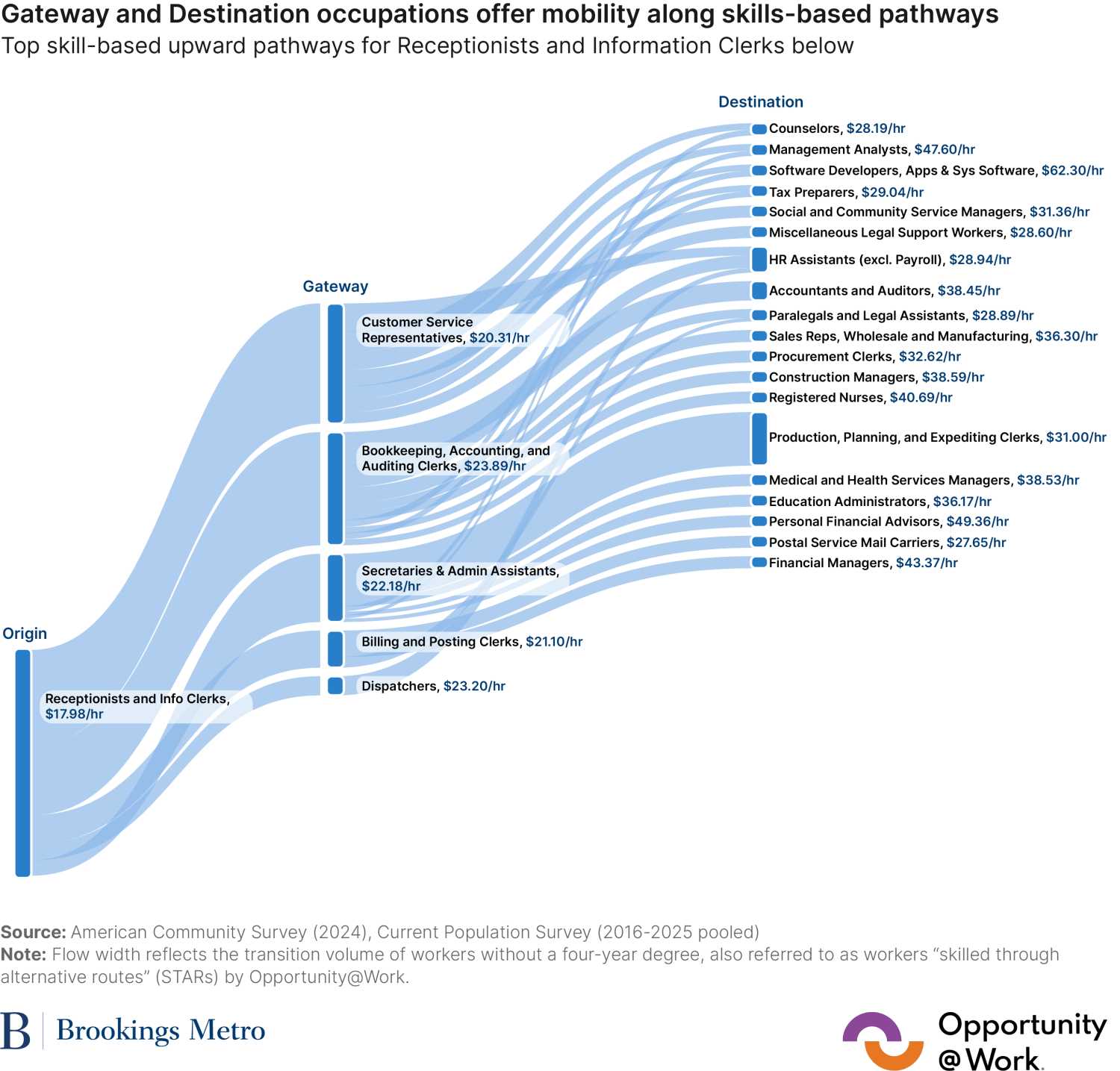
Such progressions—from Origin to Gateway to Destination occupations—have provided a template for upward mobility over the past 40 years. Overall, more than 23 million STARs have transitioned across occupations on pathways to higher-wage work over the last 10 years.
AI may impact not just jobs, but also the pathways that drive economic mobility
AI’s workplace impacts to any given occupation will not be felt in isolation. Rather, AI systems will likely impinge broadly on entire pathways containing millions of jobs.
Jobs function as interconnected stepping stones, so the disruption of a key role within a pathway can alter employment opportunities both upstream and downstream. And because these pathways depend heavily on key transition points (especially Gateway occupations), disruptions in these roles can have outsized effects on workers’ ability to move into higher-wage work.
For instance, if AI were to significantly reorient or automate a customer service role, the opportunity for economic mobility for workers in Origin roles such as receptionists and clerks would likely also be impaired, undercutting the route toward Destination roles such as payroll and timekeeping clerks and human resources assistants.
These are not singular effects. Given the interconnection of jobs across numerous pathways, AI’s growing diffusion across the economy implies broad impacts on individual jobs, but also on career progressions that matter for both workers and employers who rely on accessible and experienced talent pipelines.
To explore what AI exposure on these sequences looks like, we use Anthropic’s new “observed exposure” measure, which estimates the share of tasks within an occupation that AI can perform or assist with based on a combination of model capabilities and real world usage data from the Claude large language model (LLM). In this fashion, the present analysis examines the involvement of various occupations with AI tools. Rather than predicting job losses or gains, exposure assesses general impacts on work, whether positive or negative.
Employing these data, our analysis raises concerns about AI’s ramifications for the nation’s STARs and the pathways they rely on for upward mobility.
To start, millions of the nation’s workers without four-year degrees will be significantly involved with AI, for better or worse, given the nature of their occupations. Specifically:
- Some 15.6 million—or one-fifth of the nation’s 70 million STARs—work in roles highly exposed to AI, meaning they reside in the top quartile of observed occupational task exposure among occupations.
- Those 15.6 million STARs make up 43% of all U.S. workers in the top quartile of U.S. AI exposure.
- Twenty-three million STARs have low adaptive capacity, meaning they have limited ability to weather job displacement and transition to new work, as defined by researchers Sam Manning and Tomás Aguirre. These STARs represent 68% of the nation’s workers with low adaptive capacity.
The job pathways STARs use for economic mobility are likely also coming under pressure. Figure 2 provides a conceptual look at the varied ways AI may impact both individual occupations and the pathways that connect them.
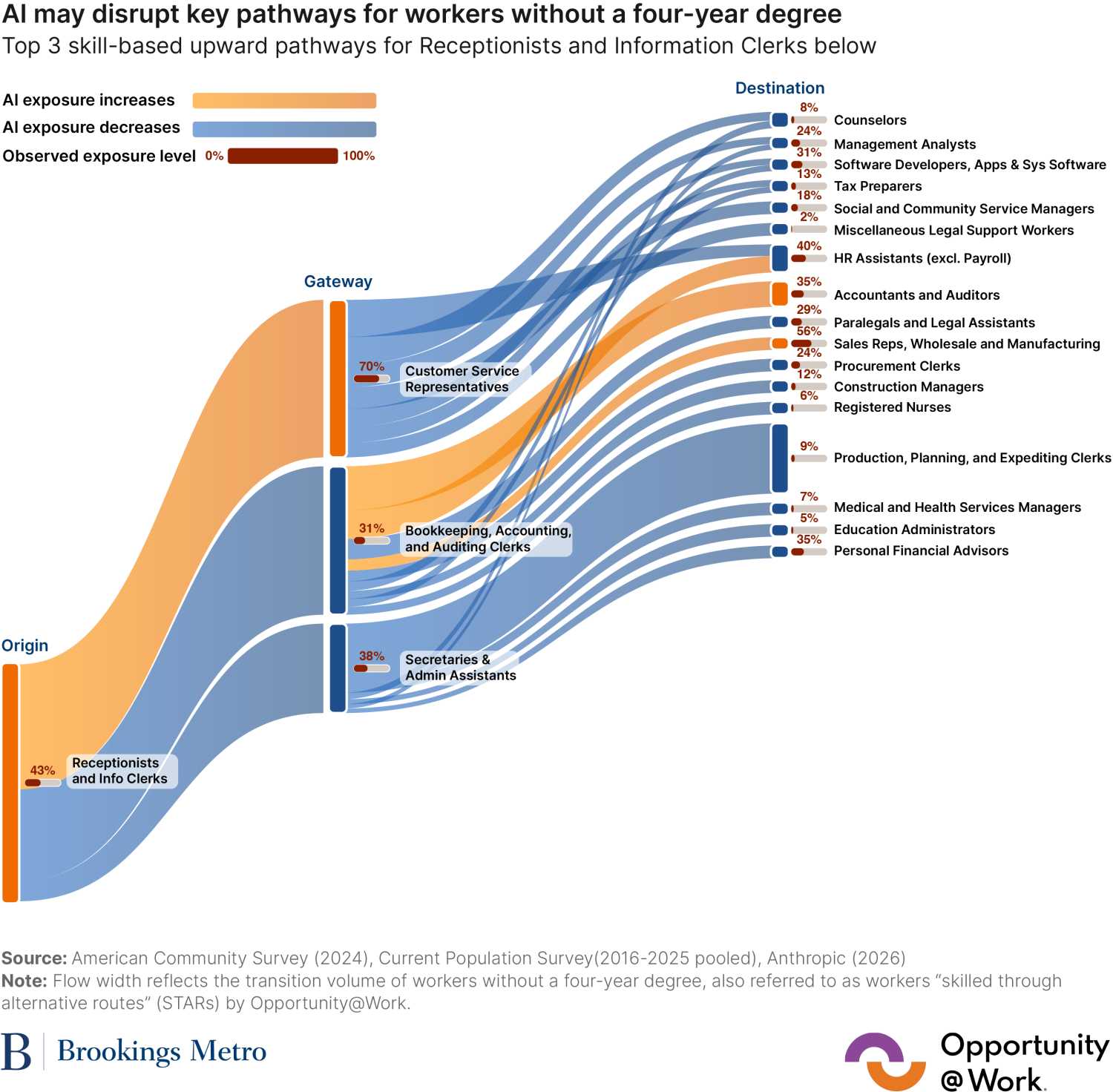
In the aggregate, high AI exposure among STARs in Gateway and Destination occupations may complicate workers’ movement along career pathways. Our analysis finds that:
- Nearly 11 million STARs are in Gateway occupations that are highly AI-exposed, with six Gateway occupations alone accounting for almost 8 million STARs in high AI-exposure work. Many of these workers are concentrated in clerical and administrative roles (which are often woman-dominated), creating uncertainty around a critical set of stepping-stone jobs that support upward mobility.
- Across Destination occupations, 12.9 million workers—or around one-third of all workers in those occupations—may now be highly exposed to AI, including roles such as sales representatives, accountants and auditors, and financial managers. Erosion of stable employment in these roles would be a serious blow to many workers’ advancement.
- Only 51% of job pathways between Gateway and Destination occupations are not highly exposed to AI.
It’s important to specify that “AI exposure” does not necessarily mean job dislocation. The technology holds out both encouraging and worrisome possibilities, as it entails the potential to either augment or automate some or all work tasks, depending on how it is deployed and adopted.
In some cases, AI may enhance roles along job pathways. Occupations such as tax preparers, computer support specialists, and certain managerial roles could see AI accelerate learning, support iterative problem-solving, and provide valuable feedback on written and analytical work. Such augmentation could actually increase STARs’ access to higher-wage Gateway and Destination roles by closing knowledge gaps, reducing skill distances, and decreasing transition friction between occupations. In this vein, economists Daron Acemoglu, David Autor, and Simon Johnson argue that AI’s potential to serve as a collaborator may in many cases enable new tasks, create new work, and increase the value of human expertise.
Yet at the same time, workplace exposure to AI might well entail automation and displacement, as broad fears in society forecast. This AI-prompted disruption may radiate outward, from a few occupations to many, given that labor market pathways are interconnected. Lower-wage roles—which are subject to automation, as Acemoglu and company observe—may lose viable pathways to advancement even as higher-wage roles lose established talent pipelines.
While these risks to pathways have implications for all workers and employers, STARs may be most acutely impacted. These workers are both highly exposed to AI and often the least well positioned to navigate potential job losses. Recent research combining measures of occupational exposure with Manning and Aguirre’s measures of adaptive capacity suggests a concerning pattern: Many highly exposed workers also have limited capacity to adapt. STARs, in particular, may face greater challenges weathering an involuntary job loss, given their savings, skills, location, and age. Around 3.5 million STARs account for 67% of workers who are both highly exposed to AI and have low adaptive capacity.
What happens next will depend on how AI is deployed and how employers, workforce systems, and policymakers respond. If AI is used in ways that complement workers, expand skill development, and strengthen connections between roles, it could reinforce pathways and broaden access to upward mobility.
But if AI adoption instead displaces workers from key roles without building new pathways that allow them to develop skills and move from lower- to higher-wage work, the result could be a wholesale weakening of the pathways that workers and employers alike depend on. In that scenario, advancement opportunities will narrow, talent pipelines will thin, and workers will find fewer viable entry points into higher-wage work, even as employers struggle to cultivate experienced talent.
Workforce pathways and economic mobility will need to be maintained locally
Economic mobility does not occur in the abstract. It happens in places—and it varies.
That’s because the systems that shape labor market opportunities are regional. Specifically, career pathways depend on intricate coordination among employers, training providers, intermediaries, and workforce systems—all of which are local. What’s more, with approximately 73% of U.S. workers living and working within the same county, the strength of these pathways will be shaped locally by the mix of occupations and their associated AI exposure.
Notably, many of the career pathways that STARs rely on most are concentrated in metropolitan areas, where they are impinged on by varying levels of AI exposure. As a result, the concentration of STARs in highly exposed Gateway occupations varies across regions, creating locally distinct workforce challenges.
The findings and map below illustrate the uneven terrain of opportunities and risks for workers:
- Overall, STARs concentrate within administrative, clerical, and customer service Gateway occupations that score high on observed AI exposure, particularly in the Northeast and the Sun Belt. The share of STARs in highly exposed Gateway occupations is shown in the map below.
- For example, Northeast metro areas such as Albany, N.Y. (32.8%), Harrisburg, Pa. (32.6%), and Providence, R.I. (30.1%)—all state capitals—show large shares of STARs in highly exposed Gateway occupations, given that pathways there are concentrated in administrative and clerical roles with high AI involvement.
- Sun Belt metro areas stand out for the highest AI exposure, reflecting fast-growing service economies with many STARs in office support roles. Some Florida metro areas have especially high percentages of AI-exposed STARs in Gateway occupations, including Palm Bay (35.5%), Cape Coral (34.7%), Jacksonville (33%), North Port–Sarasota (32.7%), Orlando (32.2%), and Tampa (32.2%).
- Midwest metro areas—including Cincinnati (24.1%), Milwaukee (24%), and Des Moines (26%)—appear less exposed, as Gateway occupations there might be more tilted toward operational and logistical roles.
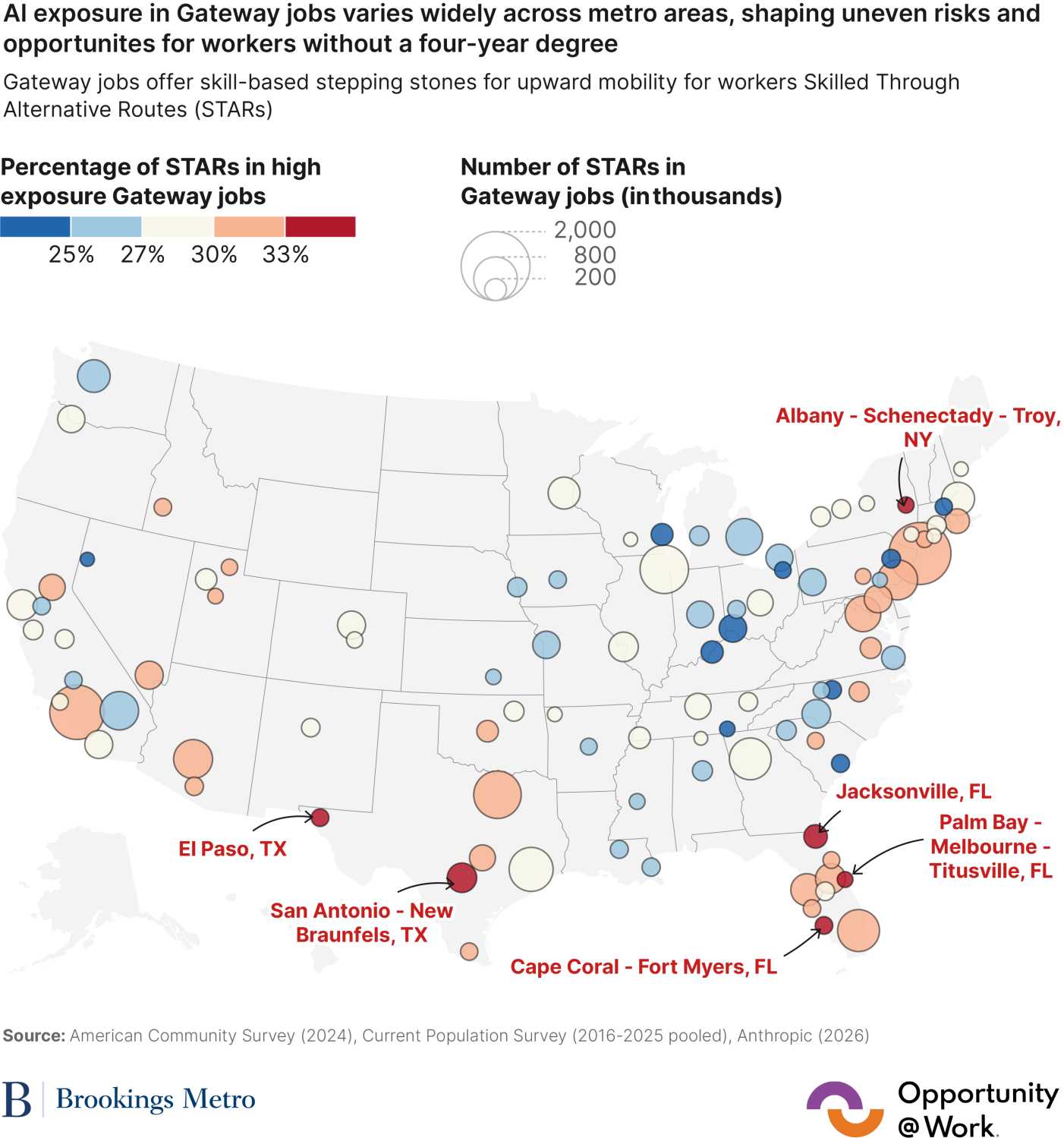
These statistics and the map underscore that maintaining upward mobility for workers without four-year degrees will require strong and grounded local efforts that vary across the nation’s labor market geography.
The urgency is high: When local employment pathways weaken, workers there become increasingly concentrated in lower-wage roles with limited advancement opportunities, while employers face growing difficulty in locally sourcing talent. Over time, these frictions can constrain local workforce development, depress economic dynamism, and limit regions’ capacity to adapt to technological change.
Given that, states and regions, ideally with federal support, must determine how to ensure AI can strengthen regional job pathways rather than shred them.
Next steps for advancing worker mobility in the AI economy
Looking ahead, the central labor market challenge of AI may not be as simple as which workers or jobs are most disrupted, but rather how AI reshapes the career pathways that connect entry-level and low-wage workers to higher-wage opportunities and family-sustaining work. If those pathways narrow or disappear, the consequences will extend beyond individual workers to firms and entire regional economies that rely on steady pipelines of talent.
In order to set strategies that effectively meet the moment, the field must grapple with a set of urgent questions:
- How and where is AI reconfiguring job pathways? AI adoption varies widely by occupation, pathway, firm, and region. In addition, the concentration of opportunities along pathways might vary substantially from place to place. Within a regional context, the field needs to investigate which pathways are continuing to work well, which are emerging as new advancement routes, and which are eroding.
- What skills are becoming more valuable in terms of the mobility they generate, and to whom are they accessible? Abstract skill taxonomies offer limited guidance for workers, educators, and regional leaders. Therefore, other inquiries are needed, such as: What specific skills are employers seeking in AI-integrated roles? Are those skills learnable through work-based routes and short-term training, or are they gated by formal credentials? To what extent do existing pathways still allow STARs to build and signal these skills over time?
- What does “high-road” AI adoption look like in practice? While AI disruption poses immediate risks to both workers and regional economies, it also poses longer-term risks if pathways into mid- and senior-level roles collapse. If fewer workers can enter and advance today, regions may face acute shortages of experienced talent five to 10 years from now. So, it’s important to ask: Are there emerging “high-road” models in which AI is deployed in ways that upgrade jobs, support worker learning, and maintain pipelines of experience? What incentives, policies, and employer practices support these outcomes? How can the lessons from such models be documented and replicated at scale before skill and experience bottlenecks emerge?
- What forms of collective action are required to sustain regional resilience? No single employer, training provider, or jurisdiction can be individually responsible for the health of job pathways that generate economic mobility. As such, responding effectively to the risk and opportunity of AI disruption will require coordinated, collective action across systems. What mechanisms enable coordination across workforce systems, employers, educators, and policymakers? What data infrastructure is needed to detect pathway erosion early enough to respond to the needs of both workers and employers?
Framed this way, the question is not whether AI will generate efficiency gains or displace workers; both are likely. Instead, the question is whether short-term decisions about AI adoption come at the cost of future mobility and talent supply. Decisions being made now about job design, hiring practices, and skill development will shape whether regions experience expanded opportunities for their workers or more severe bottlenecks. Investigating the status of job pathway health and how to sustain it stands as critical work.
Authors
The Brookings Institution is committed to quality, independence, and impact.
We are supported by a diverse array of funders. In line with our values and policies, each Brookings publication represents the sole views of its author(s).