The paper summarized here is part of the spring 2026 edition of the Brookings Papers on Economic Activity, the leading conference series and journal in economics for timely, cutting-edge research about real-world policy issues. Research findings are presented in a clear and accessible style to maximize their impact on economic understanding and policymaking. The editors are Brookings Nonresident Senior Fellows Janice Eberly and Jón Steinsson.
See the spring 2026 BPEA event page to watch paper presentations and read summaries of all the papers from this edition. Submit a proposal to present at a future BPEA conference here.
The growth of health care spending in the United States seems to have permanently slowed thanks in part to technological advances making medical treatments cheaper and more effective, according to a paper to be discussed at the Brookings Papers on Economic Activity (BPEA) conference on March 27.
The United States spent more than $5 trillion on medical care in 2024, or 18% of its gross domestic product (GDP). That’s up a bit from 17.2% of GDP in 2010, but far below the 21.2% share of GDP—nearly $1 trillion less—forecast by government actuaries in 2010.
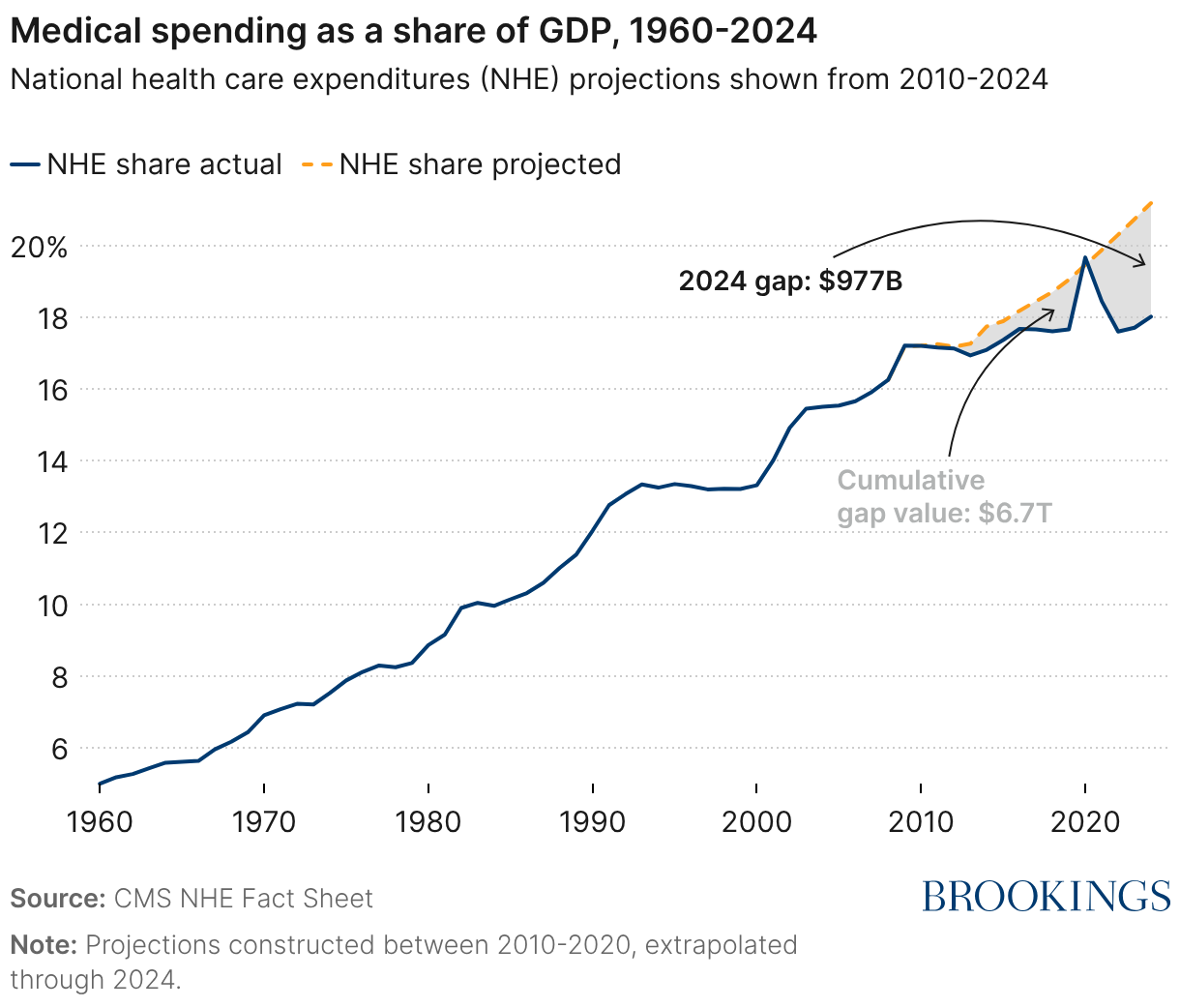
“The slowdown in medical spending growth is not only large substantively, it is unprecedented historically,” write the authors, David M. Cutler and Lev Klarnet of Harvard University. “Since … 1960, no 14-year period has seen as slow growth of medical spending relative to GDP as was realized over the 2010-2024 time period.”
The authors explore reasons for the slower growth and “conclude that the United States has bent the health care cost curve, though not as much as it could be or will need to be bent.”
Price declines in some areas, such as for medical imaging and the shift to generic drugs from brand-name drugs, explains some of the slower growth. Also, the use of some medical technologies (such as advanced imaging and new drugs) has stopped increasing.
In particular, the authors highlight a shift in the impact of technological change. In the past, new technologies usually increased costs (for example, a new kind of chemotherapy to treat cancer) and were often of limited efficacy. But, as technology improves to make treatments better and cause fewer side effects, it not only improves health, it also lowers costs. Examples of cost-saving technological change include a shift to outpatient surgery from inpatient surgery and the wider diffusion of drugs that prevent costly illnesses, such as statins to reduce cholesterol.
“Treatments that are less difficult on the body turn out to be less difficult on the wallet,” Cutler said in an interview with the Brookings Institution.
The authors conclude that health care spending will continue on its slower-growth trajectory because the nature of technological innovations is different now than in the past. But they warn that more changes will almost certainly be needed to bring U.S. medical spending closer to the roughly 12% of GDP spent in other advanced economies.
“Medical spending is still higher in the United States than elsewhere, and health outcomes do not appear to justify that additional expense. … And … even people who are insured find it increasingly difficult to access care,” they write.
“There is still a lot of care that, clinically, doesn’t need to be done,” Cutler said in the interview. “The administrative costs of health care are absurd, and we don’t use AI enough. We could lower costs a lot and make life better for doctors and patients,” Cutler said in the interview.
Authors


CITATION
Cutler, David M. and Lev Klarnet. 2026. “Has the United States Bent the Health Care Cost Curve?” BPEA Conference Draft, Spring.
-
Acknowledgements and disclosures
David Skidmore authored the summary language for this paper. Chris Miller assisted with data visualization.
The Brookings Institution is committed to quality, independence, and impact.
We are supported by a diverse array of funders. In line with our values and policies, each Brookings publication represents the sole views of its author(s).