This viewpoint is part of Chapter 4 of Foresight Africa 2026, a report on how Africa can navigate the challenges of 2026 and chart a path toward inclusive, resilient, and self-determined growth. Read the full chapter on governance, institutions, and state capacity.
Social media can be a powerful tool for policymakers looking to increase the political and economic participation of young people who make up the majority of Africa’s growing population.
In June 2024, thousands of young Kenyans took to the streets to protest a proposed finance bill that would significantly increase the price of essential goods like bread, sanitary products, and digital services, further straining households already burdened with a higher cost of living in the post-pandemic period.1 The protesters used social media platforms like X (formerly Twitter) and Tik Tok to educate each other on the bill, correct perceived misinformation in government narratives, and organize demonstrations across the country. The event became known as the “Gen Z protests,” highlighting the power of social media for political participation of Africa’s youth.2
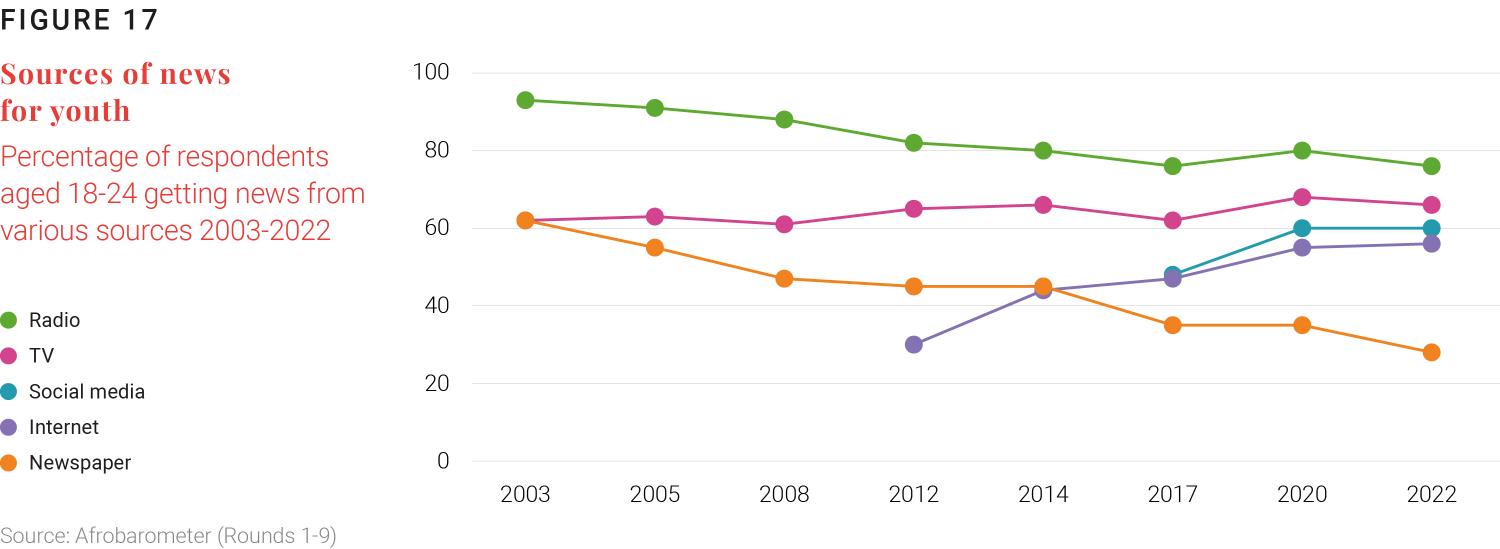
Recently, social media has emerged as a powerful, if contested,3 tool that can help Africa’s youth engage politically and economically in ways that go beyond protest (e.g., participation in voting, community meetings, electoral rallies, and other methods within democracies).4 At the same time, social media can have negative effects on this same engagement if, in the absence of effective, context-informed regulation, public and private actors (both domestic and foreign) use platforms to repress civil liberties and spread disinformation that can further erode trust and participation in democratic institutions. Social media can be a powerful tool for policymakers looking to increase the political and economic participation of young people who make up the majority of Africa’s growing population.5 For these policymakers, engaging these platforms is extremely important given that social media is now the dominant form of news consumption among youth aged 18-246 —this in a continent where over 60% of the population is young people under the age of 25, and where the rise of access to internet7 means that Africans are increasingly more online than ever (Figure 17).
Since young Africans are using these platforms for everything—from communication, news, education, information, to employment, policymakers can harness youth access to these platforms in three major ways: (1) to incentivize higher, less costly political participation; (2) to deliver economic benefits; and (3) to invest in effective regulation against disinformation and local, citizen-owned social media platforms that can boost returns to (1) and (2). They must do so while, crucially, investing in regulation that protects the data and civil liberties of African citizens and local, regional, and global partnerships and platforms that reduce misinformation, disinformation, polarization, and violent content that can reduce the returns to (1) and (2). I outline specific policies to deliver these benefits below.
How can policymakers leverage social media to incentivize higher, but less costly, political participation of youth?
How are youth engaging politically, and what constraints do they face in doing this?
Based on a representative sample of African citizens,8 Figure 18 shows political participation by age cohort across five major participation categories such as voting and protest participation. Notably, African youth (aged 18-24) are much less likely to vote, with just 41% of youth reporting having voted in the previous election compared to 77% of older populations in 2022. Moreover, figures for youth voting have remained low over time.
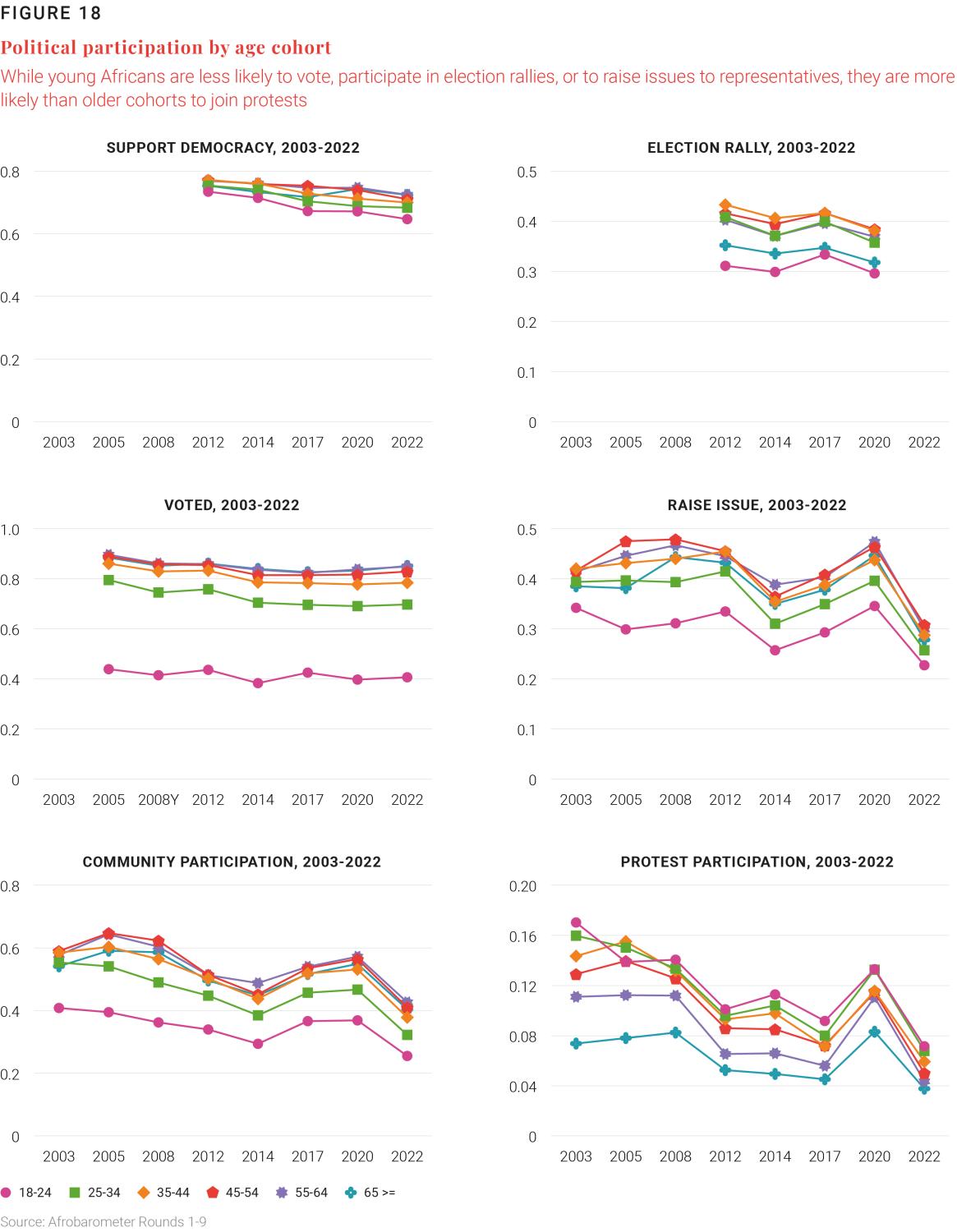
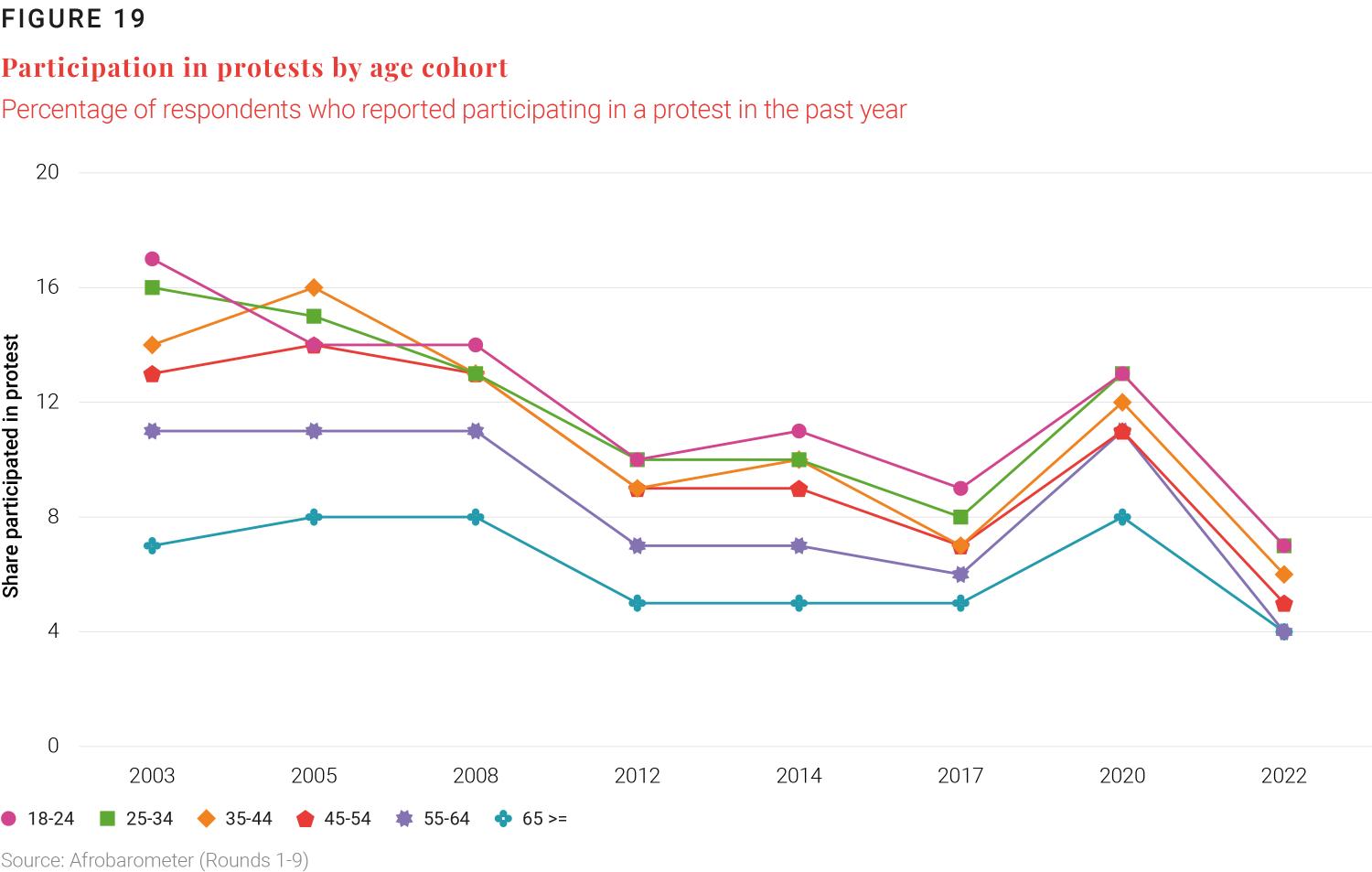
Another key observation is that while youth are less likely to be politically engaged across almost all categories, protest participation is an exception—youth are significantly more likely to participate in protests relative to other age cohorts, with 7% of youth reporting protest participation as of 2022 (Figure 19).
What about news and information? Figure 17 shows news consumption by age cohort. While traditional forms of media like radio and newspapers remain popular forms of news consumption, these mediums experienced marked declines in consumption between 2003 and 2022. Conversely, more Africans, and especially African youth, are consuming news from social media and general internet sources, with 60% of youth reporting consuming news from social media as of 2022.
How can policymakers leverage social media access to promote less costly political participation by Africa’s youth?
Given these statistics on relatively higher youth consumption of news through social media and higher youth protest participation, what policies could harness social media access to boost other types of low-risk, political participation? I highlight three policies below:
- Policymakers can use social media to provide political news and civic education on how to get involved in community meetings/local politics. This can be implemented through the Ministry of Education or in partnership with institutions that youth trust or that involve young people in their decisionmaking (e.g., youth-focused civil society organizations).
- Policymakers can also leverage social media platforms of government organizations where young adults participate in high numbers, including communicating civic education through social media accounts of public universities, among others. Where they exist, another avenue could be through national youth service programs (like Nigeria’s or Ghana’s National Youth Service system) to communicate this information/civic education both in person and via social media.
- Cultural and creative industries (CCI) are a large and growing share of Africa’s economy.9 Governments can leverage this cultural capital and work with young artists who often have large social media following,10 to share civic education and information about the benefits of political engagement.
How can policymakers leverage access to social media to improve youth economic outcomes?
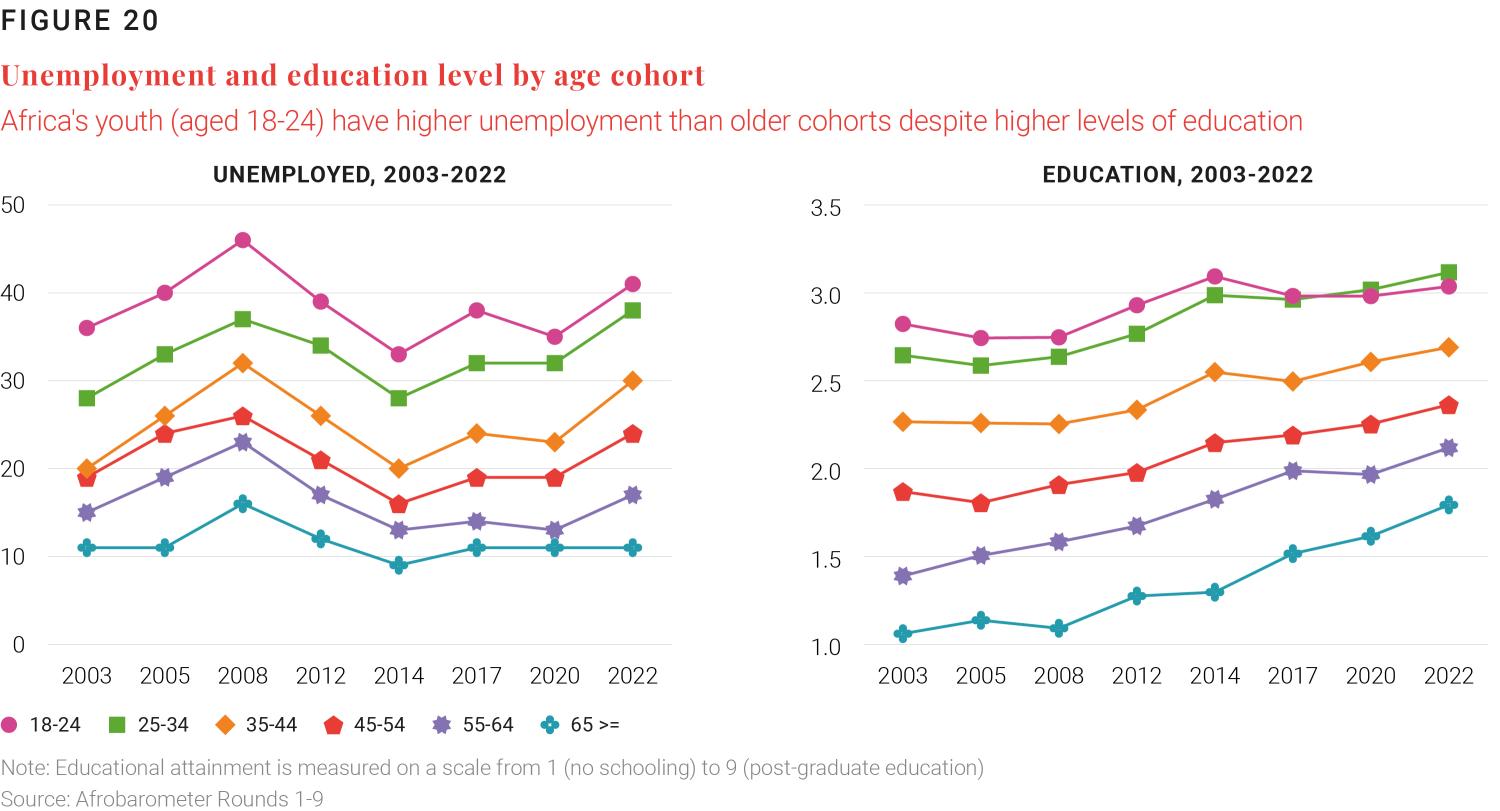
Africa’s youth have some of the highest unemployment rates in the world, despite being among the most educated cohorts in the continent’s history, with 41% of youth reporting being unemployed as of 2022 (Figure 20).
At the same time, young people are increasingly using social media sites such as LinkedIn, as well as related local online job portals like Jobberman in West Africa and Brighter Monday in East Africa for employment purposes.11 Governments should work with these online local platforms to share information (with both firms and job applicants) on strategies to boost employment and firm productivity. This will reduce matching costs for firms looking for skilled applicants and can help provide young entrepreneurs, and especially young female entrepreneurs/applicants, who often face bias and worse labor market outcomes, with skills, capital, and networks needed to succeed in the labor market.12
To deliver political and economic benefits, policymakers must, crucially, invest in (1) partnerships with local and international stakeholders to design context-informed, transparent, and consistent regulation and (2) locally grown African social media platforms. The proliferation of social media has been accompanied by a rise in misinformation and disinformation, with potentially deadly results—as in the case of the 2017 massacre in Myanmar, which was fueled through disinformation campaigns on Facebook.13 Additionally, the growing use of AI which uses consumer data extracted through these social media platforms highlights the urgent need for stricter regulations to protect the data privacy of African citizens using these platforms. Some African countries, like Nigeria with its 2023 Data Protection Act, have begun introducing stricter data protection legislation, but more regional coordination is needed for both stronger regulation and enforcement.14 Regulation is also needed to foster investment in locally developed, African-owned social media platforms, which could advance more locally-relevant information and online content. African policymakers should work to ensure African representation on the boards of existing social media firms, and also partner with African AI experts working to protect African users and workers in the social media space, like content moderators’ unions, to design careful, context-informed regulation, with safeguards to protect users and lessen the misuse of social media by malicious actors: Both global and domestic, and both within and outside of government.15
African policymakers who invest in effective regulatory institutions and infrastructure to reduce disinformation, misinformation, and violent content, while protecting the data and civil liberties of African citizens will be well-placed to deliver economic and political returns and boost the wellbeing of the world’s fastest growing demographic—Africa’s youth.16
Author

Related Content

-
Acknowledgements and disclosures
Thanks to Pierre Nguimkeu, Nicole Ntungire, Dafe Oputu, the Brookings Africa Growth Initiative team, Andikan Archibong, and an anonymous referee for helpful comments and suggestions. All errors are the author’s own.
-
Footnotes
- Judy Mbugua, “Why Kenya’s Gen Z Has Taken to the Streets,” Journal of Democracy, July 2025.
- Mbugua, “Why Kenya’s Gen Z Has Taken to the Streets.”
- Joël Cariolle et al., “Strengthening Social Contracts in Africa: Is Social Media a Blessing or a Curse?,” World Bank Blogs, September 16, 2024.
- Belinda Archibong and Raiyan Kabir, “Building Blocs: Examining the Links Between Youth, Trust and Civic and Political Engagement in Africa,” paper presented at World Bank Conference on “Social Contracts in Africa,” March 5, 2019.
- Belinda Archibong and Peter Blair Henry, “Shocking Offers: Gender, Wage Inequality, and Recessions in Online Labor Markets,” AEA Papers and Proceedings 114 (May 2024): 196–200.
- People aged 15-24 years are defined as youth by United Nations definitions. I focus on adult populations here.
- Jonas Hjort and Jonas Poulsen, “The Arrival of Fast Internet and Employment in Africa,” American Economic Review 109, no. 3 (2019): 1032–79.
- Using data from the nationally representative Afrobarometer surveys.
- Landry Signé, “The Outsized Potential of the Cultural and Creative Industries in Africa,” Brookings Institution, May 5, 2025.
- For example, Afrobeats star and Grammy nominee Ayra Starr has over 7 million followers on Instagram alone.
- Belinda Archibong, “A Laws-Jobs-Cash Framework for Gender and Youth-Based Economic Transformation in Africa,” Brookings Institution, January 13, 2025.
- Belinda Archibong, “How to Reduce Gender Inequality in Labor Markets in Africa,” Brookings Institution, February 13, 2024.
- Barbara Ortutay, “Amnesty Report Finds Facebook Amplified Hate Ahead of Rohingya Massacre in Myanmar,” PBS News, September 29, 2022.
- World Bank, Regulating Digital Data in Africa (Washington, DC: World Bank, 2024).
- Michelle Du and Chinasa T. Okolo, “Reimagining the Future of Data and AI Labor in the Global South,” Brookings Institution, October 7, 2025.
- Declan Walsh, “Old World, Young Africa,” The New York Times, November 7, 2023.
The Brookings Institution is committed to quality, independence, and impact.
We are supported by a diverse array of funders. In line with our values and policies, each Brookings publication represents the sole views of its author(s).

Commentary
Harnessing social media for increased political engagement
March 3, 2026