Uganda has made remarkable progress in expanding access to education, yet for many girls in post-conflict Northern Uganda, education still fails to translate into skills, dignity, or meaningful opportunities. Listening to girls’ voices reveals why a justice-oriented approach to education is urgently needed. Government initiatives such as Universal Primary Education (UPE) and Universal Secondary Education (USE), and a handful of skills-based education programs supported by gender-responsive strategies introduced since 1997, have significantly expanded school enrollment and gender parity in primary education. These reforms reflect a strong national commitment to expanding educational opportunities. However, increased enrollment has not translated into completion or meaningful transition pathways for girls. Many remain less likely to complete secondary education or progress to higher levels, and their participation in technical and vocational education remains lower than that of boys.
These disparities are particularly pronounced in rural and post-conflict regions such as the Acholi region in Northern Uganda. In these contexts, girls face intersecting barriers such as high rates of teenage pregnancy, early marriages, rigid gender norms, poverty, caregiving responsibilities, stigma, and weak institutional support systems. As a result, many girls either drop out of school or complete their education without acquiring the practical skills, confidence, or opportunities needed to pursue sustainable livelihoods.
Although many girls aspire to economic independence, leadership, and meaningful participation in their communities, the current education systems remain largely exam-oriented and insufficiently responsive to their lived realities. This disconnect raises critical questions about how education systems can better support girls’ aspirations, strengthen their agency, and promote livelihood pathways in Northern Uganda.
To explore these questions, I conducted qualitative research in Kitgum and Lamwo districts of Uganda (July-August 2025) with 28 girls ages 15-24, including girls in and out of school, adolescent mothers, and education stakeholders. Through focus groups, storytelling, and key informant interviews, the study centered on girls’ voices and lived experiences to understand their aspirations, barriers, and support systems shaping girls’ agency and livelihood opportunities.
Girls’ aspirations: From survival to leadership
Girls in post-conflict Northern Uganda aspire to secure livelihoods and economic independence, support their families, and contribute to community recovery. Many hope to become entrepreneurs, nurses, journalists, or teachers, linking education to dignity, independence, and survival. However, they often feel schooling does not provide practical skills for real-life challenges. Beyond personal success, girls want to uplift their families and serve as role models in their communities. Many also aspire to challenge injustices such as gender inequality and violence. As one participant noted, “We need an education that teaches us to survive, to lead, and to help others.”
Figure 1. Girls’ educational aspirations in Northern Uganda are shaped by practical, strategic, and systemic needs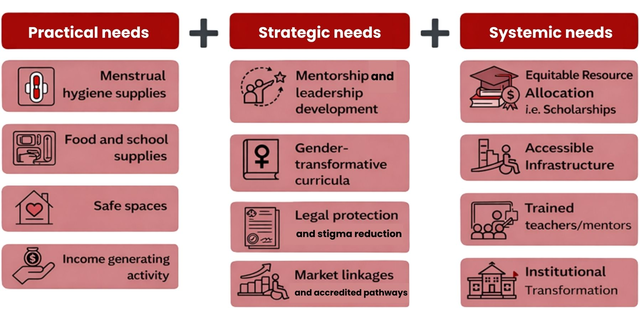 Source: Author’s conceptualization
Practical needs are immediate and survival-driven and enable girls’ day-to-day participation. When these needs go unmet, girls are often forced to miss classes or drop out of school entirely.
Strategic needs, by contrast, are long-term and empowerment-focused, building the agency, confidence, and independence required to sustain girls to complete their education and transform their futures.
Systemic needs are institutional, cultural, and structural conditions that determine whether girls’ practical and strategic needs can be met and sustained. These factors shape and sustain girls’ ability to navigate systems and convert opportunities into viable, long-term pathways and are key to the realization of their aspirations.
Why current education systems fail to support girls’ aspirations
Girls rely on support from families, communities, and institutions to pursue education and livelihoods. Mothers, senior women teachers, community leaders, NGOs, and savings groups provide care, mentorship, and limited financial support. However, these networks remain fragile, inconsistent, and shaped by social connections, highlighting the need for coordinated and institutionalized support systems for girls’ empowerment.
Although Uganda has expanded access to education through formal schooling and vocational training, girls’ voices reveal that these systems still fall short in nurturing the skills, confidence, and opportunities they need to achieve their aspirations:
- Formal schooling remains disconnected from livelihood realities. Many girls describe an exam-driven system focused on memorization rather than practical skills, critical thinking, or problem solving. As one girl explained, “Most of the subjects we were learning were just theory, not things I can use to survive.” As a result, many complete school without the confidence or skills needed for meaningful livelihoods.
- Vocational training programs remain gendered and limited. Girls are often directed toward stereotypically “feminine” trades such as tailoring or hairdressing, which offer limited income opportunities. One participant noted, “I was trained in tailoring because that’s what was given to girls, but there are too many of us doing the same thing and no real income.”
- Adolescent mothers and out-of-school girls face persistent exclusion. Stigma, rigid school structures, lack of childcare, and weak enforcement of re-entry policies make it difficult for them to return to education or training. As one young mother shared, “I want to go back to school, but people laugh and say I am spoiled.”
These barriers highlight the need for a justice-oriented education approach that moves beyond access to address structural inequalities shaping girls’ opportunities.
Justice-oriented education: A pathway for transformation and sustainable livelihoods
From girls’ perspectives, education should do more than award credentials; it should build agency, restore dignity, and create pathways to independence and leadership. As one 19-year-old in Lamwo said, “Education must develop the capacity to think critically … and provide equity for those whose voices are not heard.”
Girls in post-conflict Northern Uganda have strong aspirations, yet social norms, poverty, and weak institutional support continue to limit their opportunities. Addressing these challenges requires a justice-oriented approach that links education to skills, rights, psychosocial support, and real livelihood pathways.
Figure 2. Justice-oriented education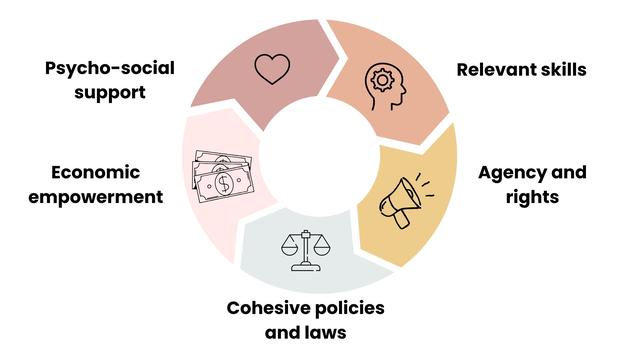 Source: Author’s conceptualization
Justice-Oriented Education (JOE) would respond to girls’ aspirations and needs and the systemic barriers they face. Grounded in social justice principles, human rights, and gender equality, JOE combines skills development, psychosocial support, and community engagement to strengthen existing education policies and promote girls’ agency, dignity, and livelihood opportunities in marginalized contexts.
Advancing justice-oriented education in conflict-affected northern Uganda requires coordinated effort from multiple actors at the school, community, and national levels, including:
- The government must integrate practical life skills, financial and digital literacy, gender equality, and flexible pathways for adolescent mothers into education policies while strengthening monitoring systems.
- NGOs and development partners must provide gender-responsive skills training, mentorship, and coordinated programs linked to local economies.
- Communities and schools must help reduce stigma, support school re-entry, and create safe environments that sustain girls’ participation in education.
Girls in Northern Uganda are not passive victims; they have clear aspirations and ideas for change. What they need is an education system that moves from access to justice, agency, and opportunity. Justice-oriented education would ensure education moves beyond helping girls stay in school to ensuring learning that equips them with the skills, dignity, and opportunities needed to shape their own futures and rebuild their communities.
Author
The Brookings Institution is committed to quality, independence, and impact.
We are supported by a diverse array of funders. In line with our values and policies, each Brookings publication represents the sole views of its author(s).

Commentary
Reimagining education for girls in post-conflict Northern Uganda: Why a justice-oriented education approach matters
April 7, 2026