

In Partnership With

During a recent research visit to study the transforming neighborhoods of Detroit, a conversation with a longtime resident and community leader stayed with us. She described witnessing “big money” flowing in and around her neighborhood, resulting in new construction, rising property values, and institutional expansion. She said she was feeling two things at the same time: hopeful for growth and opportunity, as well as anxiety that those dynamics may not be for people like her. “Growth, but for whom?” she asked.
Her question is not unique to Detroit. Across U.S. cities, capital is moving in and around neighborhoods in ways that will transform those places’ well-being, but current measurement tools often struggle to capture the complexity of these changes. This report proposes a framework, inspired by the dynamics in Detroit, that brings together multiple dimensions—investment, displacement risk, equity, and community voice—to help residents, investors, and decisionmakers understand and guide neighborhood change.
How dynamics in Detroit inspired the framework
Detroit offers a striking example of a city where investment at scale is rapidly changing the landscape of opportunities and challenges residents face. But who gets access to those opportunities, who loses, and who decides to leave or stay?
Detroit is no stranger to episodes of rapid development, and after decades of disinvestment and a prolonged period of low growth, it is once again on the radar for big investments. Dan Gilbert’s Bedrock has invested and committed over $7.5 billion across more than 140 commercial real estate projects in the downtown area. JPMorgan Chase has surpassed $2 billion in investments since 2014, including $160 million toward more than 3,800 units of affordable housing. The Kresge Foundation, Knight Foundation, and other philanthropies have directed hundreds of millions of dollars toward neighborhood stabilization and community development programs in the city. Henry Ford Health is expanding its campuses to the city’s New Center district and building a joint research facility with Michigan State University, which is intended to attract multi-income residential housing, retail, and green space.
Collectively, private investment has been a big driver of overall investment in the region, along with anchor institution expansion and a focus on real estate development. Most of this investment is geographically concentrated in midtown and downtown Detroit, while neighborhoods just a few miles away are characterized by high housing vacancies, decades of commercial disinvestment, and challenges ranging from aging populations to a scarcity of grocery stores and quality schools.
Understanding neighborhood ‘tipping points’
Detroiters across different neighborhoods echoed concerns around how investment will translate into community uplift. There is a fear among residents that costs are rising faster than opportunities or incomes, and they want to see more commitment toward equitable and inclusive growth. Most of Detroit is undergoing a visible transformation, and neighborhoods within the city are feeling the ripple effects and changing neighborhood conditions. These places find themselves on a spectrum of “tipping” over to a space where growth and equity trajectories are being determined by the interaction of market forces and changing demographics.
Historically, such “tipping points” have been associated with racial compositional change in episodes of transition, when a neighborhood’s demographic makeup shifts irreversibly in one direction. Yet contemporary neighborhood transformation rarely tips along a single factor. While race remains central (especially in cities shaped by segregation and racial wealth inequality), neighborhood change occurs multidimensionally through socioeconomic shifts in income, educational attainment, tenure, and who can afford to stay.
Often in the context of large-scale, geographically concentrated investments, the tipping point occurs when market forces and demographic change simultaneously reinforce each other: Price changes drive demographic shifts, and these shifts are interpreted as signals for further price appreciation. Rising costs determine the changing demographic makeup in neighborhoods and cities with histories of racial segregation and wealth inequality, while gentrification occurs through race and class lines simultaneously.
Thus, neighborhood tipping points in contemporary America are simultaneously a market, race, and class phenomenon, in which demographic change, income inequality, and market pressure shape the collective landscape of the neighborhood. This requires a new definition of a “tipping point neighborhood”—one that better fits the realities of contemporary growth and development. We propose the following:
A tipping point neighborhood is a place showing signs of rising investment and market interest, while still facing structural economic vulnerability and inequality. The tipping point is a moment in which increases in coordinated capital, targeted policy, strategic support, and community action can accelerate equitable economic growth and prosperity.
Tipping point neighborhoods are neighborhoods in motion, and their trajectory is not predetermined. Tipping point dynamics in a neighborhood signal market interest, demographic change, and a changing landscape of opportunity and challenges for residents across the racial and socioeconomic spectrum. In other words, a neighborhood’s growth trajectory can be shaped in a way so that investment generates equitable outcomes and builds on community assets—or it can displace long-term residents and institutions, thereby increasing disparities between groups who gain from investments and opportunities and those who lose out on them.
The nuance in our definition is that the tipping point is an analytically significant moment of intervention rather than a point of irreversibility. Gentrification today is more rapid and widespread than in prior decades, with an increased role for large-scale developers and the state. What we call a “tipping point moment” is thus an analytically crucial window where the dynamics of equitable growth or displacement have started to reach a critical mass that will determine a neighborhood’s medium- or long-term trajectory.
Given that this trajectory is not predetermined, targeted and thoughtful investment has the potential to generate equitable outcomes, strengthen community assets, and create opportunities for existing residents. But without intentional policies and community-centered investments, this growth runs the risk of displacing long-term residents and increasing inequalities in and around neighborhoods.
How to move from theory to action to support neighborhood change
The questions driving this work are simple: Can a neighborhood thrive on its own terms? Can it build on local assets, protect vulnerable neighbors, and shape the trajectory of development and big capital toward equitable outcomes for everyone, not just for newcomers?
In the coming year, we’ll use the framework presented here to build a data dashboard that aims to measure these dimensions in a way that is useful to residents, philanthropies, local governments, and other decisionmakers. It will be designed to visualize how a neighborhood is doing in terms of its proximity to a tipping point, its risks of displacement, synergies between local assets and growth, and the gains and losses in equitable outcomes for residents.
Community power and voice are fundamental to what we’re trying to measure and make visible. Through qualitative layers, we will capture the strength of that voice—its organizing capacity, institutional presence, and civic infrastructure—so that local leaders can better represent neighborhood needs as equal partners in shaping their own trajectories.
Given the complexity of neighborhood ecosystems, the dashboard cannot predict change. Instead, it proposes a useful yet imperfect way to make change visible, so decisions can be made before it’s too late, or a neighborhood has already tipped over. The dashboard is a neighborhood-level decision support tool that combines quantitative indicators and qualitative community insights to track how investments (in and around neighborhoods), displacement risk, quality of life, equity outcomes, and community power and agency are changing over time. The intended users are residents, community organizations, philanthropy, community development financial institutions (CDFIs), and local government and other decisionmakers.
Standard well-being statistics such as poverty, inequality, and unemployment remain central to assessing the health of a neighborhood. However, in the absence of other dynamic indicators contextualizing the why and where, standalone measures can only give us limited insight. For instance, a declining poverty rate could mean several things, among which is that lower-income residents are moving out of the neighborhood rather than existing residents earning more. Thus, observing “change” requires additional indicators or metrics measuring investment flows, displacement signals, residential mobility, demographic shifts, and more. The purpose is to provide a fuller picture of the pulse of a neighborhood—one in which decisionmakers can observe change as it unfolds and direct investments in the most meaningful and timely manner possible.
A breakdown of our new framework for measuring neighborhood transformation and equity
The neighborhood is where policy, investment, and institutional decisions become lived experience. Neighborhood-level well-being is a granular measure of whether growth is reaching its intended beneficiaries or not. Through our dashboard framework, we aim to ask: How are investments shaping change? Are there signs of displacement risk? Who gains, who loses, and what can stakeholders do to shape trajectories toward equitable outcomes?
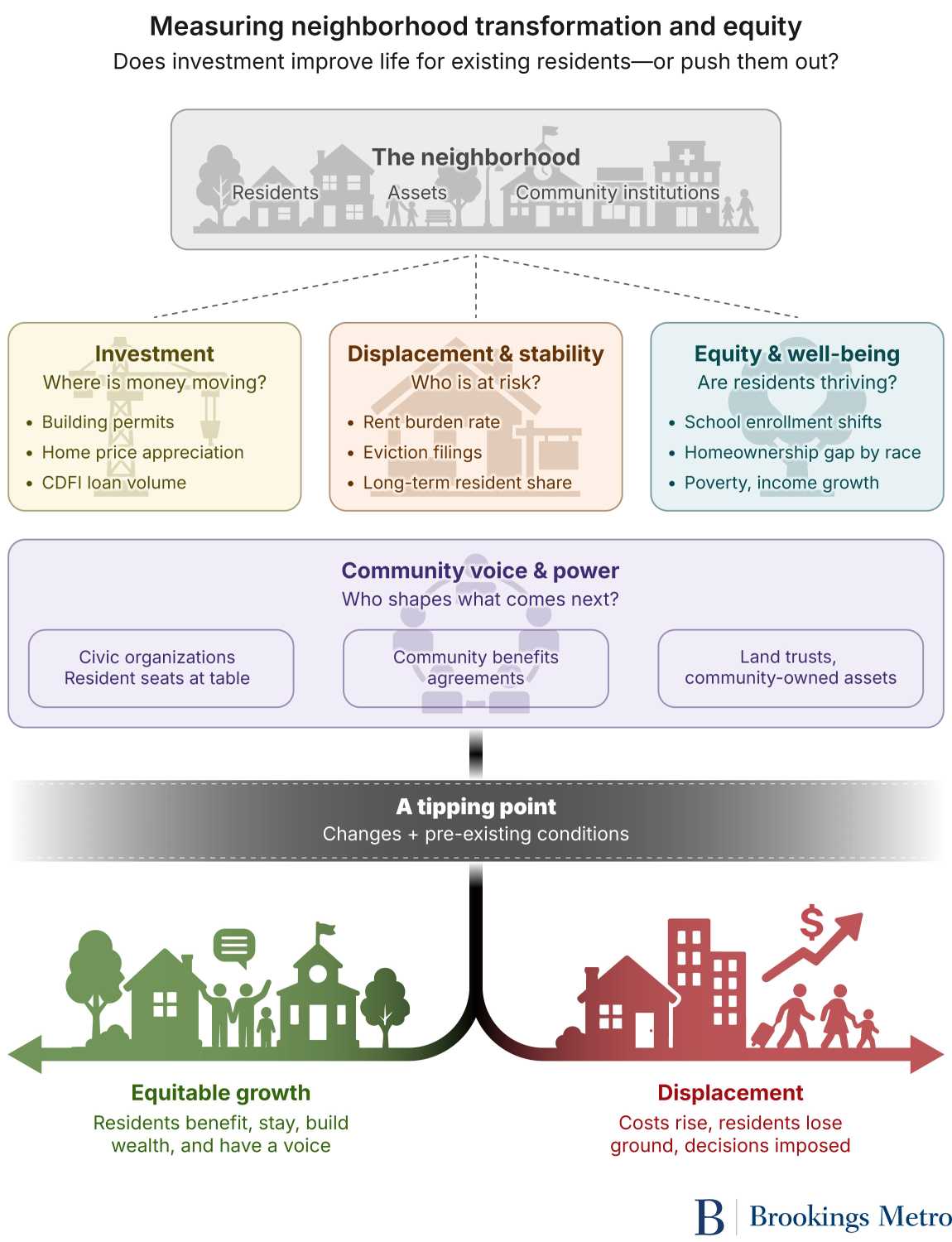
The “Investment” pillar aims to capture market activity signals; i.e., private and public capital flowing into or around a neighborhood. Indicators such as building permit rates (commercial and residential), home sale price changes, and public capital project counts and dollar amounts help display where money is moving and how fast. Additional indicators such as CDFI presence and loan volume, new businesses license rates by sector, and affordable housing delivery rates provide insight into who is benefiting from the flow of capital. Of course, the full extent of capturing the flow of money is harder to measure systematically and requires data partnerships or manual collection.
The “Displacement and stability” pillar captures several themes, ranging from housing pressure and affordability to eviction risk, demographic change, and mobility, as well as climate vulnerability and environmental risk. It aims to track early warning signals of whether residents are at risk by monitoring rent burdens, home sale prices, property tax increases, eviction filings, and more. The pillar captures demographic change and residential mobility to track how transformation is impacting various subgroups within the neighborhood.
The “Equity and well-being” pillar captures whether locals are thriving or not. It tracks outcomes disaggregated by race, age, and income where possible, including homeownership gaps, food insecurity, safety net uptake, access to quality schools, and transit and interconnectedness.
Finally, the “Community voice and power” pillar captures the civic infrastructure that determines whether residents have meaningful influence over the decisions shaping their neighborhoods. Such infrastructure includes the density of community-based organizations, faith institutions, and neighborhood associations per capita; the presence and coverage of community benefits agreements on major development projects; whether residents hold seats on the boards and committees where investment decisions are made; and the strength of community-owned assets such as community land trusts, community development corporations, and cooperatives. Much of this pillar is inherently qualitative, measuring not just whether residents are informed about decisions, but whether they are consulted before them and whether their consent is required, drawing on frameworks such as Arnstein’s Ladder of Citizen Participation. Research into this pillar will develop through fieldwork, partner interviews, and similar information gathering. This dimension of neighborhood life is hardest to quantify and is what most determines whether a community can shape its own trajectory.
Answering the question of ‘who gains?’
Ultimately, the question of “who gains” from neighborhood transformation is a political and moral one, and one that society needs to hold its representatives accountable to. Through this framework, we hope to develop a powerful data dashboard that can provide decisionmakers and residents with the information they need to positively shape the trajectory of their neighborhood. But this framework is only a tool; the power to change the destiny of a neighborhood rests with its residents and local policymakers.
Data alone cannot make the decisions that need to be made, but can help surface the question of whether investments are resulting in equitable growth for locals or displacing them, and is a first step in the direction of equity and community power. In forthcoming work, we will first apply this framework in Detroit, where billions of dollars in capital are reshaping neighborhoods, and ultimately apply the framework in communities in the midst of transformation across the country.
Author
The Brookings Institution is committed to quality, independence, and impact.
We are supported by a diverse array of funders. In line with our values and policies, each Brookings publication represents the sole views of its author(s).