In January, images of agents arresting 5-year-old Liam Conejo Ramos on his way home from school in Minneapolis shocked the consciences of people worldwide. Photographs of the pre-kindergartener juxtaposed his playful blue woven winter cap with the child’s look of fear and bewilderment—while an officer held him by his backpack to force him into a government vehicle.
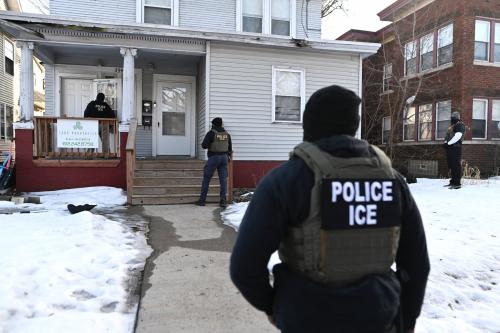
Prior to 2025, enforcement actions against school-aged children in the interior of the country were rare. Indeed, for the past 30 years, presidents from both political parties supported immigration enforcement policies that discouraged agents from taking actions at schools and other “sensitive” locations. One of the Trump administration’s first actions was to rescind this guidance. An unidentified spokesperson for the Department of Homeland Security (DHS) indicated that the rescission of the sensitive locations policy meant that “criminals will no longer be able to hide out in America’s schools and churches to avoid arrest.” An analysis conducted using data from the Deportation Data Project indicates that enforcement against minors led to nearly 4,000 detentions in the first 10 months since Donald Trump’s return to the White House.
Trump officials had revealed their willingness to aggressively enforce immigration priorities against children during the first administration. In that first iteration, the White House again faced widespread outcry after it began separating children from their parents in what agency officials termed a “zero tolerance policy.” In 2018, when the administration enforced federal criminal prosecutions for irregular border crossings, almost 3,000 children were separated from their families. While the administration subsequently disavowed the policy, its enforcement signaled the extremes to which Trump officials would resort regarding the impact of their policies on children.
But in the first year of Donald Trump’s second term, a new trend has emerged in state and local politics. The election that led to the reestablishment of Donald Trump also led to the election of a new Congress with a slim Republican majority. As a result, Republicans in the federal government lack the numbers needed to significantly change national immigration law—a paralytic condition that has persisted at the federal level for 30 years, regardless of the party in power.
State lawmakers have sought to fill that gap, expanding their activities on immigration enforcement at the state and local levels. In the first few weeks of Trump 2.0, state officials throughout the country introduced measures to support the White House’s aggressive immigration agenda. One of the red states’ signature legislative moves—including efforts in Tennessee—focused on excluding immigrant children from state-funded public education. Based on a policy document that the Heritage Foundation published in 2024, the last year of the Biden administration, the proposed legislation clearly conflicts with current constitutional law. Indeed, the Heritage Foundation authors of the policy argue that the proposed legislation’s incompatibility with federal constitutional law is a major reason why states should enact educational exclusions. The Heritage Foundation anticipates that the legislation would “draw a lawsuit from the Left, which would likely lead the Supreme Court to reconsider its ill-considered Plyler v. Doe decision.”
Plyler involved a group of Mexican American families whose children were forced from public school in Texas when they couldn’t show proof of legal immigration status. In a 5-to-4 decision issued in 1982, the Supreme Court ruled for the families. The Court concluded that denial of a public education based on undocumented immigration status violates the Equal Protection Clause of the Fourteenth Amendment. The state of Texas’ attempt to exclude undocumented children from school must be understood within a longer history of school segregation based on ethnic identity.
That the Court in Plyler relied on the landmark case of Brown v. Board of Education is well established. Writing for the Plyler majority, Justice William Brennan quoted Brown approvingly, determining that education is of such national importance as to form “a right which must be made available to all on equal terms.” In a 2019 report, education scholars Rubén Donato and Jarrod Hanson explain that the “complex experiences of Mexican Americans are both distinct from and intertwined with the desegregation story of Black Americans.”
Namely, Donato and Hanson document the ways in which the de facto segregation of Mexican American children differed from the de jure segregation that excluded Black students by law. Mexican Americans were deemed “white” according to the Treaty of Guadalupe Hidalgo in 1848. This legal status served to cede the southwestern territories to the United States from Mexico while conferring U.S. citizenship on the inhabitants of those territories. The designation was necessary because U.S. citizenship was still limited at the time to those who were racially “white.”
Mexican Americans were treated as socially inferior within the newly acquired southwestern United States, and localities segregated Mexican Americans in their school systems for generations. In detailing this history of educational segregation, scholar Gilbert Gonzalez points to a 1913 report on schools in California. The report found that special rooms were set aside for “Spanish” children and that the curriculum in those classrooms emphasized manual labor, differing from the courses offered to Anglo students. Indeed, a decade before the Court decided Plyler, the federal government commissioned a series of studies documenting the problem of ethnic segregation in southwestern schools. The United States Commission on Civil Rights’ Mexican American Education Study published a 1971 report entitled Ethnic Isolation of Mexican Americans in the Public Schools of the Southwest. Consisting in part of interviews with local officials, the commission learned from one interviewee in Texas that in the official’s view:
“The white child looks on the Mexican as [Southerners looked] on the Negro before the war, to be cuffed about, and used as inferior people. If you can segregate a few grades until they learn they are not inferior (except socially), then you can put them together . . . If [segregated in the early grades] they will learn to take their places as whites and citizens.”
It is not hard to imagine how these racist attitudes toward children of Mexican heritage could have influenced the perspectives of Texas officials who later sought to exclude more recently arrived Mexican immigrants in Plyler. In concluding that the scheme for excluding immigrant children served no substantial state interest, the Court in Plyler determined that any cost savings to the state achieved by exclusion were “wholly insubstantial in light of the costs involved to these children, the State, and the Nation.”
While Plyler ultimately became—and remains at the time of this writing—the law of the land, recent state efforts to provoke a challenge signal cause for concern.
In 2025, at least six states introduced legislation that would target undocumented children for monitoring or exclusion from public education. To date, none of these efforts have succeeded, but many state officials continue their campaign against undocumented students.
In the 2026 legislative session for the state of Tennessee, lawmakers introduced legislation to collect K-12 students’ immigration statuses. This effort reinvigorates a stalled legislative effort in the Tennessee General Assembly during the 2025 session. At that time, lawmakers feared that a series of bills aimed at excluding undocumented children from Tennessee public education could put more than a billion dollars of federal funding at risk.
Preparing for the 2026 session, lawmakers appeared more confident after working closely with White House officials. Tennessee House Speaker Cameron Sexton told reporters that “we’re close to, I think, having a better understanding of what the federal government will or will not do on that piece of legislation.”
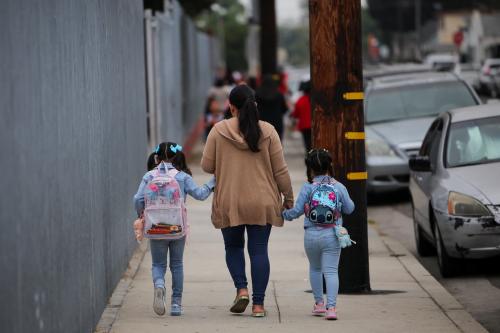
Even without these aggressive legislative moves, many families have been impacted by shifting policies targeting children and schools. According to a national survey of Latino immigrants, more than 50% of Latinos worry that a family member or close friend will be deported, with nearly 20% worrying “a great deal and/or all the time.” The effect on families with preschool-aged children like Liam Conejo Ramos is particularly acute. These children are often too young for compulsory education, and their families’ attitudes and behaviors demonstrate a deep shift. In 2025, nearly a third (30%) of Latino families reported they would not enroll their children in early childhood programs out of fear of potential detention or deportation.
Even without a direct challenge to Plyler v. Doe, federal and state policies are creating chilling effects on students that threaten to undo generations of progress toward equal access to education.
While some states are aligning with the federal government’s regressive approach to education access, other states are forging a different path forward. In Illinois, state lawmakers amended the school code to affirm the state’s commitments to students regardless of immigration status. Other localities are passing ordinances to create “ICE-free zones” on locally owned property.
With these actions, local authorities are seeking to reestablish a semblance of the “sensitive locations” approach recognized for decades by presidents from both parties. Until the federal government can return to implementing those policies, state and local efforts are necessary to fend off the threats to public education.
In addition to policies that protect students at school at the state and local levels, federal lawmakers should resume legislating and engaging in good-faith bipartisan conversations about comprehensive immigration reform. Many of the Plyler v. Doe plaintiffs eventually obtained legal status through an immigration reform program brokered by a Democratic-majority House and Republican-led Senate. Ronald Reagan, the first president to promise to “make America great again,” signed the bill into law in 1986—granting legal status to millions of people.
In the absence of a commonsense legislative solution on immigration, states, localities—and especially the federal government—should reject immigration enforcement at schools and strive to uphold Plyler’s protection of education for all children in the United States.
Related Content
Author

The Brookings Institution is committed to quality, independence, and impact.
We are supported by a diverse array of funders. In line with our values and policies, each Brookings publication represents the sole views of its author(s).
Commentary
Federal and state policies targeting immigrant children at school erode decades of progress in education access
March 30, 2026