The following is a summary of the 43rd session of the Congressional Study Group on Foreign Relations and National Security, a program for congressional staff focused on critically engaging the legal and policy factors that define the role that Congress plays in various aspects of U.S. foreign relations and national security policy.
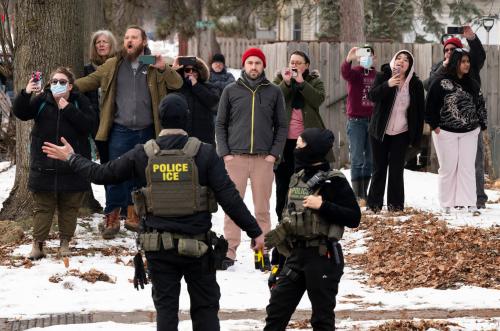
On July 9, 2025, the Congressional Study Group on Foreign Relations and National Security convened in-person on Capitol Hill to discuss the related legal doctrines of state secrets and executive privilege. The Trump administration had recently invoked state secrets privilege to avoid having to disclose information regarding its diplomatic and immigration enforcement activities in litigation over its invocation of the Alien Enemies Act. But this was hardly the first time the executive branch had invoked privilege to shield sensitive national security information from disclosure. Moreover, concerns about the state secrets privilege—like other executive privileges—can extend beyond the courtroom, as such claims can also obstruct congressional oversight efforts.
For the session, the study group was joined by two distinguished legal scholars, who coordinator Scott R. Anderson led in an initial discussion:
- Jonathan Shaub, professor of law at the University of Kentucky Rosenberg College of Law and a former senior associate counsel in the White House Counsel’s office; and
- Heidi Kitrosser, professor of law at Northwestern University’s Pritzker School of Law.
Background readings circulated before the session included:
- “The Secret Life of Secrets,” This American Life, Ep. 383 (2009) (radio segment);
- Robert Chesney, “No Appetite for Change: The Supreme Court Buttresses the State Secrets Privilege, Twice,” 136 Harvard Law Review 170, 173-179 (2022);
- Jeffrey Vagle, “The Tangled History of the State Secrets Privilege,” Lawfare (Apr. 8, 2025); and
- Jonathan Shaub, “Common Law Executive Privileges,” 100 Indiana Law Journal 923, 929-934 (2025).
Kitrosser began the discussion by clarifying that the state secrets privilege and the executive privilege are distinct, though often conflated. State secrets is a litigation privilege that allows the executive to block the disclosure of evidence in legal proceedings where release would pose a reasonable danger to national security. Unlike executive privilege, it does not require presidential involvement and can be asserted by agency heads. While its roots lie in English common law, its constitutional status remains unresolved.
The Supreme Court formally recognized the privilege in United States v. Reynolds (1953), but courts have since applied it with varying levels of deference. Critics argue that this deference has allowed the government to withhold evidence without adequate judicial scrutiny, including instances where later declassifications revealed no legitimate national security threat. Kitrosser explained that while some courts review disputed materials in camera, others rely solely on executive affidavits.
The conversation also covered the Totten bar, a related doctrine that permits dismissal of cases whose very subject matter is deemed too secret to litigate. Kitrosser noted that both doctrines have been invoked more frequently since 9/11, sometimes resulting in early dismissal of entire lawsuits and raising concerns about transparency and accountability. These trends have fueled calls for statutory reform, including legislation modeled on the Classified Information Procedures Act (CIPA)—a legal framework designed to manage sensitive information in ways that protect both national security and constitutional rights.
Shaub then turned to executive privilege more broadly, describing it as an umbrella term covering several protections: presidential communications, deliberative process, law enforcement materials, and national security information. He emphasized that while United States v. Nixon (1974) affirmed a constitutional privilege for presidential communications, it also rejected the notion of an absolute privilege, requiring courts to balance confidentiality against competing needs such as due process or oversight.
Unlike state secrets, executive privilege is often invoked outside of court—especially during congressional investigations. In those settings, executive agencies frequently describe information as “potentially privileged” without formally asserting the privilege, postponing direct conflict unless Congress moves toward a contempt vote. This creates what Shaub described as a “prophylactic” privilege—used more to delay or avoid disclosure than to defend a formal legal claim.
Both scholars discussed the broader trend of constitutionalizing executive secrecy. Kitrosser argued that while some frame the state secrets privilege as constitutionally grounded in Article II powers, the better view—supported by its history and scope—is that it remains a common law doctrine and thus open to congressional regulation.
The session concluded with a discussion of potential reforms. Both speakers acknowledged that statutory limits on executive privilege face steep challenges, including veto threats and limited opportunities for judicial enforcement. In light of these obstacles, they emphasized the importance of procedural reforms. Shaub noted that Congress is most effective when it issues narrow, specific requests that compel the executive to confront the privilege question head-on. He also suggested that Congress could enhance its leverage by revising internal rules—such as allowing agency counsel at depositions—to prevent the executive from avoiding compliance on procedural grounds. Kitrosser pointed to the rise of absolutist privilege claims based on the “candor” rationale, which posits that compelled disclosure would chill the president’s internal deliberations. She argued this reasoning has hardened into a categorical doctrine since the mid-20th century and called for subject-specific legislation as a more politically viable and judicially sustainable path forward.
Both outside experts agreed that interbranch conflicts over access to information are not inherently partisan. Whether in the context of litigation or oversight, the expanding use of executive secrecy underscores the need for clearer legal standards, stronger institutional checks, and a renewed commitment to accountability. They encouraged staff to consider both targeted legislative strategies and practical procedural tools as ways to promote transparency and gradually strengthen Congress’ ability to conduct meaningful oversight.
The session then concluded with an open discussion wherein attendees were invited to ask questions or present their own views on some of the issues raised.
The Brookings Institution is committed to quality, independence, and impact.
We are supported by a diverse array of funders. In line with our values and policies, each Brookings publication represents the sole views of its author(s).