This synthesis report is part of a project on the state of democracy in Africa. See our other works from this project.
Over the modern era of political development, democracy has expanded to encompass billions of citizens worldwide. As of 2016, almost four billion people across 96 countries lived in either an electoral or liberal democracy. However, in the decade since, democracy has receded, with just over two billion now living in countries considered democratic (Herre et al. 2025). In fact, 40% of the world’s population now lives in a country that, after initially transitioning to an electoral or liberal democracy during the global wave of democratization in the 1990s, now has regressed to either an electoral or closed autocracy (Lindberg 2026).
The African continent is not immune to these fluctuations in democracy. On the one hand, the number of electoral or liberal democracies in the region has declined from 22 to 15 over the last decade (Our World in Data 2025a, 2025b). Many countries have experienced constitutional and military coups, increasingly restrictive environments for civil society organizations, and a growing number of violent and uncompetitive elections (Matlosa 2025; Rakner 2019). On the other hand, countries such as Senegal, Botswana, Mauritius, Ghana, and Malawi have demonstrated notable democratic strengthening, with opposition parties successfully defeating incumbent governments in recent elections (Wotjanik 2026). Overall, the demand for democracy is still high across the region, regardless of regime type, with Afrobarometer data collected in 2023 across 39 countries showing that 66% of respondents agree with the statement that “democracy is preferable to any other kind of government.”(Afrobarometer 2024)1 Given this preference, what options are available to avert backsliding in some contexts and deepen democratic gains in others?
Addressing this question is especially crucial in the wake of shifts in donor funding. Donor support for democracy and governance assistance was always dwarfed by spending for other sectors, but the loss of USAID, plus the shift towards defense spending by the EU, has further reduced such funding in recent years. For instance, more than $14 billion in democracy, rights, and governance grants were cut in 2025 as part of wider reductions in U.S. foreign assistance (Silva-Leander et al 2025).
Given these trends, we examine what democracy support options may have an impact on the region and how they can be calibrated to a country’s current democratic status. As part of a Brookings Institution project on the state of democracy in Africa, we examined the political trajectories of five countries—the Democratic Republic of the Congo (DRC), Ghana, Kenya, Mali, and Zimbabwe—to determine what factors accounted for their democratic resilience, backsliding, or autocratic stagnation. As seen in Figure 1, all of these countries started at relatively similar low levels of democracy in the early 1990s and have not only diverged dramatically over time but also have experienced different degrees of volatility in their trajectories.
In this brief, we synthesize in-depth case studies on the policy options available to strengthen democracy in these countries, with the goal of offering broader implications for the region. We first review insights from the democracy support literature in general and specific applications to Africa. Subsequently, we highlight three key lessons that emerge from these cases: tap into locally appropriate customs and traditions, prioritize interventions to target the main constraints to democratic deepening, and explore novel entry points if extant democracy support efforts have floundered.
Figure 1. Democratic trajectories over time in focus countries
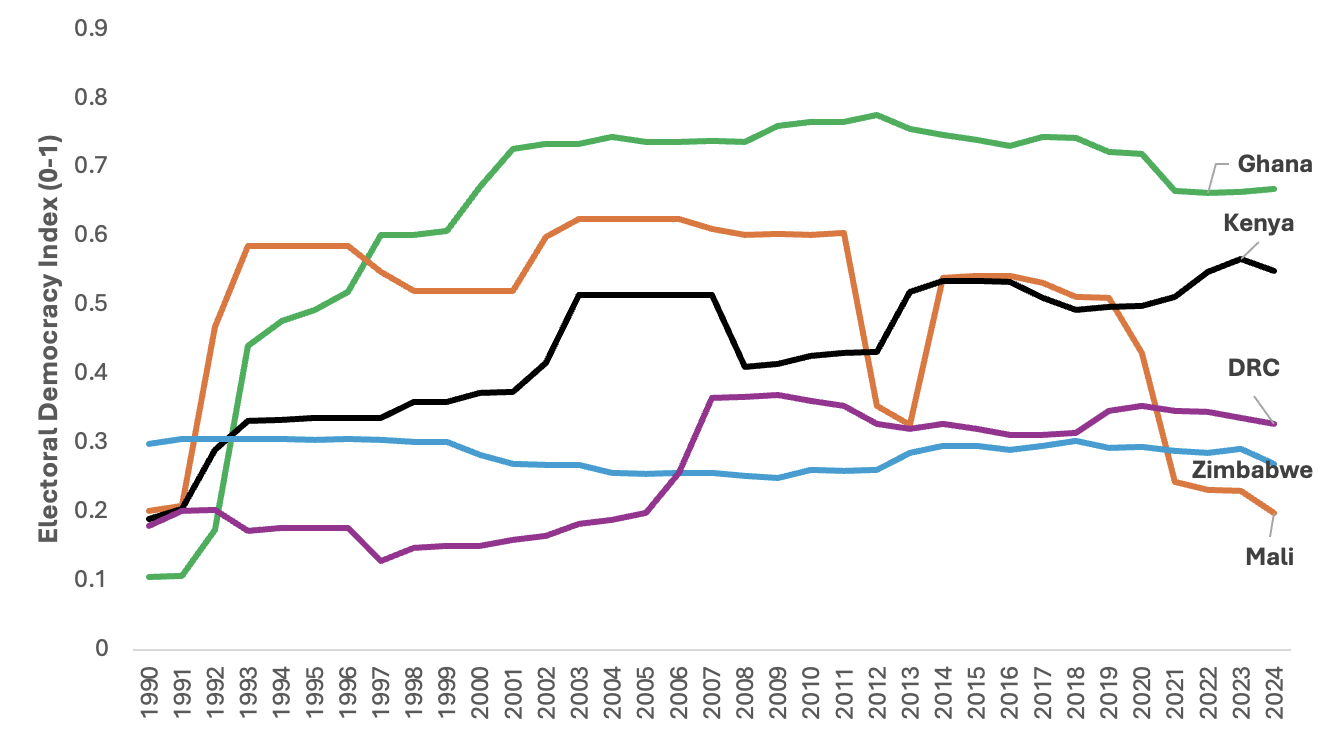
Source: V-Democracy database (Coppedge et al), using the v2x_polyarchy index. Based on this index, 0 is worst performance and 1 is best performance.
Authors


Related Content
2026
-
Acknowledgements and disclosures
The Brookings Institution is a nonprofit organization devoted to independent research and policy solutions. Its mission is to conduct high-quality, independent research and based on that research, to provide innovative, practical recommendations for policymakers and the public. The conclusions and recommendations of any Brookings publication are solely those of its author(s), and do not reflect the views or policies of the Institution, its management, its other scholars, or the funders acknowledged below.
This publication is supported by a grant from the Open Society Foundations.
Brookings recognizes that the value it provides is in its absolute commitment to quality, independence, and impact. Activities supported by its donors reflect this commitment.
-
Footnotes
- Data available from Afrobarometer (https://www.afrobarometer.org/data/merged-data/), Q23. Respondents are asked which statement they agree with the most: “Democracy is preferable to any other kind of government,” “In some circumstances, a non-democratic government can be preferable,” and “For someone like me, it doesn’t matter what kind of government we have.”
The Brookings Institution is committed to quality, independence, and impact.
We are supported by a diverse array of funders. In line with our values and policies, each Brookings publication represents the sole views of its author(s).