This viewpoint is part of Chapter 4 of Foresight Africa 2026, a report on how Africa can navigate the challenges of 2026 and chart a path toward inclusive, resilient, and self-determined growth. Read the full chapter on governance, institutions, and state capacity.
A peaceful Sudan is therefore critical not just for economic and human development of the country, but also for the region.
Why ending the Sudanese war matters
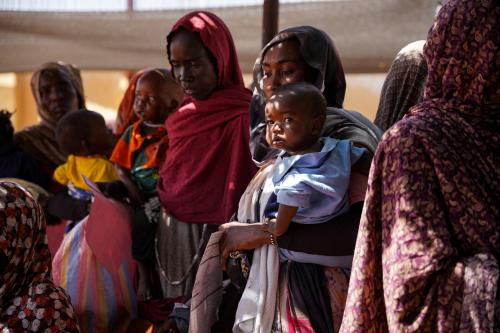
The Republic of the Sudan is Africa’s third largest country by land mass and shares borders with seven other countries. The current conflict, which began in April 2023, has already had significant economic, social, humanitarian, and political ripple effects. According to the U.N., it “is now the world’s worst humanitarian crisis for women and girls” who “make up more than half of the more than 12 million people displaced.”1 In addition, many of these women and girls “are being deliberately targeted with sexual violence.”
In terms of geography, Sudan is very important to many countries in East and North Africa. First, the capital city Khartoum is where the White Nile and the Blue Nile converge to form the Nile River. The war could hinder management of the Nile’s resources, affecting all 11 riparian states2—but particularly downstream Egypt, which relies on the Nile for over 90% of its fresh water supplies.3 Continued political instability is therefore detrimental to peaceful resolution of Nile Basin conflicts and threatens Egypt’s water security.
Second, Sudan is located on the Red Sea, with the Red Sea city of Port Sudan serving as the country’s main seaport and a primary hub for trade flows into and out of the region. Exports (such as oil, cotton, and livestock) and imports (such as machinery, refined petroleum, wheat, and others) flow through this important port on a regular basis. It is estimated that the port is responsible for a combined 7.9 billion in exports and imports for the region.4 A peaceful Sudan is therefore critical not just for economic and human development of the country, but also for the region. Consider, for example, the fact that South Sudan’s oil exports, which account for 90% of government revenue, must travel through its northern neighbor to reach international markets.5 Without peace, Juba would not be able export its oil and could be starved of funds to provide basic services to its citizens.
Third, for centuries, Sudan has served as a major transit route for African Muslims who embark every year on the hajj to Mecca. Many air carriers also transit through Sudan on their way to Mecca. Continued violence could force these carriers to seek alternative but more expensive and longer routes, raising travel costs and preventing many Muslims from performing this important religious rite.
Root causes of the conflict
The present conflict erupted in April 2023 between the Rapid Support Forces (RSF), led by General Mohamed Hamdan Dagalo (commonly known as Hemedti), and the Sudan Armed Forces (SAF), led by Gen. Abdel Fattah al-Burhan.6 The RSF traces its origins to the Janjaweed tribal militias, which fought under the command of the government of President Omar al-Bashir during the Darfur war in the 2000s, and had been accused of committing atrocities in Darfur.
After the ouster of President al-Bashir by coup in 2019, the SAF and the RSF shared power.7 Under the collective presidency, which was referred to as the Sovereignty Council, Hemedti served as a deputy to al-Burhan. However, disagreement between the two leaders on how to integrate the RSF into the national army triggered “nationwide collapse” and the ongoing civil war. Throughout the conflict, internal and external actors have seized on deep-rooted ethnic, political, and economic grievances, particularly between northern and southern regions and within Darfur.8
Some analysts have suggested that if Hemedti defeats the SAF and emerges as the country’s ruler, “the Sudanese government, or remnants thereof, would become a wholly owned subsidiary of the commercial-military-ethnic agenda of the Dagalo family and its most powerful backers.”9 This conclusion is in line with what many experts have long said about paramilitary governance: It destroys; it consumes; but it does not build, neither does it create institutional environments that enable peaceful coexistence or nation-building.
A complex web of regional and global actors
At least ten countries have been drawn into Sudan’s civil war through supplying support in the form of weapons, financial resources, or political backing.10 Importantly, the U.S.-backed “quartet” or “quad,” which is made up of Egypt, the UAE, Saudi Arabia and the United States, have called for “a three-month humanitarian truce,” which is to be “followed by a nine-month political process.”11 But details on this plan are not forthcoming, and the interests of these nations are important to note here.
Saudi Arabia has backed the SAF through economic aid and diplomatic meditation efforts, with an eye on protecting Riyadh’s economic interests in the Red Sea region, as well as the peaceful movement of pilgrims through Port Sudan to Mecca.12 The United Arab Emirates (UAE), on the other hand, supports the RSF, allegedly due to concerns about the threat of Islamist groups that underpin the SAF.13 Yet it is difficult to overlook the UAE’s economic and geopolitical interests in Sudan—the UAE has been the major buyer of Sudan’s gold, which many observers believe is the “lifeblood” of the civil war—some estimates put the exports of Sudanese gold to the UAE at more than $13.4 billion.14 Cairo backs the SAF, primarily due to historical ties between the armies of the two countries.15 Egypt and Sudan share not just a long border, but also significant strategic interests, some of which derive from their position as the only two downstream Nile Basin states and their coveted protection of shipping lanes along the Red Sea.16 Finally, on November 21, U.S. legislation was introduced “seeking to halt American weapons sales to the United Arab Emirates until the United States certifies that the UAE is not arming the paramilitary Rapid Support Forces (RSF) in Sudan.” It is generally believed that the RSF would not have been able to continue the civil war without the UAE’s backing,17 and thus stopping U.S., (as well as U.K.) arms shipments to the UAE could enhance the environment for peace negotiations. However, Reuters notes the bill is “unlikely to win significant support in Congress as U.S. administrations under presidents of both parties long have viewed the UAE as a vital regional security partner.”18
The way forward
What then is the way forward for Sudan? Will the “self-serving army and militia forces” that are battling for political and economic “supremacy” sideline the struggle for people-driven democratic governance that undergirded the 2018-2019 revolution that ousted the brutal dictatorship of Omar al-Bashir?19 Will the peoples of Sudan be trapped indefinitely in a state of violence and underdevelopment? The status quo cannot be considered acceptable, especially given the catastrophic suffering and gross human rights violations caused by the ongoing struggle. Below are possible pathways to lasting peace.
First, the AU, working with regional organizations, as well as civil society in Sudan, should seek a mediated ceasefire, which would allow for necessary humanitarian aid to flow to those who need it the most. While international actors (e.g., the U.S.- led “quartet”) can help this process, it is important that the peace process be owned and directed by the AU, the Sudanese peoples, and the country’s regional neighbors.
Second is the establishment of a credible, inclusive, civilian-led transitional government, one that is produced through a people-driven political and constitutional process. Such a government is to be created through a constitution that is drafted through a bottom-up, collective process which reflects the country’s religious and ethnic diversity.
Third, the international community, which to this point, has not been unified on its approach to the conflict in Sudan, must adopt an approach that is undergirded by the advancement of the governance and development aspirations of the Sudanese peoples. International involvement or intervention in Sudan must not exacerbate or prolong the conflict. It is clear that fragmented international support is emboldening the two parties to continue fighting. A unified international approach should pressure both parties to accept a ceasefire.
Fourth, a legal process must be put in place to hold accountable those alleged to have engaged in widespread human rights violations, including ethnic cleansing, as part of the war. This process must be established through the constitution and could take the form of a Truth and Reconciliation Commission.
Fifth, all international actors should consider ceasing arms shipments into Sudan as well as military aid to either of the fighting parties. Instead, international actors/ partners should direct their attention and resources to civil society organizations that are currently working to provide emergency aid to displaced civilian populations, including children and women who are suffering from lack of access to food and healthcare.
Sixth, when peace is achieved, Sudan will need financial resources to restore economic infrastructure (e.g., roads, water treatment plans, hospitals, etc.) that has been destroyed by the war. The international community can and should aid Sudan in this rehabilitation and transformation effort.
Seventh, there is urgent need to grant priority to the flow of humanitarian aid to parts of the country where people, particularly children and women, are under the threat of famine and, in addition, have been deprived of access to basic healthcare and education. Both parties to the conflict must cease attacks on civilians and aid workers in order to allow people seek help and for humanitarian workers to provide that aid.
Finally, the AU, together with its regional partners, must disabuse both parties of the belief that they can win militarily, given the fact that such a belief will place Sudan on the road to political fragmentation, economic ruin, and social disintegration.
Author
Related Content
-
Footnotes
- U.N. Women, “Two years of war in Sudan: The world’s worst humanitarian crisis for women and girls,” April 15, 2025
- John Mukum Mbaku, “The African Union is working on peace in Sudan: expert explains why it’s in everyone’s interests,” The Conversation, January 24, 2024
- U.N. Department of Economic and Social Affairs, “Egypt: Progress on achieving SDG 6,”
- “The Rising Importance of Port Sudan,” Africa News Portal, n.d.
- Mbaku, The African Union, op. cit.
- Aljazeera Staff, “Sudan unrest: What are the Rapid Support Forces?,” Aljazeera, April 16, 2023
- Mishra, “‘Blood on the Sand. Blood on the Hands’: UN Decries World’s Failure as Sudan’s El Fasher Falls.”
- John Mukum Mbaku, “Sudan: foreign interests are deepening a devastating war—only regional diplomacy can stop them,” The Conversation, June 26, 2025
- Alex De Waal, “Sudan’s future is being shaped by guns and money—like its past,” The Conversation, Aug. 24, 2023
- John Mukum Mbaku, “Sudan: Foreign Interests Are Deepening a Devastating War – Only Regional Diplomacy Can Stop Them,” Defence Web, July 9, 2025; Zeinab Mohammed Salih, “Conflict in Sudan: A Map of Regional and International Actors,” Wilson Center, December 19, 2024.
- Keath and Price, “The Role Outside Powers Are Playing in Sudan’s Continued, Brutal War.”
- Declan Walsh and Vivian Nereim, “A Saudi Behest, Trump Vows to Seek Peace in Sudan, a Goal He Had Spurned,” The New York Times, Nov. 20, 2025
- Lee Keath and Michelle Price, “The Role Outside Powers Are Playing in Sudan’s Continued, Brutal War,” PBS News, November 7, 2025.
- Mohammad Khansa, “Five reasons why the UAE is fixated on Sudan,” Peoples Dispatch, July 27, 2025. It is estimated that in 2023, “99 % of Sudan’s $1.03 bn gold exports” were “sold to the United Arab Emirates.” Mohamed A. Hussein and Marium Ali, “Sudan has vast oil, gold and agricultural resources: Who controls them?,” Aljazeera, Nov. 20, 2025.
- Keath and Price, “The Role Outside Powers Are Playing in Sudan’s Continued, Brutal War.”
- Keath and Price, “The Role Outside Powers Are Playing in Sudan’s Continued, Brutal War.”
- CAAT, “Genocide in Sudan”
- Patricia Zengerle, “US Lawmakers Seek to Halt Weapons Sales to UAE, Citing Sudan,” Reuters, November 21, 2024.
- Michelle Gavin, “Sudan in Crisis,” Council on Foreign Relations, April 20, 2023.
The Brookings Institution is committed to quality, independence, and impact.
We are supported by a diverse array of funders. In line with our values and policies, each Brookings publication represents the sole views of its author(s).
Commentary
Ending Sudan’s civil war: A roadmap to peace and reconciliation
January 20, 2026