The paper summarized here is part of the fall 2026 edition of the Brookings Papers on Economic Activity, the leading conference series and journal in economics for timely, cutting-edge research about real-world policy issues. Research findings are presented in a clear and accessible style to maximize their impact on economic understanding and policymaking. The editors are Brookings Nonresident Senior Fellows Janice Eberly and Jón Steinsson.
See the fall 2026 BPEA event page to watch paper presentations and read summaries of all the papers from this edition. Submit a proposal to present at a future BPEA conference here.
Unexpectedly strong demand for goods and services contributed more to rising prices after the COVID-19 pandemic than supply disruptions, according to a paper discussed at the Brookings Papers on Economic Activity (BPEA) conference on September 25.
The authors, Domenico Giannone of Johns Hopkins University and Giorgio E. Primiceri of Northwestern University, use economic models to examine consumer price inflation during and after the pandemic in both the United States and the euro area (EA).
Inflation remained subdued during 2020, with the pandemic depressing both supply and demand. Then “U.S. inflation accelerated in the first half of 2021, reached its peak in the second quarter of 2022, and has since gradually declined,” the authors write. “Inflation in the EA followed the same path, only delayed by approximately six months.”
Historical decomposition of inflation dynamics
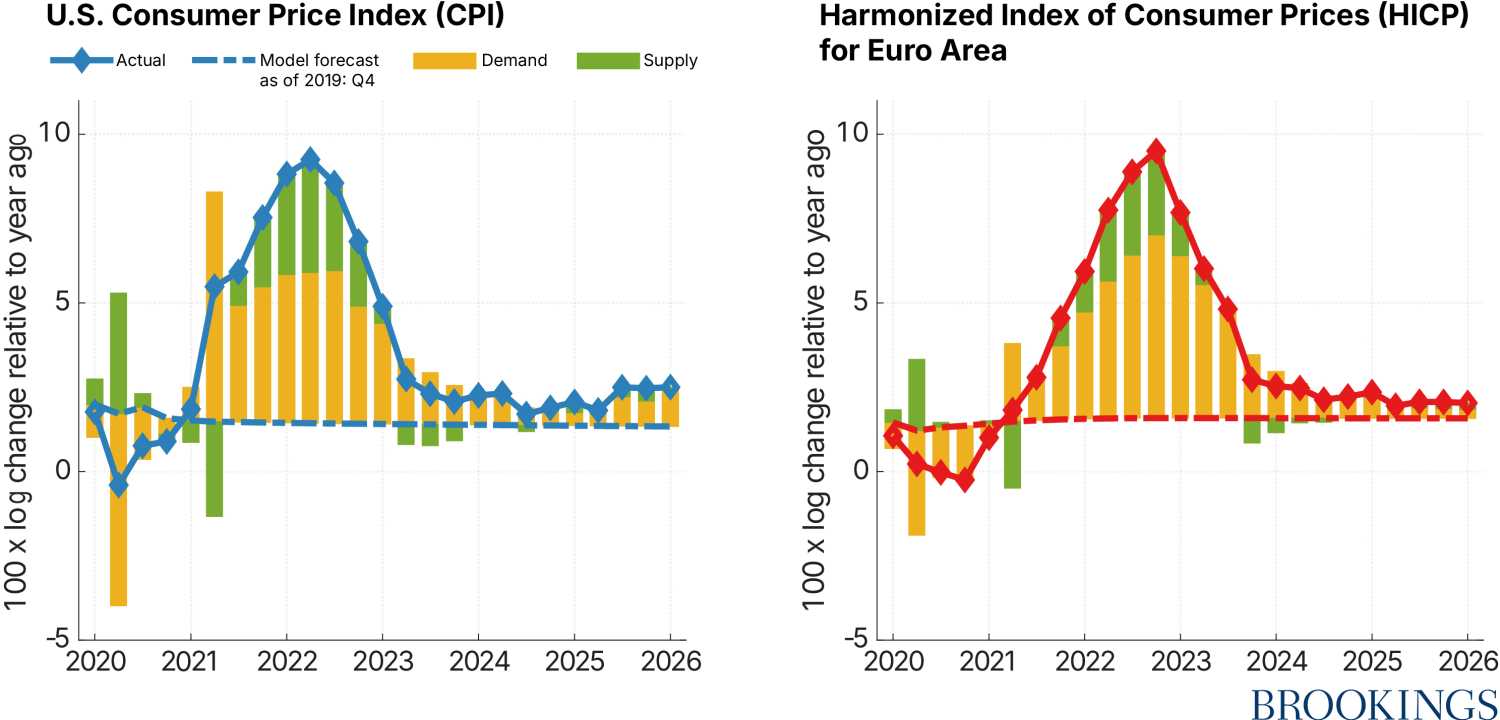
Sources: Bureau of Economic Analysis, the Bureau of Labor Statistics and Eurostat; accessed via Haver Analytics; computations by authors.
Notes: CPI is excluding ‘owners’ equivalent rent of residences.
“Such similar inflation experiences across the Atlantic are unlikely to be mere coincidences. Our central finding is that unexpectedly strong demand was the dominant driver of the post-pandemic surge in both regions,” they write. Three forces made demand unusually strong: a robust spending rebound as pandemic restrictions were eased, expansionary deficit-financed government spending, and accommodative monetary policy that kept interest rates low well into the inflation surge.
The authors also note that economic forecasters and policymakers on both sides of the Atlantic underestimated both the persistence of inflation and the strength of the recovery in economic activity, precisely the pattern one would expect if demand were running ahead of what anyone anticipated.
The conclusion that inflation was mainly demand driven may seem at odds with the widespread emphasis on supply-chain disruptions and supply disturbances in energy markets. These supply shocks mattered too, according to the authors. But monetary policy accommodated much of their contractionary effect, supporting the recovery at the cost of additional inflation.
“We take no stand … on whether that trade-off was desirable,” the authors write. “Indeed, the appropriate policy response may well have involved accepting temporarily higher inflation in order to cushion the effects of the pandemic on economic activity.” Nor is it clear that the accommodation was deliberate. As the authors note, “real-time GDP [gross domestic product] releases painted a substantially more pessimistic picture of economic activity than subsequently revised data,” suggesting that policymakers may simply have been responding to an economy that appeared weaker than it actually was.
The paper does, however, point to a potential lesson from the episode. Primiceri, in an interview with the Brookings Institution, noted that central banks’ ability to “look through” temporary supply shocks depends critically on their credibility—credibility that is itself based on their past history of reacting strongly enough to contain inflation.
“These shocks are transitory not because of an intrinsic law,” he said. “So, if you suddenly start looking through them, then you might lose this transitory-ness, which I think is something that happened during the pandemic.”
Authors


-
CITATION
Giannone, Domenico, and Giorgio E. Primiceri. 2026. “Demand-Driven Inflation.” BPEA Conference Draft, Fall.
-
Acknowledgements and disclosures
David Skidmore authored the summary language for this paper.
The Brookings Institution is committed to quality, independence, and impact.
We are supported by a diverse array of funders. In line with our values and policies, each Brookings publication represents the sole views of its author(s).