This piece is part of the Taiwan-U.S. Quarterly Analysis series, which features the original writings of experts with the goal of providing a range of perspectives on developments relating to Taiwan.
On November 25, 2025, Taiwan President Lai Ching-te announced in The Washington Post his intention to increase defense spending to 3.3% of GDP in 2026, reaching 5% by 2030. To help reach those benchmarks, he proposed a $40 billion “special defense budget” that would support the acquisition of advanced U.S. weapon systems, invest in Taiwan’s defense industry, and accelerate the development of an ambitious integrated air defense network he dubbed “T-Dome.”
Lai was responding as much to China’s unprecedented military buildup targeting Taiwan as he was to the Trump administration’s pressure for Taiwan to increase defense spending. U.S. President Donald Trump had long railed against U.S. allies underspending on their own defense. During his March 2025 Senate confirmation hearing, Trump’s nominee for undersecretary of defense for policy, Elbridge Colby, reaffirmed Trump’s quip that Taiwan should spend 10% of its GDP on defense in light of the threat from China, menacingly avowing that “we need to properly incentivize them.”
From 1998 to 2016, Taiwan’s defense budget hovered consistently around $10 billion per year, regardless of China’s military buildup beginning with the 2000 reforms of the People’s Liberation Army (PLA). The PLA’s budget saw a six-fold increase from 2000 to 2013, with average annual budget increases of 10% for more than a decade. Since Xi Jinping came to power in 2013, China’s announced defense spending has nearly doubled. The disparity in defense resources is huge. Even though Taiwan’s annual defense spending has effectively doubled in the decade following President Tsai Ing-wen’s inauguration in 2016, China’s annual spending increase is usually greater than Taiwan’s total defense budget.
Taiwan’s defense spending and domestic politics
Taiwan’s defense spending has long been politically contentious, caught up in partisan politics between the two main political parties, the Democratic Progressive Party (DPP) and the Kuomintang (KMT), as well as societal pressure to prioritize spending on social programs rather than the military and imported weapon systems. With low tax rates and virtually no debt spending, Taiwan’s government budget is relatively lean, resulting in available resources channeled toward infrastructure and social services rather than defense. Health care indexes regularly rank Taiwan number one in the world. Taiwan’s education system metrics exceed those of most countries in the Organization for Economic Cooperation and Development. According to the University of Oxford’s World Happiness Report, Taiwan is the happiest place in Asia. Government spending is a zero-sum endeavor, and social spending pays off for political incumbents in democratic Taiwan.
Defense spending is, therefore, a politically charged issue before one even considers the complexities of the cross-Strait relationship. For almost two decades, Taiwan’s largest trading partner and destination for investment was China. Prior to 2019, up to a million Taiwanese lived in China, despite steadily changing cultural self-identification trends in Taiwan and the PLA’s growing military coercion. China has long represented both a threat and an opportunity for Taiwanese voters, complicating domestic attitudes toward defense in Taiwan just as it does elsewhere in the world. The ruling DPP, opposition KMT, and Taiwan People’s Party (TPP) are ideologically divided on their perspective of and approach to China, with the DPP favoring autonomy and a stronger attachment to the United States, while the KMT and TPP favor appeasement and pragmatic engagement with the Communist Party of China over increased defense spending. The political landscape for defense budgets was further complicated by the 2024 election, when Lai, from the DPP, was elected president and the KMT and TPP gained a majority of seats in the Legislative Yuan.
With Taiwan’s executive and legislative branches controlled by different parties, contention is the norm, especially regarding defense rather than social spending. Taiwan’s legislature has the right to cut or freeze portions of the executive branch’s defense budget, but it does not have the ability to include line items. The legislature can therefore be characterized as more of a disruptor, rather than a constructor, of the defense budget. Thus, it is unsurprising that Lai’s proposed $40 billion special defense budget was politically controversial in Taipei from the moment he announced it, no matter how welcomed it was in Washington.
How special defense budgets work
Special defense budgets are ad hoc supplements to the annual defense budget, usually multiyear commitments. While annual defense budgets are sometimes contested in the legislature, the requirements of sustaining and recapitalizing the current force create a path dependency, so budgets generally pass—after debate and occasional procedural theatrics such as temporary freezes or demands for reports. Special budgets are reserved for large acquisitions, such as arms sales from the United States or major indigenous defense programs, making them easier to block without disrupting or shutting down the entire military.
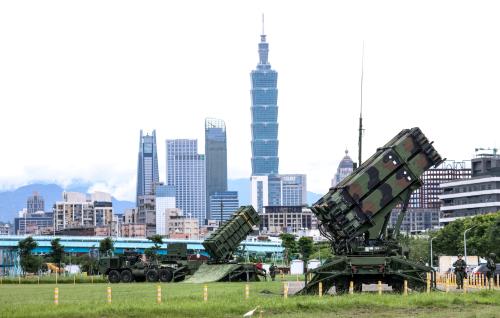
In 2004, for example, then-President Chen Shui-bian, the first DPP executive, proposed an almost $10 billion special budget that would have funded the acquisition of P-3C Orion patrol aircraft, Patriot PAC-3 air defense missile systems, and a diesel-electric submarine program. After three years of stonewalling by the KMT-controlled legislature, Chen dropped the proposal and incorporated the aircraft and air defense programs into the regular defense budget. The 2021 $8.6 billion special defense budget proposed by President Tsai Ing-wen covered domestically made ships, anti-ship missiles, and unmanned aerial vehicles (UAVs). It passed more easily because of its content and because the DPP controlled both the executive and legislative branches.
The KMT’s counterproposal
On March 5, the KMT counter-proposed a $380 billion new Taiwan dollar (about $12 billion) special defense budget focused on nine items identified in the U.S. government’s December 2025 notification to Congress. Four items in this special budget, TOW-2B and Javelin anti-tank missiles, M109A7 self-propelled howitzers, and the HIMARS multiple rocket launcher systems, have already progressed to the contracting stage—referred to as Letter of Offer and Acceptance (LOA)—imposing a deadline on Taiwan to accept the offers before they expire. The KMT-controlled legislature has reportedly authorized the Ministry of Defense to sign these LOAs to close the deal before the budget impasse is completely resolved. The other systems in the KMT’s budget include funds to acquire Altius loitering munitions, the Taiwan Tactical Network, Harpoon missile follow-on support, and AH1 Apache helicopter parts. The TPP has proposed its own budget similar to the KMT’s proposal, without the helicopter spare parts.
With the KMT controlling the legislature, passage of its $12 billion special budget bill, comprising the eight items U.S.-offered items, seems to be the most likely near-term outcome of the political wrangling between the executive and the legislature.
Lai’s $40 billion special defense budget contains a combination of indigenous and U.S.-made weapon systems and is considerably larger than past cases. The KMT’s knee-jerk reaction to oppose the president’s budget is politically driven, but one member of the legislature told me that its objective is practical, too. Several of the line items in the budget are vague and do not identify specific systems, such as the broad description, “Equipment related to sustained combat capability (including war reserve stockpiles, production lines, and battlefield denial).” In response, the Ministry of Defense has prepared classified and unclassified reports to the legislature listing munitions, missiles, UAVs, and specific indigenous systems it wants to acquire through the special budget, indicating that there is much more debate to come.
The bigger picture
Despite the political wrangling that appears to jeopardize Taiwan’s defense spending, Taipei’s commitment to its own defense is increasingly credible. Taiwan’s annual defense spending has steadily and sustainably grown for more than a decade and shows no sign of slowing. Polling shows growing public awareness of the threat from China, support for conscription, and majority support for defense spending. Last year, Lai launched a whole-of-society defense resilience campaign intended to bolster civilian support for military operations in contingencies, further contributing to deterrence and Taiwan’s ability to resist Beijing’s military and political coercion. Indigenous defense systems are increasingly important components of Taiwan’s defense strategy, boosting morale, public confidence in Taiwan’s own defense abilities, and support for increased spending.
The KMT and DPP legislators are currently wrangling over the size and scope of the special budget. However, they are likely to reach a compromise and eventually pass a smaller compromise version than Lai proposed because of broad public support. Lai and Taiwan-watchers in Washington might be disappointed that the $40 billion special defense budget was not passed quickly and cleanly, but the overall trends are more positive than this one setback would imply.
Author

Related Content
The Brookings Institution is committed to quality, independence, and impact.
We are supported by a diverse array of funders. In line with our values and policies, each Brookings publication represents the sole views of its author(s).
Commentary
Defense in a democracy: Political competition and Taiwan’s special defense budget
March 30, 2026