




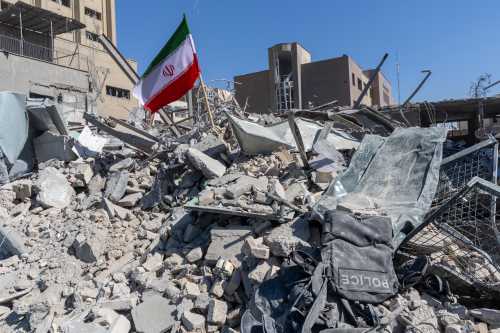
Two weeks into the United States’ and Israel’s war with Iran, there are increasingly urgent questions about Iran’s future and the Trump administration’s objectives. In this episode of The Current, Brookings Fellow Aslı Aydıntaşbaş is joined by Vice President of Foreign Policy Suzanne Maloney and Visiting Fellow Mara Karlin to discuss the state of the war, the Iranian regime, and the global ripple effects of the conflict.
Related Content
Transcript
MALONEY: I think at some point President Trump will absolutely seek an off ramp. The challenge for him is that he did come out publicly on a number of occasions, particularly at the start of the war, calling for regime change. And that is going to be a standard to which he is held in the press and in the public if in fact what we see is just a a slightly less scary version of the Islamic Republic retaining power.
[music]
AYDINTAŞBAŞ: Hello and welcome to The Current. My name is Aslı Aydintaşbaş, and I’m a fellow at the Foreign Policy Program at Brookings Institution. We’re taping this on Tuesday, March 10th. And here with me are two amazing colleagues. Across from me, Suzanne Maloney, the vice president and the director of the Foreign Policy Program at Brookings and one of the world’s top experts on Iran. And next to me is Mara Karlin, a visiting fellow at the Foreign Policy Program, and of course the former assistant secretary for defense and strategy and war planning in many ways at the Pentagon.
So the three of us met a little over a month ago to discuss the protests in Iran and the very tragic crackdown there. Suzanne, let me start with you to see where we are two weeks into this war. You’ve been very consistent in warning that regime change in Iran is not an easy proposition through bombing alone and that the regime has spent decades, not years, but decades, preparing for this moment. Where are we two weeks into this war?
[1:39]
MALONEY: Two weeks into the war, I think that the United States and Israel have scored some very impressive victories in the sense of taking out Ayatollah Ali Khamenei, the supreme leader of Iran, in the very first hours of the conflict, and the consistent degradation over the course of these two weeks of Iran’s military capabilities, particularly its ballistic missile program, which has been a source of growing concern particularly since the June war in which the United States and Israel did major damage to Iran’s nuclear program. That is the plus side for the United States and Israel.
I think at the moment, the larger set of concerns are that the Iranians have been able to maintain a steady pace, although declining, of retaliation against the Gulf States that has been very disruptive to economic and energy infrastructure in the region. At this stage, there’s very little passing through the Strait of Hormuz, and that’s having a direct impact on energy prices.
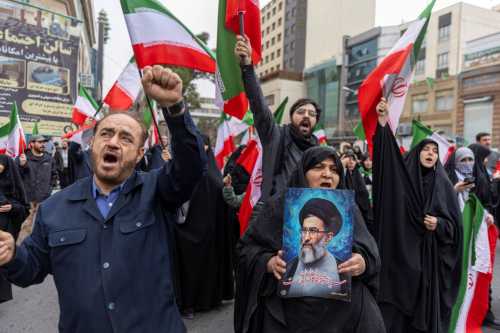
Iran’s leadership seems to have held together. We’ve seen no major defections despite a significant number of losses at the top beyond Khamenei himself. They have managed the formal process of transition to a new supreme leader in the form of Khamenei’s son, which puts a an even more hard line figure at the top of the theocratic state.
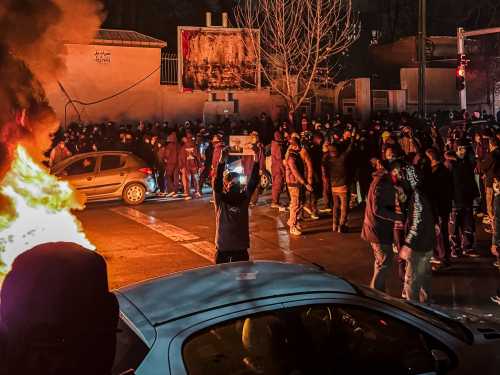
And at this point, we don’t see any major signs of a recurrence of the protests that began in January, and might have been the spark in the mind of President Trump when he talked at various points as he has over the course of this conflict about regime change. So for the Iranians, they’re holding firm even if they’re taking a beating.
[3:23]
AYDINTAŞBAŞ: So, just to go back to the succession issue. What signal is the system sending by picking Mojtaba Khamenei as the supreme leader?
[3:34]
MALONEY: I think it was the only selection that was possible under the current circumstances. Mojtaba is a figure who had very little public presence over the course of his career. And he might have been an intolerable choice for the system in ordinary times, because he seems to endorse the principle of dynastic rule, which of course is anathema to a revolution that came about ousting a hereditary monarchy.
But under the circumstances with the regime is being battered as badly as this one is, picking a figure who can play to themes of martyrdom, who can reinforce the coherence of the existing political elite, and who has an excellent relationship with the security services and the military seems to be the right option.
Now, there are other figures in the mix. There appears to have been at least some dissension among the the senior officials who appear to be running the show in Tehran. Ali Larijani, the head of the Supreme National Security Council, is one figure who is said to have opposed Mojtaba’s elevation, perhaps
AYDINTAŞBAŞ: his brother
MALONEY: because his brother was in contention, so, and had been a member of the three-person council that was named per the constitution to run the country in the immediate aftermath of the supreme leader’s death.
But you know, realistically, Mojtaba has a target on his back. We don’t know how long he’s going to last. We haven’t seen him in public yet. He is said to have suffered serious wounds in the attack that killed his father, his mother, his wife, other members of his family. And so we don’t know what he will do in office because he’s literally had no public statements or public presence or even interviews conducted with him on a regular basis over the course of his career.
So we are in a period of time in which there’s a symbolic leader. It is an opportunity to rally what’s left of the regime around some forward path. But I don’t think we can say what a post-Khamenei or a post-Ali Khamenei Islamic Republic is going to look like.
[5:31]
AYDINTAŞBAŞ: What a Shakespearean turn of events.
Mara, let me turn to you. What’s the first thing you check every morning in terms of how you’re assessing where this war is going? And actually more broadly, same question as Suzanne, where are we in two weeks? I know you’ve been doing battlefield assessment also on our website, but more broadly, I think, where are we in the end game?
[5:54]
KARLIN: Absolutely. So on the first question, the number one indicator I keep looking for is is anyone defecting? Is anyone pulling away from the military, pulling away from the security services, and either taking their weapons and staying home or taking their weapons and acting against the regime? I haven’t seen much on that front whatsoever. But that’s the thing I’m focused on.
More broadly, where do I assess that that we are? Look, the U.S. and Israeli militaries have run this campaign to their comparative advantage. Right? These are militaries that can operate pretty effectively at the high-end, conventional, of the of the continuum of conflict. So that’s what what we have seen. And they’ve achieved a whole bunch of battlefield successes. Right? Pulling down a number of political and military leaders, a number of institutions as well. So that’s been pretty impressive on one hand.
Yet on the other hand, operational success conventionally doesn’t necessarily translate into strategic success, as I think Suzanne just talked about. And what we really need to start to see is who is going to fill the space? Who is now going to populate these institutions? Is there any sort of armed opposition on the ground? We’re not seeing a whole lot of indicators along those lines as well.
So it’s conceivable to me that sooner rather than later, President Trump says we’ve achieved victory. Look, whole lot less worried about Iran’s nuclear capabilities, minus a couple hundred kilograms of highly enriched uranium that one should be concerned about. Whole lot less worried about Iran’s missile capabilities, both actual missiles and missile launchers. Iran’s navy, Iran’s air force, whole whole bunch of things that are much less of a problem.
You also, however, have a regime that while in seeking its collapse is actually devolving its command and control. What ends up happening to those folks and what do they do with their weapons?
[7:51]
AYDINTAŞBAŞ: So, both of you have talked about shifting goalposts and sort of confusion about end games. The administration has struggled to have a consistent message early in this conflict. But yesterday, Marco Rubio said the goal of the mission is to destroy the ability of the regime to launch missiles, destroy the launchers, destroy factories where these missiles are produced, and the navy. So that seems to have been a narrower end game, allowing perhaps President Trump to come out and say, I’m done.
[8:23]
KARLIN: I think that’s absolutely conceivable. I mean, the challenge is, however, you’ve got a rump state, and a rump state that doesn’t look 180 degrees different from what the previous state had been.
So look, you won’t have this degree of military capabilities. When we look across the region, Iran’s proxies are a whole lot weaker than they were if we were sitting here two years ago.
But fundamentally, it’s not, like ideologically you have changed the regime. It’s just you bought yourself a bunch of time while they try to regroup. And maybe you’ve given some sort of impetus given how weak the regime is to folks who want to try to push for a further collapse.
[9:03]
AYDINTAŞBAŞ: Suzanne, what is so dangerous about a rump state? And if President Trump ends it tomorrow, what type of repercussions might he be facing?
[9:15]
MALONEY: Those are both great questions and they’re very much interlinked. I think the danger of a of a hardened, bloodied Islamic Republic that has fewer capabilities to project power outside its borders, but probably maintains significant capabilities to dominate state and society within the borders of Iran, is that this is going to be a regime that’s looking for retaliation against adversaries at home.
It will also be looking to flex its muscles to avoid the the specter of continuous Israeli and potentially future American attacks, both conventionally and through the kind of intelligence apparatus that the Israelis have demonstrated so effectively in the course of this conflict and in the course of the 12-day war back in June. So they’re going to be looking to kind of reestablish their deterrence.
They’ve also seen how effective that they can be through the use of drones against their neighbors to the south, that they have seen that they can have a massive disruption on air travel, and on the larger economic and social political projects that the leaders of Saudi Arabia, the Emirates, Qatar are trying to move forward. And those are very much based on attracting tourism and finance and technology.
And of course all that relies on the interconnections with the global economy and with air travel. And to the extent that they can continue through very minimalist use of force disrupt that, they may be incentivized to do it because, of course, from the Iranian perspective, they believe that the Gulf States have have provided the launching pads for this American side of the attack on their own country.
[10:52]
AYDINTAŞBAŞ: It’s been a little bit confusing to understand what President Trump is hinting, because over the weekend he said he wants full surrender. And yesterday he said we’re far ahead of the schedule and suggesting that he was planning on ending the war perhaps soon. At least that’s how the markets took it. Do you think he’s seeking an off ramp?
[11:14]
MALONEY: I think at some point President Trump will absolutely seek an off ramp. The challenge for him is that he did come out publicly on a number of occasions, particularly at the start of the war, calling for regime change. And that is going to be a standard to which he is held in the press and in the public if in fact what we see is just a a slightly less scary version of the Islamic Republic retaining power.
And so I think, you know, this is a political challenge for him, particularly because the war has, at least in the short term, contributed to a spike in gasoline prices, and a return of the Russians to energy markets potentially in Europe and elsewhere–
AYDINTAŞBAŞ: –and through India, by selling a significant amount of oil to India.
MALONEY: Exactly. So these are all, you know, don’t look like the great geopolitical win for the president. And also could have some impact on the economy here in the United States, especially at a time when Americans start to think about their summer vacation, summer travel. If the price of gasoline remains high, that will hurt the president in the upcoming midterm elections.
[12:18]
AYDINTAŞBAŞ: So do both of you think that the Venezuela 2.0 formula is now off the table, that it’s foreclosed?
[12:26]
KARLIN: I don’t see any evidence of how it’s possible. Right? Venezuela is effectively you take the very top person, remove them from the system, but the whole rest of the system stays as it is. You’ve already seen a bunch of things happen that don’t enable that. Right? Widespread removal of political and military leaders. So I I don’t see that occurring. Moreover, Trump has really talked about some sort of transformation of this regime, and I think that would be an impossibility.
[12:57]
AYDINTAŞBAŞ: I noticed that in the end game that Rubio and Hegseth laid out, they did not mention the nuclear program. Should I read into that, or is that in just sort of they forgot?
[13:08]
KARLIN: I think from the beginning we’ve been given a dim sum menu of reasons for going to war. And so with any one interaction, you’re going to get a couple items from that menu and not all of them. I would not read more into it.
[13:20]
MALONEY: Can I just jump in though, because that I think is the real concern about Iran in the medium term in the aftermath of this crisis, because as Mara alluded previously, we know that the nuclear program was not wholly obliterated. That in fact there is a considerable stockpile of highly enriched uranium, not at bomb-grade level, but close to it, that may be accessible to the Iranians under the right circumstances.
And I think this is the real challenge that an Iran that has experienced this kind of an attack by the United States and Israel, that its neighbors have contributed to, is going to be an Iran that’s looking for an effective deterrent. And that HEU could be accessed, could be used for a dirty bomb, or could be used to try to resume at least some work toward a an actual nuclear weapon.
And that, I think, is the the fundamental concern that is driving how this war ends. Because if the president walks away from this conflict and Iran still has access to nuclear material, then in in some ways we might have accelerated their progress toward a weapon rather than deterred it. And that could be a legitimate security threat for the world. And obviously a political hit for the president.
[14:30]
AYDINTAŞBAŞ: Well, so Axios has reported that administration officials told Axios they were thinking of sending Special Forces to go in and re-obliterate the obliterated nuclear stockpile.
[14:45]
KARLIN: Re-obliterate.
Look, sending in ground forces is a an inflection point in this conflict. Even if you’re just talking about small teams of special operators.
AYDINTAŞBAŞ: It’s very risky.
KARLIN: It’s incredibly risky. You have to worry about casualties; you have to worry about the mission that they are trying to achieve and the extent to which they can achieve it. I think there are probably really big questions about the extent to which the U.S. intelligence community really understands what is happening in Iran up to this moment and also going going forward.
[15:19]
AYDINTAŞBAŞ: Suzanne, I want to take a moment and ask you to talk about the people of Iran. I imagine it must be terrifying to be living in Tehran or Isfahan at the moment. You have been following the public sentiment. Tell us how Iranians inside the country are thinking of this moment, especially given they went through a horrific phase of an internal crackdown as recent as January.
[15:43]
MALONEY: I don’t think I can speak for 92 million Iranians, but I think we can all imagine what it must be like, and we’re seeing at least some sentiment coming out. Although the internet shut down by the government is limiting how much we’re able to access genuine public opinion from Iran.
This is a country that’s under massive bombardment, thousands of attacks that have taken place, many of them proximate to major cities. At various points in time, some of those strikes have targeted oil depots that produce massive flames and effectively black smoke and acid rain that continued over Tehran in the days following the attacks.
You know, this is just a a period of immense trauma for Iranians who underwent something unprecedented in January with the murder of thousands of people who came to the streets to demand regime change. At that time, of course, President Trump promised that the United States was “locked and loaded.” He encouraged Iranians to seize their institutions.
We will see how this all lands at the end of the day, but if the Islamic Republic remains and Iranians themselves have endured significant bombing and loss of civilian life in this conflict as we’re beginning to see, I think the sense of betrayal that many Iranians felt about prior points of American policy, particularly the 1953 overthrow of Prime Minister Mohammad Mosaddegh, they will pale in comparison to the sense that the United States has come in and only hardened the regime that they hated so much.
[17:13]
AYDINTAŞBAŞ: Mara, let me quickly turn to you for potential spillover effects. There’s all sorts of ways this could spread. Obviously we heard a story about the Kurds, but then Trump said it was off the table. There’s tension rising in Eastern Mediterranean. There’s always Turkey, Israel and so on. China and Russia might step into support Iran or maybe not. Are any of these scenarios plausible to you?
[17:39]
KARLIN: Absolutely. We’ve already seen a whole lot of spillover, including at least 14 or so countries. I mean, it’s pretty unsurprising that as the Iranian regime is fighting for its life, it has chosen to attack a number of countries around the Gulf, stretching all the way to Turkey as well. So they fired missiles, they fired drones. A lot of that has slowed down, but is nevertheless, I think, pretty worrisome for the folks in those various countries.
I think we should worry that they will continue to try to increase the cost of this war for folks around the entire region, that Iran will do what it can to increase the cost of this war in the hopes that it will get the United States and Israel to begin to to deescalate.
What I’m wondering a lot of is if you’ve got devolved command and control, what are those different folks on the ground going to do with their weapons? So that’s an internal question of course, but also externally. We’ve seen desalinization plants that are hit, we’ve seen hotels, a whole bunch of airports, soft targets that are hit around the Gulf in particular. I would assume that as the regime gets more desperate, it will do what it can along those lines.
You know, I think there’s a piece of this war that’s not getting as much attention, which is what’s happening in Lebanon. And it is worth just maybe sitting on that for half a beat. Hezbollah at this moment in time is really the weakest it’s been since its establishment a couple decades ago. And when it triggered the latest round of fighting with Israel, you saw some really fundamental dynamic shift inside Lebanon. So the Lebanese military for the last few months has been working to disarm Hezbollah south of the Litani River. We’ve never seen the Lebanese military do anything meaningful against Hezbollah in its existence. The closest happened in May 2008 where they said they would do something and Hezbollah immediately went to the streets and turned its weapons on the Lebanese people.
And what’s happened in the last few days is the Lebanese Cabinet has announced that it is banning Hezbollah, has begun arresting Hezbollah members. So this is all occurring as there’s this massive Israeli attack. It’s a pretty plastic moment inside Lebanon as domestically they’re trying to figure out what to do with the state within a state, but they’re doing that under massive military attack as well.
[20:05]
AYDINTAŞBAŞ: I want to ask a quick question to both of you to wrap it up. It’s hypothetical, but if President Trump was to end this war this week, by the end of this week, who wins? Suzanne?
[20:19]
MALONEY: From Tehran’s point of view, they’ve survived the war, and that for them is a victory. That’s what they need, is to make it through the day. There has been no regime change. There has been no uprising on the streets. They are left to fight another day. And they have now exposed the vulnerability and the inadequacy in some respects of the U.S. military– incredibly competent and capable of degrading Iran’s own military assets, but not really capable of extracting the Islamic Republic from the region. That will be a massive victory for this regime at a time when they were, you know, facing an uprising on their own streets.
And it really calls into question how this operation was planned, what the contingencies were considered by the U.S. government. You know, I look back on my own career. I was in the private sector at the time of the run-up to and aftermath of the U.S. invasion of Iraq in 2003. We modeled all the contingencies. We were prepared for a number of adverse as well as also positive outcomes.
And of course, that became almost emblematic of a set of circumstances in which the United States didn’t foresee outcomes; how it is possible that, you know, more than two decades later we find ourselves in another war in the Middle East that we don’t appear to have thought through very fully. That may not be surprising with this particular administration, but given that President Donald Trump really tapped into this sense of frustration among the American people with the human and financial costs of the war in Iraq, it is really incredible malpractice that they have launched this war, created the set of circumstances in the region that has long-term economic and strategic consequences without fully thinking through the potential outcomes.
[22:04]
KARLIN: I completely agree with Suzanne. I mean, war planning involves a whole bunch of branches and sequels, right? You’re trying to figure out what are the different things that could occur. And a lot of what’s happened has actually been tremendously obvious. Iran’s backed into a corner as the U.S. and Israel are trying to collapse its regime? Of course it is going to attack the Gulf and others. You’ve got hundreds of thousands of Americans arrayed across the Middle East? Of course, you’re going to have to figure out a way to start evacuating them.
It just seems as though some of these really simple, obvious moves weren’t considered in contingency planning.
I like Suzanne’s answer about who the winner is. I would just underscore two points. First, that’s a really low bar for the Iranian regime. Right? Merely surviving as a rump state is a win, so we should just recognize that.
I think also a number of other folks can tell themselves that they are winners as well. The U.S. and Israeli militaries will be able to stand up and say, look, not much of Iran’s military left to worry about. Look what we’ve been able to do to the leadership. I think they will also highlight their tremendous operational and joint collaboration. And so they’ll be able to tell this story as well.
I guess the most interesting piece in my mind is to fast forward and figure out what’s the story that Gulf States tell themselves, because this has been very profoundly uncomfortable as places that have for decades said, we are the ones that you can come to, we are the ones that you can visit, we’re extremely prosperous, we’re extremely safe. And at this moment in time, that’s not quite what’s happening.
AYDINTAŞBAŞ: Well, thanks to both of you for this amazing conversation, and thanks to our listeners for tuning in. There’s a lot more commentary, analysis, and videos on our website, Brookings dot edu, including a public panel we had earlier last week.
[music]
My name is Aslı Aydintaşbaş, and this is The Current.
Participants


More information:
- Listen to The Current on Apple, Spotify, YouTube, or wherever you like to get podcasts.
- Learn about other Brookings podcasts from the Brookings Podcast Network.
- Sign up for the podcasts newsletter for occasional updates on featured episodes and new shows.
- Send feedback email to [email protected].
The Brookings Institution is committed to quality, independence, and impact.
We are supported by a diverse array of funders. In line with our values and policies, each Brookings publication represents the sole views of its author(s).
Commentary
PodcastCan Iran’s regime survive the war?
Listen on
The Brookings Current
March 11, 2026