



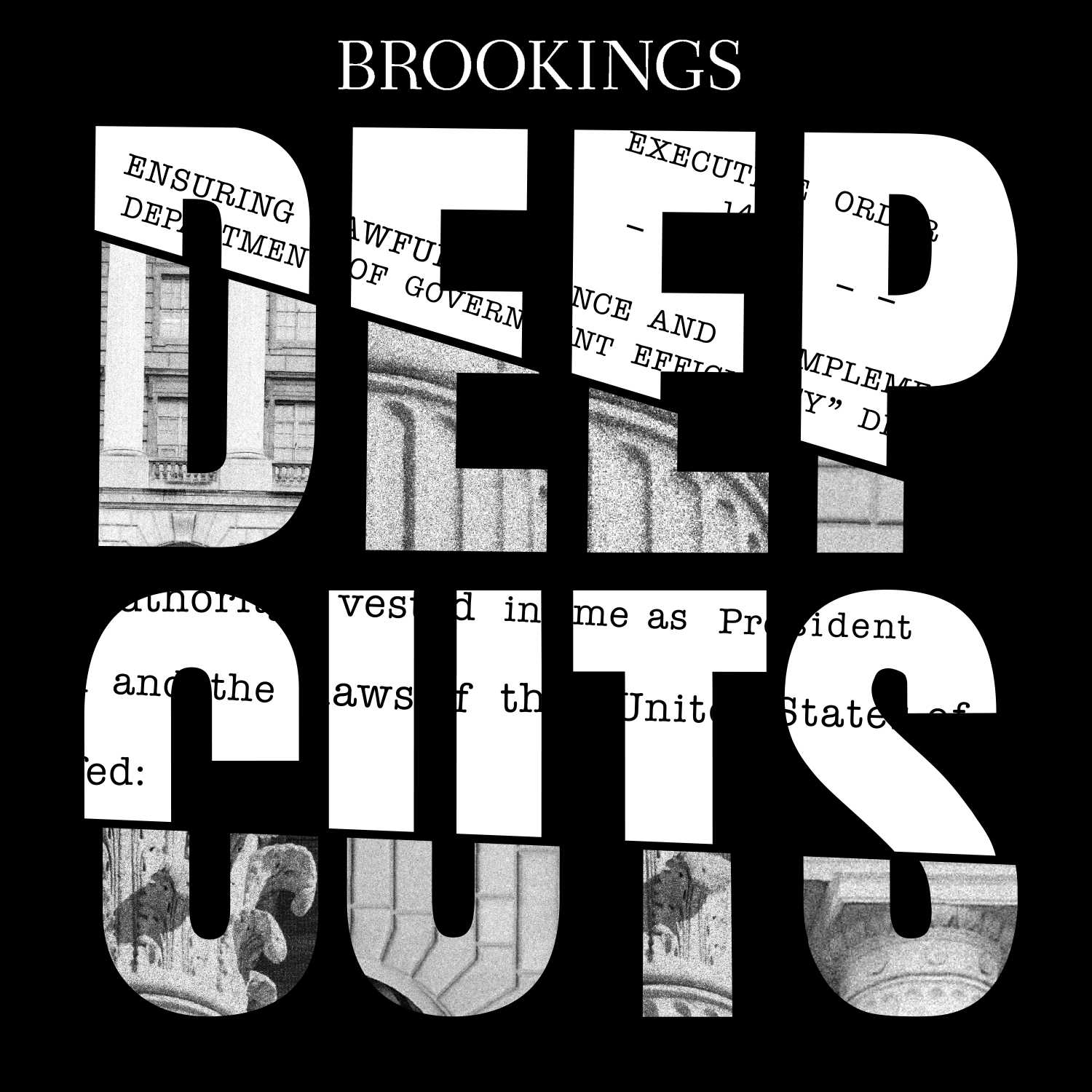
What was lost after the most dramatic restructuring of government in modern American history? “Deep Cuts” is a narrative documentary series from the Brookings Institution about what happens when the machinery of government is rapidly dismantled, downsized, or reshaped.
Each episode goes inside one federal agency or program affected by the Trump administration’s cuts and asks a deceptively simple question: what did this thing actually do, and what happens when it stops?
Stay tuned for the first release coming out on November 17.
- Listen to “Deep Cuts” on Apple, Spotify, or wherever you like to get podcasts.
- Learn about other Brookings podcasts from the Brookings Podcast Network.
- Sign up for the podcasts newsletter for occasional updates on featured episodes and new shows.
- Send feedback email to [email protected].
TRANSCRIPT
SCOTT R. ANDERSON: In January 2025, the federal government entered one of the most dramatic periods of upheaval in modern American history.
PRESIDENT DONALD TRUMP: I got elected on making government better, more efficient, and smaller.
ANDERSON: The second Trump administration had arrived, and it had a theory.
TRUMP: And to that end, I have created the brand new Department of Government Efficiency.
DOGE.
ANDERSON: The government was too large, too slow, too expensive, too independent, in many cases, too political, and the president’s job was to cut it back to size.
NEWS ANCHOR: Department of Government Efficiency got to work to aggressively shrink the size of the federal government last year. The OPM said it was, quote, “In line with President Trump’s goal of a smaller, more efficient government.”
ANDERSON: Contracts were canceled, payments frozen, civil servants fired, whole agencies disappeared.
NICHOLAS ENRICH: The immediate thing that keeps me up at night is we haven’t even started to really see the worst of it yet.
ANDERSON: This series is about that experiment. We’ll meet the people who built those institutions, the civil servants who ran them, and the Americans who depended on them in ways they may not even realize.
JONATHAN FISHER: I had been working in my career for over 20 years and got to the point where I can have a great impact, and I really saw the benefits to everyday Americans of what I was going to be doing.
TRACI DIMARTINI: How do we make the world better? That’s how I ended up in the federal government.
JEREMY KONYNDYK: That it’s also about really the fundamentals of rule of law and the basics of the U.S. Constitution.
PAIGE ALEXANDER: It’s not just our generation, it’s the next generation, because what has been taken down in the past 18 months has been something that’s gonna affect us for decades.
ANDERSON: And when these things all go away, what happens to the people they are supposed to serve?
HOUSE SPEAKER MIKE JOHNSON: Government is too big, it does too many things, and it does almost nothing well.[00:02:00]
And so, my fellow Americans.
FORMER PRESIDENT RONALD REAGAN: Government is not the solution to our problem.
JOHNSON: Ask not what your country can do for you.
REAGAN: Government is the problem.
ENRICH: How far have we set ourselves back? How much of the progress will be reversed before we step in and fix this problem?
JOHNSON: Ask what you can do for your country.
ANDERSON: The most important thing about government may not be what you notice while it’s working. It may be what you miss when it’s gone. From the Brookings Institution, this is Deep Cuts.
Participants


The Brookings Institution is committed to quality, independence, and impact.
We are supported by a diverse array of funders. In line with our values and policies, each Brookings publication represents the sole views of its author(s).
Commentary
PodcastAnnouncing “Deep Cuts,” a podcast unpacking the tearing down of the federal government—and how to build it back
November 12, 2026
Listen on
Deep Cuts