Executive summary
Despite steady progress on the substance of the U.S.-Taiwan relationship, the narrative surrounding Taiwan in Washington is moving in a dangerous direction. U.S. Treasury Secretary Scott Bessent’s warning that Taiwan’s concentration of chip production constitutes a “single point of failure” for the global economy reflects a broader current of thinking that views Taiwan as a vulnerability for the United States. The solution, according to some of Trump’s advisors and supporters, is to rapidly lessen dependence on Taiwan and lower America’s exposure to events in the Taiwan Strait. Left unaddressed, this narrative has the potential to upend decades of American efforts to uphold peace and stability in the Taiwan Strait. Narrative, after all, is the master structure within which strategy is formed.
This paper offers an update to framing America’s approach to Taiwan and cross-Strait relations. It argues that there is no inevitability to U.S.-China conflict over Taiwan. It further observes Taiwan’s centrality to America’s artificial intelligence (AI) ambitions. There is simply no substitute for Taiwan’s hardware, which is the backbone upon which America’s AI breakthroughs are built. Lastly, America’s purpose for involvement in cross-Strait relations is to create conditions for leaders in Taipei and Beijing to engage in dialogue free from coercion. Until such time as there are leaders in Beijing and Taipei who share a determination to address cross-Strait differences, America will need to hold firm in opposing unilateral changes to the status quo by either side. Put differently, America’s project is not to fight China or abandon Taiwan. It is to keep a path open and encourage progress toward a peaceful and non-coercive resolution of cross-Strait differences.
The substance of U.S.-Taiwan relations is strong
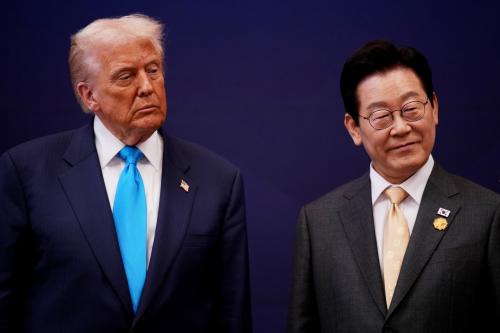
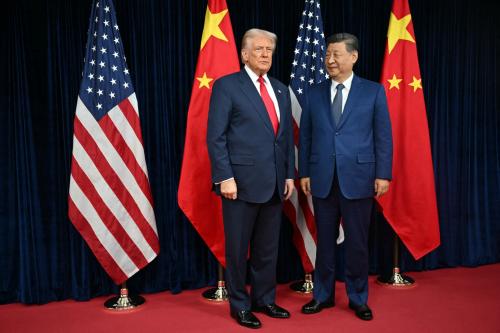
On substance, the U.S.-Taiwan relationship appears to be gaining momentum. Contrary to speculation from some in the expert community, U.S. President Donald Trump has not sold out Taiwan. He did not make any concessions on Taiwan when he met Chinese President Xi Jinping in Busan last October. In fact, according to press reporting, Taiwan was not even raised as a topic of conversation between the two leaders. In the ensuing months, the United States and Taiwan concluded a trade agreement to cut U.S. tariffs from 32% to 15%. In exchange, Taiwan technology firms will invest at least $250 billion to grow America’s tech ecosystem in the United States. The world’s leading semiconductor company, TSMC, announced plans to significantly expand its footprint in the United States. U.S. and Taiwan officials recently held a productive Economic Prosperity Partnership Dialogue; they agreed to integrate Taiwan into the Pax Silica initiative, a U.S.-led international consortium to secure trusted supply chains for technologies foundational to the AI era. On the security front, the Trump administration announced an $11.5 billion arms sale package in December. There are reports that the Trump administration may follow up with another arms sale package in the coming period.
Thus far, the Trump administration has maintained steady progress in advancing U.S.-Taiwan relations. With plans for Trump to meet Xi multiple times in 2026, there are reasonable grounds to question whether momentum in the U.S.-Taiwan relationship will be sustained in the year ahead. Some American experts worry that Trump will become more reluctant to signal support for Taiwan out of concern that doing so could limit his ability to secure economic deals and new understandings with China. Trump’s recent statement that he was consulting with Xi on a potential arms sale to Taiwan ahead of his trip to China in April heightened these concerns. Nevertheless, to date, the Trump administration has demonstrated meaningful support for Taiwan.
The storytelling around U.S.-Taiwan relations is breaking down
The current risk for the U.S.-Taiwan relationship is less about substance and more about storytelling. Previously, Taiwan was perceived in the United States as a David versus Goliath story. Taiwan was seen as a plucky underdog standing firm in the face of an aggressive China. More recently, following Russia’s invasion of Ukraine, Taiwan was described as a democratic partner deserving of American support. China could not be allowed to seize Taiwan, so the narrative went, lest the norm against territorial conquest collapse. Now, with Trump coveting Greenland and securing control of natural resources in Venezuela, the notion of America serving as the defender of international law and norms has appeared quaint.
More recently, an argument has developed that Taiwan will be protected by a “silicon shield.” According to this logic, Taiwan is so central to global value chains through its near monopoly in the production of advanced semiconductor chips that the rest of the world could not countenance conflict in the Taiwan Strait. If Beijing attempted to use force to seize Taiwan, so the thinking goes, the global economic blast radius would be so significant that it would compel a broad coalition of countries to push back against China. And this foreknowledge of the global mobilization against any attack on Taiwan would help deter China from attacking Taiwan.
This same logic about Taiwan’s centrality to the global economy is now being flipped on its head. At Davos this year, Bessent warned that “the single biggest threat to the world economy, the single biggest point of failure, is that 97 percent of high-end chips are made in Taiwan.” He warned that any major disruption to Taiwan’s chip production would trigger an “economic apocalypse.”
This view of Taiwan as a vulnerability is gaining traction in discussions about Taiwan in the United States, particularly among conservative-leaning pundits, Trump administration officials, and their supporters. As with many things relating to the Trump administration, there is not perfect message consistency in how officials and official documents describe Taiwan. Broadly speaking, this narrative of Taiwan as a strategic liability appears more prevalent among economic officials than national security officials. The 2025 National Security Strategy, for example, emphasizes Taiwan’s geographic significance for the United States, followed by its central role in semiconductor supply chains. The 2026 National Defense Strategy omits any direct mention of Taiwan but emphasizes America will adopt a “denial-based defense along the First Island Chain,” which includes Taiwan.
In contrast, on the economic side of the policy ledger, U.S. Commerce Secretary Howard Lutnick has vowed that America will reduce dependence on Taiwan’s chips as much as possible, as rapidly as possible. He has set about browbeating Taiwan firms to move production to the United States. Lutnick has forecast that by the end of Trump’s term in 2029, 40% of Taiwan’s semiconductor supply chain could be reshored to the United States, a goal that Taiwan’s top trade negotiator has publicly characterized as impossible.
Regardless of whether it is feasible to move 40% of Taiwan’s semiconductor production to the United States by the end of 2028, this direction of travel reflects a view that former Republican presidential candidate and current Trump-backed Ohio gubernatorial candidate Vivek Ramaswamy previously foreshadowed. Several years back, Ramaswamy said, “My message to China is clear. Do not mess with Taiwan before 2028. And before 2028, our commitments are strong. After 2028, we have semiconductor independence. We have different commitments, lower commitments…to a situation in which you’re sorting out a nationalistic dispute dating back to 1949.”
In other words, Taiwan is increasingly coming to be discussed by Trump-supportive voices as a liability on America’s strategic balance sheet that needs to be moved off its books as soon as possible. There are several likely reasons why these concerns from U.S. policymakers are bubbling up now. First, America’s AI build-out has spurred a massive demand cycle for advanced semiconductor chips. This has focused policy attention in Washington on the importance of securing access to a reliable supply of chips. Second, China’s weaponization of rare earths elements and magnets in the U.S.-China trade war has heightened policy awareness of the dangers of external sole-source dependence for critical economic inputs. And third, China has increased military pressure surrounding Taiwan, which has concentrated policy attention on America’s potential vulnerabilities in a cross-Strait crisis.
Even though Taiwan continues to enjoy broad, bipartisan Congressional support and the backing of the American public, Taipei cannot afford to ignore this emerging narrative of Taiwan as a liability. Trump’s action-oriented approach to foreign policy, combined with Congress’s fecklessness in exercising meaningful oversight, has laid bare the limits of relying upon Congressional support.
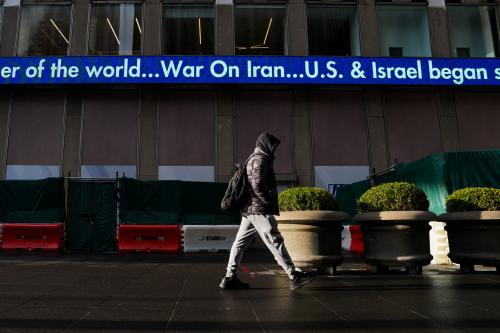
This narrative of Taiwan as a liability is given sustenance by Beijing’s efforts to build an aura of inevitability around its designs to integrate and unify Taiwan into the People’s Republic of China. Beijing wants to seed a view that the only way Washington can avoid a collision between two nuclear-armed powers is by backing away from its support for Taiwan. If Washington does so, according to Beijing’s preferred logic, then peaceful unification can advance, and U.S.-China relations can improve. If Washington resists, in Beijing’s telling, then it risks inviting violence unto itself, because China cares more about Taiwan than the United States does, and will be more willing to climb the escalation ladder to achieve its aims there. Particularly at a moment when Washington is managing tensions in Ukraine, Iran, Venezuela, and elsewhere, while also prioritizing efforts to regenerate its strength at home, the prospect of another flashpoint erupting in the Taiwan Strait is deeply unattractive for America’s leaders.
Updating the Taiwan narrative in the United States
The solution is not to fall back on time-worn totems of U.S. policy. Invocations of strategic ambiguity or the “one China” policy do not resonate with Trump or his advisors. A new narrative is needed that gives purpose and direction to American involvement in cross-Strait relations.
A new framing for America’s role should build upon three planks.
Still possible to preserve peace and stability
First, it is doable for the United States and its partners to preserve peace and stability in the Taiwan Strait. For all its bristling military strength, Beijing lacks cause for confidence that it would prevail in a full-scale conflict or a blockade around Taiwan. Taiwan, like Ukraine, would not need to defeat China’s military. It would just need to prevent it from winning. Taiwan is learning lessons every day from Ukraine on how best to do so.
Any decision by Beijing to launch an amphibious invasion over a tumultuous body of water onto a jaggedly mountainous and densely populated island would be arguably the most daring military decision since U.S. President Dwight D. Eisenhower led Allied troops across the English Channel for D-Day in World War II. Alongside Taiwan’s significant and growing investments in asymmetric defensive capabilities, such as sensors, sea mines, drones, mobile missile launchers, anti-ship missiles, and air and missile defense, Taipei is working assiduously to accentuate its geographic advantages.
America is simultaneously coordinating with allies such as Japan, Korea, Australia, and the Philippines to field and disperse its most advanced military capabilities across the First Island Chain. America’s undersea warfare capabilities also remain peerless and would offer a significant defensive advantage. Put simply, America’s allies are quietly but steadily strengthening military preparation and planning for any future cross-Strait contingency and doing so in ways that are designed to sow doubts into the minds of China’s decisionmakers.
These quiet efforts to reinforce America’s deterrent capability are arguably more impactful than threats of imposing economic penalties on China as retaliation in a cross-Strait crisis. Rightly or not, economic threats of sanctions do not seem to stir significant anxiety in Beijing. This is due in part to Beijing’s assessment that European and Asian countries are too trade and investment-dependent on China to sacrifice their own economic well-being in service of Taiwan. Chinese officials also have observed the limits of international economic pressure on Russia following its invasion of Ukraine.
China has embarked on a massive military build-up for a Taiwan contingency. Even so, there is also no inevitability that China is preparing imminently to launch any type of military assault on Taiwan. Although the Chinese Communist Party has demonstrated unblinking determination to secure control of Taiwan and shows no signs of letting up on that goal, the People’s Republic of China has survived for 77 years without gaining control of Taiwan. China’s leadership is presently purging its military high command in record numbers. Furthermore, Xi and his deputies can tell themselves a story now that they are making directional progress toward their goals. They can credibly claim that they have foreclosed Taiwan’s ability to declare independence or pursue permanent separation through their fielding of such massive military capabilities surrounding Taiwan. Additionally, China’s continued expansion in national power bolsters its ability to assert that the goal of unification is coming into clearer focus, even as a date for realizing unification remains undetermined.
Taken together, this mix of factors should be used to puncture any arguments in the United States that Washington is courting catastrophe by maintaining a principled posture of working to uphold peace and stability in the Taiwan Strait. If anything, the alternative, i.e., going wobbly on Taiwan, is the greater risk. Beijing remains deterred from using force against Taiwan now, but it may grow more aggressive if it determines that America lacks either the political will or military strength to uphold peace and stability.
America’s economic fortunes are connected with Taiwan
America’s support for peace and stability in the Taiwan Strait is driven by self-interest, not charity or deference to high-minded ideals.
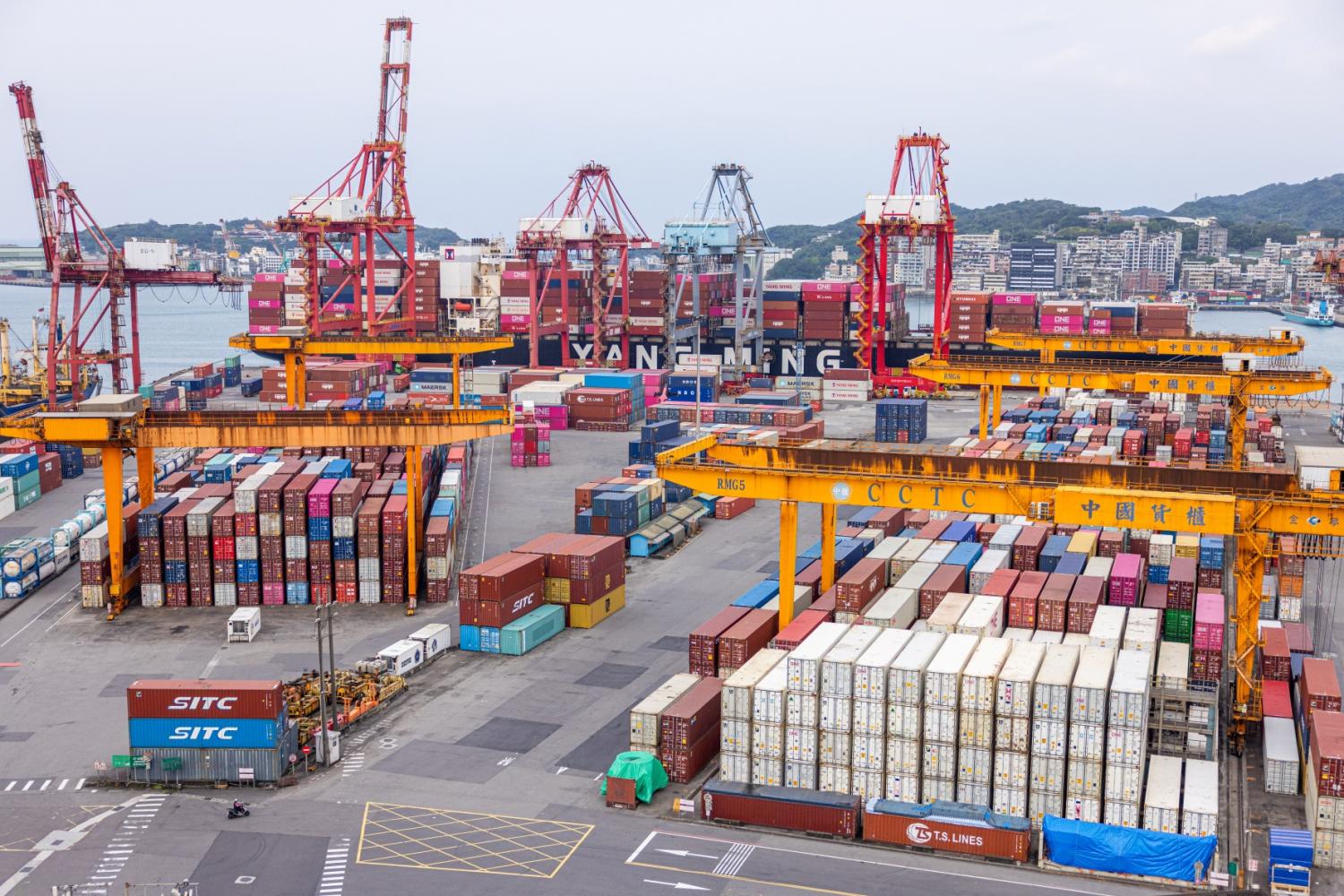
America’s economic trajectory hinges heavily on whether the country’s big bet on AI pays off. There is no path for America to realize its AI ambitions without a strong and close relationship with Taiwan. America is a leading driver of AI innovation and applications. America’s breakthroughs are built on the manufacturing and hardware backbone that Taiwan’s leading companies provide.
More so than with any other trading partner in the world, America and Taiwan are interwoven actors in pushing out the frontier of innovation on AI. This reliance on Taiwan for hardware is a symptom of a broader trend that has compounded across Democratic and Republican administrations – American capacity to produce industrial outputs at scale has declined sharply. Reversing this trend will be a generational project, not a light-switch moment.
Behind the Trump administration’s frothy rhetoric about reshoring advanced semiconductor production, the reality remains that America will remain dependent on Taiwan’s products for at least the next decade, and likely longer. TSMC’s capital expenditure in Taiwan continues to outpace its investments in the United States. Put differently, TSMC and other leading Taiwan technology firms are continuing to grow their research and development (R&D) and cutting-edge production capabilities in Taiwan even as they increase investments in the United States. As a result, America’s commercialization of edge computing, advanced manufacturing, and embodied-AI applications will either be propelled or halted depending upon its success in sustaining productive relations with Taiwan.
Keeping a path open to eventual peaceful resolution of cross-Strait differences
America’s objective is not to deny Taiwan to the People’s Republic of China or to keep Taiwan permanently in America’s security perimeter. It is not to act as a judge or mediator of cross-Strait disputes. America’s role is, in the words of American Institute in Taiwan Director Ray Greene, to “establish conditions for dialogue free from coercion. The United States has always insisted on the peaceful resolution of cross-Strait differences.”
Going forward, American officials would benefit from being more outspoken and energetic in support of efforts by Beijing and Taipei to narrow and eventually resolve cross-Strait differences. This is a way out of the Taiwan tinderbox that could drag America into war with China and risk crashing the global economy.
In the near term, there is not much cause for optimism that leaders in Beijing are prepared to exercise creativity to bridge cross-Strait differences. Neither side has laid out a compelling solution to cross-Strait differences that could meet the minimum requirements of the other side. The current leaders in Beijing and Taipei will not be in power forever, though. The project for America in the near term is to make clear to both sides that it encourages constructive efforts to solve challenges, and that it will oppose efforts by either side to rock the boat by unilaterally altering the status quo. American diplomats should also build channels to future leaders in Taipei and Beijing and encourage them to begin generating new thinking now about how they would engage their cross-Strait counterparts more effectively in the future.
There are three reasons why America needs to embrace this purpose for its participation in cross-Strait affairs. First, America’s strong and steady presence is a necessary precondition for Taiwan’s leaders to have confidence in their position to engage in dialogue with Beijing when they deem it appropriate to do so. The United States has made a significant contribution to the vibrant and dynamic society that Taiwan has become. Ultimately, though, the responsibility for managing cross-Strait relations belongs to leaders in Taipei and Beijing, not Washington.
Second, a firm and steady U.S. military and diplomatic presence is a prerequisite for diminishing Beijing’s confidence that it can achieve its aims through force or coercion. Instead, U.S. leaders must continually impress upon their Chinese counterparts that the center of gravity for the future of Taiwan is the preferences of its 23 million people. If China wants to make progress in pulling Taiwan closer, it needs to appeal to the interests and aspirations of Taiwan’s people. Beijing must also recognize that any significant agreement to peacefully resolve cross-Strait issues likely will require popular approval within Taiwan’s constitutional democratic system.
Third, to sustain public support at home, American leaders need to be able to explain to their constituents that they are pursuing a principled approach to cross-Strait relations, as opposed to merely playing a defensive game of downside risk mitigation. Washington is not dictating outcomes to either side. Rather, it is insisting that a status quo that has underwritten global peace and prosperity remains in place until leaders on both sides of the Strait find a mutually acceptable formula for improving upon it.
For some, this proposed update to America’s narrative on Taiwan may feel unsatisfying. For example, there is a constituency of expert voices in Washington advocating for increasing awareness about the nearness of the threat of U.S.-China conflict over Taiwan. They believe doing so could focus public attention and mobilize resources for strengthening military deterrence. Such an approach would rhyme with the narrative that top officials in the Department of Defense promoted early in the Biden administration. At that time, senior Pentagon officials engaged in a public guessing game to predict when Beijing would invade Taiwan. In so doing, they contributed to Beijing’s efforts to wear down the psychological will of Taiwan’s people. They also exposed indiscipline and undermined perceptions of professional competence, which are critical elements for sustaining deterrence.
Others may suggest that America’s narrative needs to stress the geographic significance of Taiwan for America’s strategic interests. In this telling, Taiwan serves as a cork in the bottle to keep China hemmed in within the First Island Chain and prevent Beijing from asserting hegemony over Asia. This framing implies that America must permanently keep Taiwan in its security perimeter, and if it does not, then Taiwan could be the first domino to fall in Asia. By extension, this suggests that America’s posture on Taiwan is oppositional to China’s ambitions. At a time when the American public’s top priority on China is to avoid war, positioning U.S. policy as diametrically opposite to China’s goals is not a winning formula for attracting enduring public support.
As tempting as it is for some to try to rally the American public to prepare for a showdown with China over Taiwan, such efforts are wrong-headed in the current environment. First, they are unlikely to mobilize the American public. Second, with the Trump administration already requesting a record $1 trillion for defense spending this year, there realistically is not fiscal space to increase defense spending considerably beyond current levels. And third, framing a public narrative around impending conflict confuses the essential nature of cross-Strait tensions. The unresolved dispute between Taipei and Beijing is political in nature with a military dimension, not vice versa.
Conclusion
China’s military build-up is generating significant concern in Washington about the risk of war in the Taiwan Strait and potential implications for America’s economic future. As significant as the military threat is, it is not the only path Beijing is pursuing in its quest to secure control of Taiwan. China is also working to wear down the psychological will of the people of Taiwan. China would like to cause Taiwan’s 23 million residents to conclude that America is unreliable and that resistance to China’s designs is futile. Beijing is persistently advancing its own narrative about the inevitability of cross-Strait unification. To protect its interests, the United States must also update its own story about why Taiwan matters and what Washington aims to achieve in cross-Strait relations.
America’s updated narrative on Taiwan should focus on three core themes: (1) there is no inevitability to conflict; (2) Taiwan is critical to America’s AI ambitions; and (3) the purpose of America’s policy is to keep a path open for peaceful resolution of cross-Strait disputes, however long that may take. Will such an updated framing radically transform America’s views of Taiwan and cross-Strait relations? Probably not. At a minimum, though, it will help Americans understand that the United States’ interests are tightly bound to events in the Taiwan Strait, and that the best way for America to protect its interests there is to establish conditions for dialogue between leaders on both sides of the Strait. That approach would offer an alternative to the false binary that is taking up oxygen in discussions in Washington today – that America needs to abandon Taiwan or brace for war with China. There is a middle path between these two extremes. If Trump wants to be remembered as a leader of peace, he should take that middle path.
Author

Related Content

The Brookings Institution is committed to quality, independence, and impact.
We are supported by a diverse array of funders. In line with our values and policies, each Brookings publication represents the sole views of its author(s).