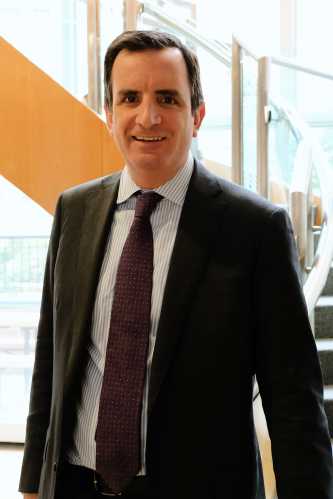

Thomas (Tom) Wright is a senior fellow with the Strobe Talbott Center for Security, Strategy and Technology at the Brookings Institution. Tom most recently served as special assistant to the president and senior director for strategic planning at the National Security Council in the Biden administration.
At the White House, Tom worked on a wide range of projects and issues, including the 2022 U.S. National Security Strategy, the Russia-Ukraine war and European security, U.S.-China relations, the global south, foreign economic policy, and countering the growing alignment between U.S. adversaries and competitors (China, Russia, Iran, and North Korea).
Tom is the author of “All Measures Short of War: The Contest For the 21st Century and the Future of American Power” (Yale University Press, 2017), which argued that the post-Cold War period of great power convergence was being replaced by an era of intense strategic competition in an interdependent world. He is the co-author, with Colin Kahl, of “Aftershocks: Pandemic Politics and the End of the Old International Order” (St Martin’s Press, 2021). He has also written extensively for The Atlantic as a contributing writer and for many other publications. These pieces included a Politico Magazine essay in January 2016 that was the first to identify Donald Trump’s “America First” worldview.
Tom has a doctorate from Georgetown University, a Master of Philosophy from Cambridge University, and a bachelor’s and master’s from University College Dublin. He has also held a pre-doctoral fellowship at Harvard University’s Belfer Center for Science and International Affairs and a postdoctoral fellowship at Princeton University.
Affiliations:
- International Capital Strategies, senior advisor
- Lowy Institute, nonresident fellow
- The Atlantic, contributing writer
-
Past Positions
- Special Assistant to the President and Senior Director for Strategic Planning, National Security Council
- Senior Fellow/Fellow, The Brookings Institution
- Director of Studies, Chicago Council on Global Affairs
-
Education
- Ph.D., Georgetown University
- M.Phil., Cambridge University
- M.A., University College Dublin
- B.A., University College Dublin