This viewpoint is part of Chapter 2 of Foresight Africa 2026, a report on how Africa can navigate the challenges of 2026 and chart a path toward inclusive, resilient, and self-determined growth. Read the full chapter on fostering human capital and quality jobs for youth.
Many of the existing structural gender inequalities in the labor market transfer to the digital environment.
Digital technologies are transforming the world of work.1 This transformation has brought improvements in employment opportunities and earnings for African women. For example, three years after mobile internet became available in Nigeria, female labor force participation went up and the share of households in extreme poverty fell by 7%.
Digital job platforms are one such technology revolutionizing work in Africa. These “gig work” platforms match potential workers with clients requesting tasks—from delivery services to domestic work. In this viewpoint, I explore the opportunities and risks that gig work presents for women in Africa, highlighting both the potential benefits and challenges faced in this rapidly evolving sector.
Characteristics of Africa’s gig work platforms and how they work
Gig work platforms supply an algorithmic infrastructure to match those seeking a short-term job with those seeking a provider of services. They typically include a governance structure, rules for work to be carried out, and a payment mechanism. Many firms operating gig work platforms in Africa are global giants in the gig work outsourcing field (e.g., Uber, Fiverr, Upwork) while others are regional, national, or local (e.g., Onesha in Kenya, Asqua and Findworka in Nigeria, or Move, the carsharing app based in Rwanda).2 Gig workers enter into formal agreements with the platform to provide services to the platform’s clients in return for compensation mediated through the platform. The gig worker does not have a relationship with the client beyond the task assignment and has the flexibility to decide when they work and what work they want to do subject to the rules of the platform.
There are two types of gig work platforms:
- Those offering location-based gig jobs (microtask work) such as taxi, delivery, or in-home services such as cleaning or care. In this case, the platform owner usually plays a strong role in setting the terms of service (task, pay) and selecting the workers, who are then employed as dependent contractors.
- Those offering online gig jobs, which can be done by workers and for clients anywhere in the world (sometimes referred to as “crowdwork”).3 In this case, the role of the platform varies regarding the selection of workers, terms of the task, and compensation. In platforms matching freelance tasks with potential workers, a bidding system is often used to set compensation, whereas in microtask work (small, simple, and often repetitive tasks that can be completed in a short amount of time), jobs are standardized and the pay per task is set by the platform.
Challenges women face in using gig work platforms
Women lag men in online gig work; in 2023 they comprised only 27% of the online gig workforce in sub-Saharan Africa.4 One reason for this is the 37% gender gap in access to digital technologies in Africa—one of the highest of any region—caused by financial and social costs that impact women disproportionately.5
In addition, compared to their male counterparts, more female online gig workers identify access to training as a top need (36.6% compared to 26.1% for males).6 These results suggest online female gig workers lack access to training, owing partly to the digital access gap mentioned above, but also to other structural and societal barriers such as low digital literacy and poorly designed curricula that don’t consider gender-specific needs and constraints.
Apart from access to training, World Bank data shows that female gig workers identify access to credit for purchasing equipment like computers as the second most important need, followed closely by access to health insurance. Notably, while health insurance features among the top three needs for female gig workers, it is a distant fifth for their male counterparts. This suggests that female gig workers also face barriers to entry such as high costs of working capital and lack of access to social protections and benefits like health insurance. The latter is of particular importance in the African context given that women are usually the primary carers for the sick in their families and communities.7
Analysis of women’s experiences with online work platforms finds that many of the existing structural gender inequalities in the labor market transfer to the digital environment. These include occupational segregation, gender pay gaps, and vulnerability to harassment.8 For example, a study of 1,150 Kenyan women platform workers found that in location-based sectors, one-quarter of workers reported experiencing harassment, mainly verbal abuse and payment withholding.9 African women working from home on platforms, balancing paid gig work and household unpaid work, also report both social isolation and fatigue.10
Gig platform algorithms can also disadvantage women. For example, transportation platforms such as Uber and Move incorporate surge pricing: higher pay when demand is highest. However, women are often least able to work during these times, either due to the gender-based dangers associated with driving at night or because of weekend childcare responsibilities.11 Studies in several countries have also shown evidence of gender bias in customer ratings, in that women in gig work receive systematically lower customer ratings than their male counterparts.12
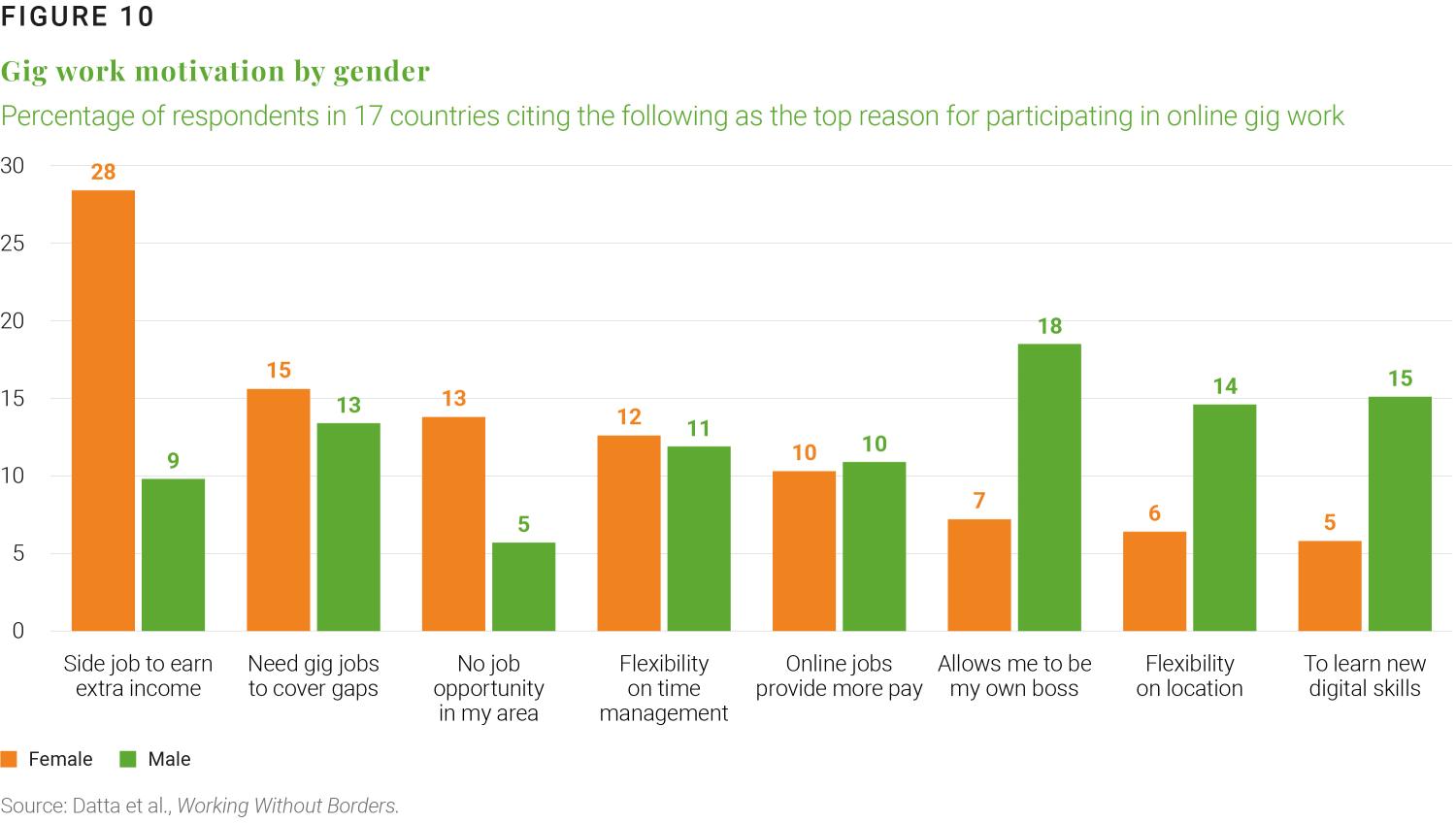
The previously referenced World Bank study shows that while men typically choose gig work for a desire to be their own boss or learn digital skills, women are more likely to cite their need for additional income and the lack of alternative jobs in their area (see Figure 10).13 Studies within Africa have also found that women are far more likely than men to report gig work as their primary or only source of income.14 For women, gig work is often an attractive opportunity given its flexibility and the lack of suitable alternatives in the formal economy. Platforms have also offered incentives to help women workers break into predominantly male sectors like transportation.15
Policy implications
African governments have several tools at their disposal to make gig work more inclusive for women:
- Reduce costs of participation in the gig work. Africa has the highest internet costs in the world,16 and costs of electricity and mobile devices can also be prohibitive. African governments can lower tariffs on digital devices and use competition to bring down internet costs. Lower costs especially benefit women, who have less access to financing.17
- Support training programs for women to enhance their digital skills as well as the “soft” skills needed to effectively bid and negotiate compensation. Governments should partner with international agencies or NGOs such as the International Labour Organization, who run the Women In Digital Business training initiative; Germany’s GIZ, which has a Gig Economy Initiative in Ghana; or the Soronoko Academy or ImpactHer, who provide training and help women access funding to purchase necessary equipment.
- Increase demand for digital workers through e-government programs and include pro-women elements in bidding documents. Examples include encouraging local platforms bidding on contracts to digitize public records, offering loans for purchasing digital devices to use for online gig work, or connecting women aspiring to become gig workers with training opportunities.
- Update labor laws as necessary to ensure that gig workers are covered by anti-discrimination and anti-harassment policies. For international platforms, this may require revisions to dispute resolution systems.18 Law enforcement officers may need to be trained on how to enforce anti-harassment policies in the context of digital service platforms.
- Encourage or require licensed platforms to use third party monitoring systems to ensure that platform incentive and compensation systems do not disadvantage women. One example is the Fairwork Foundation, which rates platforms on aspects such as the extent to which a platform ensures fairness in pay, fair working conditions, representation, etc.19 Fairwork Foundation ratings could be used as a quality factor when platforms bid for government contracts.
Together, these avenues could maximize the opportunities for women in Africa’s growing digital gig work sector, while mitigating risks.
Author

Related Content


-
Footnotes
- Tania Begazo et al., Digital Africa: Technological Transformation for Jobs (World Bank, 2023).
- Namita Datta et al., Working Without Borders: The Promise and Peril of Online Gig Work (World Bank, 2023).
- World Bank, Africa’s Pulse, No. 28, October 2023: Delivering Growth to People through Better Jobs (World Bank, 2023), 69.
- Ibid, p.84
- Victoria Kwakwa, “Accelerating Gender Equality: Let’s Make Digital Technology Work for All,” World Bank Blogs, March 7, 2023; Matt Shanahan, “The Mobile Gender Gap Report 2022,” GSMA, March 20, 2025.
- Natnael Simachew Nigatu, “Working Without Borders: The Promise and Peril of Online Gig Work” (World Bank, 2023).
- Kui Muraya et al., “Applying a Gender Lens to Understand Pathways through Care for Acutely Ill Young Children in Kenyan Urban Informal Settlements,” International Journal for Equity in Health 20, no. 1 (January 6, 2021).
- Uma Rani et al., “Women, Work, and the Digital Economy,” Gender & Development 30, no. 3 (2022): 421–35.
- International Labour Organization, ed., Digital Labour Platforms in Kenya: Exploring Women’s Opportunities and Challenges across Various Sectors (International Labour Office, 2024), xix.
- Anwar, “Platforms of Inequality,” 757–58.
- Mohammad Amir Anwar, “Platforms of Inequality: Gender Dynamics of Digital Labour in Africa,” Gender & Development 30, no. 3 (2022): 754–55.
- Rani et al., “Women, Work, and the Digital Economy.”
- Datta et al, Working Without Borders, 22.
- Anwar, “Platforms of Inequality,” 754.
- Celen Ebru Paytoncular, “Uber’s Marjorie Saint-Lot on Inclusion and Sustainability in Africa,” Connecting Africa, October 24, 2023.
- International Telecommunications Union, Measuring Digital Development: Facts and Figures 2024 (ITUPublications, 2024), 13–14.
- Hanan Morsy, “Access to Finance: Why Aren’t Women Leaning In?,” Finance & Development, March 2020.
- International Labour Organization, Digital Labour Platforms in Kenya, 29, 249.
- Datta et al., Working Without Borders, 164.
The Brookings Institution is committed to quality, independence, and impact.
We are supported by a diverse array of funders. In line with our values and policies, each Brookings publication represents the sole views of its author(s).



Commentary
Women and the gig economy in Africa
February 11, 2026