Following the military operation in Venezuela against Nicolas Maduro, President Trump turned his attention to Greenland, a large, ice-covered island of about 56,000 people, which is part of the Kingdom of Denmark. Trump has long argued that Greenland is essential to U.S. security. His bellicose announcements this month made clear that he wanted to annex the island in one of two ways: either by buying it from Denmark or by taking it militarily.
The reaction, especially to the possibility of the use of force, was immediate and negative both domestically and internationally. First, Denmark is a member of NATO, and an attack on Greenland would be an attack by a NATO member on another NATO member—effectively marking the end of the alliance. Second, as many pointed out, the U.S. doesn’t need to own Greenland to accomplish its security objectives.
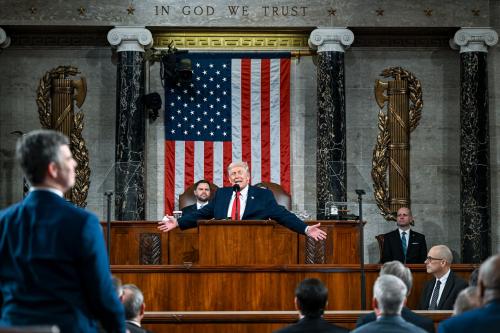
These arguments and plans for greater American-backed security measures in Greenland didn’t deter Trump from the threat of using force to take the island—until he finally took the military option off the table at a speech at the World Economic Forum in Davos, Switzerland, this week, and many breathed a sigh of relief.
Why did Trump back down? The answer depends on who you ask. Only hours after his speech in Davos, Trump also withdrew his threat of imposing tariffs on eight EU countries and maintained that he had achieved a “framework” for a deal—a statement aimed at touting his business acumen. As of this writing, the exact contents of the framework are elusive, but seem to include some sanctions on Russia and a definition of sovereignty for American military bases. European leaders, for their part, continued to insist that Greenland’s sovereignty is crucial to any deal. Ultimately, the prospect of economic countermeasures by some EU countries with significant trade ties to the United States may have done the trick.
Market reactions to Trump’s rattling the sword earlier this week surely mattered as well. The fear of economic chaos caused the stock market to take a big fall—likely further pushing Trump to reconsider. The pattern should sound familiar: Adverse market reaction to his Liberation Day pronouncement of steep tariffs last spring also provoked Trump to back down. Arguments that he is uniquely unconstrained in conducting American foreign policy might be slightly wide of the mark: A coordinated opposition, backed by sliding markets, seems to hem him in.
With military force off the table, at least for now, Trump has a few options. He can forget the whole issue; he can announce a series of security enhancements to take place in Greenland, which may not be a bad idea; or he can continue to try and buy the island, even though Denmark repeatedly said it’s not for sale.
This is not the first time an American president has made an attempt to do so. In 1944, President Harry Truman sent a pitch to Denmark, offering to buy Greenland for $100 million. The pitch was secret, and Congress never even knew about it. Greenland had become important to U.S. security during World War II, when bases were established there to protect against Germany’s navy, and it continued to be important in the Cold War, during which the U.S. had fifty military installations in operation on the island.
Denmark turned down President Truman and proceeded instead to negotiate the 1951 “Defense of Greenland Agreement,” under which the United States has essentially carte blanche with regard to its military presence in Greenland. Over the decades, the U.S. greatly reduced its military footprint there; today, only one American air force base remains.
The United States did manage to buy territory from Denmark earlier in the century. In 1915, the sinking of the Lusitania by a German submarine killed 128 Americans aboard. This event helped propel the United States into World War I, which was already raging in Europe. President Wilson feared that if Germany were to annex Denmark, it would obtain a strategic naval base on the Danish West Indies. While many Danes originally resisted a sale due to the US’s civil rights record and the potential consequences on the island’s predominantly Black population, Secretary of State Lansing pressured them by threatening occupation. The Senate ratified the “Treaty of the Danish West Indies” on September 6, 1916, and the acquisition of the U.S. Virgin Islands was completed on March 31, 1917, with a transfer of $25 million in gold coins to Denmark.
What happens next is anyone’s guess. Clearly, the idea of buying Greenland seems tame in comparison to the idea of invading it. For Denmark and Greenland, the idea of “selling” its citizens is an absolute non-starter, and Europe seems solidly behind them on this issue. Adding to the complexity of the issue, the United States—European Union trade deal is due to be signed soon. Will Donald Trump’s stance derail the deal, or will economic realities once again persuade him that the stakes are too high to pursue Greenland, especially when security matters and mineral rights can still be negotiated?
Part of the answer to this question lies in how steadfast Europe will be in creating, or at least threatening to create, painful economic consequences for the United States. The most powerful instrument at Europe’s disposal is the so-called “bazooka option,” or the European Union’s Anti-Coercion Instrument, which could be used to restrict American products from EU countries. It has never been deployed, but in the past few weeks, Trump’s overreach on Greenland has European leaders talking about it. Having averted a blowup of NATO, Trump’s next option could be just as serious.
Many are asking whether the Greenland episode marks the beginning of the end for NATO and the stable global trading order that has underpinned international relations for decades. Donald Trump may view his transactional approach to foreign policy as a sign of personal—and American—strength. Europe, however, appears to see it quite differently, increasingly moving to shield itself from the unpredictability of the Trump administration. If this episode deepens European unity and enables the continent to act with greater purpose, it may be Europe, not President Trump, that has the last laugh.
Related Content


Author

The Brookings Institution is committed to quality, independence, and impact.
We are supported by a diverse array of funders. In line with our values and policies, each Brookings publication represents the sole views of its author(s).


Commentary
What follows President Trump’s decision to step back from threatening to use force in Greenland?
January 23, 2026