This viewpoint is part of Chapter 5 of Foresight Africa 2026, a report on how Africa can navigate the challenges of 2026 and chart a path toward inclusive, resilient, and self-determined growth. Read the full chapter on rebooting global partnerships.
Africa’s freedom of action and development trajectory will be determined by its ability to balance the two elephants in the room: the U.S. and China.
There is no clear, detailed African position of a preferred future “global order,” except to note the continent’s shared prioritization of rapid, inclusive economic growth and reform of the U.N. system.1 That goal presumes a minimum level of global stability and predictability and inevitably suffers from the growing tensions between the U.S., Europe, and China. Perhaps the most coherent statement of African priorities is reflected in Agenda 2063, the African Union’s long-term strategic blueprint for its future with the aspiration for Africa to be a “united and influential partner” in international affairs, rather than a passive recipient of external agendas. That goal presumes deep regional integration, which is now on the cards with the launch of the African Continental Free Trade Agreement (AfCFTA).2
Competition between partners
Previously, during the Cold War, competition between the former Soviet Union and Western countries was a major source of instability in Africa. The balance of power in Europe and elsewhere came at a great cost to countries and regions on the periphery, including those in Southwest Africa and the Horn (Angola and Somalia/Ethiopia in particular). As a result, the years prior to the fall of the Berlin Wall were Africa’s most violent.3 Today, conflict and tensions are again high, with a war in Europe, rising tensions between the U.S. and China, and fracturing transatlantic relations.
The effects of these conflicts are already being felt in Africa. The Russia-Ukraine war has driven up the price of food, fertilizer, and oil for Africa and its trading partners.4 Russia has also pursued its war aims against European supporters of Ukraine in Africa by deploying Wagner Group mercenaries (augmented in 2024 by the paramilitary group Africa Corps) to take advantage of disaffection with France and domestic security crises.5 The costs of rising tension are also evident in other areas, for example the reluctance of some Western partners, such as the U.S., to collaborate with China on connecting the Lobito Corridor with the Chinese refurbishment of the TAZARA railway line, which aims to establish an east-west corridor spanning Southern Africa,6 or in the competition between the Kon Kweni deposit, owned by a U.S.-based mining company in Guinea, and the Chinese-owned and run Simandou mine in the same country.
New actors such as the United Arab Emirates and Turkey are also becoming increasingly influential in Africa, but China, Europe, and the U.S. remain Africa’s most important development partners. Each brings different advantages to the table, and the ongoing tensions between them are disadvantageous for Africa.
Looking ahead to future relations
For Africa, there will be, ideally, no choice to be made. Europe remains the largest source of investment to Africa, and Africa has a trade surplus with Europe compared to its deficit with China.7
At the same time, Chinese companies now build the most infrastructure and do so more quickly and cheaply than Western companies,8 although the latter often demonstrate higher standards of governance, compliance, and stronger technology and innovation capabilities.9 Above all, the U.S. and Europe sit atop a dam of potential investment monies that could improve Africa’s prospects.
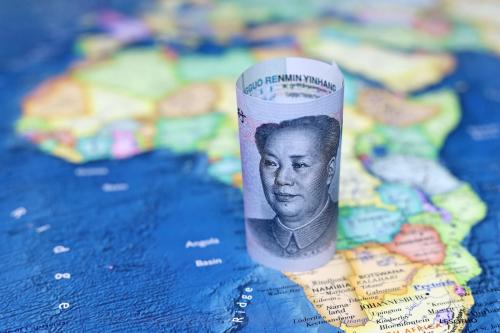
On the other hand, Africa’s trade with China, already the largest with any single country, is set to continue its rapid expansion. It has already grown from $10 billion in 2000 to $262 billion in 2023.10 Using a gravity model, Collin Meisel forecasts that Chinese-African trade will more than triple in value over the next two decades.11 U.S.- Africa trade is also expected to increase, more than doubling, but from a much lower base, thus remaining significantly below Africa’s trade with China, the EU, or India in absolute terms. Rather than a deliberate strategy to control Africa and its strategic minerals, the increase in trade with China and India reflects the extent to which the epicenter of the global economy and power is shifting to Asia and away from the North Atlantic, finds Meisel.
Although the Chinese and Indian populations are unlikely to ever attain the average income levels of Americans or Europeans, the current path forecast from the International Futures forecasting platform and others1213 is that the Chinese economy is expected to surpass the U.S. sometime in the mid-2030s. China’s economy is already larger in purchasing power parity (PPP) terms, while India is the only other single country with great power potential that could, towards the end of the century, compare with that of China and the U.S.
As much as one can generalize, Africans generally balk at the prospect of a world dominated by either the U.S. or China, or the prospects of a return to the bipolar competition of yesteryear. African citizens’ desire for greater influence on the global stage and their favorable views towards competing great power suggest a preference for a multipolar order.14 To this end, multipolarity cannot just be more of the same. Globalization has ushered in progress through trade and knowledge transfers. But privilege is still ingrained the current international system through profit shifting and the unbalanced global tax regime.15 Multipolarity necessitates norms and rules that safeguard the weak against the strong, particularly crucial for a continent comprising 54 mostly small, independent countries.
In a world of slower growth, rising fragmentation and contested power, Africa’s freedom of action and development trajectory will be determined by its ability to balance the two elephants in the room: the U.S. and China, and its success in advocating for a rules-based future. Power asymmetries mean that Africans cannot do so alone. The most obvious avenue to explore would be a partnership with the European Union, despite the challenging historical legacies. The material power of the EU is declining, but it brings considerable soft power to the table and evidences the norms and values that democratic Africa aspires to. Articulated in the Constitutive Act establishing the African Union and Agenda 2063, these include good governance, human rights, democratic institutions, and peace as foundations for sustainable development and global influence. Others should join, but this cannot merely be in defense of the current inequitable system. Future systems of global partnership should include reforms that would provide a degree of protection and predictability to balance the current volatility.
Related Content
-
Footnotes
- African Union, “Decision on the Reform of the United Nations Security Council Assembly/AU/9(XV),” July 27, 2010, African Union Common Repository.
- African Union, Agreement Establishing the African Continental Free Trade Area (2018).
- BBC, “Snuffed out Democracies and Poisoned Toothpaste: How the Cold War Wreaked Havoc in PostColonial Africa,” History Extra, August 19, 2021.
- Sherillyn Raga et al. (2024). ‘Impact of the Russia–Ukraine war on Africa: policy implications for navigating shocks and building resilience’ ODI Synthesis Report.
- Shaun Walker, “Ukraine Military Intelligence Claims Role in Deadly Wagner Ambush in Mali,” The Guardian, July 29, 2024; “Mali: Army, Wagner Group Disappear, Execute Fulani Civilians,” Human Rights Watch, July 22, 2025.
- Samuel W. Yankee, “China, America, and the Great Railway Race in Africa,” The Diplomat, March 5, 2025
- Alicia García-Herrero, “While Africa’s Economic Relations with China Are Hyped, Its Relationship with the EU Is More Favourable,” Bruegel, July 22, 2024.
- Jayaram et al., The Closest Look yet at Chinese Economic Engagement in Africa
- David Dollar, “China’s Engagement with Africa: From Natural Resources to Human Resources” (2016), John L. Thornton China Center at Brookings.
- Elisa Gambino, “Beyond Trade: China Private Capital under Africa Free Trade Area,” Austrlian Centre for International Studies, September 30, 2025.
- Collin Meisel, Right-sizing Africa’s “China challenge”, African futures blog, 21 August 2025.
- IFs version 8.55, Frederick S Pardee Institute for International Futures, University of Denver.
- Citigroup Inc., “When Will China’s GDP Surpass the US? And What Will It Mean?,” Citigroup.com, 2023.
- “Africa Day: Majority of Africans Say African Countries Should Be given Greater Influence in International Decision-Making Bodies,” Afrobarometer, May 23, 2025.
- Krishen Mehta and Thomas Pogge, eds., Global Tax Fairness, Oxford Scholarship Online (Oxford University Press, 2016).
The Brookings Institution is committed to quality, independence, and impact.
We are supported by a diverse array of funders. In line with our values and policies, each Brookings publication represents the sole views of its author(s).
Commentary
What does greater global competition mean for Africa?
February 4, 2026