



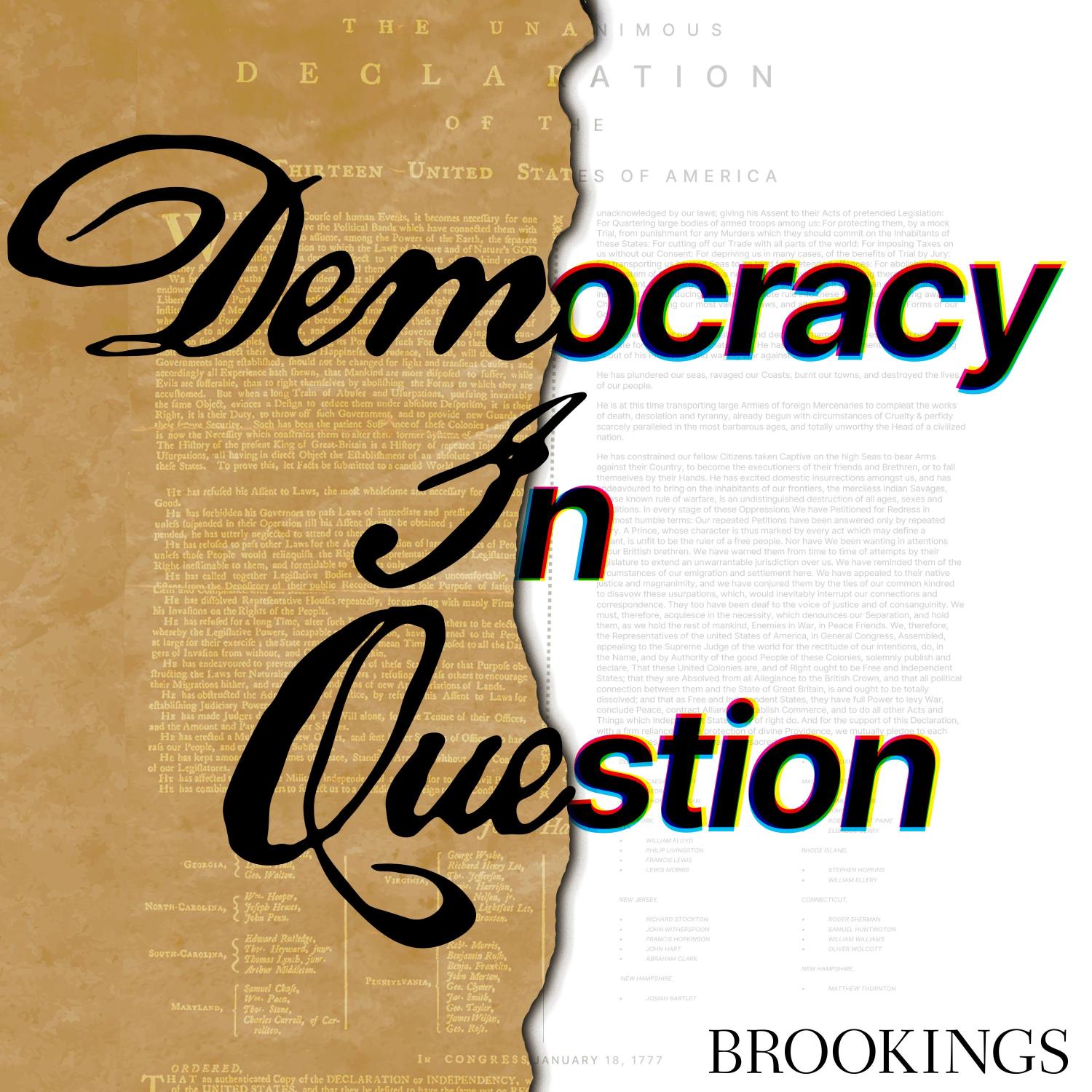
“We hold these truths to be self-evident,” but what did those words really mean in 1776, and who were they written for? In the season 3 premiere of Democracy In Question, Katie Dunn Tenpas and Vanessa Williamson dig into the radical promise within this phrase from the Declaration of Independence. They unpack its evolution, from the abolitionists who wielded it as a tool for equality, to why its vision of shared truth and self-government feels more urgent than ever.
- Listen to Democracy in Question on Apple, Spotify, or wherever you like to get podcasts.
- Watch episodes on YouTube.
- Learn about other Brookings podcasts from the Brookings Podcast Network.
- Sign up for the podcasts newsletter for occasional updates on featured episodes and new shows.
- Send feedback email to [email protected].
Transcript
KENNEDY: We hold these truths to be self-evident, that all men are created equal, that they are endowed by their creator with certain unalienable rights.
[music]
TENPAS: Hi, I’m Katie Dunn Tenpas, a visiting fellow in Governance Studies at the Brookings Institution, and director of the Initiative on Improving Interbranch Relations and Government. And this is season three of Democracy in Question. This season, we’re doing something a little unusual for a policy podcast. We’re going back, 250 years back, to when a document was written that every American is familiar with, most can quote from, but very few have actually reckoned with seriously as a governing text: the Declaration of Independence.
The founding document, written primarily to establish a rationale for the American Revolution, was written well in advance of the Articles of Confederation and the Constitution and its Bill of Rights. The body of the document is just over 1,300 words, but explains exactly why the United States of America came to exist in the first place.
Over eight episodes, we’re going to explore the Declaration of Independence phrase by phrase. I’ll ask special guests what key lines meant in 1776, what history has done to alter their meaning, and most importantly, what they actually mean for how we practice democracy today.
I am excited to kick off this season with my wonderful colleague, Vanessa Williamson, a senior fellow in Governance Studies at Brookings. Vanessa studies taxation and democracy in America, and recently published a book called The Price of Democracy, which reveals the revolutionary power of taxation throughout American history.
Thrilled to have you on the podcast, Vanessa.
WILLIAMSON: I’m so glad to be here.
[1:57]
TENPAS: Before we really dive in, I’d like to just take us back to that point in time. It’s the summer of 1776. It’s brutally hot. There’s a war being fought outside with George Washington serving as commander-in-chief of the Continental Army in New York City. And in Philadelphia, a 33-year-old Thomas Jefferson has been handed a blank sheet of paper and told more or less, explain to the world why we’re declaring independence. Can you talk about that?
[2:28]
WILLIAMSON: Yeah. So I mean, I think it’s so long in the past that we can forget what an extraordinary risk the colonists were taking in the decision to declare independence. Britain was indisputably the most powerful empire the world had ever known. And so there is sort of a romantic story that we we sometimes, I think, forget now– we’re sort of cynical– about how brave fundamentally it was to decide to challenge that great military force. Right? A military force that consistently defeated France for example. Right? And what were these, little colonies thinking they were gonna do?
And so, after the fact, it seems obvious that the United States would achieve independence, but at the time the participants in the move for independence were risking their lives. It was quite a brave action to go to Philadelphia and to sign a document that asserted the independence of a new nation. Just across the hall, in Philadelphia, they were handling much more prosaic matters, but you know, they were figuring out how they could melt down drainpipes for the lead so that they could make shot. Right? So, I mean, this was a war whose outcome was in no sense obvious.
[3:39]
TENPAS: Right. But their mindset, was it sort of against all odds?
[3:42]
WILLIAMSON: Yeah. I mean, they had taken their lives in their hands at that point. And so this document is, you know, I mean, it’s a legal document. It’s a piece of international law, right? It was intended to formalize something that had been already underway in communities across the country. But it was sort of a point of no return in that sense.
TENPAS: Right. There’s a lot at stake.
WILLIAMSON: Yeah.
[4:04]
TENPAS: And tell me at the time, what did Americans generally think about this Declaration of Independence?
[4:10]
WILLIAMSON: So Americans were divided on the war. Plenty of people were loyalists. And there were a lot of different issues that were pushing the colonies to independence. Several of them are not particularly romantic to think about today. For example, one of the issues that the American colonists were mad about was that Britain was, in their mind, acting too slowly to open new lands to settlers. That is to say acting too slowly to expropriate the Native nations who had long lived upon those lands. And so it was not a war of pure idealism, by any stretch of the imagination.
But one of the things that this document does is present the moral case for independence and to place the case of the United States, which was in many ways, you know, sort of an economic case for independence, in a much bigger moral, ethical, philosophical framework that explained what justified what would become the United States to the world.
[5:05]
TENPAS: Right. And and was this sort of the first opportunity, too, that they got to represent themselves not as individual states, but as the United States?
[5:13]
WILLIAMSON: So this is a problem that persists, right? The Declaration of Independence, of course isn’t actual independence, and it is more than a decade before we even begin to start moving towards the Constitution. And so yeah, we’re absolutely taking the first small step towards a unified nation. And we’re going to be coping with the historical accident of the particular colonies and therefore the particular states, I mean, to the present day.
[5:38]
TENPAS: Yeah. Yeah. Interesting. Let’s dig down a little bit deeper. I’d like to focus on one phrase in particular at the beginning of the Declaration: “we hold these truths to be self-evident.” The founders, namely Thomas Jefferson and Ben Franklin, wrote this phrase in a matter of days, but it’s been the topic of scholarly debate for 250 years. Can you talk about that?
[6:02]
WILLIAMSON: Yeah. So, Thomas Jefferson takes the first draft of the preamble to this document. And the preamble is what anyone ever quotes really. Although every now and again you hear about some of the specific grievances these days, but I think most people, the preamble is the part that sticks in their mind. And so when Thomas Jefferson wrote it, he first wrote it as saying, “we hold these truths to be sacred and undeniable,” which has not nearly as beautiful of a ring to it. It is widely thought that it was Franklin who chose a less highfalutin phrase, “self-evident.” And part of that sort of plays into the historical memory of Jefferson as sort of the southern aristocrat and, you know, philosopher and Ben Franklin is, you know, the the guy who worked in a print shop and sort of spoke for the average American.
But I think there’s something really beautiful in that change, because to say that truths are sacred is to sort of put a religious cast on, a sort of a mystical cast, if you will, on the meaning of the truths that would follow. Whereas in Franklin’s wording, we’ve gone with “self-evident,” which is a much more empirical, factual, down to earth approach.
That transition from sort of a highfalutin magical orientation for the basis for human rights, and a much more practical sort of basically science-based approach to the concept of democracy is of the great achievements, I think, of the document.
Historically there is a reason that science and democracy develop in the same era. The idea of science rests on the notion that different people in different places, with different lived experiences can interrogate the empirical world and come to conclusions, and then those conclusions can be tested by others. Right? And that we share an empirical reality, and we share the same basic reasoning faculties to judge that.
And democracy rests very much on the same idea, except that it applies it to self-governance, right? It’s that there is a world that we share and that we come to it each with our own capacities for reason. And in working together, right? in testing one another’s conclusions in conversation, in debate, in discussion, whether about scientific laws or about what the tax rate should be, we can come to better, stronger conclusions —
TENPAS: — right —
WILLIAMSON: — as a group.
[8:34]
TENPAS: Right. And at the time when Thomas Jefferson did draft it and use the term “sacred,” what was the role of religion at that time? And was he sort of somewhat pressured to include it, to allude to a religious aspect of this or not?
[8:48]
WILLIAMSON: Well, it was a very different vision of religion at the time. You know, Thomas Jefferson was a deist. He was not a sort of an active Christian, and many of the founders doubted, largely in their private letters, but in writing, that God was an active presence in the day-to-day lives of man. They were much more sort of a clockwork universe, right? The sort of vision of the world that there were perhaps mysteries that we could not unravel, but that we didn’t need to turn to mysticism or religion to understand the world around us or to guide our actions. We could come to conclusions about, for example, the dignity and worth of people, not necessarily from having received a guidance from a particular book or a particular religious leader, but simply from our shared recognition that we all are human beings who are reasoning together and have a certain equality.
[9:44]
TENPAS: So Jefferson was likely influenced by the enlightenment thinkers. So, Voltaire, Locke, Rousseau. Was this phrase at the time, genuinely radical, or was it kind of a common philosophical stance at that time?
[9:58]
WILLIAMSON: Well, I think even the most commonplace philosophical stance, when you decide to go to war over it, and base the justification of a new nation upon it becomes quite radical. Right? And I think that’s what we see here. Yes, I think in some ways some of the phrases in the Declaration were commonplace of Enlightenment thinking. But to say that this is what justifies a new nation and to back it up with a war was indeed, I think, very radical.
And, you know, I think there’s something kind of wonderful in a way about that commitment, both that you would feel that a nation shouldn’t just be justified instead of a might makes right kind of a way, but also that you would want to lay out a reasoned case, that you would want to, in the phrase later in the Declaration, “let facts be submitted to a candid world.”
This idea that what would make it right for the United States being an independent nation was not simply whether our militiamen with their muskets could defeat the Red Coats. But rather this much bigger claim about the basis upon which a nation should be made.
[11:17]
TENPAS: Yeah, yeah. And who was the intended audience? Was it King George? Was it the courts of England? Was it the American people?
[11:25]
WILLIAMSON: Well, any decent political document has more than one audience in mind. It technically, of course, it’s about the king. A lot of the actual complaints were really about Parliament. But, you know, it was sort of the the manner of the time to direct one’s grievances to the king.
But yeah, I mean, a big piece of what is happening in this document is making the case to other Americans, right? The United States was not a united nation on the question of independence. There were a very large number of loyalists, people who thought we should remain part of the British Empire. And it is worth pointing out that as much as we talk today about the beautiful phrase about things like all men being created equal, at the time of the Revolution, most Black men fought on the side of Britain. Because it was Britain that they thought, and at the time quite correctly, was more likely to live up to the goals of emancipation no matter what our founding documents had said.
[12:15]
TENPAS: Yeah. Wow. That’s stunning. What about if we think about, historically, there are times when the phrase, “we hold these truths to be self-evident,” the meaning has changed. And so since 1776, what historical moment was it that caused us or Americans generally to rethink that meaning?
[12:34]
WILLIAMSON: So almost as soon as the Declaration was printed, abolitionists seized upon it. Right? Because, you think about it, this document is today put on par with our Constitution in most Americans’ minds. It’s probably the two documents any American can name. I mean, maybe Gettysburg Address in in a distant third. But these are our founding documents.
But, I mean, it was a letter that we wrote to a king. We write all kinds of letters to foreign potentates all the time, and they are very rarely seen in the way that our Declaration of Independence is. Now part of that speaks to the beauty of the language itself in the preamble. But it was also a concerted campaign on the part of abolitionists, because they read that preamble and were not merely struck by the startling hypocrisy of it, right? “We hold these truths to be self-evident that all that are created equal,” written by a man who over his lifetime owned 600 people, and freed extraordinarily few of them. And that hypocrisy of course leaps to the eye. But that isn’t where they stopped.
They devoted themselves to making the language of the Declaration something to which the nation would have to live up, because we bound our justification as a nation to very profound statements about what it means to be a person. It gave a rhetoric to people who recognized our failures to live up to that high flying rhetoric. And it gave freedom fighters throughout our history, from the abolitionist to the women’s movement to today, a language to draw upon.
And frankly, they put the founders on their back foot. From then on they would have to justify anytime they were stepping away. You know, it wasn’t that we were starting from a a presumption of inequality, right? There wasn’t a presumption of hierarchy, which underlay British society, of course, lords and so forth. Now the presumption is equality, and you have to explain why you aren’t fulfilling that, right?
And so, the abolitionists is achieved two things. One, they pushed forward the still incomplete promise of the United States, but they also made this one letter into a founding document —
TENPAS: — right —
WILLIAMSON: — they helped define what the country would be.
[14:56]
TENPAS: Right. So that’s an incredible growth. To me, it strikes me as something that’s thought to be almost a treaty. Then becomes this document that all sorts of groups have latched onto, the rhetoric of it. What was the timeframe specifically. Like, when would you say It was sort of the moment where it clearly shifted from being, like, a letter to being this fundamental document of American democracy that groups were latching onto?
WILLIAMSON: Almost immediately.
TENPAS: Oh, wow!
WILLIAMSON: Yeah.
TENPAS: Okay.
[15:22]
WILLIAMSON: So, John Adams, who was of course present while this document was being written, argued about, and signed, he thought we would celebrate July 2nd as the day that they voted for independence, not the day they signed the document. But the document was so strong that it became almost immediately we celebrate July 4th, the signing of this very specific document. We’d already voted, we voted for, you know, independence days earlier, but that’s not the moment. It very soon it becomes July 4th tied to this specific document and this specific preamble.
[15:54]
TENPAS: So there are key moments in American history where it seems as though Americans are much more drawn to language in the Declaration of Independence, and it becomes more and more of a sacred document almost over time.
[16:06]
WILLIAMSON: Yeah. Yeah, that’s right. I mean, you see, for example, you see Abraham Lincoln draw very much on the rhetoric of the Declaration when he is trying to justify the “new birth of freedom,” right? that comes with the Reconstruction amendments at the end of the Civil War and the Emancipation Proclamation. And you see it again, you know, with Martin Luther King, right? when he draws upon the language of the Declaration and talks about the check that came back balance due.
Every time we as a nation are forced to confront the ways in which we have never quite lived up to the meaning that is so very self-evident in our preamble to our Declaration of Independence, every time we hit back up against our shortcomings, somehow the Declaration is there.
And I think it’s, of course, in some sense a coincidence that this happens to be 250 years. But I also think there’s something very powerful about it —
TENPAS: — yeah —
WILLIAMSON: — as we’re reconsidering the path of the nation.
[17:04]
TENPAS: Right. And so let’s bring it up to today. Self-evident means a truth needs no proof. And I feel like in this era of political polarization where news and experiences are shared from fundamentally different realities, is this concept of self-evident truths applicable today?
[17:21]
WILLIAMSON: I mean, I think this is one of the great questions, is how we are going to rediscover … the truths are always the same. Empirical reality, is always the same, whether we accept it or not. You know, science continues to operate as it always has. But we have lost the institutions — many of the institutions are very fundamentally weakened– by which the facts on the ground influenced public opinion, influenced policymakers influenced civil institutions, and those losses are really profound.
I mean, I think it, it’s not a coincidence that we find serious dangers to the functioning of our electoral institutions precisely when we have undermined scientific research, a place where the United States had been at the forefront for several generations. We are no longer making investments in the same way.
That to me I think is something the founders would not be surprised by. They might be surprised by the direction, but the fact that these two things go together, that the strength of our democracy and our capacity to come to a consensus based on facts, come to an agreement based on a shared reality, that these things would be endangered at the same time, I think, would be obvious to them.
[18:38]
TENPAS: Right. And is the erosion that you’re seeing due to this current situation that we’re into? Is that something we can recover from? It seems to me that the democratic self-governance only works if citizens share a baseline of these foundational truths. So it strikes me that we’re here at this 250th anniversary, but it’s not clear how we move forward given the current state of things.
[19:04]
WILLIAMSON: Yeah, I mean, I have to believe, right? I mean, I work at the Brookings Institution. I have to believe in the power of evidence-based policymaking. And there isn’t in any serious sense an alternative, right? You know, an old phrase that they use, speaking truths to power, right? The idea that you would challenge authority based on, the fundamental authority, which is what is actually true. That no matter how much, for example, an autocrat wants to declare what is untrue to be true, the reality is still there. Right? And that is a powerful tool in the hands of oppressed people around the world. And so without that shared truth there is only power.
And so to me, there is no alternative to rebuilding the institutions that allow empirical realities, whether it’s about climate change or vaccines or any of the million other issues, we need to rebuild the institutions that allow scientific discoveries to be socialized into society, be powerful tools in the hands of policymakers. That we don’t have to agree on what policies should be, but we do have to agree on the facts on the ground to which we are trying to apply those policies.
I don’t know that we can rebuild that in, you know, our era of social media and AI fakes. It is in many ways, I think, a brave new world. But I have no doubt that that challenge and the challenge of democracy are one challenge, right? Like the challenge is whether We, the People, can reason together about the world in which we live and about the government that we can build.
[20:46]
TENPAS: Right. And what are the biggest obstacles to getting to that point? Is it sort of the current moment and maybe it will pass, sort of we’re at a crescendo of kind of misinformation, disinformation.
[20:57]
WILLIAMSON: So I think we face some genuinely new technological challenges to the determining of truth, but we also have amazing new technological tools for determining the truth, right?
So to me the main challenges on the side of our institutions, like, how we organize ourselves to use the information we have available. We obviously know far more about the world than our founders did. John Adams, at one point, travels to England and meets the man who builds the enormous telescope that discovers a new planet. So we didn’t even know about all the planets then, right?
We have vastly, vastly more information. It is a question of being able to harness that information into decisionmaking, right? So in that sense, I’m quite optimistic.
[21:41]
TENPAS: So if you had to identify one single feature of the Declaration that Americans today should really sort of be thinking about and have present in their mind, what would it be and why?
[21:55]
WILLIAMSON: You know, the most profound thing to me is that we felt that our actions required justification, and not justification in the sense that we were going to win through force. Obviously that was, how we would achieve independence. But the idea was that that was not enough. We needed to justify our actions to the wider world and to justify it based on fundamental principles of right and wrong; fundamental ideas about what was true and how truth could be identified; that we weren’t claiming a higher knowledge that justified us; we weren’t simply saying that might makes right.
We were saying that reasonable people around the world will look at our case and say that it is justified for these people to take the incredibly bold step of declaring independence. And that that justification, that right to revolution, was available to all people. It wasn’t a special thing that was only for Americans, that we were a special people who deserved our independence. No. The idea was that all people have the right to self-government. And if they feel that they do not have self-government, they have the right to resist the government that exists. That is, to this day, extraordinarily radical.
And I think that there’s something that Americans should continue to hold. Right? That our government, its actions need to be justified based on facts, based on principle, and that principle cannot just be strength. That principle has to be something more fundamental, and it has to be a principle that is equally true for all people.
[23:56]
TENPAS: Right. So maybe this 250th anniversary is actually a really terrific opportunity for people to not only to appreciate the against all odds effort that was made back in 1776, but to realize that it’s evergreen, those ideals and what we’re striving for on a daily basis. It continues to be the same despite dramatic technological innovations and changes in the country.
[24:20]
WILLIAMSON: Yeah, I mean, I think all people need a history. And you don’t need to tell yourself a fairy tale about these basically superhuman people who did this incredible thing that no one else could do. Because that’s very much not what the founders believed, right? They wrote a document that was about the rights of all people, and then they failed to live up to it. Right? And that’s the fight that we continue to have.
So to me, all of those fights, all of that history is something that Americans deserve to know and that a clear-eyed vision of where we came from is the thing that will get us where we need to go.
TENPAS: Yeah. It’s a great note to end on. Thank you so much for your time.
WILLIAMSON: Thank you.
[music]
TENPAS: And thank you for listening. On the next episode, we’ll take on the highly debated phrase that comes right after, “that all men are created equal.” Stay tuned.
Democracy in Question is a production of the Brookings Podcast Network. Thank you for listening, and thank you to my guests for sharing their time and expertise on this episode.
Also, thanks to the team that makes this podcast possible, including Ike Blake, supervising producer; Fred Dews, producer; Gastón Reboredo, audio engineer; Daniel Morales and Teddy Wansink, video producers; the team in Governance Studies including associate producers Adelle Patten and Massi Colonna; and our government affairs and promotion colleagues in the Office of Communications at Brookings. Special thanks to my colleague Vanessa Williamson for her collaboration. Adelle Patten designed the beautiful show art.
You can find episodes of Democracy in Question and learn more about the show on our website at Brookings dot edu slash Democracy in Question, all one word.
I’m Katie Dunn Tenpas. Thank you for listening.
Participants

The Brookings Institution is committed to quality, independence, and impact.
We are supported by a diverse array of funders. In line with our values and policies, each Brookings publication represents the sole views of its author(s).
Commentary
PodcastWhat do the Declaration’s “self-evident truths” mean today?
Listen on
Democracy in Question: America at 250
March 26, 2026